A columnist of heart and mind

A columnist of heart and mind
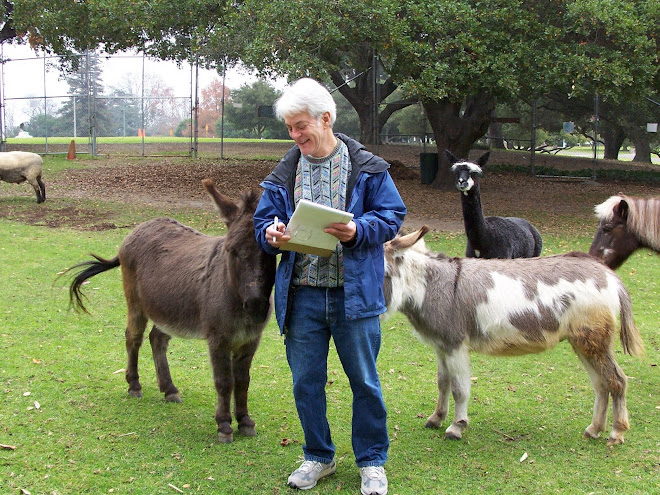
Interviewing the animals at Children's Fairyland in Oakland. L-R: Bobo the sheep, Gideon the miniature donkey, me, Tumbleweed Tommy the miniature donkey, Juan the alpaca, Coco the pony

Saturday, April 23, 2011

Never Again


Two inexpressibly sad anniversaries are coming up next week.
On May 1 Berkeley will join cities all over the world in observing Holocaust Remembrance Day, mourning the six million Jews who were murdered by the Nazis.
This year, the ceremony has been moved from the City Council Chamber to the New Freight & Salvage in downtown Berkeley. It will start at 10:30 a.m., and the public is cordially invited.
The guest of honor will be Murray Gordon, a survivor of the Dachau concentration camp, who fought with the Lithuanian resistance against the German forces who invaded his country.
He was only 15 the day they marched into his hometown. The first thing they did was round up everyone who was too old, too young or too sick to work, including his grandmother and grandfather, and shoot them.
1.5 million children perished during the Holocaust, including 1.2 million Jewish children, tens of thousands of Gypsy children and thousands of handicapped children.
But Gordon escaped through a hole in the barbed wire fence and made his way to the Lithuanian forest, where he joined a group of freedom fighters.
He was wounded five different times and finally captured by the Germans, who sent him to Dachau. On April 29, 1945, the camp was liberated by the 442nd Regimental Combat Team, the Japanese American unit that was awarded more medals than any other unit in American history.
"For a long time, I couldn't talk about the liberation without tears," he says.
But the Holocaust wasn't history's first genocide. And, as more recent mass murders in Cambodia, Rwanda, Bosnia, Darfur and other countries have sadly proved, it wasn't the last, either.
On April 24 Armenians will mourn the genocide of their people during World War I, when Turkish troops forced more than a million Armenian civilians on a death march in the Syrian desert with no food or water. Anyone who lagged behind was shot.
Unlike the Holocaust, which happened so recently that many survivors are still here to bear witness, the Armenian genocide happened so long ago that no eyewitnesses are left.
So the stories have been handed down in each family from generation to generation. I talked with some Cal students of Armenian descent a few months ago, and they still feel the pain as if it had happened yesterday.
"To this day, any time my grandmother tells her father's story, she cries," said Nairi Hartooni.
Like the Holocaust, the Armenian genocide has its deniers, who claim it never happened; or if it did, the numbers are exaggerated; or even if the numbers are correct, it was just collateral damage.
But more objective observers, including contemporary reports in the New York Times, put the deaths at somewhere between 500,000 and 1.5 million. And, as usual, a disproportionate number were women and children.
Neither Jews nor Armenians are asking for vengeance. We can't even expect justice because there's no punishment severe enough to fit the crime.
But there is one thing we must do: Never forget.
On August 22, 1939, Adolf Hitler met with his top henchmen to plan the Final Solution. Somebody pointed out that murdering millions of Jews might be bad public relations, but Hitler laughed him off.
"After all," he said, "who speaks today of the annihilation of the Armenians?"

Monday, April 11, 2011

Backyard Beauties


(Bruce, Lusk and Cookiepuss, three of the cats waiting for a backyard to live in.)

Three months ago, Merry Bates, president of Island Cat Resources and Adoption (ICRA, for short), got a frantic phone call from an elderly couple in West Oakland.
A few years before, they discovered a semi-feral cat living in their basement, and they started feeding it. And, because it wasn't spayed, it didn't take long for that one cat to become 10.
But last January they got bad news: Their home was about to be foreclosed.
Unfortunately, their basement was the only home these cats have ever known. They are completely dependent on this couple, having been born in the basement with a daily food and water source there since their births.
When these big-hearted people find a new home, they clearly won't be able to take the cats with them.
So ICRA volunteers swung into action. First, they humanely trapped and neutered the cats. Then they started searching for backyards where the kitties could make their new homes.
To date, they've found garden locations for four cats. But the other six are still waiting, and time is running out for them. The couple must be out by the end of the month, and so do the cats.
There are three males and three females, about a year old, in a range of colors. All have been fixed, vaccinated and FeLV/FIV tested. And all are as cute as can be.
Do you have room in your backyard for one or more of these hapless creatures? ICRA won't simply dump them on you; they'll hold your hand all the way, including lending you an outdoor kitty condo for the cats to live in until they decide that your yard is their new home. All you have to supply is food, water, shelter from the rain and love.
Although these cats are called feral, they are not wild or aggressive - just shy. They need safe outdoor spaces in which to live out their natural lives. Some of these cats, in time, will allow petting from a trusted caregiver. Others will keep a safe distance but enjoy playing or sleeping in the garden while you are nearby. Most are curious about people and will interact with you at feeding time.
It's a win-win deal: The cats get a second chance at life, and you get the pleasure of watching them and the satisfaction of giving them a desperately needed home.
If you can help, please visit the ICRA website at www.icraeastbay.org or call 510-869-2584.
And don't forget ICRA's annual auction on May 7 at the Alameda Elks Lodge. It's ICRA's big fundraiser for the year, and 100 percent of the money goes to the kitties. If you can't make it to the auction, you can also donate through the website.
Remember what Gandhi said: "The greatness of a nation can be judged by the way it treats its animals."

Sunday, April 3, 2011

Looking Backward

(Above: Mrs. Lacey's first grade class, El Rodeo School, 1951. I'm in the back row, second kid from the left. Standing between me and Mrs. Lacey is David Ansen, who grew up to become Newsweek's movie critic. Click on the picture to enlarge it.)

Since Donald Trump is demanding to see President Obama's birth certificate, I decided to dig up mine to see if it proves that I was born in this country, too.
Alas, it doesn't reveal much more than Obama's. All it says is that I was born on April 5, 1945 - shortly before the end of World War II - at Holy Cross Hospital in Salt Lake City, Utah. Make of that what you will, Donald.
My arrival was a blessed event for my family in more ways than one, since it meant they were entitled to another precious book of ration coupons. Four days after I was born, the Office of Price Administration duly issued me War Ration Book No. 356021, which I still have.
Since I was too young to fill in the blanks, my father did it for me. In the box marked "Occupation" he wrote, "Baby."
A lot has changed since I was a kid - some for better, some for worse.
Back then, labor unions had real clout, taxes on the rich were high, and the economy was booming. People were so used to prosperity, any unemployment rate higher than four percent was considered the kiss of death for an incumbent politician.
California had the best public schools in the country, and every high school grad was guaranteed a free education at either one of the UC campuses, the state colleges or the junior colleges, depending on your grades. After college, you could count on a job with the same company for your whole life.
The most popular spectator sports were baseball, boxing and horse racing. The NFL lagged far behind, and its best teams were the Lions and Browns. The worst were the Packers and Steelers.
The Giants were still in New York, and the A's and Warriors were still in Philadelphia. In college football, Miami of Ohio, not Florida, was the big powerhouse.
Though a few African Americans had been playing in the NBA since 1951, most coaches and sportswriters were sure they couldn't play basketball as well as whites. There were no black pitchers, no black quarterbacks, and no black coaches or managers.
And we had some pretty weird ideas about what the future would be like. For instance, we all believed that the Cold War would either drag on forever or end in a nuclear holocaust. Similarly, apartheid in South Africa would either never end or would end in a bloodbath.
We were taught that we would never find out what killed the dinosaurs, or whether the universe started with a Big Bang or has been the same forever.
And, of course, a Catholic would never be elected President, much less an African American.
And something I was sure would be imprinted on people's memories forever is already being forgotten. Last week I was talking with a friend in her late thirties, and I mentioned a date that I was sure anyone would recognize: Nov. 22, 1963.
But all I saw was a blank stare. Sure, she had heard of JFK's assassination, but the date didn't ring a bell.
I was taken aback, but I console myself with the thought that 30 years from now, some young person is going to ask her what Sept. 11, 2001 means.

Sunday, March 27, 2011

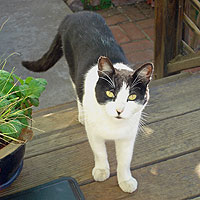
Nice Kitty


When Magic the cat, the resident mouser at Children's Fairyland in Oakland, died eight years ago, the local mice - whom Magic had kept at bay for years - immediately went to work raiding Fairyland's stores of food for the critters in its Animal Corral.
Clearly, a new feline enforcer was needed. So Yvonne Backman, Fairyland's animal caretaker, went to the Oakland animal shelter to interview job applicants.
Her gaze alighted on a sweet little black-and-white female with the romantic name of No. 1773342. She was friendly, she was curious and - best of all - the card on her cage said she hadn't been declawed.
This was important because a major part of the job description is hunting mice, and she needed her claws for that.
That sealed the deal. Backman took little No. 1773342 back to Fairyland and renamed her Jewel.
From Day One, Jewel appointed herself queen of the park. She spent her days roaming at will, graciously accepting petting and praise from everyone she ran into.
"And on Mondays, when the park was closed, we'd find her out in front by the Shoe, waiting for passers-by to pet her and adore her," says Fairyland's horticulturalist, Robin North.
Jewel was the center of attention at every staff meeting. She'd walk around the table and get petted by each person in turn. Then she'd settle down in the middle of the table, curl up, and monitor the proceedings.
"And she was amazing with kids," says development director Ann Singer. "They'd pick her up and let her dangle precariously, but she never hissed or bit anyone. She knew they were just kids."
The other animals adored her, especially the Three Amigos - Juan the alpaca, Twinkle the sheep and Dori the pony - and the Bad Boys - Gideon and Tumbleweed Tommy, the miniature donkeys - whom she visited regularly on her daily rounds.
Curiously, two weeks after she was adopted, executive director C.J, Hirschfield was playing with Jewel in her lap and suddenly said, "This cat has been declawed!"
Backman couldn't believe it. After all, the card on Jewel's cage said she hadn't been declawed. But sure enough, no claws.
By then, of course, everyone had fallen in love with her, so there was no question of taking her back. But here's the funny part: The lack of claws never hampered her mousing ability. Backman kept a running total of her kills on a tally board in the office to prove to disbelievers that Jewel was doing her job.
Alas, it ended all too soon. Two weeks ago Jewel suddenly developed severe intestinal distress, and after a week of heroic efforts, the reluctant decision was made to have her euthanized.
Everyone at Fairyland is devastated. They miss her terribly.
Unfortunately, they had to run up some serious medical bills in this losing fight. And for a place like Fairyland, which is running on the tightest of budgets in these troubled times, there's no money for unanticipated emergencies like this.
If you, or a child you love, have ever been charmed by this sweet little cat or one of the other animals at Fairyland, now's the time to say thanks by sending a contribution to the Jewel Fund, c/o Children's Fairyland, 699 Bellevue Ave., Oakland CA 94610.
Go to sleep now, Jewel. Good kitty.

Sunday, March 20, 2011

Teachers


The first was Mr. Shaver, my 8th Grade history teacher. He was the toughest teacher in the school, which, paradoxically, meant he was also the most popular. He expected only the best from us, and none of us wanted to disappoint him. So we surprised ourselves by doing better than we ever dreamed we could. Mr. Shaver died last year.
The next was Mrs. Helgesson, my high school English teacher. She managed to convince us that learning in general, and English literature in particular, were jolly good fun. It was a priceless lesson we have carried with us our whole lives. She died last year, too, a few months after Mr. Shaver.
I already told you a few weeks ago about Mr. Occhipinti, the history teacher who challenged us to write what he considered an "intelligent" book review of "Huckleberry Finn." I didn't take him up on it then, but how many times do you think I've written and re-written that report in my mind in the years since?
But my favorite was Mr. Rosemond, a history teacher who had just moved to California from Massachusetts. And I was his favorite student - or, at least, I was his favorite on the west coast. His favorite on the east coast was a kid named Randy Alfred whom he had taught in junior high back in Massachusetts.
As luck would have it, Randy and I ended up at the same college. So on the first day of freshman year, I marched up to him and handed him a letter of introduction from Mr. Rosemond. And we've been friends ever since.
Mr. Rosemond died shortly after Randy and I graduated from college. We still talk about him all the time. And we still miss him.
These are the people who made me who I am. They taught me lots of great stuff, but they did more: They nurtured and encouraged me every step of the way. And I'll bet you have a similar list.
A few years ago I worked part time as a substitute teacher in the West Contra Costa School District. I was gratified to find that there are still lot of Mr. Rosemonds and Mrs. Helgessons out there, trying their hardest to educate and nurture the next generation, despite the low pay and lousy working conditions.
And yet it seems to be open season on teachers these days. They're being blamed for everything that's wrong with our education system, when the truth is that they're the only thing that's right.
Yeah, yeah, I've heard the talk: They only work nine months out of the year, and they get off work at 3:15.
But let me tell you: Teaching is the hardest job I've ever done. There are no breaks, even for a second, because you have to pay constant attention to 30 different people. After nine months of this, you need a vacation just to catch your breath again.
And as far as getting off at 3:15, the workday actually goes on well into the night. Somebody has to grade all those exams, term papers and homework assignments, and make lesson plans for the next day.
Our teachers are the most valuable asset we have because without them, there is no next generation. It's time we started treating them as such.

Saturday, March 12, 2011

Human Wave


If you drive past the corner of Oregon Street and Martin Luther King Way in Berkeley on Tuesday, March 22, between 7:30 and 9:30 a.m., you'll see a bunch of people on the northeast corner waving and wishing you a good day. Some will be wearing orange construction workers' gloves. Several of your fellow drivers will be waving back.
They all - wavers and drivers alike - will be celebrating the 101st birthday of Joseph Charles, the late Berkeley Waving Man, who lived in the house on that corner.
For exactly 30 years - from Oct. 6, 1962 to Oct. 6, 1992 - he stood on his corner, rain or shine, and waved cheerfully to the passing cars. Instantly recognizable in his orange gloves, he would call out, "Keep smiling!" and "Have a GOOD day!"
On that first day, a few neighbors thought he was crazy and called the cops. But when the police arrived, they quickly sized up the situation and said, "Go ahead, Mr. Charles. You just keep on waving for as long as you want."
And people kept saying that to him for the rest of his life. Joseph Charles was to Berkeley what Sundar Shadi was to El Cerrito: He was our collective grandfather.
The Bible tells us to love our neighbors as we love ourselves, and that's exactly what he did. It might seem like a small thing, but he meant it literally when he wished us a good day. He loved us, and we loved him right back.
People would drive miles out of their way, just so they could start their day waving to the Waving Man. He brought a big smile to everyone's face.
Mayor after mayor issued proclamations in his honor no fewer than seven times. He was grand marshal of both the Solano Stroll and the How Berkeley Can You Be? parade.
Mr. Charles - that's what everyone called him - had quite an interesting life even before he started waving. He grew up in Louisiana and played ball in the Negro Leagues as a young man.
He faced Satchel Paige once when the great pitcher came through town on a barnstorming tour. He struck out on three straight pitches, but at least he made contact, which was better than anyone else did that day.
In 1942 he joined the great migration of African Americans from the deep South to the Bay Area, where he helped build Liberty ships at the Kaiser shipyards in Richmond.
After the war he worked as a stevedore at the Oakland Naval Supply Center until his retirement in 1962.
That's when he began his true calling, the one for which he will be remembered long after you and I are long forgotten.
He died in 2002, just a few days short of his 92nd birthday, and the whole city went into mourning. He was truly one of a kind.
If you can, I hope you'll drive by his old corner Tuesday morning and wave to the wavers. I'll be one of them.
And if you can't, feel free to stand on your own corner, wherever you are, and wave to your neighbors. Already, people have pledged to wave in Portland, Oregon; Silver Spring, Maryland; and Germany, as well as all over the Bay Area.
Until then, keep smiling. And have a GOOD day.

Monday, March 7, 2011

The Floating White House


Seventy-eight years ago, Franklin D. Roosevelt stood before the American people and told us the only thing we have to fear is fear itself - words we would do well to ponder today.
The pressures on FDR were almost unbearable, and he got away from it all by going fishing on his presidential yacht, the USS Potomac.
That's the official version. But I think he really did it to get away from Mrs. Nesbitt.
Henrietta Nesbitt was the White House cook; and her food was worse than inedible, it was disgusting.
"And the worst part was that the menu was always the same, week after week and year after year," says senior lead docent Bill Hodges, one of the hundreds of volunteers who are keeping the Potomac alive, more than 65 years after FDR's death.
"Monday was boiled tongue, Tuesday was boiled chicken and broccoli - and he really hated broccoli - Wednesday was overcooked roast beef, Thursday was sweetbreads - and he hated sweetbreads, too - and so on.
"But aboard the Potomac the Navy stewards would cook the fish he caught on a little hot plate, supplemented by fresh crabs that local fisherman would sell the president as their boats came alongside. Security was a lot less strict in those days."
No matter how many times he begged Eleanor to fire Mrs. Nesbitt, she never did. Historian Doris Kearns Goodwin says it was because Eleanor's idea of a good dinner was great conversation, not good food. Personally, I think it was payback for Lucy Mercer.
Eleanor rarely came aboard the Potomac - she was prone to seasickness - but FDR's Scottish terrier, Fala, was a frequent visitor.
"Fala was not popular with the crew because he refused to use the sandbox," says Hodges. "He'd relieve himself on the ship's mooring lines, instead."
After FDR's death in 1945 the Potomac was decommissioned and went through a succession of owners. The last one decided to junk her and turn her into scrap.
But at the last moment a rescuer stepped up - none other than Elvis Presley!
He bought the Potomac and donated her to St. Jude's Hospital. The ship's later adventures included being turned into a floating disco and being seized by the DEA for drug running.
She was finally bought at auction in 1981 by the Port of Oakland for only $15,000. Under the leadership of FDR's eldest son, James, the ship was restored as close as possible to the way she was in the days when FDR fished off the fantail.
Today, she's a floating museum docked at Jack London Square. Thousands of schoolchildren have visited her.
Alas, nobody foresaw this recession, and two years ago the Port of Oakland was forced to cancel its financial support. But the ship's operating expenses go on.
One day, the economy is going to bounce back. The only question is whether the Potomac can stay afloat until then. It would be a shame if she can't.
If you want to help, one way is to visit the ship. Go to www.usspotomac.org for a schedule of dockside tours, historical Bay cruises and special events.
Even better, you can become a member of the Friends of the Potomac. Go to the website or call 510-627-1215 for details.
Don't give up the ship.