A columnist of heart and mind

A columnist of heart and mind
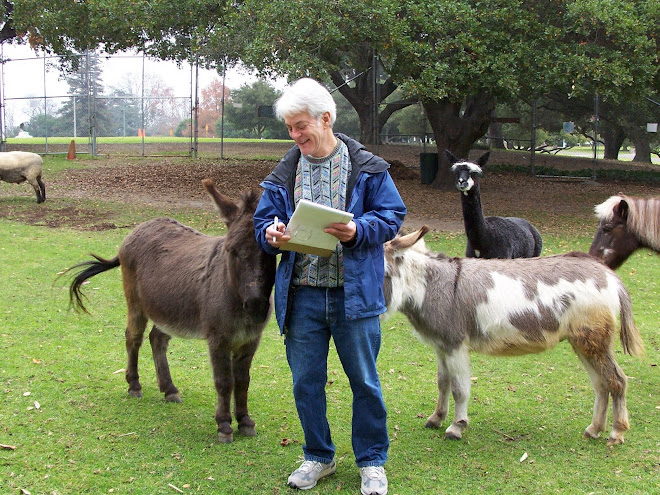
Interviewing the animals at Children's Fairyland in Oakland. L-R: Bobo the sheep, Gideon the miniature donkey, me, Tumbleweed Tommy the miniature donkey, Juan the alpaca, Coco the pony

Tuesday, April 21, 2015

How Tweet It Was!

(In a 2011 photo, Caitlin Baldridge, Theo Quayle and Austin Kelley rehearse their bird call on the stage of "Late Night With David Letterman" before their appearance on the national CBS show. Photo courtesy of Debbie Kelley)
Update: The birdcallers will make their final appearance on Letterman tonight!

The feathers were flying on April 17 when Piedmont High School presented the 50th annual Leonard J. Waxdeck Birdcalling Contest.
Sitting in the audience, along with the current generation of Piedmont students, were former birdcallers whom the school invited to join the celebration.
"We're trying to call everyone back to the nest," says Social Studies teacher Ken Brown, the faculty advisor for the past five years.
The birdcalling contest began in 1963 as a class project in Waxdeck's biology course. According to legend, a student asked him, "Wax, what can we do to liven things up around here?" But many Piedmont alums maintain that no one ever would have had the temerity to call him "Wax."
For the first few years the competition was an informal affair at lunchtime in Waxdeck's classroom. Instead of judges, the class voted for the first, second and third place winners by a show of hands.
"There were no Latin names, no sound trucks, no follow-up TV appearances, and no preparation," recalls the winner of the initial contest, Jay Knowland (who did two calls – a rooster and a generic "jungle bird.") "We just made up the calls in the classroom. One girl, Maryanne Endicott, didn't do a bird at all. She did a crying baby."
It didn't take long for the event to outgrow Waxdeck's classroom, as word got out and other students and teachers started dropping by at lunchtime to see the fun. In 1966 it moved to the school's Alan Harvey Theater, where it remains to this day.
From the start it bore the imprint of Waxdeck's personality, including the dress code - three-piece suits for the boys, dresses with skirts that reach below the knees for the girls – the scientific nomenclature, and the deadpan mock seriousness that made the calls even funnier.
"The contest definitely had its tongue stuck firmly in its cheek back then," recalls Matthew Callahan, who finished second in 1984 with the call of Pelicanus Occidentalis, the western brown pelican, and returned as a judge in 2007.
"One of the highlights was Waxdeck's ritual reading of telegrams of regrets from celebrities like Pope John Paul II, the Queen of England, the President of the United States, and movie stars," he continues. "Nobody really knew whether the regrets were real or not, but he sure as hell sent the invitations out. And I know that at least one of them was real – the one from the Queen of England. I saw it with my own eyes."
With or without Her Majesty, the birdcalling contest soon became the hottest ticket in town.
"Starting at 7 a.m., four or five trucks of potted plants and floral arrangements would start arriving," says Callahan. "In those days the contest was held in mid-May, and it would be a warm day. So they'd open the doors of the theater, and the smell would waft out into the quad area and over the whole campus. Inside the theater it smelled like a nursery – minus the fertilizer, of course."
"By 3 p.m., a half hour before show time, the theater was filled to capacity. People were sitting in the aisles, and all the kids were backstage, nervous as hell."
Tickets were so hard to get, it was rare for a student to get one.
"All the VIPs in town were calling in their IOUs," Callahan recalls. "The year I entered I got a ticket for my mother, but as a general rule the only way to see the contest was to be in it."
In 1975 a 7th grader entered the contest for the first and only time: 13-year-old Marc Schweitzer, who won second place with his call of Gavia Immer, the common loon.
The novelty of someone so young beating the big kids was picked up by the local newspapers; and one of the articles caught the eye of a scout for Johnny Carson, who flew Waxdeck, Schweitzer  and the contest winners down to Burbank to appear on The Tonight Show.
"Marc was only 13, and his voice cracked in the middle of his call," says his sister Laurie. "But Carson was quick on the uptake. He said, 'That's OK, Marc. Many people have trouble while mating!'"
It got a big laugh, and a new tradition was born. Carson had Waxdeck and the birdcallers on his show every year until his retirement in 1992. And the ripple effects lasted even longer.
"I met my husband because of Johnny Carson," says Liz Wagman '87. "On the first day of my freshman year at UC Davis I was wearing my Piedmont High sweatshirt, and he said, 'I saw you on The Tonight Show!'"
On the other hand, she adds, "I teach high school in Clayton, and when I tell my students I was on the Johnny Carson show, they say, 'Who?'"
Another tradition was born in 1977, when Peter Chovanes performed the first introductory skit.
"My bird was Spheniscus demersu, commonly known as the jackass penguin because of its braying sound," he says. "So I wore a top hat, white tie and tails, and carried a cane. As I waddled onto the stage I tossed my cane to the emcee, Jim Hoglan, then I handed him my hat and he folded it. After I did my call Jimmy tossed the hat and cane back to me, and I waddled off again. The audience loved it."
Over the years the skits have become more and more elaborate – much to the dismay of some old-timers, who miss the understated deadpan deliveries of yore, and to the delight of today's students.
Two years after Carson retired in 1992, Waxdeck suddenly died from a stroke. And the birdcalling contest went dark for two years.
But the people of Piedmont refused to let it die. A coalition of parents and former birdcallers – with behind-the-scenes help from Piedmont Middle School P.E. teacher Linda Jarvis that continues to this day – resurrected the competition in 1996, with the winner's trophy renamed the Leonard J. Waxdeck Trophy.
Feelers were put out to Carson's successor, Jay Leno, to have the kids on his show. But Leno, who was anxious to escape Carson's shadow, wouldn't touch anything that reminded people of Johnny. So for one year they appeared on the Arsenio Hall Show.
Then, in 1976, David Letterman, who idolized Carson – and couldn't pass up a chance to stick it to Leno – was only too glad to have the birdcallers on his program. And there they have appeared every year since then. Their final appearance before his retirement in May will be next Tuesday, April 21.
The only downside was that Letterman routinely brought four birdcalling acts back to New York, but one of them would be cut at the last minute.
"We got cut the first year, and it was really disappointing" says Jill Pervere Saper, who won first place 2001 with her best friend, Rachel Winograd. "Both of my grandmothers had flown to New York to be in the audience. They didn't know we'd been cut, and I was stuck in the green room with no way to warn them. So when we went to back New York the next year I told them, 'No one can come.' Naturally, we got on the show."
Enter the man who, apart from Waxdeck himself, is the most important person in the history of the birdcalling contest: Randall Booker, who took over as faculty advisor in 2005 when he became assistant principal. Tactfully but firmly, he informed Letterman's producers that from now on it would be all or nothing.
"I saw kids sitting in the green room crying, and I said, 'We can't do that; this is cruel.' I was a little nervous about bringing it up, but it didn't take much convincing. I don't think they saw them before as kids with feelings."
Though the essentials of the contest remain the same, some details have changed.
"The dresses and three-piece suits have been replaced by jeans and T-shirts, and the VIPs in the audience have given way to actual students," says Callahan. "But the biggest change is that the bird calls are much more authentic than they were in my day. And instead of sports stars and local TV celebrities, the judges are now people who actually know something about bird calls."
This year's judges will include an ornithologist from Francisco State, prominent Piedmont community member Matt Heafey, and Waxdeck's son, Joel.
And discerning observers might detect a resemblance to a certain biology teacher – goatee, floppy forelock and all - in the Cedar Waxwing on this year's Birdcalling Contest poster.
"If you knew Leonard, you might recognize him," says Brown. "He's still an integral part of this event."
As for the future, no approaches have been made yet to Ellen, Conan, Colbert, Fallon, Kimmel et al. But they have a year to find another show. Brown says whatever happens – or not – is fine with him.
"This is really about the community," he says. "Television is just the frosting on the cake. The frosting is sweet, but the cake is pretty sweet, too."
"One of the things I like best about the birdcalling contest is that it lets kids just be kids," adds Booker. "Once they get into high school, it all gets so serious. They're focused so much on college admissions, tutoring, club sports teams, and community service. The birdcalling contest allows them to be silly. They have the rest of their lives to be serious."
(Footnote: Booker was promoted to principal in 2007, serving in that capacity until 2010, when he became assistant superintendent of schools. On July 1 he will become Piedmont's next superintendent.)

Sunday, April 19, 2015

Hearing Is Believing


(Above: Teacher Kim Burke Giusti leads her a kids in Circle Time, during which they sing and sign.)
On April 23, volunteers from XOMA Corporation, a biotech company based in West Berkeley, will get together with Habitat for Humanity East Bay/Silicon Valley at XOMA's headquarters to build and paint a specially designed playhouse for the children at the Center for Early Intervention on Deafness, aka CEID.
It'll replace CEID's old playhouse, which has seen better days. (Part of it has to be held together with duck tape.)
And it'll have a lot of cool features that the old one lacks. It's wood instead of plastic; it's charming instead of cheesy; and, best of all, it'll be accessible to kids in wheelchairs or walkers.
XOMA and Habitot gave CEID's executive director, Cindy Dickeson, the choice about how it should be painted, and she requested a garden design to go with CEID's vegetable garden.
The paint should be dry by 2:30 p.m., then the playhouse will be disassembled into its component parts – sides, doors, windows, roof and trim - and driven to CEID a few blocks away. Then they'll be put together again in the CEID courtyard, right next to the vegetable garden.
"This has been on our wish list for some time," says Dickeson. "And the timing couldn't be better, coming as it does on our 35th anniversary."
CEID was founded in 1980, based on a simple but crucial insight: The first five years of life are the formative years, in every sense of the word.
Most kids don't start reading until they're five, so before that they have to get their information through their ears.
But what if you're deaf? While the other kids are soaking up all that vital data, you're not. If something isn't done, you'll be playing catch-up for the rest of your life.
So it's crucial to identify hearing loss in babies and start dealing with it ASAP, whether it's teaching them sign language or lip reading, or fitting them with hearing aids or cochlear implants, or a combination.
And while you're doing that, you also have to find another way to get that crucial information into their little brains.
That's what CEID does. Every year, its early intervention and education programs serve more than 50 kids and their families. And every year, its audiology screening program helps more than 1,000 families from 23 different counties spot their babies' hearing problems at the earliest possible moment.
How important are these programs? Deaf or hard of hearing kids who don't get them typically never get to read above a third grade level. But kids who do get these programs can read just as well as anyone else.
How can you tell if your own baby has a hearing problem? Trust your instincts.
"If a parent has a gut instinct that something is wrong, they're probably right," says Dickeson. "Some doctors might say, 'Oh, they'll grow out of it.' But they won't."
Call CEID at 510-848-4800 and make an appointment for an audiology test. Don't worry if you're on Medi-Cal; CEID will accept it, one of the few organizations of its kind that will.
CEID operates on an extremely tight budget, but they get a lot of bang for each buck. If you want to contribute to this very worthy organization, visit www.ceid.org or send a tax-deductible check to CEID, 1035 Grayson Street, Berkeley CA 94710.

Sunday, April 5, 2015

What A Long, Strange Trip It's Been

(Above: Grace and Paul when I met them)

Here's wishing a speedy recovery to Paul Kantner, vocalist/ guoitarist with Jefferson Airplane (which later morphed into Jefferson Starship), who is recuperating from a heart attack he suffered on March 25.
I met him once back in 1972, when I was a patient at Mount Sinai Hospital in San Francisco for some minor surgery.
For the first week I was the only patient on the ward who was under 80, but that changed on Week 2 when Grace Slick, the Airplane's lead singer (and Kantner's girlfriend) checked in.
I struck up a friendship with them – Grace dubbed me "Morton Snort" – and I spent most of each day in her room playing endless games of chess with Paul while Grace was glued to the news on TV, looking for inspiration for the songs she was writing for her next album.
As it happens, Grace and I were both discharged on the same day. My parents came to take me home, and just as we were about to leave Grace and Paul appeared in the doorway.
"We wanted to say goodbye," they explained.
Being a moderately well-mannered person, I did the introductions: "Mom and Dad, this is Grace and Paul."
"What do you do, young man?" my father asked Paul. 
"I play in a rock'n'roll band," he replied.
"Oh?" said my dad. "Give me your card. My nephew is having a Bar Mitzvah next month, and maybe we can use you!"
* * *
In other news, I celebrated my 70th birthday on Sunday.
It was a very different world I was born into, and it was about to change in a big way. Within a week Franklin D. Roosevelt was dead – the running joke in my family was that the shock of my birth was too much for him – and Hitler killed himself 12 days later. Three weeks after that, Churchill was kicked out of office in a huge election upset.
The top record on the hit parade was "Rum And Coca-Cola" by the Andrews Sisters, the top movie was a Sherlock Holmes flick called "The House of Fear," and the best selling book was "Forever Amber" by Kathleen Winsor. Bread was selling for nine cents a loaf, and gas – when you could get it – was 21 cents a gallon.
For my parents, my arrival was a blessed event in more ways than one. It meant that my family was now entitled to another ration book - including those all-important gas coupons – in my name.
And they lost no time in applying for it. I still have that ration book, filled out the day after my birth in my father's unmistakable handwriting. Under "Name" he wrote, "Martin M. Snapp Jr." And under "Occupation" he wrote, "Baby."
So what have I learned in the last 70 years? Not much. The little I have learned can be summed up by a quote from Kurt Vonnegut's "God Bless You, Mr. Rosewater," when the hero is addressing a nursery ward full of babies:
"Hello, babies. Welcome to Earth. It's hot in the summer and cold in the winter. It's round and wet and crowded. At the outside, babies, you’ve got about a hundred years here. There’s only one rule that I know of, babies - 'God damn it, you’ve got to be kind.'"

Thursday, March 26, 2015

Back To Bach

(Above: Marika Kuzma, director of the UC Berkeley Chamber Chorus and Community Chorus, conducts both groups in a joint performance of Handel’s Messiah at UC Berkeley’s Hertz Hall. Photograph by Kathleen Karn.)

One of the best concerts I've heard in a long time was a performance of Handel's Messiah by the UC Chamber Chorus and the University Chorus just before Christmas in 2013. I was totally blown away.
Well, they're back. And this time they're tackling an even more ambitious project: Bach's monumental masterpiece, the B Minor Mass, which they'll perform with a baroque orchestra on April 10 and 11 at UC Berkeley's Hertz Hall.
It's the first time they've sung the B Minor Mass since 1999, and it might very well be the last because it's such a mammoth undertaking. It's so huge, Bach himself never heard it performed in his lifetime.
"With all those fugues, it's a real challenge to give each one a different personality," says Professor of Music Marika Kuzma, who conducts both the Chamber Chorus and the University Chorus.
But it's worth the trouble because the B Minor Mass is so gorgeous, especially the exquisite Dona Nobis Pacem movement, which is one of the true glories of Western music.
By the way, the "B Minor" in the title is a misnomer. Minor keys often imply lugubrious music, and this work is anything but. Most of the movements are actually in D Major.
"And nothing says 'joy' like D Major," says Kuzma.
Good thing, too, because the mass is two hours long, and that would be a long time to feel sad. Be sure and stay to the end because that's when the Dona Nobis Pacem occurs.
"We're saving the best for last," she says.
The B Minor Mass has special meaning for Kuzma because it was the piece that changed her career.
"I was playing violin in the student orchestra when I was a freshman at North Carolina," she says. "Then I heard the B Minor Mass, and it was so amazing I thought the ceiling had come off. I immediately dropped the orchestra and switched to chorus, instead."
It's impossible to overstate the high level of musicality in both the Chamber Chorus and the University Chorus, even though the members are still college kids. Many have gone on to sing with some of the country's finest baroque ensembles and choruses, including the Philharmonia Baroque, American Bach Soloists and the National Cathedral Choir.
Several of them will be flying in from as far away as New York, Los Angeles and Florida for the two concerts to sing some of the solos. Partly, it's a tribute to their love for the music. But it's also a tribute to their devotion to Kuzma, who has always gone out of her way to bring out her students' best.
She conducts the same way Seurat painted. Instead of making the singers twist their throats into pretzels to get the tonality she's looking for, as many other conductors do, she re-positions them strategically next to each other in such a way that the combination of their voices achieves the same effect, without trashing their larynxes.
Both concerts start at 7:30 p.m. Tickets are on a sliding scale, with discounts for students, seniors and retired Cal faculty and staff. You can get them at the door - assuming it hasn't been sold out, as it was last time - or ahead of time at tickets.berkeley.edu or by calling 510-642-9988.

Sunday, March 22, 2015

Bibi's Blunder

No matter what news my grandmother, Myra Cohen, heard – whether it was "Grandma, there's been a terrible flood in India" or "Grandma, the Dodgers just won the World Series" - she always had the same response: "Is it good for the Jews or bad for the Jews?"
Well, last week's Israeli election was VERY bad for the Jews.
Before anyone accuses me of being a self-loathing Jew, my Zionist credentials are at least as good as yours.
My father, who was an Army surplus dealer in Los Angeles after World War II, smuggled guns to the Palmach, the forerunner of the Israeli Defense Force, during the 1948 War of Independence.
The State Department had issued regulations that made it illegal to ship weapons to the Jews in Palestine. But there was a loophole: The ban applied only to working weapons, and a rifle without a firing pin wasn't considered a working weapon.
So Dad would send a shipment of 10,000 surplus M-1 rifles without pins to the Palmach; and his business partner, Leo Fenton, would send them 10,000 firing pins via a separate shipment.
My brother Steve was a big supporter of Israel, too. If you go to the town of Hatzor, you'll see a cultural center, gym, school computer center and a soccer field, all named after him and his wife, Barbara, who raised the funds to build them.
I grew up watching movies like "Exodus," starring Paul Newman as Ari Ben Canaan (a thinly veiled portrayal of Ariel Sharon, BTW), and I rooted for Israel against her neighbors the way you'd root for David against Goliath.
Ironically, all that changed at the moment of Israel's greatest triumph: the 1967 Six-Day War that added Gaza and the West Bank to her possessions. All of a sudden, she didn't look so much like David anymore.
Worse, she now had responsibility for millions of new people who resent their subjugation and have a birth rate so high, it's only a matter of time before they're a majority.
The central question has always been: What is Israel, which was founded as a Jewish democracy, going to do with them?
Netanyhu's inflammatory warning on election day about the danger of Arab voters doesn't give much hope that they'll be granted equal political status, which means Isreal would no longer be a democracy.
The other alternative is giving them equal status, which means Israel would no longer be a Jewish state. It's a no-win situation.
The obvious solution is to create a Palestinian state that will take them off Israel's hands, but Netanyahu now says that's out of the question, too.
Meanwhile, he's busy building new Jewish settlements on the West Bank and burning bridges with the only ally that counts – the United States – by meddling in American politics and turning U.S. support for Israel into a partisan issue.
We know why the Republicans are doing this: It's a handy club to beat Obama over the head with. Besides, the reason a large part of their base supports Netanyahu so fervently is that they believe a Jewish state is a necessary prerequisite for The Rapture – to which no Jews will be invited, of course.
But why is Israel doing this? It breaks my heart to see her on such a suicidal path.

Sunday, March 15, 2015

Vetter Was Right

(Above: Karl Marlantes speaking at our last reunion)

I stopped by the Musical Offering Café in Berkeley last week to have one of their great Caesar salads, and who did I run into? My favorite teacher.
His name is Jan Vetter, and he's the professor at UC Berkeley's law school – which we old-timers stubbornly persist in calling Boalt Hall – who gave me the lowest grade I ever got (thoroughly justified, of course).
It was in his Labor Law course. The grade was so low, he was obligated to write an explanation. And this is what he wrote:
"Mr. Snapp demonstrates a remarkable command of legal rules and principles. Unfortunately, they are not rules and principles that are recognized by any jurisdiction of which I am aware."
Oops! Busted!
Professor Vetter was the smartest professor on the faculty, and that's saying a lot because law school professors are really, really smart.
He was also the nicest. And, as you can see above, the funniest. Those of us in the know made it a point to sit in the front row to catch the witty asides he muttered under his breath.
It's also because of him that I wasn't thrown out of school. During the Vietnam War I was hauled before the UC Berkeley Executive Committee for violating the University's time, place and manner regulations at a stop-the-draft demonstration.
Translation: I was in the lobby of Sproul Hall during a sit-in, leading the crowd in singing "Yellow Submarine."
But they didn't throw me out, thanks to Professor Vetter's expert lawyering.
Afterward, I thanked him for getting me off the hook.
"You're welcome," he said, "but I think you're on the wrong track about abolishing the draft. I understand what you're doing: You're using the draft as a club to beat the war over the head with. But I don't think you've thought through the long-term implications."
That was almost 50 years ago. And I've long since come to the conclusion that Professor Vetter was right, and I was wrong.
Look what has happened since the draft was abolished. Far from making war less likely, we've had decade after decade of almost non-stop fighting.
And the burden has been borne by only one percent of the population. For the other 99 percent, it's been business as usual. The pain never touches them, so why should they care?
It's not only unfair; it's undemocratic. One advantage of a draft is that it throws young people from all races, regions and regions together. And they have to learn to work together or they'll all get killed. That tends to broaden the mind.
And the greater the mobility between the civilian world and the military, the more each side is likely to understand the other, which is one of the reasons why we've never had a military coup in this country.
 Finally, as my college classmate Karl Marlantes, who wrote an award-winning novel called "Matternorn," about his experiences as a Marine lieutenant in Vietnam, pointed out at our last reunion, the last 20 years of non-stop war have been brought to us by presidents with no military experience who constantly defer to the top brass.
"We need people in the White House who have served in uniform," he said, "if only because they know enough to say '(bleep) you' to the generals."

Sunday, March 8, 2015

Calming The Savage Breast

(Audrey playing Mozart’s Piano Concerto No. 17 at the 2013 Midsummer Mozart Festival at the Legion of Honor in San Francisco. Photo by Meina Xu)

Audrey Vardanega of Oakland, the sensational 19-year-old concert pianist who has been captivating music critics, other musicians, and even grumpy old newspaper columnists ever since her smashing debut at the Midsummer Mozart Festival at age 14 – the youngest soloist, by far, in the festival's 41-year history – will return to the Bay Area from New York, where she is a sophomore at Columbia, for a concert at the Hillside Club in Berkeley on March 15.
She will play Beethoven's "Tempest" Sonata, Liszt's "Valee O'Oberman," and Schumann's Symphonic Etudes.
"I guess for me, the most inspiring thing about the program is that all three composers were emotional wrecks," she says. "For example, the Beethoven piece is called 'The Tempest' because it's constantly changing. It starts with a storm, followed by a very sweet section. It's completely bipolar, just like Beethoven himself.
"Then we go on to the Liszt, which is about another emotional crisis. It's based on a German novel that was very popular in the 19th Century. The hero is stuck in a valley in the Swiss Alps, all by himself, and he doesn't know how to get out. He's having an existential crisis. As a Columbia student in my second year, still trying to decide what my major is, this is definitely a piece I can relate to!"
Finally, there's the Schuman etudes, a 30-minute-long set of variations on a theme.
"Schuman went crazy," she says. "It's very awkward to play, with chords spread out all over the place. You have to contort your hands to fit them. He doesn't make it easy.
"It's especially hard for me because I have small hands. My maximum reach is a ninth. He'll insert a fourth way below or add a third three octaves above."
But even more difficult is the basic paradox at the core of the piece.
"The bones are a simple pastoral melody, but it's very easy for a pianist to get caught up in all that jumping around and lose sight of that. It's hard to balance the physicality of it – a reflection of Schumann's own craziness and obsession with getting beyond the limits of what the hand can do – with the basic simplicity and lyricism of what he's trying to express.
"And that's the theme of the entire program: what I can physically do and what I'm trying to express."
But if all this makes it sound like Audrey's life is filled with sturm und drang, it's anything but.
To the contrary, she's having the time of her life soaking up knowledge and new experiences like a sponge, from reading Hegel, Hume and St. Augustine in her political science courses to hanging out in jazz clubs with her friends, many of whom are jazz musicians.
"I'm learning to embrace change and see it as growth," she says. "Look at my teacher, Seymour Lipkin. He's 80 years old, and he's still reinventing himself! I want to be like that. I'm embracing the fact that I'll probably look back in two years and say, 'Was I a horrible pianist!'"
The concert starts at 7 p.m. The Hillside Club is at 2286 Cedar Street in north Berkeley. Tickets are available at the door, and I'd get there a half-hour early to get a good parking space on the street.