A columnist of heart and mind

A columnist of heart and mind
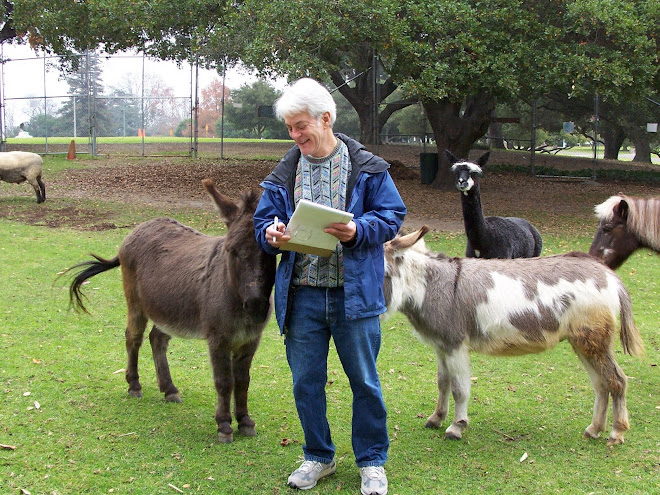
Interviewing the animals at Children's Fairyland in Oakland. L-R: Bobo the sheep, Gideon the miniature donkey, me, Tumbleweed Tommy the miniature donkey, Juan the alpaca, Coco the pony

Sunday, September 22, 2013

A Clear View Of Discrimination

(Above: Belo Cipriani and his previous guide dog, Madge, at Madge's retirement ceremony last month.)

Belo Cipriani, the popular Writer In Residence at Holy Names University in Oakland, is an immigrant, a person of color, and gay. So which one gets him the most discrimination?
"None of the above," he says. "I get the most discrimination because I'm blind."
Seriously?
"Look at the numbers. The unemployment rate for blind people in this country is 70 percent. And most of the other 30 percent who do have jobs work for blind organizations."
Cipriani knows what he's talking about; he was a recruiting manager for Apple and Google before he lost his sight six years ago. He says employers don't realize that the blind can do pretty much any job sighted people can, especially if it involves a computer.
"There are a slew of adaptive tech toys that make most jobs accessible, such as a portable scanner to read print. And most of them cost less than $1,000, a negligible amount for a serious business."
Anti-blind bias even infects the language we use, such as "the blind leading the blind," which implies they have poor navigation skills.
"Actually, we have better workplace safety records than our sighted colleagues because we have an attention to detail that most sighted people lack," he says.
"For instance, when I cross the street I can feel the arch of the sewer system as I approach the other side, and then when I feel the ground dip slightly I know the curb is coming up."
But that doesn't stop well-meaning people from trying to "help" him. Once, a guy even picked him up, slung him over his shoulder, and carried him across the street!
"Sometimes all you can do is laugh," he says.
But the petty insults and trivializations just keep coming.
"People slow their speech down and explain things as if I were a child," he says. "When I go into department stores, the clerks tell me they don't have Braille clothing. When I go to a restaurant with a friend, the servers invariably ask, 'What does he want?' instead of addressing me directly. And when I showed up at a bar for speed dating night, they said, 'I'm sorry, but we don't have enough blind people for you to date.'"
The visually impaired also face discrimination in housing, although there are laws on the books against it.
"I've been discriminated against by 10 different landlords. They're afraid a blind tenant will fall down and get hurt, as if we can't walk or climb stairs."
And some of the worst problems occur when he travels with his guide dog, a friendly black Lab named Oslow.
"Cab drivers are notorious for flying away if someone has a service dog," he says.
Once, when he was flying to the East Coast, the plane's bathroom was too small for both him and the dog, so he left the pooch outside and went in by himself.
"When I emerged, the whole cabin erupted in applause. Several people said, 'You're so inspirational!' They think it's amazing that I can tie my shoelaces."
And I'll bet people with other disabilities have similar stories to tell. With October being National Disability Awareness Month, it's a good time for all of us to wonder: How many Helen Kellers and Franklin D. Roosevelts are being wasted because of our ignorance?

Sunday, September 15, 2013

The Wise Walrus Of Strawberry Canyon

(Above: the statue of Pappy at Faculty Glade, erected by Pappy's Boys.)

Cal's 52-34 beatdown by Ohio State last Saturday was pretty bad – although Cal still leads OSU in Nobel Prize winners, 22-3 - but it wasn't the worst humiliation the Bears have suffered at the hands of the Buckeyes.
That came at the 1950 Rose Bowl, but not during the game. It happened at halftime, when the Cal Marching Band was upstaged by the Ohio State Marching Band, whose spiffy costumes and high-stepping strutting made Cal's old-fashioned, military-style band look mundane by comparison.
The fans booed. The Daily Cal wrote scathing editorials. Even President Robert Gordon Sproul got into the act, saying, "The band smells." The band's director, a respected music professor who had led the band for 16 years, was fired.
Enter the hero of the story: football coach Pappy Waldorf.
Two years later, the Bears were in Columbus to play Ohio State, and while they were there Pappy secretly filmed the OSU band and gave the film to the Cal band, which copied all the moves.
But they couldn't copy Ohio State's band uniforms, which were – shudder - red. So they copied Michigan's maize-and-blue uniforms instead.
Next October 3 would have been Pappy's 111th birthday, which gives me an excuse to write about the greatest football coach who ever lived.
Yes, there were coaches who won more games, although Pappy's 67-32-4 record, including three straight Rose Bowl appearances and back-to-back 10-win seasons, is not too shabby.
But the thing that sets Pappy apart from the rest is that they did it with fear, while he did it with love.
Nobody can ever remember him cursing or yelling at a player. Never.
In fact, he didn't even correct players' mistakes during a game. As far as he was concerned, that's what practices were for. Game time was for keeping their spirits up and doing the X's and O's.
When he corrected a player's mistake at practice, he had a four-step technique that was described for me by one of his assistant coaches, John Ralston, who went on to employ Pappy's methods with great success at Stanford.
Step 1: Make physical contact. If you can, put your arm around his shoulder.
Step: 2: Praise him for something good he did. Only then do you get to:
Step 3: Point out the mistake and show him how to correct it, followed immediately by:
Step 4; Put your arm around him again and reassure him that he's still your boy and you still love him.
I know it sounds too good to be true, like a story out of a boy's dime novel. But Pappy believed his real job was to build character, and that the victories would follow.
And he did build their characters – many of "Pappy's Boys," as they call themselves, went on to have happy families and successful careers – and the victories did follow.
The newspapers dubbed him "The Wise Walrus of Strawberry Canyon," and Clark Kerr, who succeeded Sproul as president, said, "I considered him to be our best teacher. He had more moral impact on more students than did any other faculty member."
Pappy died in 1981, leaving a wife, two daughters and 542 sons.
Yes, martinets like Nick Saban and Urban Meyer have won more games. But nobody's ever going to call them Pappy.

Sunday, September 8, 2013

I'm Sorry

Have you ever received one of those weasely I'm-sorry-if-you-were-offended apologies that only make you madder? Worse, have you ever sent one?
I asked Sarah Kidder, a professional etiquette expert and event planner in Oakland, for tips on how to apologize properly.
Tip No. 1: Mean it. "The most important ingredient in an apology is sincerity," says Kidder. "An insincere apology adds insult to injury."
Tip No. 2: Less is more. "When you're late for my birthday party, would I like an acknowledgement that you're sorry? Yes. But should you stop the party for a 10-minute monolog on your amazing adventures in traffic, hijacking the party and boring the entire room? No.
"Of course, when you've done something that truly hurts someone's feelings, a fuller apology may be required. But that doesn't mean throwing in a bunch of justifications. It's not about you; it's about what you did. Why you did it is irrelevant."
Tip No. 3: If you break or lose something, replace it. "Again, the bother and the cost should not be born by the person who owned the item, but by the person who broke or lost it," says Kidder. "They already did you one favor by lending it to you in the first place. They shouldn't have to keep doing more."
Speaking of borrowed stuff, Kidder says few things hurt a friendship more than not returning them.
"Trust and respect disintegrates with each month that you don't give the stuff back. Since embarrassment and forgetfulness are often to blame, I've created Return To Sender Day to make it easier for people to ask for their stuff back without sounding like a nag, and to take the shame out of returning something two years late."
Return To Sender Day – RTS Day, for short - is held twice a year: on the spring and fall equinox, which means the next one is Sept. 22. To make it easier, Kidder has set up a website and Facebook page with some downloadable reminders to send your friends. Among them:
"Missing: Deep Fryer. Last seen: Your house. You said you'd bring it back Monday. That was nine months ago. I'd like it back on RTS Day."
"Wanted: Faux Vintage Telephone. You borrowed it for a theme party. You don't even have a landline. Please return it on RTS Day."
"I have your DVDs. I'll drop them in your mailbox on RTS Day. Sorry it's taken so long to get them back to you."
To access the Facebook page, go to www.facebook.com/RTSDay/ To access the website, visit www.sarahkidderdesigns.com/
"I don't know where this is all headed, but I hope it goes viral," she says. "I think it would be wonderful if people had a way to get their power drills or Tupperware back and keep their friendships."
What's on your RTS list?
                                          * * *
Finally, happy birthday to Puddles the Duck, one of the most popular residents at Children's Fairyland in Oakland, who celebrated his 10th birthday last week. That's twice the normal life expectancy of ducks like him, which goes to show how much TLC the animals at Fairyland get.
Puddles is a very friendly duck who will jump up in your lap. But don't let him stay there too long. They don't call him Puddles for nothing.

Sunday, August 25, 2013

The Real Linda Lovelace


There's a new movie out called "Lovelace," about Linda Lovelace, the star of the 1972 hardcore porn movie "Deep Throat," which unaccountably became a mainstream hit and even got a review in the New York Times.
It made her an instant star, and she "wrote" not one but two autobiographies that claimed it was all great fun and she loved every minute of it.
As it happens, I actually met Linda Lovelace once. The year was 1980, and by then she was calling herself Linda Marchiano.
She had divorced her husband/manager Chuck Traynor, quit the porn business, and joined the anti-pornography movement. She was on a book tour to promote a third autobiography called "Ordeal," which said the first two books were all lies, that the porn business was a living hell, and she only did it because Traynor beat her and forced her to do it at gunpoint.
I was working at KCBS as a fill-in producer for a daily, two-hour interview/call-in show called "The KCBS Newsmagazine," and I booked her on the show.
She was very sweet and rather shy, and I liked her.
I can't say the same for her new husband, a cable installer named Larry Marchiano, who hovered protectively over her like a mother hen on steroids. A few years later she wrote yet another autobiography that claimed he was a control freak, and I believe it.
She and the program's host, Lila Petersen, sat in the broadcast studio, which was separated by a plate of glass from the engineer's booth, where I sat with the engineer. I was screening calls from listeners and funneling them into the booth, and I invited Larry to join us while the show was going on.
The program went nicely for the first half hour, but then Lila asked her a question that any reporter would ask: "You said in your first two books that the porn business was great, and now you're saying the exact opposite. Were you lying then, or are you lying now?"
That did it. Larry leaped out of his seat in a fury, tore out of the engineering booth, and rushed into the studio to yank her off the show – followed immediately by me, who grabbed him by the collar and dragged him out of the studio so the show could proceed without further interruption.
Afterwards, I expected to get praised by the news director for saving the day.
Instead, he said, "You should have let him pull her off the show. It would have made great live radio."
And that's when I learned one of the great lessons of journalism: Always go with the story and follow it wherever it leads.
I've built my entire career on that lesson, and I've always had a warm spot in my heart for Linda Lovelace because of it.
P.S. A few years later Linda quit the anti-pornography movement, too, saying they had exploited her as much as the porn business had.
I wish I could say she finally found happiness, but her later years were marred by chronic health problems stemming from a car crash when she was 20. In 2002 she was in another car crash, and this one killed her. She was only 53.
I hope this new movie doesn't exploit her all over again.

Tuesday, August 20, 2013

Hail To The Emperor!

Could San Francisco's most beloved eccentric finally be getting his due? There's an Internet petition at Change.org to name the Bay Bridge after Norton I, Emperor of the United States and Protector of Mexico, who reigned from 1859 to 1880. a
"The response has been overwhelming," says writer John Lumea, who created the petition. "But what's been most moving are the comments people are leaving. He still touches people's hearts, all these years later."
Joshua Norton was born in London, England, and came to San Francisco in 1849 in the wake of the gold rush.
He quickly made $250,000 in the real estate business and just as quickly lost every penny trying to corner the market in Peruvian rice.
He also lost his mind. He vanished from sight and reappeared a year later with a proclamation declaring himself Norton I, Emperor of the United States. (He added the "Protector of Mexico" bit later.) 
Since he was Emperor, he saw no need for a Congress, so his next proclamation dissolved the Senate and House of Representatives.
Subsequent proclamations abolished the Republican and Democratic parties, religious warfare, and the name "Frisco."
Crazy? No doubt. But the people of San Francisco decided to play along. He issued his own currency in denominations ranging from 50 cents to ten dollars, which were honored as legal tender by the city's banks and businesses.
Though penniless, he dined for free every night in the city's finest restaurants. And a luxury box was reserved for him in all the city's theaters on Opening Night.
Dressed in a fancy blue dress uniform with gold epaulets, he spent his days inspecting the condition of the city's sidewalks and cable cars.
In 1867 a policeman arrested him and attempted to have him committed to a mental asylum, triggering an explosion of outrage throughout the city. The Chief of Police ordered his release and formally apologized to him, and thereafter every policeman in San Francisco saluted smartly whenever His Imperial Highness passed by.
It started as a joke; but as the years went by, Norton began acting more and more like the statesman he pretended to be.
One day he faced down a mob that was advancing on Chinatown, intent on riot and murder. He blocked their path with his head bowed, reciting the Lord's Prayer over and over until they shamefacedly dispersed.
 And some of his ideas don't sound so crazy today. In 1872 he issued an Imperial Proclamation ordering construction of a suspension bridge between San Francisco and Oakland and a tunnel under the Bay – ideas that finally came to pass almost a century later.
When he died in 1880 the whole city went into mourning. Thirty thousand people lined the street for his funeral procession, which stretched for more than two miles.
In 2004 the San Francisco Board of Supervisors endorsed naming the bridge's western span after Norton. But the Oakland City Council refused to go along, and the idea died.
Now a resolution to name the span after Willie Brown is wending its way through the state legislature. But with all due respect to Da Mayor, I think it should be named after the man who came up with the idea of a bridge in the first place.
If you'd like to sign the petition, go to http://chn.ge/1eu7qju/

Sunday, August 11, 2013

Children's Best Friend

            (Backstage at the Puppet Theater with Lewis (L) and Randal (R)

Now playing at Children's Fairyland's Open Storybook Puppet Theater: "The Magic Blossom," written and designed by Fairyland's beloved Master Puppeteer, Lewis Mahlmann.
"The Magic Blossom" is the 150th puppet production Mahlmann has created for Fairyland, where he was Director of Puppets for 43 years, from 1967 until his retirement in 2006.
And it's also the final one. At 85, Mahlmann has firmly stated that this is his last hurrah.
"The Magic Blossom" is the puppet version of a literary classic: Shakespeare's "A Midsummer Night's Dream." Over the years, he has puppetized such other classics as "Pinocchio," "The Magic Flute," "Hansel and Gretel," "Peter and the Wolf," "The Nutcracker," "Coppelia" and "Peer Gynt."
"I do puppet shows to entertain, but not just to entertain," he once told me. "I want to show the children that there are wonderful stories out there that they can read, and I also want to teach them the right way to live."
For instance, in his version of "Pinocchio," Pinocchio doesn't achieve his dream of becoming a real boy until he learns to be kind to others.
The Blue Fairy asks him, "If I give you a wish, would you rather be a real boy?"
He replies, "I'd rather my father get well."
At the end of the play Pinocchio finally becomes a real boy, but he doesn't recognize his friend, the cricket any more. The cricket turns to the audience and says, "Maybe there's somebody else out there who needs me."
Heavy stuff for a 5-year-old, but Mahlmann makes the message go down easier with a constant barrage of jokes and puns that keep the little ones screaming with laughter.
"One thing I never do is talk down to a child," he told me. "That may sound phony, but it's true. I'll tailor the language to their learning level, but that's not the same thing."
Every kid loves puppets, but a few get absolutely hooked and decide to become puppeteers themselves when they grow up. And Mahlmann has always taken them under his wing and taught them everything he could.
One was a 10-year-old named Randal Metz, who shyly knocked on the door of the Puppet Theater one day in 1970. And, except for a couple of years with the Muppets, he's been there ever since, succeeding Mahlmann as Director of Puppets in 2006.
Mahlmann pays him the ultimate compliment: "He loves puppetry as deeply as I do."
And Metz, who still talks to Mahlmann every day to get his advice, returns the sentiment.
"Lewis is a teacher, first and foremost, and his job has always been to educate in a sensitive, positive way. He believes each Fairyland show should be as if a kid was seeing a theatrical stage production, not just 'Hi! I'm a bunny rabbit! How are you today?'"
"And his influence goes way beyond the Puppet Theater," adds Fairyland's executive director, C.J. Hirschfield. "The Beatrix Potter rabbit village, the Old West Junction and the murals for the Jolly Roger Pirate ship are all his designs, too."
"The Magic Blossom" will run until August 29.
"It's Lewis's final gift to the Puppet Theater – and the kids – he loves," says Hirschfield. "But his productions will be playing as long as there is a Fairyland, which I hope is forever."

Sunday, August 4, 2013

Are You Scared Of This Man?

Last Saturday I went to a local hotel to interview some alumni from Berkeley High who are planning an all-class reunion for everyone who ever went to the school. As it happened, everyone in the group was African American.
I was a few minutes late, so they were already seated in the hotel's restaurant/lounge when I arrived. We really hit it off, and they told me some wonderful stories about the old days, and I had a terrific time.
After the interview I got up to leave, and they all thanked me for coming.
"Hey, thank you for all the great stories," I replied.
"No, you don't understand," said the woman sitting next to me. "Before you arrived, the manager kept pressuring us to leave. But once you showed up, everything was fine."
I was shocked, but they weren't.
"Happens all the time," she said. "When white people see more than a half dozen black people together, they start getting nervous."
Ironically, the reason they invited me to the meeting is that they want to get the word out to all alumni, especially white alums, that they are more than welcome.
I'm writing this column 24 hours later, and I'm still shaken by the experience. It brought home to me the fact that I have absolutely no idea what it's like to be black in America.
I don’t know what it's like to walk down street and hear the door locks go "click." My heart has never sunk when women clutch their purses more tightly – or even cross the street - when they see me coming.
I've never been pulled over for "Driving While Black." Or had to listen to pundits like Sean Hannity and Bill O'Reilly say that the problems in my community are due to some inherent character flaw.
At best, this white paranoia can be soul-killing. At worst, it can literally be lethal, as the George Zimmerman trial demonstrates.
Whites have been paranoid about black violence at least since Nat Turner's slave rebellion in 1831, and probably long before that. But the facts have never born out their fears.
To the contrary, the dominant theme in American history has been white-on-black violence, from slavery to the Ku Klux Klan.
So when I hear people like John Roberts say racism isn't a problem any more, it makes me wonder at the bubble we are living in. The facts are staring us in the face, but we refuse to see.
And don't tell me everything is OK now because we finally have a black president. A lot of people hated Bush and Clinton, too, but nobody ever tried to deny their legitimacy, as birthers like Donald Trump constantly do to Obama. And I never saw any signs depicting Bush or Clinton with bones through their noses.
As we approach the 50th anniversary of the March on Washington at the end of this month, it's easy to forget how much farther we still have to go.
We are never going to solve the racial problem in this country until white people use their imaginations for once and try to imagine what it must be like to walk in a black person's shoes. 
Some might call that empathy. I call it patriotism.