A columnist of heart and mind

A columnist of heart and mind
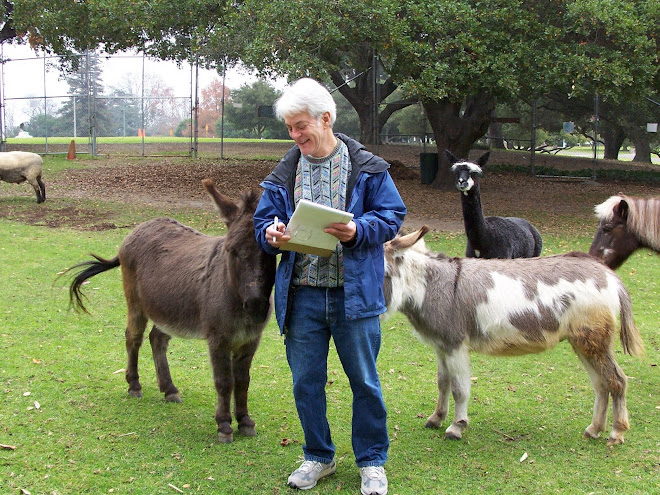
Interviewing the animals at Children's Fairyland in Oakland. L-R: Bobo the sheep, Gideon the miniature donkey, me, Tumbleweed Tommy the miniature donkey, Juan the alpaca, Coco the pony

Monday, May 10, 2010

A Little Night Music


One day in 1974, Maestro George Cleve and a few friends were kicking back with some beers after a long rehearsal of Mozart's opera, "The Abduction From The Seraglio."
In true Mickey Rooney/Judy Garland fashion, somebody said, "Wouldn't it be fun if we could play Mozart all the time?" Somebody else said, "We could make it an all-Mozart festival!" And the rest is history.
Thus was born the Midsummer Mozart Festival. This year's edition will run from July 15-25, with performances in Berkeley, Sonoma, Santa Clara and San Francisco.
And now Cleve and his friends have come up with another brainstorm: Wouldn't it be cool to pair some of the best teenaged musicians in the Bay Area with pros from the Midsummer Mozart Festival in a side-by-side mentor/student chamber orchestra?
Thus was born the Mozart Youth Camerata. Violinists Julie and Mia Kim of the San Francisco Opera sit in with the violins, violinist/violist Victor Romasevich of the San Francisco Symphony and violist Betsy London of the California Symphony sit in with the violas, cellist Wanda Warkentin of Symphony Silicon Valley sits in with the cellists, and bass player Tim Spears of the Santa Rosa Symphony sits in with the basses.
The Youth Camerata will make its debut on May 23 at the El Cerrito Community Center, followed by a second concert on May 30 at the Berkeley City Club.
I've had the pleasure of listening to some of their rehearsals, and let me tell you: These kids don't play well for young people; they play well, period.
"Very well, actually," Cleve corrected me. "Believe me, I'm no less demanding with them than I would be with a professional orchestra. The only difference is that their response is even quicker."
I had the even greater pleasure of hanging out with a few of them: violinists Maya Ranchandran, a junior at College Prep; Ashley Mao, a sophomore at Head Royce; Albert Yamamoto, a 7th grader at the Crowden School in Berkeley; and cellist Franz Zhao, a sophomore at the School of the Arts in San Francisco. And I've never met nicer kids in my life.
There's a lot more to them than just their prodigious musical talent. Maya runs cross-country, plays soccer, interns at the Lawrence Hall of Science and never misses an episode of "Bones" or "Glee." Franz plays tennis and ping-pong and listens to a lot of "J-Pop" - Japanese pop music. Ashley is getting seriously into tango music. And Albert is a huge hip-hop fan.
But they also love Mozart, although playing him is a lot tougher than it sounds.
"On the surface it seems easier than it is," says Maya. "But to sound good, you have to understand the nuances and phrasing."
Franz agrees. "In terms of notes, anyone can play Mozart. But to play it well, you have to truly understand the music, which is a lot more challenging."
"He always keeps you on your toes," Ashley concurs. "There's always something new, no matter how many times you play it."
But curiously, none of them have ambitions to be a composer when they grow up.
Albert explains, "Mozart already took all the good ideas."
For more information about the Camerata concerts, visit midsummermozart.org.

Tuesday, April 27, 2010

American Heroes


(Above: Sadeo Munemori, who was posthumously awarded the Medal of Honor for throwing himself on a live grenade, saving his buddies at the cost of his own life. The date: April 5, 1945 - the day I was born. He died so I could live.)

Sixty-five years ago this week, Germany surrendered to the Allies, ending World War II in Europe.
It's been called "The Good War," but in fact it was the most terrible war ever fought, with deaths topping 60 million. And the overwhelming majority of those deaths were civilians.
The war brought out the best and worst of humankind. It's obvious who were the worst: the Nazis and their collaborators.
And I would argue that the best were the American G.I.s, who left the comfort and security of their homes and families and laid their lives on the line to set free a suffering world.
And the best of the best were the men - boys, really - of the 442nd Regimental Combat Team, the Army unit that was awarded more medals, man for man, than any other unit in American history.
They rescued the famous Lost Battalion, a Texas National Guard unit that was trapped behind enemy lines, saving 211 men – but at a cost of more than 800 of their own.
They liberated the French town of Bruyeres just hours before the Gestapo was scheduled to execute thousands of Resistance fighters in its prisons – including a 16-year-old boy named Francois Mitterrand, who grew up to become President of France.
They broke down the gates of the Dachau concentration camp, rescuing many prisoners who were on the brink of death.
And the most remarkable thing is that they did all this while their own families were languishing behind barbed wire back home. More than 150,000 innocent Japanese Americans were rounded up and imprisoned in detention camps for the duration of the war.
And yet these men volunteered to fight for our country. Our government betrayed them, but they kept the faith. It's hard to think of a similar example of returning good for evil.
But you'll never get them to admit that they are heroes. Every year at this time, they gather at Roberts Park in Oakland to honor the people they consider the real heroes: their buddies who never came back.
Under the cathedral-like canopy of the Blossom Rock Navigation Trees, they hold an interfaith service at the 442nd Memorial Redwood Tree, which is flanked by a small stone monument and a memorial bench.
It's the only private monument in the East Bay Regional Park District, whose rules forbid such shrines. William Penn Mott, the park district's longtime director, was so moved by the 442nd's story, he made an exception for them.
This year's service will be held Saturday, May 15, at noon, and the men of the 442nd would love you to join them. They especially want to invite young people, the next great generation.
Roberts Park is on Redwood Road, on the way to the Chabot Space & Science Center. Turn right into the parking entrance and drive to the south lot. We'll gather there at about 11:45, then walk a hundred yards or so to the site.
The ceremony will be short but very moving. And the chance to meet these wonderful men is an opportunity not to be missed.
We are losing our World War II veterans by the thousands every day. We won't have them with us much longer. The least we can do is say, "Thank you" while we still can.

Sunday, April 25, 2010

Helping Teachers Teach


A few years ago, I worked as a substitute teacher in the West Contra Costa Unified School District, one of the poorest districts in the state.
I loved the kids. They were sweet, bright-eyed and eager to learn, and they were just as smart as kids in more affluent schools.
They would be due to graduate from high school right now; but I wonder how many of them actually will because the deck is so stacked against them.
Few of them have ever been to the beach, or the East Bay hills, or the Lawrence Hall of Science, or even taken BART across the Bay to San Francisco.
They've never stepped on a college campus, even though UC Berkeley is only a few miles away. And it certainly never occurred to them that they could actually go to college there.
This is a heartbreaking waste of talent - not only for their sake, but for the country's.
That's why the work of a private group called the West Contra Costa Public Education Fund - better known as the Ed. Fund - is so important. It tries to fill in some of the gaps by giving small grants to good teachers for field trips, science projects, drug prevention and other enrichment programs, as well as college scholarships to promising students.
"We can't replace the $30 million the district has lost in the last two years, so we have to be smart and strategic about where we invest the money," says executive director Jennifer Henry. "We want the money to go directly to those teachers who, in some cases, spend more time with these kids than their parents do. They know how to spend it more effectively than anyone else."
The Ed. Fund will hold its major fundraiser, the annual Excellence in Education Banquet, on May 14 at the Doubletree Hotel in Berkeley, where outstanding teachers and students will be honored. Even if you can't attend, you can contribute anyway by visiting www.edfundwest.org or calling 510-233-1464.
Meanwhile, here's wishing a happy birthday to the Berkeley/Oakland YWCA, which is 120 years old this year.
The YW's motto is "Eliminating Racism, Empowering Women," and they really mean it.
Back in the 1920s, four decades before the Berkeley schools were finally desegregated, the YW already was calling for racial equality on campus and in the community.
In 1942, YW members protested the detention of Japanese Americans and later assisted the detainees' return to the Bay Area by meeting their trains, helping them get settled and finding them jobs.
In partnership with the student YMCA, the YW pioneered many services for Cal students - such as student housing, loans and freshman orientation - that eventually were taken over by the university itself.
Today, its focus is more on the local community, including a conversational English program for visiting scholars and a math/science program for 4th and 5th graders called TechGYRLS, where Cal undergrads mentor the next generation of young women.
"We haven't gotten stuck in our history," says the YW's unofficial historian, Dorothy Clemens. "We move along with the times, but not necessarily with the fads."
Clemens will sign copies of the new, updated version of her history of the YW at the 120th Birthday party on May 12. For more information, visit vww.ywca-berkeley.org or call 510-848-6370.

Monday, April 19, 2010

Little bodies, big hearts


(Below: Oliver 11 days after his rescue. Right: Chocolate Bunny today.)

Choco the kitten was only three weeks old when he was rescued from LaPreda Thomas' house in Oakland last July. His right eye had been gouged out with an ice pick. The vet who treated him said this injury is rare because of the shape of a cat's head.
"You usually see it only when there's been a lot of trauma, such as getting hit by a car."
And the harm went beyond the physical damage.
"His gaze was an empty stare," says Merry Bates, president of Island Cat Resources and Adoption, which teamed with Oakland Animal Services to rescue Choco and six other cats and kittens from the house. "When held in your arms, he was still, as though he was trying to be 'good' and hoping for the best."
Another 3-week-old kitten, a sweet orange Tabby named Oliver, had two broken legs, pneumonia and severe malnutrition.
"He was near death for several weeks," says Bates. "X-rays found kitty litter in his stomach, which meant he had been eating it to fend off starvation."
Thomas was arrested and pleaded no contest to two counts of felony animal abuse. She'll come up for sentencing June 1. But I was wondering: How are the kittens doing?
Oliver was adopted by Art and Terrie Kurrasch of Alameda.
"When they first took the casts off, his legs were too weak to stand, no matter how desperately he tried," says Terrie. "Even today, he can't jump up to high places. But he compensates by using pieces of furniture to get where he wants to be."
Oliver has turned into a little bundle of energy whose favorite game is playing fetch.
"He loves it when I toss one of his toys over the railing from our bedroom on the second floor. He'll race down the steps and get it and then race back upstairs and drop it on the bed so I'll throw it over the railing again."
Meanwhile, Choco was adopted by Leslie and Louie Hernandez of San Leandro, who changed his name to Chocolate Bunny. And he has completely changed the dynamics of the Hernandez household.
"Before he came, we had a male cat named McCargar, who was feuding with our three females - Oso, Priscilla and Elvis," Leslie says.
"The first thing he did was walk up to McCargar and start grooming him, and McCargar started grooming him back. Then he went to work on the girls. Now everybody loves everybody. He literally neutralized the animosity that we had been living with for a year and a half."
Leslie's theory is that Chocolate Bunny learned his empathy and compassion for other cats from listening to the screams of the other kittens being tortured.
There are many heroes to this story, especially Bates and her fellow volunteers at ICRA, who alerted the cops to the problem, donated the thousands of dollars for the kittens' medical expenses, and placed them in new homes.
ICRA's big fund-raiser of the year is a silent auction at 7 p.m. on May 1 at the Elks Lodge in Alameda. You can find out details or donate at www.icraeastbay.org or 510-869-2584.
But the biggest heroes are the kittens themselves, who are teaching us priceless lessons in resilience and learning to trust again.
We may have it over them intellectually; but morally, they are our superiors in every way.

Sunday, April 11, 2010

Riding to the rescue


(Above: Councilman De La Fuente)

If Ignacio De La Fuente isn't careful, he's going to give politicians a good name.
The Oakland city councilman has a reputation as a hard-nosed political operative, but to the folks at Children's Fairyland he's Robin Hood, King Arthur and Prince Charming, all rolled into one.
Last week, Fairyland's executive director, C.J. Hirschfield, heard that the Oakland City Council was going to cut its contribution to Fairland by 25 percent at its meeting the next day.
That comes to $25,000, which is a tiny fraction of the city's budget. But to Fairyland, which already has slashed its own expenditures to the bone, it means everything.
Hirschfield and her staff are working for much less than they could earn anywhere else. And they've left no stone unturned searching for new revenues, including renting the theater, Aesop's Playhouse, to performing arts groups and offering the park itself for catered birthday parties and other special events.
At the council meeting, Fairyland got a temporary stay of execution when the lawmakers put off the decision until April 29. But with Oakland scrambling to pay its own bills, they held out little hope they would change their minds.
That's when De La Fuente jumped in. He discovered two overlooked potential sources of income - $150,000 per year from an existing billboard and an annual rental savings of $384,000 by moving a Public Works Agency service center to a city-owned site.
That would be enough to restore not only the cuts to Fairyland, but also the city's cultural arts programs, which were slated for the chopping block, too.
"Here's this guy who has this tough guy image," says Hirschfield. "But when we opened our Wild West Junction and the curtain parted, what did people see? Ignacio on a horse. The 'tough guy' really cares about this place."
Mind you, this is no done deal. De La Fuente still has to convince at least four of his colleagues to go along with him, and all of them have worthy projects in their own districts.
That's always been part of the problem in Oakland: Everybody is so busy protecting their own constituents that nobody can look beyond their district boundaries and think of the best interests of the city as a whole.
Nobody but De La Fuente, that is. Fairyland isn't even in his district, but he was able to see the big picture. Here's hoping his colleagues follow his example. We'll find out April 29.
P.S. Fairyland has a new four-footed resident: Heidi the hamster. Heidi has been living at Fairyland for the last month - she was rescued after somebody dumped her by a creek in San Leandro - and she's already become a favorite with the little kids.
She can look forward to a long life. All the animals at Fairyland outlast their normal life expectancy because of the TLC they get. But all those carrots, apples, hay, oats and mealworms - a treat for Henry the rooster - don't come cheap.
So Fairyland has launched an Adopt An Animal program. For anywhere from $30 to $500, you can "adopt" Twinkle the sheep, Puddles the duck, Dori the pony, Juan the Alpaca, Mini the rabbit, Tina the goat, Mr. Bean the goat, Jewel the cat or Gideon and Tommy, the miniature donkeys. Find out more at www.fairyland.org or call 510-452-2259.

Tuesday, April 6, 2010


(Above: The entrance gate at Auschwitz. The words translate as "Work shall make you free.")

Susan Greenwald remembers March 19, 1944 like it was yesterday.
It was the day after her 19th birthday. But more important, it was the day the Germans marched into Hungary, where she and her family lived.
Two days later, Jews like Susan and her family were ordered to wear yellow armbands with the Star of David.
Two weeks after that, every Jew was rounded up and sent to a ghetto, with ten families crammed into apartments where only one had lived before.
In August they were deported to Auschwitz. They were marched to the train station past their former neighbors, who were laughing, clapping and yelling anti-Semitic slogans.
They were herded into cattle cars - 70 to 80 people per car - with no food or water and only a metal bucket for a toilet.
When they arrived at Auschwitz several days later, they were greeted by SS troops with machine guns and snarling police dogs. In the confusion, Susan and her mother lost sight of her little brother, Laszlo
They were divided into two groups - the young and strong in one group and the old people, pregnant women and children in the other.
Susan and her mother were in the first group. They were stripped naked and their heads shaved. Then they were herded into a huge room with showerheads dangling from the ceiling.
To their relief, what came out of the showerheads was only warm water.
"Only later did we find out that the other group had been taken to a similar building," she says. "But when they entered, the doors closed; and out of the shower heads came zyklon gas."
That night, they saw something strange through the window: a huge perpetual flame that burned day and night, emitting an awful smell. It was the crematorium.
The SS guards were brutal sadists, and the worst were the females.
"They had young, beautiful, angelic faces, but the cruelty of these women was much worse than the male guards," she says. "From time to time, Dr. Mengele also came around, looking for human guinea pigs for his terrible experiments."
They were being starved and worked to death. If anyone fainted, she was shot. Their only respite was Sunday afternoons.
"We would gather at someone's bed, sitting on the floor, and talk about home," she says, weeping at the memory. "It gave us strength."
Their nightmare finally ended when they were liberated by the British Army. Susan and her mother made their way back to their hometown, and waiting for them at the railway station was her stepfather, who had been liberated from another camp.
"They ran toward each other and they hugged like they would never let each other go again, crying and not saying a word."
The next day, and every day for months afterward, Susan went back to the railway station, hoping to see her little brother, Laszlo, coming home. But he never did.
"We found out later that he died in Buchenwald nine days after the war was over. He was only 18."
Susan Greenwald will be the guest of honor this Sunday, when Berkeley observes its 7th annual Holocaust Remembrance Day. This year, the event has been moved to the new Freight & Salvage at 2020 Addison Street, near the downtown Berkeley BART station.
The ceremony starts at 11:30 a.m. I'll be there, and I hope you will, too.

Saturday, April 3, 2010

So let it be written...


OMG! (And I mean that literally.) I was just channel surfing during a commercial break in the Final Four, and guess what's on ABC tonight? That Cecil B. DeMille sex-and-sandals epic, "The Ten Commandments," featuring some of the most unintentionally campy lines of all time including "Catch a lotus and you catch a wish," "A charging chariot knows no rank" and my favorite, "Oh Moses, Moses, you stubborn, splendid, adorable fool!"