A columnist of heart and mind

A columnist of heart and mind
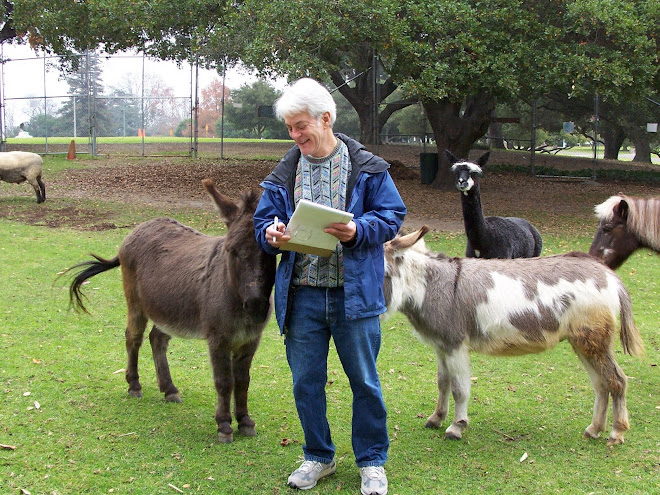
Interviewing the animals at Children's Fairyland in Oakland. L-R: Bobo the sheep, Gideon the miniature donkey, me, Tumbleweed Tommy the miniature donkey, Juan the alpaca, Coco the pony

Saturday, November 14, 2015

The Last Time I Saw Paris

The last time I saw Paris, her heart was warm and gay.
I heard the laughter of her heart in every street café.
The last time I saw Paris, her trees were dressed for spring.
And lovers walked beneath those trees and birds found songs to sing.
I dodged the same old taxicabs that I had dodged for years.
The chorus of their squeaky horns was music to my ears.
The last time I saw Paris, her heart was warm and gay.
No matter how they change her, I'll remember her that way.
      - Oscar Hammerstein II, written a few days after the fall of France in 1940

My heart is breaking. Paris – the cultural capital of Europe, the city of lights, where every building is an exquisite piece of baroque sculpture – violated by cruel, naïve, and unfathomably dangerous true believers. Children slaughtered while attending a rock concert. People gunned down while eating their dinners. It's almost too much to bear.
If you've never been to Paris, do yourself a favor and put it on your bucket list. With all respect to New York, London and Rome, it's the greatest city in the world. And it has captured the hearts and imaginations of Americans ever since Benjamin Franklin and Thomas Jefferson served as our country's first two ambassadors there.
"If you are ever lucky enough to have lived in Paris as a young man," Hemingway wrote, "then wherever you go for the rest of your life, it stays with you, for Paris is a moveable feast."
Predictably, American politicians are falling over themselves to exploit this tragedy. And just as predictably, they're coming up with all the wrong answers and pointing their fingers at all the wrong people.
A lot of them are blaming the Syrian refugees, ignoring the fact that these refugees are fleeing from ISIS, the very same people who committed the Paris attacks. Ted Cruz says we should only admit refugees who are Christians. Mike Huckabee wants to use this as an excuse to cancel the nuclear deal with Iran, ignoring the fact that the only boots on the ground who are having any success against ISIS – apart from the Kurds - are the Iranians.
And Donald Trump took a break from his war on Mexicans – who, as far as I can recall, haven't bombed anybody – to train his fire on the Syrian refugees, saying, "If I win, they're going back."
It reminds me of what Great Britain did during World War II: It imprisoned Jewish refugees from Nazi Germany on the grounds that they might be German spies. None of them were, of course, any more than the 120,000 Japanese American citizens we imprisoned after Pearl Harbor.
It's only human to lash out at the nearest target when something like this happens, but is it wise? When Bin Laden ordered the 9/11 attacks, his goal was to trigger World War III between Islam and the West. It's a war that no one can win but everyone can lose.
Let's step back, take time to mourn the desecration of this beautiful city, and then fight. But this time, let's use our heads for strategy and our hearts for compassion, instead of being suckered into fear-based, impulsive action. The latter is what he would have wanted.

Monday, November 9, 2015

Walking Through History

Want a great stocking stuffer to give your Berkeley friends this holiday season? Have I got a book for you! It's "Berkeley Walks: Revealing Rambles Through America's Most Intriguing City," by Bob Johnson, a longtime member of the city's Landmarks Preservation Commission, and Janet Byron, my former colleague at the Oakland Tribune
 It features do-it-yourself walking tours of 18 different areas in the city, including 1444 Addison Street, where Mario Savio lived during the Free Speech movement in 1964, around the corner from 2315 Spaulding, where fitness guru Jack LaLanne lived when he was a student at Berkeley High (Class of 1934).
Then there's the love nest at 2267 Derby, where Bill Clinton lived with his girlfriend, Hillary Rodham, during the summer of 1971, which is just a stone's throw from 2603 Benvenue, where Patty Hearst was kidnapped by the Symbionese Liberation Army three years later.
Not far away is a converted garage at 2628-A Regent, where Ted Kaczynski, the notorious Unabomber, lived while he was teaching at Cal. (The authors note that despite the fact he was the youngest teacher on the faculty, his students heartily disliked him.)
One block over is 2419 Oregon, where the future New Yorker film critic Pauline Kael lived from 1955 to 1964 while she was managing the Cinema Guild Theater at Haste and Telegraph.
2925 Russell Street is the former home of Jay Ward, the man who gave us not one but two cultural icons: Crusader Rabbit and "The Rocky & Bullwinkel Show." Around the corner is 2598 College, where Pulitzer Prize-winning playwright and novelist Thornton Wilder lived from 1906 to 1910 when he was in middle school. (It's now the Sigma Epsilon Omega fraternity house.)
Beat poet Allen Ginsberg wrote his masterpiece, "Howl," in 1955 while he was living in a cottage behind 1624 Milvia Street. (The cottage is gone, but his poem "A Strange New Cottage In Berkeley," which he also wrote while living there, remains.) At 1301 Henry is the commune of Woodstock emcee/Ben & Jerry's ice cream flavor Wavy Gravy.
The book also highlights memorable structures by Julia Morgan, Frank Lloyd Wright, Walter Ratcliff and Bernard Maybeck, including Maybeck's masterpiece, First Church of Christ, Scientist, at the corner of Dwight and Bowditch, one of only two designated National Landmarks in the city.
The authors aren't shy about making aesthetic judgments, such as the wonderfully quirky Normandy Village on Spruce Street, which they accurately label "a whimsical collection of apartment houses in the Hansel and Gretel style," or the house at 2325 Piedmont, which they call "another example of a Julia Morgan house destroyed by an insensitive 'modernization.'"
The book, an outgrowth of the walking tours Johnson and Byron have been conducting for years for Greenbelt Alliance, has been three long years in the making.
"We had no idea what we were getting into," says Johnson. "Five rounds of editing – two on the text, three on the galley proofs. I thought it would never end."
So what's next? A sequel.
"We have so many other areas to cover," Byron explains, "including the area between Grizzly Peak and Shasta, the wineries in West Berkeley, and the galleries near Fourth Street."
Meanwhile, they're still conducting their walking tours. To find out what's coming up and reserve your space, visit www.berkeleywalks.com.

Sunday, November 1, 2015

Where Are The Campaign Slogans Of Yesteryear?

        (Above: My hero, the crook)

The presidential election is one year away, and many Americans are already complaining about the candidates.
My complaint is a little different: I find their campaign slogans uninspiring, whether it's "Hillary For America" (Clinton), "Heal, Inspire, Revive" (Carson), "Reigniting The Promise Of America" (Cruz), "Defeat The Washington Machine" (Paul), "Make America Great Again" (Trump), "New Possibilities. Real Leadership" (Fiorina), or that Seinfeldian slogan that says absolutely nothing, "Jeb!"
Sure, there have been some lousy slogans in the past, like "I'm Madly For Adlai" (Stevenson 1952) or ""We Polked you in '44, We shall Pierce you in '52" (Franklin Pierce 1852), referring to James K. Polk, who was elected eight year before.
But many of them have been great, although some of the winners reneged as soon as they were elected. For instance:
"54-40 or Fight!" (Polk 1844), referring to a border dispute with Canada. Polk won but settled the border on much less favorable terms, at the 49th parallel, instead.
"Read my lips. No new taxes." (George H.W. Bush 1988), who, of course, promptly raised new taxes.
"A chicken in every pot and a new car in every garage." – (Hoover 1928), who within a year was presiding over the worst depression in American history.
"He kept us out of war." (Wilson 1916), who took America into World War I six months later.
"Let's make it a Landon-slide." (Landon 1936), who got his wish, although not the way he intended: He lost in the greatest landslide in history up to that time.
And, of course, "Nixon's the One" (Nixon 1968), a slogan that took on ironic meaning during the Watergate scandal.
But some slogans have been sheer genius, including:
"Tippecanoe and Tyler Too" (Harrison 1840), referring to his victory at the Battle of Tippecanoe. His running mate was John Tyler.
"Keep cool with Coolidge." (Coolidge 1924)
"I'm just mild about Harry." (Dewey 1948)
Occasionally we have had dueling slogans, for instance:
"Ma, ma, where's my pa?" (Blaine 1884), referring to Grover Cleveland's admission that he had fathered an illegitimate child.
"Gone to the White House, Ha, Ha, Ha!" (Cleveland 1884)
"No third term." (Willkie 1940)
"Better a third termer than a third rater." (FDR 1940)
"In your heart you know he's right." (Goldwater 1964)
"In your guts you know he's nuts." (Johnson 1964)
 And the best presidential campaign slogan of all? Easy: "I like Ike" (1952). Short, sweet and simple. And it rhymes!
But my favorite slogan comes not from a presidential race but the 1991 Louisiana governor's race. On one side: former Gov. Edwin Edwards. He was corrupt through and through, which wasn't much of a problem in a state that has a long history of charming rogues. (He once boasted, "The only way I'm going to lose is if I'm found in bed with a dead girl or a live boy.") But he did have a big drawback: He was a supporter of civil rights. A local newspaper predicted, "The only way he could win would be if his opponent is Adolf Hitler."
His opponent wasn't Hitler, but he turned out to be the next best thing: David Duke, Grand Wizard of the Ku Klux Klan and a notorious neo-Nazi.
Edwards' winning slogan: "Vote for the crook. It's important."

Wednesday, October 28, 2015

New Kitties!

(Above: Barbara and Sweetie)

Two years ago, a kind soul in Oakland – whose name I'm withholding to protect her privacy - adopted a homeless orange male tabby cat that kept coming to her door and named him Red. Red had been living in a nearby feral cat colony, and it's unusual for a cat past the kitten stage to be tame enough to be adoptable. But not Red.
Last week, she found out why. She took him to the Fix Our Ferals spay/neuter clinic in Richmond, where they discovered he had not only been neutered already, he had a microchip. Clearly, he had once been someone else's kitty.
But whose? They did an Internet search for the microchip and came up empty. So Michelle Jewell, the clinic manager, called the microchip company, and they told her the chip had never been registered. All they had was the name of the animal hospital that inserted it.
 Michelle called the hospital, and they gave her the name of the first owner, who lived only a few blocks away from the new owner.
She told Michelle that Red – whose original name was Tego – had escaped from her house six years ago, just two days after she moved in. And being new to the neighborhood, he didn't know where to go. He was lucky to find that feral cat colony. She had no idea he was living only a few blocks away all this time.
Michelle put the two women together, and the new owner handed Red – or Tego - over. She was sad to give him up, but she knew he would be happiest with his original mom.
Moral: It's not enough to get your dog or cat microchipped. You have to take the final step and register it.
If you'd like to support Fix Our Ferals' lifesaving mission, you can donate online at fixourferals.org or send a check to P.O. box 13083, Berkeley CA 94712. They're an all-volunteer group; so if you'd like to help, call 510-215-9300.
                                          * * *
Meanwhile, there's good news from Berkeley: Darling Flower Shop finally has a new cat, a tiny grey-and-white kitten.
The shop had been without a cat since this time last year, when the previous kitty, named Kitty, died. Owners Jay and Barbara Touriel missed her too much to even think of getting another one.
But last week Jay got a call from Walter Griffin, a friend of his in the Berkeley Lions Club, who had a family of feral cats living in his back yard. One of the kittens, the runt of the litter, had been abandoned by the mother and left to die. Walter nursed her back to health and then called Barbara and Jay.
They went over to see her and instantly fell in love. They named her Sweetie – and no name was ever more appropriate – and moved her into the flower shop, which she promptly took over.
Sweetie loves everybody – the employees, the customers, the local letter carrier, everybody. But her heart really belongs to Barbara and Jay, and the feeling is mutual. Her favorite pastime is riding around on Jay's shoulders or inside the bib of Barbara's smock.
Welcome, Sweetie. You have some mighty big paw prints to fill, but I know you're more than up to the job.

Sunday, October 25, 2015

Heads In The Sand

Who is the president of Mexico? Don't know? Neither do I.
Meanwhile, our neighbor to the north, Canada, held a national election on Monday. Do you know who won?
Most of us know that Vladimir Putin rules Russia, but who rules China? Or Japan? Or India?
Who are the major players in the Middle East, which is giving us so much trouble these days? Or on the Indian subcontinent, where India and Pakistan keep threatening to go to war with each other, both armed with nuclear weapons. Who's in charge there?
And that's just the leaders. I won't even bother asking who leads the opposition in these various countries. Or what the major political issues are. Or what people in other countries think of us. Or why.
My point is that we Americans are woefully ignorant about the rest of the world, and that's a recipe for disaster. If anybody runs the world, we do; but we know next to nothing about that world we seek to lead. So we continually get taken by surprise, over and over again.
Admit it: Before the terrorist attacks on 9/11, you had never heard of Al Qaeda. Ditto for ISIS before it suddenly popped up in the headlines last year. For that matter, why does Obama call it ISIL when the media call it ISIS? There's actually a reason, but do you know what it is? I don't.
The pundits predict that foreign policy will be a major factor in next year's presidential election; but with an electorate that knows absolutely nothing about the issues, how can we possibly make an informed choice?
Most Americans would say that we already lead busy lives and don't have time to do the homework, so we leave it to the experts to do our thinking for us. But these "experts" don't know much more than we do.
In 1953, the experts in the CIA and State Department teamed with the British Secret Intelligence Service to overthrow the democratically elected prime minister of Iran, Mohammed Mossaddegh, and replaced him with the Shah.
We promptly forgot all about it, but the Iranians sure didn't. So when the Shah fell in 1979, the Iranians, instead of turning to pro-Western alternatives like Abolhassan Banisadr, turned instead to Ayatollah Khomeini, who wasn't tainted by association with us.
In 1954 the experts did it again, overthrowing the democratically elected president of Guatemala, Jacobo Arbenz. That let loose a Pandora's Box of Arbenz's followers, including Fidel Castro and Che Guevara, who spread throughout Latin America, fomenting revolution wherever they went for the next forty years.
Ten years later we went to war in Vietnam on the theory that North Vietnam was just a proxy for Chinese expansion. Who knew that the Vietnamese and Chinese have mistrusted each other for centuries? Not the experts in Washington.
And no one was more surprised when the Soviet empire imploded in 1989 than the CIA, which had no clue that the USSR had been rotting from the inside for decades.
There's plenty of blame to go around, including the news media and our schools, who have been woefully inadequate in educating us about the world. But in the final analysis, as Shakespeare said, "The fault, dear Brutus, is not in our stars, but in ourselves."

Sunday, October 11, 2015

The Ride Of Their Lives


Last month's Valley Fire was a catastrophe: four people and thousands of animals killed, 76,000 acres burned, 1,910 structures (1,238 of them single-family homes) destroyed, and loss of habitat for countless numbers of wildlife.
It also created a dilemma for the Bay Area Outreach and Recreation Program – aka BORP – the Berkeley-based organization that offers adaptive recreation equipment and programs for physically disabled or visually impaired kids and adults, which was due to hold its annual fundraiser, the Revolution Ride, on Sept. 26 at the Trentadue Winery in Geyserville.
"We didn't want to cancel if we could help it because for many of these people, this is their favorite day of the year," says event planner Sarah Kidder, who helped organize the ride. "But it was looking doubtful. Yes, the fire was still on the other side of the Russian River, but a fire does what it wants to do. There's never a guarantee, especially the way it was spreading."
So she and BORP's executive director, Rick Smith, spent the next week anxiously monitoring the fire's progress and making backup plans for what to do if worse came to worst, including postponing the event or holding it somewhere else, like around Lake Merritt or the Berkeley Marina, which would be distant second choices at best.
Finally, on Sept. 18, came good news: The winery was still there, the roads were still open, and the air quality was good enough for the riders to breathe. So they crossed their fingers and went ahead with it.
And are they glad they did! "It was easily the most rewarding thing I've ever worked on," Kidder says. "My dad is in a wheelchair, which makes me realize how limiting life can be; but seeing the people at the BORP event, who face much, much more physical challenges than my dad, was truly inspiring. Everyone was happy and gracious and kind and thrilled to be there supporting this organization.
"There were everyone from quadriplegics to little kids with prosthetic legs from the hip down, all biking and playing and throwing paper airplanes through this beautiful vineyard. None of them were saying, 'What can you do for me?' Instead, they were out there doing for themselves. And that spirit of self-motivated behavior rippled through the entire event."
One of her concerns was whether they would be able to find enough volunteers to support the disabled riders, whether it was riding alongside them, setting up tables, tending bar or giving massages. But she needn't have worried. More than 150 showed up.
"It's been my experience with other events that usually you have a couple of great volunteers, a handful of pretty good volunteers, and the rest who are well meaning but disappear or aren't really that helpful. But at this event, at least half of the volunteers were great, and the other half were really, really good. No one disappeared, no one arrived late, and many continued to help past their designated shifts. Many of them even thanked me! It's I who should be thanking them!
"I now understand why so many people look forward to it all year long, and why this organization has done it for 13 years. It's so much more than a bike ride."
To contribute to this wonderful organization, please visit borp.org.

Tuesday, October 6, 2015

The New Colossus

(Above: Emma Lazarus' original manuscript.)

On the wall of the pedestal of the Statue of Liberty is a plaque containing a poem by Emma Lazarus called "The New Colossus," comparing Lady Liberty to one of the Seven Wonders of the Ancient World, the Colossus of Rhodes:

Not like the brazen giant of Greek fame,
With conquering limbs astride from land to land;
Here at our sea-washed, sunset gates shall stand
A mighty woman with a torch, whose flame
Is the imprisoned lightning, and her name
Mother of Exiles. From her beacon-hand
Glows world-wide welcome; her mild eyes command
The air-bridged harbor that twin cities frame.

"Keep, ancient lands, your storied pomp!" cries she
With silent lips. "Give me your tired, your poor,
Your huddled masses yearning to breathe free,
The wretched refuse of your teeming shore.
Send these, the homeless, tempest-tossed to me,
I lift my lamp beside the golden door!"

But as we prepare to celebrate Columbus Day on Monday, can anyone deny that we have made a mockery of these noble words?
Nativism is nothing new. It goes back to the very start of our country, when Ben Franklin warned that the first wave of immigrants, the Germans, would change our language from English to German. Instead, they gave us hot dogs, hamburgers and Dwight D. Eisenhower.
Throughout our history, people have always had the same complaints about immigrants: They'll eat up our resources, increase the crime rates and change our culture.
Instead, the opposite has happened. Immigrants work harder than everyone else – from the Irish and Chinese who built the Transcontinental Railroad to the Mexicans who currently labor in the fields to bring food to our tables – for one simple reason: Unlike the rest of us, who have grown soft and lazy over the generations, they still believe in the American dream and are willing to work hard to achieve it.
Statistics show they commit fewer crimes and volunteer to fight for our country in greater numbers than the rest of us, from the Irish in the Civil War to the Italians in World War II.
Yes, they do change our culture – but always for the better. If you don't believe that, no more pizza, bagels or mu shu pork for you.
And now, here we go again. Our politicians are falling over each other to prove who can be cruelest to Latin Americans immigrants, especially Mexicans.
Last year, we were treated to the spectacle of mobs of obscenity-screaming "patriots," their lips dripping with spittle and vituperation, surrounding busses of Guatemalan toddlers whose only crime was trying to escape the violence in their home country.
This year, the candidates are taking their cue from Donald Trump. The Donald says he'd still let a few immigrants in; namely, the rich ones and those with Ph.Ds. But that totally misses Emma Lazarus' point: What made America great wasn't aristocratic newcomers; it was ordinary people whose potential for greatness was untapped back in the old country.
And now Trump is upping the ante by promising to deport all the Syrian refugees we're taking in, too. But he ignores the basic truth that today's immigrants are like our own ancestors – just with different faces, that's all. They have always given back to this country far more than they got, and they always will.