A columnist of heart and mind

A columnist of heart and mind
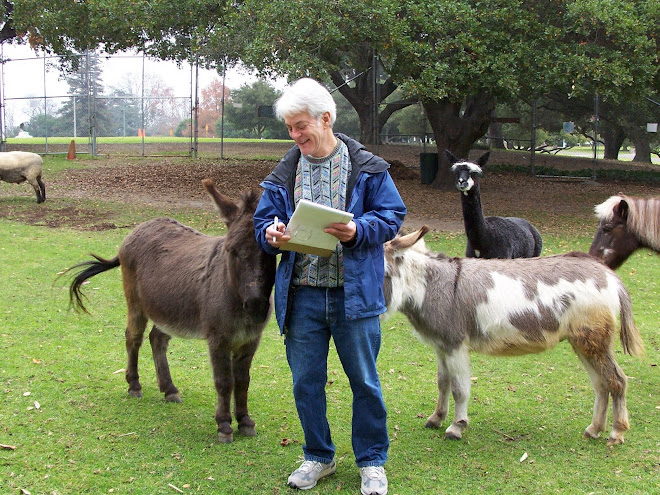
Interviewing the animals at Children's Fairyland in Oakland. L-R: Bobo the sheep, Gideon the miniature donkey, me, Tumbleweed Tommy the miniature donkey, Juan the alpaca, Coco the pony

Saturday, September 10, 2011

Happy Ending


(Left: Alexia. Right: Rosco. Photo by Miguel Buchwald.)

For Rosco the puppy, last Friday was the second-best day of his life, second only to the day five months ago when he was adopted by Kate McFarland of Oakland and her parents, Rick and Carolyn.
Rosco, a 7-month-old, brown-and-white fluffball with a black button nose and two coal black eyes, was playing with his favorite squeaky toy when the doorbell rang.
In walked his sister Alexia, whom he hadn't seen since they both survived a medical ordeal that shouldn't happen to, well, a dog.
Both dogs jumped for joy. He chased her around the room. Then she chased him around the room. Then they rolled around together and wrestled. Then, totally bushed, they flopped down and curled up together for about five minutes. Then they jumped up and started the whole routine all over again.
This continued non-stop for more than three hours. The puppies were in ecstasy. And so were their owners, watching them.
"When I think of how close both of them came to dying, it's a joy to see them so happy and healthy," said Sandy Buchwald of Vallejo who, with her husband Miguel, adopted Alexia.
Rosco and Alexia were part of a litter that were rescued last March by Paw Prints Rescue in Yuba City after they were abandoned by their mother. The two puppies were so devoted to each other, the staffers at Paw Prints dubbed them "The Twins."
Roscoe was adopted by the McFarlands after they saw his picture online and were instantly smitten. Ditto for Alexia and the Buchwalds. They were headed for happy homes, but it was doubtful that they would ever see each other again.
But a few days later, Rosco developed severe vomiting and diarrhea. His worried owners rushed him to PETS Referral Center in Berkeley, where Dr. Shea Cox, the veterinarian on duty, diagnosed parvovirus, a highly contagious and potentially lethal disease, especially in puppies.
The next day he was feeling better, so he was sent home to continue his recovery. Two hours after he left, another puppy was brought in with the same symptoms.
It was Alexia, and she was even sicker than Rosco. Pneumonia and anemia set in on top of the parvovirus, and she was soon struggling for her life.
The next day, Rosco's condition started deteriorating again, and he returned to the hospital. It was only then that the McFarlands and Buchwalds finally met. They put two and two together and realized that their puppies were littermates.
Dr. Cox put Rosco and Alexia in side-by-side cages in intensive care, hooked them up to IVs, and worked day and night to keep them alive. By now, they were down to less than three pounds.
"I had to stop the vomiting and diarrhea because they were dying of starvation and thirst," she said. "I gave them anti-emetics, antibiotics, sugar and potassium supplements, and plasma transfusions as a protein source. Plasma contains small proteins - not enough to do a big dog any good, but enough for small dogs like them."
But the best medicine of all was each other.
"It was so comforting knowing that Alexia was no longer alone in the isolation ward," said Sandy Buchwald. "I knew that if either of these puppies ever had a chance of fighting this illness off, it would be now, when they could comfort and support each other."
And she was right. After a week of medical treatment and loads of TLC, the puppies were well enough to return to their respective homes.
But they haven't seen each other since then. Alexia had to be spayed, Rosco had to be neutered, and their owners wanted to take time to let the incisions heal for fear that in their unrestrained joy at seeing each other they might tear their stitches.
That waiting period ended last Friday. By now, Rosco has grown to 15 pounds, and Alexia isn't far behind at 13 pounds. They are the picture of health and high spirits.
While the puppies cavorted, their owners compared notes and were amazed to discover how similar their personalities are.
Both love tummy rubs. Both love to chew flip-flops. Both love to ride in cars. Both like to lick the water from their owners' legs when they emerge from the shower.
Both are voracious chowhounds. Both are addicted to their squeaky toys. And both are utterly devoted to their owners - and each other.
About three hours into this play date the doorbell rang again. It was Dr. Cox, who stopped by to say hi to her former patients.
The puppies exploded with joy at seeing her again, and she wiped more than a few tears from her eyes.
""They made it!" she said. "They really did it! They were so weak when I first met them, they couldn't even lift their heads. And now look at them!"
And will there be more play dates in the future?
"Are you kidding?" says Carolyn McFarland. "After all they've been through together? These dogs will never be apart again!"

Sunday, September 4, 2011

Squandering The Spirit of 9/11


I know this sounds crazy, but I miss 9/11.
It even sounds crazy to me because that was the worst day of my life, and I suspect it was for you, too.
Each of us is haunted by memories of that day and the ones that followed. I will never forget the sad sight of the victims' families placing missing posters at Ground Zero, putting on a brave face and hoping against hope that their loved ones were still alive. I don't miss that.
What I miss is the wave of national unity that swept the county. My first column after the attacks began with the words, "Well, the 2000 election is finally over," and I had high hopes that the bitterness of the Bush/Gore election would be swept away by the realization that, to paraphrase Jefferson, we are all Republicans, we are all Democrats, united by a common dream of a land with liberty and justice for all.
Pretty naïve, huh? It didn't take long for us to get back to normal. And by normal, I mean dysfunctional.
Ronald Reagan used to ask, "Are you better off than you were four years ago?" And by any measure you use, we are worse off than we were in 2001.
Our Bill of Rights, economy, military, schools, infrastructure and international reputation are in tatters. Crucial problems such as immigration, climate change, the decline of the cities, the growing gap between the rich and poor and the pernicious influence of big money on our politics, have been kicked down the road - some, I fear, past the point of no return.
But the worst problem, the one that underlies all the others, is that many Americans hate other Americans more than they love their country.
And they're being egged on by cynical politicians and partisan media figures who tell them over and over to fear their fellow citizens.
The 9/11 tragedy isn't the only anniversary we're observing this year. It's also the 150th anniversary of the beginning of the Civil War and the 70th anniversary of our entry into World War II.
In the first case Americans split apart, and the result was more than 650,000 deaths. In the second case Americans came together, and they saved the world.
Now it's our turn. It's time to decide what kind of country we want to be. We are at a crossroads, and it can go either way.
There are some dangerous tendencies at work in the land. A lot of loose words are being thrown around about secession and "Second Amendment remedies." People are showing up at political rallies with loaded weapons. And some crazies are going even further - witness the attempted assassination of Rep. Gabrielle Giffords.
This kind of reckless talk was common in the years leading up to the Civil War, too. Sure, we don't think it will come to war this time, but that's what people thought in 1860, too.
Lincoln, of course, described it best:
"All dreaded it, all sought to avert it. Both parties deprecated war, but one of them would make war rather than let the nation survive, and the other would accept war rather than let it perish. And the war came."
United we stand, divided we fall.

Tuesday, August 23, 2011

No Straight Lines And A Surprise Around Every Corner


(Above: The Blue Fairy telling stories and singing songs at Fairyland.)

In 1948 Arthur Navlet, owner of one of Oakland's largest floral nurseries, had an idea for a children's park on the shores of Lake Merritt that would be unlike any other - not a frenetic mini-carnival, but a safe, quiet, comforting environment where children could play at their own pace and on their own terms.
He took his idea to Oakland Parks Superintendent William Penn Mott, who immediately signed on, and the Lake Merritt Breakfast Club, which pledged its support.
To design the new park, which would be called Children's Fairyland, Mott chose architect William Russell Everett.
Everett built a tiny model of the first attraction, the Merry Miller Cottage. It was a perfect replica of a medieval English cottage, and he was delighted with the result.
But Mott was not. He didn't want realism; he wanted whimsy, a little nonsensical and out of kilter - the way a small child might view the grownup world.
Enraged by the criticism, Everett grabbed a baseball bat, smashed the model to smithereens, and stalked out of the room.
Mott and Navlet were sure that was the last they'd ever hear from him. But a week later, he returned with a new model. It was oddly twisted and had no square sides, and it was painted in outlandish colors.
"That's it!" Mott exclaimed.
Thus was born the principle that has ruled Children's Fairyland ever since - "no straight lines and a surprise around every corner."
Everett went on to achieve fame and fortune as the nation's foremost designer of miniature golf courses, using the ideas he first developed at Fairyland.
And Fairyland became the model for Walt Disney when he built Disneyland. He even hired away Fairyland's first director, Dorothy Manes, and its first puppeteer, Bob Mills, for his new park.
But I much prefer the original. For six decades, Children's Fairyland has been what Mott and Navlet intended it to be: an oasis of serenity in the midst of the big city, where little kids can run free and just be little kids.
And it's all beautifully documented in a new book, "Creating a Fairyland: 60 Years of Magic at Children's Fairyland USA" by Randal Metz and Tony Jonick.
Each page is packed with memories, including:
* 10-year-old Beth Werschkul, the very first Storybook Personality, who was Alice in Wonderland in 1960.
* Popo the Clown and his six-legged cow, who enchanted generations of children from 1958 until his death in 1981.
* Master puppeteer Lewis Mahlmann, who directed the Storybook Puppet Theater from 1967 until 2003.
* The Blue Fairy (real name: Jacqueline Lynaugh), whose songs and stories have brought fairytales to life for the park's pint-sized visitors for more than 20 years.
* And, of course, all the adorable animals who have lived at Fairyland over the years, from Emo the Saint Bernard, who used to haul kids around the park in his dog cart - a tradition that was carried on by his son, Jamie, and his grandson, Hondo - to the charming but naughty miniature donkeys Gideon and Tumbleweed Tommy - aka "the bad boys" - who get into mischief every chance they get.
(In the old days Fairyland used to hold an annual Aesop's Derby, featuring races between turtles and rabbits. This being real life and not myth, the rabbits always won.)
Metz and Jonick are the perfect people to write this book. A former Storybook Personality himself, Metz is the current director of the puppet theater.
And Jonick, who met his wife at Fairyland, has been a fan ever since he was a little kid growing up in the Fiji Islands, when he read about Fairyland in a "Dennis the Menace" comic book.
Chock full of priceless pictures, "Creating a Fairyland" is the next best thing to visiting the park itself. It's available at Fairyland's Magic Leaf gift shop, A Great Good Place for Books in Montclair, Laurel Book Store on MacArthur Boulevard or Spectator Books on Piedmont Avenue.
At 60, Fairyland looks better than ever. But the important things will never change.
Children are still warned not to cross the Magic Pink Line in front of the puppet theater because if they get any closer, the puppets will become frightened and run off the stage. (Although the cynical grownup in me suspects that the real reason is that the kids will see the puppets' strings.)
And I hope you've hung on to your Magic Key because it still works.

Monday, August 22, 2011

Bullying


(Above: Mrs. Lacey's first grade class, El Rodeo School, 1951. I'm in the back row, second kid from the left. Standing between me and Mrs. Lacey is David Ansen, who grew up to become Newsweek's movie critic. Click on the picture to enlarge it.)

Last week, Phil Catalfo of Berkeley posted a message on his Facebook wall that struck a nerve with me:
"Special request to all kids returning to school in the next few days. If you see someone who is struggling to make friends, being excluded or bullied because they don't have many friends or because they are shy or not as pretty or not dressed in the most 'in' clothes, PLEASE step up. Say 'hi' or at least smile at them in the hallway. You never know what that person might be facing. Your kindness might just make a big difference in someone's life."
His words struck me because I, too, was bullied when I was young. Every morning, I woke up dreading having to face another day at school. I tried faking illness until my mother caught on and made me go anyway.
The worst part was the humiliation. I was so embarrassed, I stayed in the closet about it for years.
I was angry; but there was nothing I could do. My sole comfort was sitting in the back of the classroom and fantasizing about killing my tormentors.
Thank God I was living in a place and time where there was no access to guns. Otherwise, I might have ended up like those killers at Columbine. Trust me: Kids under pressure are incapable of making mature choices.
The scars lasted a long time. The experience turned me into a lonely, mistrustful person.
You'd think it also made me a more compassionate person, right?
Wrong. I was so pathetically desperate to fit in with the crowd that when the opportunity finally came to pick on someone even more vulnerable, I jumped at it.
He was a developmentally disabled boy named Barry. I don't know if he's still haunted by the memory of my cruelty. I sure am.
But there's a way out of this vicious circle: Turn over enforcement to the kids themselves.
At Park Day School in Oakland, for instance, on the first day of school every kindergartener is assigned a 6th grade buddy who escorts them to lunch, sits with them, and generally takes them under his/her wing. If a little kid is being bullied, he can go to his/her older buddy for help.
The little ones learn that big kids are their friends. And they excitedly look forward to the day when they'll be in the 6th grade and can mentor a kindergarten buddy of their own.
Even that dreaded childhood jungle, the playground, is kinder and gentler. If you spot someone sad, you're responsible for finding out if that kid is OK and how you can help, even if he or she isn't necessarily a friend of yours.
The result is a complete change in the campus culture. If you're in the first grade you might not pay attention to what a grownup says, but a fifth or sixth grader is the coolest thing on earth. And if that older kid tells you that bullying is totally uncool, you believe it.
That's the way the system operates at Park, but you can find variations at other local schools, public and private.
If your child's school doesn't have a similar program, tell your principal about it. It really works.
And teach your kids to be kind to each other.

Monday, August 15, 2011

Seeing Differently


Zoey Stoll and Micah McKechnie have never met each other, but they have a lot in common.
Both are scary smart, both hail from Oakland (Zoey is a junior at Oakland Tech; Micah is a junior at UC Santa Barbara) and both have a neurologically-based condition called synesthesia.
I know that sounds like a horrible disease, but it's actually something wonderful.
Synesthesia is a term scientists use to describe what happens when stimulating one sense causes an involuntary response in another sense.
In Zoey's case, it's her visual sense. When she reads, each letter and number has a specific color, gender and personality.
"It can be a real advantage," she says. "If I see a math problem, I see it in a range of colors, which is pretty cool. And it's hard for me to misspell a word because if I do, the colors don't line up right."
She feels sorry for the rest of us, who read only in black and white.
"I'm really glad I have synesthesia. Reading would be so boring without it."
Often, the letters in each word will take their cue from the first letter. If the first letter is feminine, the other letters in the word probably will be, too.
"For instance, 'M' and 'S' are feminine letters," she said. "'So I hate to tell you, but 'Martin Snapp' is a very feminine name."
When she was a little girl, she used to write science fiction stories influenced by her synesthesia.
"One of my stories was about a green planet, and all the names of places on the planet were words that started with a green letter," she says.
Micah share's Zoey's sensitivity to letters and numbers, but she's even more sensitive to vibrations, especially sounds.
"It allows me to escape in my head," she says. "Whenever I'm on a long car ride or stuck in school doing absolutely nothing for lunch, I can just close my eyes and see amazing shapes and colors from every sound I hear. I wish I were more of an artist so I could draw them."
Needless to say, music is an utter joy for her. When she closes her eyes she sees light shows that are infinitely better than anything I used to see at the Avalon or the Fillmore back in the 196Os. And she doesn't need drugs to do it, either.
That's another thing she and Zoey have in common: They adamantly refuse to touch drugs or alcohol, and for a simple reason.
"I don't like anything that messes with my head," says Micah. "I'm already there. I don't need that."
And there's one more advantage. Micah has loved horses since she was a little girl, and her riding instructors have always marveled at her perfect riding form.
"If you flex a muscle, that's just another type of vibration," she explains. "So I can see all my muscles when I'm riding. If my form is off even a little bit, I can see that in my mind."
Not much is known about this syndrome, although it seems to affect a lot of creative people.
Famous synesthetes include composers Duke Ellington, Franz Liszt and Nikolai Rimsky-Korsakov, painters David Hockney and Wassily Kandinsky, novelist Vladimir Nabokov and physicist Richard Feynman.
I'm curious: Just how widespread is this syndrome? If you have synesthesia, too, please write me and describe your experiences. I'm absolutely fascinated - and, frankly, a little jealous.

Run While You Can


In 10 days, 24-year-old Sam Fox of Berkeley will attempt an arduous outdoor trek that has been accomplished by far fewer people than have climbed Mount Everest.
He's going to run, hike and climb 2,650 miles along the Pacific Coast Trail from Canada to Mexico, an odyssey that will take him past three national monuments, seven national parks and 24 national forests.
He will ascend 60 major mountain passes, descend 19 major canyons and pass more than 1,000 lakes through freezing cold, sweltering heat and driving rains, dodging mountain lions, black bears and rattlesnakes along the way.
The trip will start on Aug. 25 at Manning Provincial Park in British Columbia and, if all goes according to schedule, finish at the Mexican border on Oct. 24.
To meet that schedule, he'll need to average 44.6 miles per day. But he has no choice.
"The weather window is so tight," he explained. "That's the reason why so few people have completed the trail north to south: Not many people have tried."
That much exertion requires more than 8,000 calories per day, some in the form of high-protein drinks he will carry with him.
The rest of the menu will be what he calls "real food" - steaks, fresh veggies (especially avocados), even the occasional Big Mac, all provided by his two-man support team, who will be traveling on a parallel course in a recreational vehicle, meeting up with him at 38 strategically located contact points along the route.
"I'll call them on the walkie-talkie when I'm about 15 miles away from each contact point, and they'll have my foot bath waiting for me when I get there."
The month-long journey is a fundraiser for Team Fox, the grassroots support organization for the Michael J. Fox (no relation) Foundation for Parkinson's Research.
He hopes to raise $250,000, which he intends to leverage into four times that amount by asking people to donate through his own website, runwhileyoucan.org.
"An anonymous donor has agreed to match everything we get from now until August 25," he said. "And the Michael J. Fox Foundation has found someone else to match all their donations. So if you donate to them through us before that date, you can quadruple your contribution."
People can also send checks to Run While You Can, P.O. Box 786, Narragansett, RI 02882. The same leveraging applies.
Fox is dedicating this run to his mother, Lucy Fox, who has been a Parkinson's patient for more than 10 years.
"My mom is not a victim. She's not sitting at home feeling sorry for herself. Her attitude is that everybody has stuff they have to deal with, and hers just happens to be Parkinson's disease. She's probably embarrassed by the spotlight I'm putting on her.
"She doesn't think of herself as an inspiration, either, although she is to me. She's just so tough. I'm sure she feels awful, but if you ask her how she's doing, she always said, 'I feel great!'"
Fox's Canada-to-Mexico trek is one of many grassroots efforts taking place throughout the country to raise funds for the Michael J. Fox Foundation.
"Michael's daughter, Esme, had a lemonade stand at this year's New York City Marathon," said Sheila Kelly, the foundation's deputy director of development. "Another person swam the English channel. We've also had mud wrestling, golf tournaments and pancake flipping events."
Sam Fox has other projects in mind, too.
"It might be somebody putting on a guitar-a-thon, or somebody writing 20 songs in 20 days," he said. "I can also see us branching out to other causes, like injured veterans.
"I didn't found Run While You Can only to fund Parkinson's research; that's just the first project. My larger goal is to remind people that you have to live in the moment because nothing is guaranteed for tomorrow. My mom's Parkinson's disease is a good example of that. A lot can happen in this life, and I don't want to regret not having given things a shot.
"So when my friends ask me, 'Why are you doing this?' I say, 'Because I want to do something for my mom, or for society.' But the real reason is because I can."

Monday, August 8, 2011

Tears of a Clown


I don't know what surprised me more: the news that Jerry Lewis has gotten an unceremonious heave-ho as host of the Muscular Dystrophy Association's Labor Day telethon, or my reaction to it.
After all, I've never been a fan of slapstick comedy, which is Jerry's shtick in trade.
But this news has me really upset. It's not only the height of ingratitude; it's a shameful way to treat a man who deserved much better from the MDA.
Over the past 45 years he raised $2.6 billion for them. More importantly, he put the disease - and the association - on the map.
But time moves on, and last spring Jerry, who is 85, and the MDA jointly announced that this would be his last telethon.
Unfortunately, last week the MDA kicked him to the curb with this terse press release:
"The Muscular Dystrophy Association announces that today Jerry Lewis has completed his run as its national chairman. . .We will not be replacing him as MDA national chairman, and he will not be appearing on the Telethon."
They're going to replace him as host with four nonentities I've never heard of: Nancy O'Dell, host of "Access Hollywood;" Nigel Lythgoe, producer of "So You Think You Can Dance;" Jann Carl, former reporter for "Entertainment Tonight" and Alison Sweeney, host of "The Biggest Loser."
No disrespect intended, but collectively they couldn't carry Jerry's whoopee cushion. This is the dumbest re-branding decision since Coca-Cola introduced New Coke.
And the way the MDA handled it is even dumber. The smart thing - as well as the kind thing - would have been to allow Jerry to take a yearlong victory lap, the way NBC did when Johnny Carson retired.
He could have spent the last few months appearing on all the talk shows, reminiscing and plugging the MDA - and you know Letterman and Leno, who greatly admire Jerry, would have been happy to have him - culminating with the telethon itself, which would have been the most star-studded event ever.
Every A-Lister in Hollywood would have lined up to appear on this historic show, and the ratings would have gone through the ceiling.
And now? They'll be lucky if they can get Carrot Top.
And will you be watching? I sure won't. I'll be surprised if it's still on TV in three years.
To his credit, Jerry is keeping mum until after the telethon. He doesn't want to rain on his "kids'" parade. Who could have guessed that Jerry Lewis, who spent his whole career cultivating a childish persona, would be the only adult in the room?
I'm not the only one who is upset. Oakland Tribune reporter Kristin Bender's late father, Phil Bender, directed the telethon's Bay Area’s remote broadcast at KTVU for many years.
"He also worked on 'Romper Room,' 'Creature Features,' 'Dialing for Dollars' and A’s games, but it was the telethons that he loved the most," she says.
Jerry has had health problems of his own, including prostate cancer, pulmonary fibrosis and two heart attacks. But it never stopped him from helping children with disabilities.
"If the MDA executives decided it was time for him to leave the telethon, that’s fine," says Kristin. "But why not let the guy have his swan song? Imagine the ratings. Imagine the viewership. Imagine how it would have made an old man feel."