A columnist of heart and mind

A columnist of heart and mind
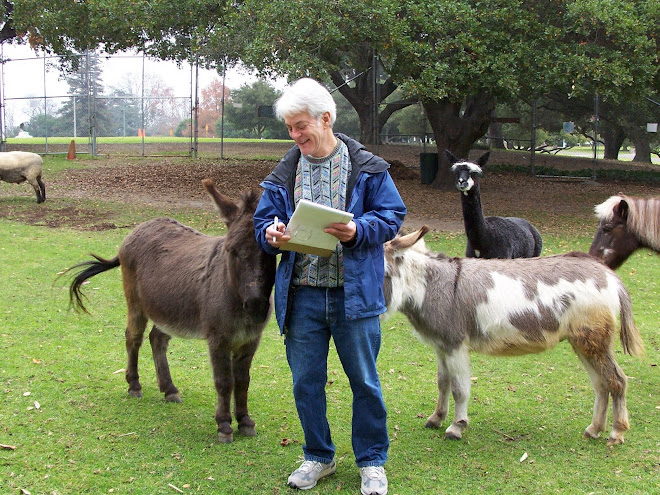
Interviewing the animals at Children's Fairyland in Oakland. L-R: Bobo the sheep, Gideon the miniature donkey, me, Tumbleweed Tommy the miniature donkey, Juan the alpaca, Coco the pony

Sunday, February 14, 2010

A Good Call


(Above: Alexander Graham Bell demonstrating his invention in 1892)

Three years ago, I reported on the most extraordinary memorial service I ever encountered. It was for Nanetta Washington of Hayward, who died after a long illness in 2007. Her service was attended by many of her closest friends.
The extraordinary part was that she had never met any of them face-to-face. And they never met each other, either. The entire service was conducted over the phone as a conference call.
They were participants in Senior Center Without Walls, an Oakland-based program that offers dozens of telephone discussion groups, classes and support groups every week to homebound seniors throughout Northern California
And SCWW is constantly expanding the number and variety of groups.
There are armchair travel groups, including aural tours of Malta, Morocco, Israel and the Tilden Park Botanic Garden.
There's an armchair birdwatching group, when an ornithologist helps callers identify the birds they see outside their windows.
There are groups for poets, animal lovers, movie buffs, food fans, joke tellers, and needle artists (I mean hobbies like knitting and crocheting, not tattoos).
In the weekly "What's the Verdict?" group, participants play sleuth in a discussion of real-life but very unusual law cases. In the monthly Socrates Café, they discuss basic philosophical questions such is "What is an authentic life?"
There are also support groups on aging, depression, anxiety, coping with loss, weight management, environmental sensitivities, bipolar disorder and living with vision loss.
Not to mention bingo, Boggle, spelling bees, sing-alongs and my favorite group, "Senior Center Without Words," when people call in and say nothing; they just listen to soothing music and do whatever they want, whether meditating or exercising.
And for non-English speakers, there are groups in Spanish and Chinese.
But beyond the good times and useful information, Senior Center Without Walls offers those who use it something far more valuable: a reconnection to the world.
That was evident at Washington's memorial service.
"Her husband said she had been depressed because of her illness, and her world kept getting smaller," says SCWW's executive director, Terry Englehart. "First it shrunk down to her house, then her bedroom, then her bed. But these people brought her out of her depression and gave her a new world again."
Is this a great idea or what? Here we have a serious problem: old people being cut off from the world because of illness or mobility problems. And here's a perfect solution.
The best part is that it's so low-tech. I mean, who doesn't know how to use the telephone?
And it's all free. Let me repeat that: F-R-E-E.
SCWW is run out of St. Paul's Episcopal Church in Oakland by Englehart and her tiny, two-person staff, aided by dozens of volunteers who facilitate the discussion groups and call people to remind them they have a conference call coming up later in the day.
The major expense is the conference calls. If you'd like to help, please send a tax-deductible check to Senior Center Without Walls, 114 Montecito Street, Oakland CA 94610.
But the real reason I'm writing this is to get the word out to the people who could use this wonderful service. If you - or anyone you know - are over 50 and homebound, SCWW can be a new lease on life.
Call toll-free 877-797-7299, and SCWW will mail you a schedule. Then sign up for the groups that interest you most and go for it.

Thursday, February 4, 2010

You Say Tomato


(Above: the Flying Tomato)

The Winter Olympics are almost here, and I'm rooting for American snowboarder Shaun White.
Not that I care about the sport; I just like his nickname - "The Flying Tomato," a tribute to his flaming red hair.
It's a throwback to the good old days, when nicknames actually told you something about the guy's personality. Heck, you could make an all-star team with just former Raiders, such as Jack "The Assassin" Tatum, Kenny "The Snake" Stabler and Lester "The Molester" Hayes.
But nowadays, nicknames are merely corny puns on the players' names, and it's all ESPN anchor Chris Berman's fault.
He's the guy who invented such cringe-worthy monikers as Bert "Be Home" Blyleven, Julio "Won't You Let Me Take You On A Sea" Cruz, Roberto "Remember The" Alomar, and Curtis "My Favorite" Martin.
Ironically, Berman has a decent nickname of his own: "Boomer," which pretty well describes his blustery on-air delivery.
Athletes don't always like their nicknames. Wilt Chamberlain hated "Wilt The Stilt" and asked people to call him "The Big Dipper," instead. Deion Sanders hated "Neon Deion," preferring the less invidious "Prime Time."
On the other hand, Joe DiMaggio beamed when people called him "Clipper," a shorter version of "The Yankee Clipper." And his great rival, Ted Williams, liked being called "The Splendid Splinter," a reference to his 6-foot-3, 180-lb. frame.
But he fell out with the sportswriters, and after a notorious incident when he spat in the direction of the press box, they renamed him "The Splendid Spitter."
Nobody had more nicknames than George Herman Ruth, who was named "Babe" after Baby Ruth, the young daughter of former President Grover Cleveland. (The candy bar was named after her, too.)
But the Bambino was so phenomenal, the writers kept inventing new names to describe him, including "the Sultan of Swat," "the Maharajah of Mash," "the Caliph of Clout," "the Behemoth of Blast" and "the Wazir of Wham."
The Sultan of Swat had many imitators, including slugger Mose Solomon, aka "The Rabbi of Swat," who played for the Giants in 1922.
Not all the nicknames of yesteryear were golden. Many were racist, and some were downright cruel. (For years, it seemed like every bald guy was called Curly, and every fat guy was called Skinny.)
My favorite recent nickname is one that Shaquille O'Neal gave himself. After someone told him about the ancient Greek philosophers, Shaq decided he had a lot in common with them, so he dubbed himself "The Big Aristotle."
Back in the early '80s, the San Francisco Examiner ran a contest to choose a nickname for Joe Montana.
The winner was "Big Sky," which, of course, was a total flop despite the Examiner's best efforts to plug it. Finally, someone pointed out that a name like Joe Montana doesn't need improvement. It's perfect as is.
Anyway, here are my Top 10 greatest sports nicknames of all time:
10. Dick "Night Train" Lane.
9. Elroy "Crazy Legs" Hirsch.
8. Gene "Big Daddy" Lipscomb.
7. Lawrence Peter "Yogi" Berra.
6. Marvin "The Human Eraser" Webster.
5. Walter "Sweetness" Payton.
4. Bill "The Big Tuna" Parcells (apparently, that's what he looks like in the shower).
3. Sal "The Barber" Maglie (because his high-and-inside pitches gave hitters such a close shave).
2. Mark "The Bird" Fydrich.
1. Doug "The Fydrich" Bird.

Saturday, January 30, 2010

Stupor Bowl


(Above: Joe Namath after Super Bowl III)

Are you ready for our real national holiday?
I'm talking about the Super Bowl, of course. Thanksgiving is a time when you get together with your family, but on Super Sunday you get together with your friends. It's a lot less stressful, and there's a lot more beer.
Not that the game is likely to be any great shakes. Most Super Bowls are stinkeroos, with one team blowing out the other by the end of the first half.
And the halftime show is even worse. Yes, they've come a long way since Super Bowl I, which featured the Anaheim High School Band. But be honest: What is the only halftime show anyone remembers?
Janet Jackson's "wardrobe malfunction," of course. And you can bet the NFL will make sure nothing like that ever happens again.
I must have been the only person in America who didn't see Janet's big moment. As soon as the first half ended and they said the entertainment was going to be her and Justin Timberlake - two people I have absolutely zero interest in - I switched over to the Animal Planet and watched puppies cavorting in the Puppy Bowl.
The best part of the Super Bowl is the annual Media Day, when the nation's best sportswriters vie for the honor of asking the dumbest question. Among my favorites:
* 1981 to Raiders QB Jim Plunkett, whose parents are disabled: "Lemme get this straight, Jim. Is it blind mother, deaf father or the other way around?"
* 1988 to Redskins QB Doug Williams: "How long have you been a black quarterback?"
* 1991 to Cowboys RB Emmitt Smith: "What are you going to wear in the game on Sunday?"
* And, of course, that divine moment in 2000 when a reporter asked Titans defensive end Jevon Kearse about the religious symbol dangling from his neck: "What's the significance of the cross?"
As part of the month-long pregame show, last week the NFL Network showed a replay of the most famous Super Bowl of them all, Super Bowl III, when the Jets upset the Colts, XVI to VII.
I was amazed that neither the Jets' not the Colts' uniforms have changed at all in the last four decades, but everything else has:
* The onscreen graphics were few and far between, and the few that appeared were incredibly primitive.
* The zebras weren't miked, so each penalty call was illustrated with extremely exaggerated gestures.
* Both kickers used the old-fashioned, straight-ahead style, not the soccer style that's universal today, which probably explains why there were five missed field goals in the game.
* This was before the NFL started pitching itself to female viewers, so there were no heart-tugging human interest stories about the players.
* Curt Gowdy did an OK job with the play-by-play, but Al DeRogatis and Kyle Rote were absolutely unintelligible as analysts. Everything that came out of their mouths was jargon and gobbledygook. It makes you appreciate the revolution that John Madden wrought.
Anyway, enjoy the game, but don't take the hype too seriously. To quote Duane Thomas, the Cowboys running back who rushed for XCV yards in Super Bowl VI, when Dallas beat Miami, XXIV to III: “If it’s the ultimate game, how come they’re going to play another one next year?”

Tuesday, January 19, 2010

The Lovely Bones


The late Washington Post publisher Phil Graham famously said that journalism is "the first rough draft of history," but it's not the last word.
That's because events that seem important at the time turn out to be less so with the passage of years. The big picture goes unnoticed until much later.
For instance, the biggest story in the Roman Empire in the year 30 A.D. was the fall of Aelius Sejanus, Prefect of the Praetorian Guard. Nobody paid any attention to the crucifixion of a Jewish carpenter-turned-preacher in Jerusalem.
Last year, Time Magazine chose Federal Reserve Board Chairman Ben Bernanke as its "Person of the Year." But I have a hunch that our descendants will decide that the real Person of the Year in 2009 was a female named "Ardi."
Short for Ardipithecus ramidus, Ardi lived 4.4 million years ago in the Afar region of Ethiopia. On Oct. 2 an international team of scientists co-led by Prof. Tim White of U.C. Berkeley announced her discovery. She is our earliest known ancestor, 1.2 million years older than Lucy (aka Australopithecus afarensis), whose partial skeleton was discovered in the same area in 1974. White calls it "the ultimate cold case investigation."
The coolest thing is that they discovered so much of Ardi's skeleton, starting with a hand bone in 1994 and eventually totaling 125 different bony parts.
"To understand the way her body worked, the parts you really want are the skull, pelvis, limbs, and hands and feet," says White. "And we have all of them."
Not only that, they also have body parts from 36 of Ardi's relatives, as well as other creatures that inhabited her environment. Among them are 20 species previously unknown to science, including shrews, bats, rodents, hares and carnivores.
One of the popular myths about evolution is that humans descended from chimps, but Darwin never said anything of the kind. What scientists really think is that we both descended from a common ancestor, whose bones have never been found.
But about 6 million years ago the family tree split into two branches, and we and the chimps have been evolving on our separate paths ever since.
At 4.4 million years, Ardi is the closest yet we've gotten to that common ancestor. And, as often happens in science, her discovery has forced scientists to rethink a lot of their earlier assumptions.
"She's not very chimp-like, which means our last common ancestor probably wasn't, either," says White. "She didn't walk on her knuckles like chimps and gorillas, and she had the ability to carry things in her hands. It's flipped our understanding of how evolution proceeded."
Ardi was about four feet tall and weighed about 110 lbs. She didn't look much like either humans or chimps, which suggests that neither did our last common ancestor.
You can find out more at a fascinating exhibit in the Valley Life Sciences Building at Cal or by visiting http://dsc.discovery.com/tv/ardipithecus/ardipithecus.html/.
One of the most interesting discoveries was that males of Ardi's species didn't have long, sharp fangs like chimps and gorillas, which implies that they might have wooed their mates less by fighting each other and more by pitching in with the chores, including provisioning their mates and children.
But confirmation will have to await future discoveries. In the meantime, isn't this cool?

Sunday, January 17, 2010

The Sweetest Sounds


Is the piano mightier than the sword?
That's what Sarah Cahill is trying to find out. For the last year, the Berkeley-based pianist has been taking her ambitious concert, "A Sweeter Music," around the country, playing in big cities (New York, Houston and Chicago) and small (Grand Forks, North Dakota).
All the pieces, which Cahill personally commissioned from the composers, are meditations on the folly of war. The concert's title is taken from Martin Luther King's Nobel Peace Prize lecture, when he said, "We must see that peace represents a sweeter music, a cosmic melody, that is far superior to the discords of war."
The composers range from 18-year-old Preben Antonsen to 77-year-old Yoko Ono. Some of their compositions, such as Antonsen's cacophonous "Dar al-Harb" (which he wrote as a tribute to his cousin, who was deeply affected by his experience as an interrogator in Iraq), are anti-war.
Others, such as Terry Riley's gentle "We Must Be Kind To One Another Rag," which he wrote as a lullaby for his grandchildren, are pro-peace.
Cahill was able to summon such a formidable array of talent because she's so popular with her peers. Though one music critic called her "the reigning diva of avant-garde pianism," the truth is that she's decidedly un-diva-like.
"You're going to have a hard time finding anyone who doesn't adore her," says Bonnie Hughes, executive director of the Berkeley Arts Festival. "She's incredibly generous, always thinking of things for other musicians to do. I mean, look at this project."
Cahill got the idea for "A Sweeter Music" from Frederick Rzewski's arrangement of the old spiritual, "Down By The Riverside."
"After reading about the latest deaths in Iraq, I would play it as a kind of catharsis," she says. "The lyrics 'Gonna lay down my sword and shield/Down by the riverside/Ain't gonna study war no more' were very meaningful for me."
But sometimes her mission must feel like a Sisyphusian task. When she began her tour a year ago, we were fighting in two wars. Now we're fighting in four, with the addition of Pakistan and Yemen.
"I do think of my father," she says. "When I started commissioning people, he said, 'It's a good idea, but it’ll be a moot point because the Democrats are going to take over the White House, and they'll end the wars, and that'll be it. You won't have any reason to play those pieces any more.'"
So does she get discouraged?
"I like to remember what Frederic Rzewski said: 'Music probably cannot change the world. But it's a good idea to act as though it could.'"
"A Sweeter Music" is coming back to the Bay Area on Jan. 30 at the San Francisco Conservatory of Music. It's a benefit for the American Friends Service Committee.
"It's an honor to be playing this concert for the American Friends Service Committee, such a courageous and visionary organization which since World War I has been showing us that there are powerful alternatives to war: nonviolence, compassion, social justice, understanding," says Cahill. "And they really put it into practice."
More information and tickets can be obtained at http://www.afsc.org/pacificmtn/ht/display/EventDetails/i/84399/pid/82363
The following day, Cahill will be joined by violinist Midori, composer John Adams and others in two panel discussions about the current state of classical music, also at the San Francisco Conservatory of Music. To find out more, visit www.performances.org.

Sunday, January 10, 2010

How To Drug An Elephant


(Above: Calle (R) and her friend, Tinkerbelle)

I was watching the Fiesta Bowl - oops! I mean the Tostitos Fiesta Bowl - on TV last week when I realized how I can make a quick buck in these troubled times: I'm going to sell the naming rights to my cat, Phoebe.
Just think: For enough money, I'll name her after your business. How does Allstate Phoebe, Little Caesar's Pizza Phoebe, or even Chick-fil-A Phoebe sound to you?
Get your bid in now. No corporation too crass to be considered. (Well, I might draw the line at Blackwater Phoebe.)
By the way, Phoebe has been feeling under the weather lately, so my veterinarian prescribed some meds and sent me to the most unusual pharmacy I've ever seen.
It's called Abbotts Pharmacy, and although it's been in Berkeley for 23 years, I'd never heard of it before.
Abbotts doesn't sell the things you see in the usual drug store. It's a compounding pharmacy, which means they make all the medications from scratch. That's especially useful if you have a little kid or a pet, who often refuse to take their medicine because it tastes so yucky.
More than half of Abbotts' business is referrals from veterinarians, for that very reason.
In Phoebe's case, they suggested either tuna, salmon, turkey or chicken flavor. I went with tuna, and she loves it.
They also offer beef, liver, strawberry, banana, apple, grape, peanut butter, butterscotch cantaloupe (a particular favorite with some finicky cats) and many more flavors.
Abbotts' most famous medication was concocted in 1999, when they made a10½-inch long suppository for Calle, an elephant at the San Francisco zoo. It was fashioned from cocoa butter donated by Guittard Chocolate Company.
"We wrote the Guinness Book of World Records to see if they would list it, but they turned us down," says Abbotts' president, John Garcia. "They said they didn't have a category for it."
They also made an enormous medicated gummy bear for an elephant at the St. Louis Zoo, but it was a trial-and-error process.
"We tried wild cherry first, but she spit it out," says pharmacist Elliot Kwok. "The zookeeper called me and said, 'I've got a face full of gummy bear meds. Let's try another flavor.' So we switched to apple, and she liked it."
Finally, did you see that video of a customer going berserk and trashing a McDonalds last week? It was all over the news and YouTube.
As I watched, I was reminded of the greatest lead in newspaper history. (A lead is the first sentence in the story.)
It was written by my friend - and fellow animal lover - Edna Buchanan, back when she was the crime reporter at the Miami Herald.
The story was about an ex-con named Gary Robinson, who went to his local Church's Chicken, shoved his way to the front of the line, and ordered a three-piece box of fried chicken.
The woman behind the counter told him he'd have to go to the back of the line, which he did. He reached the front five minutes later, only to be told that they'd run out of fried chicken.
When the woman suggested chicken nuggets instead, he hauled off and slugged her - whereupon a security guard shot him dead.
Edna's lead: "Gary Robinson died hungry."

Friday, January 1, 2010

The next "Greatest Generation"


(Left: Edward Gibbon. Right: Neil Howe)

The great historian Edward Gibbon famously remarked that history is "little more than the register of the crimes, follies and misfortune of mankind," and the decade just past is a perfect example.
It started out with acrimony and division over the Bush/Gore election and its legal aftermath, and it ended with acrimony and division over health care, global warming, and the rage that some people feel about having a black man in the White House.
In between, we had a traumatic terrorist attack, two wars, an economic collapse, countless sex scandals, and the death of a great American city from a combination of indifference and incompetence. (But hey, Brownie did a heckuva job.)
Gibbon was writing about the decline and fall of the Roman Empire, and there are a lot of people who are worried that our own empire is going the same way.
But I see a ray of hope - actually, millions of them - and they're right under our noses.
I'm talking about the younger generation, of course. Let's face it: You and I are creatures of the past. Every day that goes by, we count less and less.
But these kids are the future. They, not we, will determine whether computers turn out to be our servants or our masters, or whether genetic engineering turns us into Frankenstein's monsters. They are the ones who will have to cope with climate change, the destruction of the rainforests, the growing gap between the haves and the have-nots, and the frightening rise of fundamentalist extremists in every religion, not just Islam.
I have a friend named Neil Howe, who, along with his co-author, the late Bill Strauss, wrote a series of fascinating books ("Generations," "13th Gen," and "Fourth Turning") that trace an amazing 4-generational cycle that repeats itself in American history, over and over again.
Every four generations, they say, we get what they call a "heroic" generation. We're all familiar with the last one: the G.I.'s and Rosie the Riveteers. From Steven Spielberg to Tom Brokaw, we are heaping honors on "The Greatest Generation" even as they are slipping away from us. And we beat our breasts, wondering how we can ever live up to them.
Well, good news: Neil says this current crop of kids - the Millennials - show every sign of being another heroic generation, just like the G.I.s. If you're looking for Private Ryan, she's a senior in high school.
So what are we doing to get them ready? Just listen to the debates in Washington and Sacramento. Everybody is pushing their own pet projects, but nobody is speaking up for the Millennials.
Why are we slashing elementary and high school budgets and raising the fees at the University of California? Why do we still see kids selling raffle tickets to buy uniforms (or even worse, instruments) for their school band? Are we going to stiff another generation the way we did the Gen-Xers?
When I was their age, California had the best public schools in the country, routinely ranking first in both reading and math scores. Today, we're near the bottom, along with states like Louisiana and Mississippi.
And back then, every high school senior in California was guaranteed a free education all the way through college. The best students got a free (and I do mean free - no tuition or fees) four years at one of the U.C. campuses; the others got a free ride at one of the state colleges.
Is it too much to ask why it can't be that way again?
Mind you, there are a lot of other issues affecting children that need our attention, too, including child abuse, gun control and the creeping vulgarization of our culture. But the schools are a good place to start.
This generation, in FDR's words, has a rendezvous with destiny. Let's make sure they keep that appointment.