A columnist of heart and mind

A columnist of heart and mind
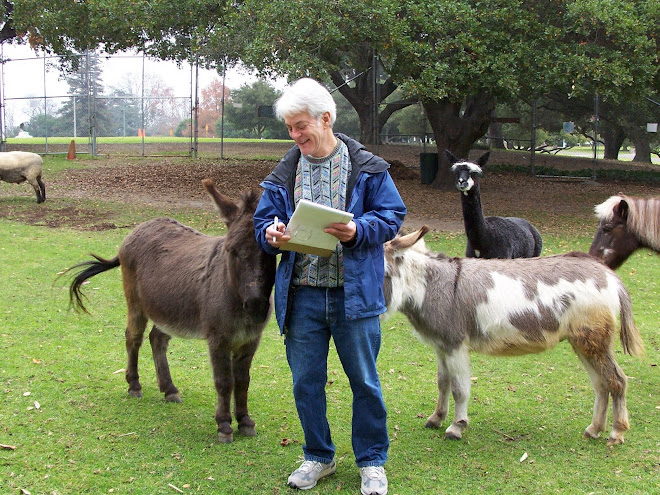
Interviewing the animals at Children's Fairyland in Oakland. L-R: Bobo the sheep, Gideon the miniature donkey, me, Tumbleweed Tommy the miniature donkey, Juan the alpaca, Coco the pony

Monday, June 22, 2009

Eat At Bill's


(Above: Judy and Bill Fujimoto)

One day many years ago, I was complaining to a friend that I would never buy another tomato again because I was tired of tomatoes that taste like soggy cardboard. And she replied, "Haven't you heard of the Monterey Market?"
Everybody in Berkeley has their own variation of this story. The Monterey Market was our introduction to seasonal, organic, locally grown fresh food.
It gave birth to a movement that changed the world. California cuisine, neighborhood farmer's markets and every natural food store, from Whole Foods to the Berkeley Bowl - all trace their origins back to the Monterey Market and the man who has run it for the past 31 years, Bill Fujimoto, one of the nicest guys on the planet.
There are two kinds of ways to run a business. One is the paranoid model, in which you do unto others before they do it to you. That means squeezing the highest price out of your customers and paying as little as possible to your suppliers and employees.
That wasn't Bill's style. He took the long view and insisted on paying his farmers a decent price for their produce, keeping them afloat financially until they could get their business on a firm footing.
And if they had more than he could sell, he'd buy their entire crop anyway and eat the loss himself.
"I want you to be in business next year," he'd explain.
He also paid his employees a living wage and kept his prices as low as possible, far less than you'd pay at the supermarket.
If a customer asked him if the pears were ripe, he'd whip out his knife, cut one in half, and say, "Why ask me? Here, have a taste."
Longtime customer Teresa Wong remembers one time when she was about to buy the most expensive peaches in the store.
"Bill came rushing up to me and said, 'No, no, no, Teresa! You don't want to get those! These over here are cheaper and are really good!'"
Among his most loyal customers are the Bay Area's finest restaurants, including Chez Panisse, Eccolo and Bay Wolf.
"We've been shopping at Monterey Market since we opened in 1975," says Bay Wolf co-owner Larry Goldman. "To have someone like Bill, who can talk with our chefs with the same knowledge and passion that they have for the produce and the growers, has been incredibly exciting."
It's been a win-win-win situation all around. Bill created a community between the people who produce food and the people who consume it. And in the process, he started a revolution.
But, unfortunately, this golden age is coming to an end. Monterey Market is a family business - it was founded by his mom and dad, Mary and Tom Fujimoto - and two weeks ago Bill was forced out in a coup d'etat.
Customers and growers are both outraged, and many are threatening boycott. But, characteristically, Bill is taking the high road.
"I'm a Buddhist," he says. "Nothing lasts forever."
There will be a community celebration from 2 to 5 p.m. on June 28 at King School Park, near the corner of Hopkins and Colusa, to honor Bill and his wife, Judy. Considering all they've done, both for Berkeley and the food community, it will be a privilege and pleasure to say thanks.

Sunday, June 21, 2009

Kittens By Rosie


(Above: Rosie cleaning one of her kittens)

Looking for the perfect kitten? (Or better yet, a pair of kittens?) Call Rosie the golden retriever.
Rosie, who is a little over a year and a half, raises homeless kittens for Island Cat Resources and Adoption in Alameda, California.
If she's in a calm mood, she'll lie down and let them climb all over her and play with her feet.
If she's in a playful mood, she'll gently roll them across the floor with her nose.
If they get too rambunctious and start nipping or scratching, she'll look up at her owner, Gail Churchill, with a look that says, "Mommy, help!" But she still lets them do it.
It all started a few months ago, when Churchill, who fosters homeless kittens for ICRA, had a litter that was so young, they had to be bottle-fed.
"Rosie was absolutely mesmerized and would sit by my lap while I was feeding them. As babies do, they got messy faces, and I knew mommy kitties clean their babies with their tongue. So I got the idea of holding the baby kitty up to Rosie, and she started cleaning its face.
"This went on for weeks. As they grew and started running around on the floor, she would corral them and keep them where I could see them. If one ever got out of my sight, I'd just go look for Rosie because I knew that's where the baby was."
Before embarking on her career as a kitten raiser, Rosie used to sleep every night right beside Churchill and her husband Jim's bed.
"But now she insists on sleeping in the kitchen, right beside the big kitty condo where the kittens sleep at night, so she can keep an eye on them."
Currently, Rosie is working on her third litter, with no end in sight.
"The number of homeless kittens is exploding this year, and the rate doesn't show any sign of slowing down," says Churchill. "I'm fostering 15 babies right now, and so are many of our other volunteers."
Some news reports say the problem is growing because cats are being abandoned by owners whose homes have been foreclosed, but Churchill says they're only a tiny fraction of the homeless cat population.
"We've seen a few abandoned pets showing up, but the kittens are coming from people not spaying or neutering their own pets or the strays showing up in their back yards."
ICRA has no shelter - which, paradoxically, is an advantage. All the kittens are raised in foster homes instead of shelter cages, so they get highly socialized.
Rosie's kittens are not only dog-friendly, they think of themselves as tiny golden retrievers and act accordingly. They do well in homes that already have a family dog.
Another ICRA volunteer, DeAnne Jarvis, has a very large male cat named Smokey Joe. Although he dislikes adult cats, he's crazy about kittens.
"She puts her kittens in the room with Smokey Joe, and they all nuzzle up and sleep with him, and he loves them and acts like an uncle kitty," says Churchill. "His kittens do great in homes that already have other cats."
Several ICRA foster homes have kids under 14, so their kittens fit right into homes with children.
ICRA exhibits cats and kittens ready for adoption every Saturday at Petco in Alameda from Noon to 4 p.m., as well as on its website, www.icraeastbay.org. Donations to ICRA can be mailed to P.O. Box 1093, Alameda CA 94501.
One of the reasons Rosie gets along so well with kittens is that she herself was raised by cats: the Churchill family felines Howdy, Jackie, Jenny, Yoshi and Jacques.
One day, when Rosie was four months old, Churchill came home and found her standing on top of the kitchen counter.
The look on her face said it all: "What's the problem? The cats do it, don’t they?"

Monday, June 15, 2009

Local Musicians Win Emmys


The Oakland-based musical duo popTuna walked away with two golden statuettes at the 38th annual Emmy Awards ceremony of the Northern California chapter of the National Academy of Television Arts and Sciences on May 16.
PopTuna - comprised of B.Z. Lewis of Montclair and Monica Pasqual of the Temescal district - won the Emmy for "Promotion Program - Single Spot" by providing the music for a promo spot for KPIX's "Eye On The Bay."
"There are two hosts on 'Eye On the Bay,' and they are very different personalities," said Lewis. "So we used the theme from 'The Odd Couple,' rearranged as a ska piece."
Pasqual said the victory was ironic because the piece isn't their favorite, to say the least.
"We have composed music that we're personally moved by, but that wasn't one of them. But that's the way it goes, I guess."
Their other Emmy was for "Promotion Program - Campaign," also for KPIX.
"In this series of spots, the station gets people to sing along with the music, usually making complete fools of themselves but always having a great time doing it," said Lewis. "Sounds silly, but it won the Emmy."
PopTuna was also nominated in three other categories, but did not win.
Lewis and Pasqual have been working together since 1997, when he was the engineer and co-producer for an album she was recording. But they didn't start composing together until two years later, when Pasqual was working as the office manager for a film company that was making a documentary for PBS about the stock market crash of 1929.
"They weren't happy with what their composer had written, so I said, 'Hey, I think this friend of mine and I can do better.' And we did."
And they've never looked back. In addition to KPIX, their clients include Nissan, the San Francisco Film Festival, the State of New Jersey Division of Tourism and Johns Hopkins University.
"We're their go-to composer for anything they produce in-house," said Pasqual.
They have also composed for MTV, "The Shield," and several TV soap operas, including "Passions" and "The Young And Restless," as well as video games such as "Guitar Hero," "The Sims" and "Madden NFL."
Currently, the new Emmys are resting on the place of honor atop the speakers at Lewis' Studio 132, where many local musicians record, including Liquid Girlfriend, Jesse Turner, Karen Mullally, Deborah Levoy and Frapper.
The glittering, black-tie Emmy Awards ceremony, featuring spotlights and a red carpet, was held at the Plaza Hotel in San Francisco.
Lewis accepted the Emmys on behalf of himself and Pasqual, who was unable to attend because she was on tour with her band, Blame Sally.
Lewis rented a tux for the occasion, accessorizing it with a bright red faux snakeskin shirt.
Most of the nominees arrived in limousines. Lewis took BART.

Saturday, June 13, 2009

Save Our Secretary!


(Above: Ms. Wendy)

At any successful school, there's usually one key person who really makes the place work. Often, it's the principal, but not always.
At Sequoia Elementary School in Oakland, it's the school secretary, Wendy Larson - or, as the kids call her, Ms. Wendy. She's a combination of Mother Teresa and Radar O'Reilly from M*A*S*H.
If you get a boo-boo on your knee, Ms. Wendy will clean it and put a Band-Aid on it. If you're hungry because you missed a meal, she'll feed you. If your parents are late picking you up after school, she'll let you stay in her office, even if you're there far later than 4 p.m., her official quitting time.
If there's a fight on the playground, she'll break it up and soothe the ruffled feathers. If you need to finish your homework, she'll let you do it in her office at recess or lunchtime.
When Principal Kyla Trammell is off campus to attend district-wide principals meetings, Ms. Wendy runs the show. In fact, when Trammell was out last fall on maternity leave, Ms. Wendy was the de facto principal.
The kids adore her, and the teachers consider her their most valuable asset.
So what is her reward for 24 years of such selfless, dedicated service?
She was just notified by the school district that, because of budget cuts, she's being bumped by someone with more seniority. She's being offered a three hour per day job at another school across town, with a lower pay rate and no benefits.
The kids are devastated, but they're not giving up without a fight.
They have launched a letter writing campaign to the school board to save their beloved Ms. Wendy.
"The soul of our school would be gone without her," wrote a 5th grader named Allison. "It would be like milk without cookies, or even peanut butter without jelly!"
"She isn't only a secretary; she's a friend," wrote a 4th grader named Kelly. "She makes us feel better when we're sad. She makes sure we take our pills if we have to. You can't take her away from us!"
Kristin, a 3rd grader, wrote, "One time when I was sick and I threw up in the hallway she helped me to the office and gave me some water and told me to lie down. She really helps us."
Perhaps most touching are the letters from the youngest kids, who illustrated their messages with their own drawings.
One little girl named Emma drew a picture of herself with tears running down her cheeks, and she's saying, "Please let her stay."
Another girl named Jemaya drew stick figures of herself and Ms. Wendy. Jemaya is saying, "Please don’t leave us," and Ms. Wendy is saying, "Don't worry, Sweety. I promise."
And there are 350 more letters just like them.
So will this story have a happy ending? Don't hold your breath. I talked with Gary Yee, who represents that area on the school board, and he's a fan of Ms. Wendy, too. But he says nothing can be done; it's all in the union contract.
When I was these kids' age, I was taught that for every wrong, there's a solution if you work hard and play by the rules.
It saddens me that they are about to find out it's not true.

Sunday, June 7, 2009

The Ultimate Dead Concert


(Above: A hallway at the Chapel of the Chimes)

June 21 is not only Father's Day, it's also the Summer Solstice, the longest day of the year.
And that means it's time again for the coolest, hippest, most unusual musical event of the year - the annual Garden of Memory concert at the Chapel of the Chimes in North Oakland.
Actually, it's 35 different concerts all going on at the same time. The idea is to take in as much as you like of each performance, then move on to the next room, where a completely different performance is going on.
The lineup includes some of the most innovative musicians in the Bay Area, including professional whistler Jason Serinus (aka "The Pavarotti of Pucker"), who will be whistling Mozart arias and Schubert lieder.
Nearby, the Orchestra Nostalgico will be playing music from old Fellini films, "The Godfather," "Psycho" and the James Bond movies.
Meanwhile, composer Larnie Fox will turn people into musical instruments, stretching nylon strings between them and plucking the strings, with rhythmic accompaniment by knitters with microphones attached to their knitting needles.
The women's vocal ensemble Kitka will perform Balkan folk songs and an original piece called "The Origin," with words from the writings of Charles Darwin.
Pianist Sarah Cahill will play a composition by Dane Rudhyar, who is better known as Elvis Presley's astrologer. (He also designed the white sequined cape-and-collar jumpsuit that Elvis wore during his Vegas gigs, but that's another story.)
And while all this is going on, composers/sound artists Thomas Dimuzio and Wobbly will visit other performers in different spaces and record them, then go back to their own space and mix them together to create a sound collage.
Does all this strike you as more than a little whimsical? It is. These are serious musicians at play - which, paradoxically, is when they do some of their most creative work.
They're playing for the sheer fun of it - for their own amusement and others'. That's why they're keeping the price as low as possible - $15 general, $10 for students and seniors.
And just as wild and crazy as the music is the setting - a columbarium, a repository for the ashes of the dead.
But the Chapel of the Chimes is not just any columbarium. It was designed by the great architect Julia Morgan, and she pulled out all the stops: gardens, fountains, cloisters, chapels, nooks and alcoves, all rising into magnificent Gothic ceilings.
But her trademark was stained glass, and it's everywhere - not only in the windows, but in the skylights, too. The whole place shimmers with a constantly changing ballet of light.
That's why the concert is always on the Summer Solstice - to take advantage of the extra light.
It might seem strange to you to have such a whimsical event in a columbarium, but it didn't seem strange to our ancestors, who weren't as freaked out by death as we are.
Keeping in their spirit, composer Gregory Moore will perform right beside the urns containing the ashes of his great-grandparents, Frank and Ollie Kellogg.
The Chapel of the Chimes is at 4499 Piedmont Avenue, next to Mountain View Cemetery. The music starts at 5 p.m. and lasts until the light runs out - usually around 9.
See you there.

Tuesday, June 2, 2009

A long life well lived

(Above: Hillside Club Poster by David Lance Goines)


Berkeley lost its oldest resident, and the historic Hillside Club lost its longest-serving member, when Marjorie Robinson died April 25 at her home on Fresno Street, where she lived for the last 70 years. She was exactly 104 ½ years old.
I had the pleasure of meeting her at her birthday party last Oct. 25 at the Hillside Club, and it was like a guided tour through local history.
Think what this area was like when she was growing up: no Bay Bridge and no Golden Gate Bridge. And everything north of Berkeley was nothing but farmland.
She graduated from Berkeley High in 1923, and it was a very different place.
"When young men got in trouble, the principal used to put them in a barrel and roll it down the stairs for punishment. You couldn't get away with that today."
But the most memorable event of her youth was the 1923 Berkeley Hills fire, which destroyed nearly 600 homes, including the house next door to hers.
"My mother and I had gone to Oakland to do a little shopping. We were coming home on the Grove Street streetcar and suddenly saw hundreds of cars coming the other way. Nearly all the hills were on fire."
When they got to Grove Street - now known as Martin Luther King Jr. Way - and University Avenue, the conductor suddenly announced, "This is far as we go," and her mother told her, "You go ahead and save what you can; I'll try to catch up with you later."
She dashed up Shattuck Avenue, circling around the police barriers until she got to Cedar Street, a block away from her home.
"A policeman was holding people back, so when he turned the other way I ducked under the rope and ran to our house."
When she got there, it was full of looters.
"People were ransacking the place, helping themselves to things like my parents' crystal decanters. They were piling stuff on a tablecloth on the dining room table, getting ready to take everything away.
"One man came up to me, thinking I was another looter, and handed me one of my father's old shoes filled with my mother's jewelry. He said, 'Here. There's enough for everybody.'
"I yelled, 'This is my home!' at the top of my lungs. And for some reason, it worked. They dropped everything and ran away."
That night, a new hazard appeared: Hundreds of rubber-neckers, who had come from as far away as Marin County to view the fire.
"The problem was that they were driving over the fire hoses, cutting the water off. So a firemen said to me, 'Stand here in the middle of the street and don't let anyone run over the hoses.' I stood there all night until 5 a.m., when the National Guard arrived and told me, 'We'll take over now.'"
But there was much more to her life, including two husbands, two children, 10 grandchildren and 19 great-grandchildren.
She was active in the First Congregational Church of Berkeley, which she joined in 1939. She was also president of the Athene of California, Northbrae Women’s Club, Alameda District Federation of Women’s Clubs and - at age 99 - Chapter LG of the PEO Sisterhood, one of the pioneer societies for women.
Hers was a long life, well lived. And a lot of people miss her already.

Friday, May 22, 2009

Mrs. Dittmer's Summer Reading List


(Above: Mrs. Dittmer)

Of all the columns I write each year, none is anticipated so eagerly by my readers as the annual Mrs. Dittmer's Summer Reading List.
Mrs. Dittmer is Helen Dittmer, the librarian at Redwood Day School in Oakland.
For two decades, she has made a more profound difference in many people's lives than any other teacher they ever had, including high school, college and grad school.
Many of them still go back to her for help with their research assignments, long after they graduated from Redwood.
She tries to know each child personally, so she can recommend books they'll like. And, when necessary, she'll also recommend a book they need.
For instance, if your parents are getting divorced, she might recommend "Charlotte's Web," so you'll learn that people don't stop loving you just because you're separated from them.
If it's your first day of school and you're worried about making friends, she might suggest "Amos and Boris" by William Steig, about a mouse and a whale who become close friends despite their obvious differences.
When Mrs. Dittmer reads aloud to the kids you can hear a pin drop. They hang on every word - partly because she chooses great stories, but also because she acts out all the characters in their own voices.
Elise Gonzalez, now a junior in college, remembers how her parents would drop her off an hour before school started, as many working parents have to do. She'd make a beeline for the library, along with about a dozen other kids in the same situation.
"Mrs. Dittmer would hand out knitting needles, and all of us – boys as well as girls – would sit around her on the floor, knitting away, while she read to us," she said. "It was a really fun way to start the day."
I've talked to many, many Redwood grads, and they all told me the same thing: They all carry a book with them wherever they go, they all read like crazy, and they all say it's due to Mrs. Dittmer.
All of them are happy that I'm writing this column. More than one said, "She's so modest, it's about time she got some recognition."
In fact, there's only one person who isn't thrilled – Mrs. Dittmer, of course.
One day, I stumbled on something about her that 99 percent of the people at Redwood don't know: She has a PhD in Russian history.
I called her up and said, "Mrs. Dittmer, you've been holding out on me. You have a PhD."
"Do you have to print that?" she said. "I don't want this to be about me; I want it to be about the school."
That's Mrs. Dittmer in a nutshell.
But she would be the first to say that even the best stories have to come to an end, and it's my sad duty to report that she is retiring. Typically, she's already been training her successor.
"Redwood will get along just fine without me," she says, but the truth is that she is irreplaceable.
But she's left us with one final summer reading list, and it's her best yet.
And here it is:

Kindergarten:

"Yoko Writes Her Name" by Rosemary Wells
When Yoko entered kindergarten she knew how to write her name in Japanese but not in English. Two students teased her and warned that she’d never graduate from kindergarten at that rate. Yoko felt such a failure that she hid under the tale. Her classmate, Angela, found her and wanted to learn how to write his name in Japanese. If she would teach him Japanese characters he would teach her English letters. From that moment on, Yoko gained confidence and found her place in the class.

"One" by Kathryn Otoshi
In this title, Otoshi takes aim at the subject of bullying, using colors as characters. Blue was a quiet color and he had friends: yellow, who was sunny; green, who was bright; and so on. But red always picked on blue and made him miserable. Red bullied the other colors into silence, which made things worse. Finally one day the number one appeared and stood up for blue, which gave courage to the other colors to do the same, and at that moment the atmosphere for everyone improved one hundred per cent.

First Grade:

"Willow" by Denise Brennan-Nelson and Rosemarie Brennan
Young Willow goes to her art class and encounters a teacher who believes that she alone knows the right way to draw and the students must emulate her. The students follow directions and they all produce the same tree - all except Willow, who creates a tree as she imagines it. The class paints an apple and again everyone’s apples are the same except for Willow’s, for she imagines a blue apple. A clash of personalities between student and her teacher is inevitable.

"Bugs In My Hair" by Catherine Stier
Here’s perfectly groomed Ellie, who goes to the school office to talk to the nurse about her itchy hair and finds to her horror that she has head lice. How awful! How humiliating! How shameful! But Ellie and her mother become much calmer and smarter as they learn about lice and the methods for dealing with them. The author offers humor and information to deal with what could be an embarrassing situation.

2nd Grade

"Library Lion" by Michelle Knudsen
When a lion enters the local public library no one knows what to do. There seem to be no rules excluding the lion, and he was actually on his best behavior. He particularly enjoyed story hour, and once he understood the rules the lion helped the librarian. He dusted, he licked envelopes for the mail room, and when an accident occurred he became a library hero!

"Planting the Trees of Kenya: The Story of Wangari Maathai" by Claire A. Nivola
Wangari Maathai grew up in the highlands of Kenya, where she developed a love and respect for the beautiful land she called home. When Maathai finished her education in America, she returned to Kenya and found that the landscape had been transformed. The hills were dry, streams no longer flowed with water and fish, trees had been chopped down and the individual farmily farms that had sustained the people were gradually disappearing. replaced by corporate farms that produced goods for export. Wangari set out to restore an environment that could feed the population.

3rd Grade:

"Crossing Bok Chitto: A Choctaw Tale of Friendship and Freedom" by Tim Tingle
Back in he 1830s, a young Choctaw girl does the forbidden - she crosses the river Bok Chitto from Choctow territory onto slave land to find blackberries for her mother’s cooking. She finds the berries but gets lost on her way home. She wanders onto the slave plantation, where she encounters a church service and then a man who has his grandson, little Mo, take her back to the river. But the boy is worried. Slave owners have threatened to punish all the family of anyone who is seen near the river. The grandfather says, "there is a way to move amongst them where they won’t even notice you: You move not too fast and not too slow, eyes to the ground, away you go.“ This is the beginning of a story of friendship and of freedom.

"Ivy And Bean" by Annie Barrows
This is the first of a delightful series (five books have been published thus far) about Ivy, who moves in across the street from fun-loving, mischievous Bean. Bean knows she’ll never be friends with quiet, bookish Ivy; but of course you know about how first impressions can be misleading, and in this book they definitely are. Bean gets herself into a “situation,” and Ivy comes to her aid, and soon Bean discovers that far from being dull, Ivy, the reserved shy girl wants to become a witch. And this is only the beginning.

4th grade:

"How To Steal A Dog" by Barbara O’Connor
Georgina Haynes faces a dismal family situation. Her father left home, and the remaining family members - mother, brother and Georgina - have been evicted and are living in the family car. Georgina is desperate to help her mother and decides the way out is to steal a rich person’s dog and then collect the money when a reward is offered. But our heroine is confronted with the fact that all her planning has been a waste of time. The dog’s owner, who she thought looked wealthy, has no money!

"Each Little Bird That Sings" by Deborah Wildes
Meet ten-year-old Comfort Snowberger and her family. The Snowbergers have owned the funeral parlor in their town for decades, and Comfort has attended 246 funerals. She works with her brother Tidings, her dog Dismay and her parents to make funerals both dignified and beautiful for the community. But she runs into a major challenge when her cousin, Peach, who is afraid of death (and all too ready to express his feelings in public) ruins Great Aunt Florentine’s funeral as well as Comfort's friendship with her friend, Declaration. This is a story about how messy life can be and how the Snowbergers accept the mess with understanding and love.

5th grade:

"We Are The Shop: The Story or Negro League Baseball" by Kadir Nelson
Kadir has brought together in this book the history of and the heroes of Negro League Baseball. Once the sport was developed in the late nineteenth century, it quickly gained nation-wide popularity. Though African Americans were excluded from the major leagues, Rube Foster - along with many players - created their own league. Kadir describes the conditions players in the Negro League faced: the inadequate equipment, the terrible umpires and rampant segregation. Despite constant hardships and harassment, fabulous baseball emerged, led by players like Josh Gibson, Grant “Home Run” Johnson and William Julius “Judy” Johnson.

"Emmy and The Incredible Shrinking Rat" by Lynne Jonell
Emmy is a good girl with a big problem. She’s working hard in school to get A’s, she eats her vegetables and does all the chores her tyrannical nanny assigns her. She hopes in this way to please her parents, who are always traveling and barely notice her when they are at home. None of these maneuvers seem to have any effect and at school the way the teacher acts and the way students treat her, she might as well be invisible. What is happening? What has she done wrong?

6th grade:

"The Road to Paris" by Nikki Grimes
Beautifully written, this book describes the plight of a young African American girl named Paris and her older brother, Malcolm, who are abandoned by their mother. The children are first put in foster care with the Boone family, where they are mistreated and finally run away. Family Protective Services then splits the pair up, with Paris going to the Lincoln family and Malcolm going who knows where. Paris isn’t told. The Lincoln family turns out to be a blessing. They are kind and thoughtful, they know how to give Paris space for herself, and they nurture her. Even the two Lincoln boys take to her. But just as Paris becomes comfortable, her birth mother returns to claim her.

"Emma Lazarus Fell Out Of A Tree" by Lauren Tarshis
Emma Jean is a smart 7th grader who tries to be a rational thinker while her classmates act illogically and emotionally. Students are often mean and tease one another for no reason, so Emma prefers to keep her distance. But one day she heads for the girls bathroom and finds a classmate, Colleen, sobbing into the sink. And why is she crying? Her best friend has ignored Colleen and invited another seventh grader to go skiing with her. Emma Jean wants to help Colleen and so she gets involved, a most irrational decision on her part.

7th Grade:

"Graveyard Book" by Neil Gaiman
Imagine a family of four sitting comfortably at home when suddenly a man, “Jack” invades the premises, kills both parents and the seven-year old child. The three-year-old boy manages to escape. He heads for a nearby cemetery and is discovered by the Owen family, two ghosts who are buried there. They and the rest of the ghost community decide to raise the boy and give him the name, “Nobody Owen” - Bod for short. Bod manages to acquire some ghostly talents. He ventures beyond the cemetery to see what life in the outside world is like - not a good idea, for he is ill equipped to deal with the real world. Meanwhile, in the background is “Jack,” the man who murdered his family and is still determined to kill him.

"Ties That Bind, Ties That Break: A Novel" by Lensie Namioka
The time is 1911; the place is China. The main character, Ailin, is about to marry the son of an upper class family, but she protests loudly and vigorously about having her feet bound, a common tradition for the Chinese elite but one that seems brutal and senseless to Ailin. So Ailin loses her chance at this marriage because of her obstinacy, and her family warns her that she has ruined her life and caused them shame beyond repair.

8th grade:

"Trouble" by Gary Scmidt,
In this novel, a young teenager (perhaps 14-years-old) deals with loss, grief and prejudice. Henry Smith, had a father who always said, “If you build your house far enough away from trouble, then trouble will never find you.” This book is proof that the adage is wrong. Henry and his older brother, Franklin, are students at a very upscale private school and seem safe from the insecurities that hover over most of us. One night, Franklin was riding with friends in a car when Chay Choun, a Cambodian immigrant, hits Franklin's car and leaves him hospitalized in critical condition. The Smith family is in shock, the town is infuriated and uses the accident to attack the Cambodian community. How can Henry handle his grief? How can Chay Choun deal with his guilt?

"The Boy In the Striped Pajamas" by John Boyne
Nine-year-old Bruno and his family lived in Berlin until 1941, when his father was appointed commandant at a place Bruno calls “outwith.” (Auschwitz). The famly moves from an elegant place in Berlin to a smaller and more ordinary house in “outwith,” and the children (Bruno has a sister) get no explanation of where they’re going. There is a barbed wire fence separating the family home from a bleak area filled with ramshackle huts, and smoke stacks and thousands of people wearing striped pajamas. Bruno wants to go and explore, but his parents have made it clear that such activity is forbidden. But what’s a nine-year-old to do for adventure? He goes exploring anyway.

Thank you, Mrs. Dittmer.