A columnist of heart and mind

A columnist of heart and mind
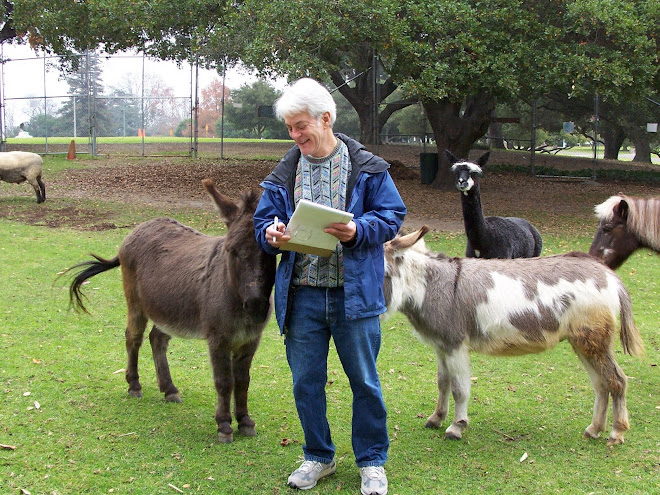
Interviewing the animals at Children's Fairyland in Oakland. L-R: Bobo the sheep, Gideon the miniature donkey, me, Tumbleweed Tommy the miniature donkey, Juan the alpaca, Coco the pony

Sunday, March 15, 2015

Vetter Was Right

(Above: Karl Marlantes speaking at our last reunion)

I stopped by the Musical Offering Café in Berkeley last week to have one of their great Caesar salads, and who did I run into? My favorite teacher.
His name is Jan Vetter, and he's the professor at UC Berkeley's law school – which we old-timers stubbornly persist in calling Boalt Hall – who gave me the lowest grade I ever got (thoroughly justified, of course).
It was in his Labor Law course. The grade was so low, he was obligated to write an explanation. And this is what he wrote:
"Mr. Snapp demonstrates a remarkable command of legal rules and principles. Unfortunately, they are not rules and principles that are recognized by any jurisdiction of which I am aware."
Oops! Busted!
Professor Vetter was the smartest professor on the faculty, and that's saying a lot because law school professors are really, really smart.
He was also the nicest. And, as you can see above, the funniest. Those of us in the know made it a point to sit in the front row to catch the witty asides he muttered under his breath.
It's also because of him that I wasn't thrown out of school. During the Vietnam War I was hauled before the UC Berkeley Executive Committee for violating the University's time, place and manner regulations at a stop-the-draft demonstration.
Translation: I was in the lobby of Sproul Hall during a sit-in, leading the crowd in singing "Yellow Submarine."
But they didn't throw me out, thanks to Professor Vetter's expert lawyering.
Afterward, I thanked him for getting me off the hook.
"You're welcome," he said, "but I think you're on the wrong track about abolishing the draft. I understand what you're doing: You're using the draft as a club to beat the war over the head with. But I don't think you've thought through the long-term implications."
That was almost 50 years ago. And I've long since come to the conclusion that Professor Vetter was right, and I was wrong.
Look what has happened since the draft was abolished. Far from making war less likely, we've had decade after decade of almost non-stop fighting.
And the burden has been borne by only one percent of the population. For the other 99 percent, it's been business as usual. The pain never touches them, so why should they care?
It's not only unfair; it's undemocratic. One advantage of a draft is that it throws young people from all races, regions and regions together. And they have to learn to work together or they'll all get killed. That tends to broaden the mind.
And the greater the mobility between the civilian world and the military, the more each side is likely to understand the other, which is one of the reasons why we've never had a military coup in this country.
 Finally, as my college classmate Karl Marlantes, who wrote an award-winning novel called "Matternorn," about his experiences as a Marine lieutenant in Vietnam, pointed out at our last reunion, the last 20 years of non-stop war have been brought to us by presidents with no military experience who constantly defer to the top brass.
"We need people in the White House who have served in uniform," he said, "if only because they know enough to say '(bleep) you' to the generals."

Sunday, March 8, 2015

Calming The Savage Breast

(Audrey playing Mozart’s Piano Concerto No. 17 at the 2013 Midsummer Mozart Festival at the Legion of Honor in San Francisco. Photo by Meina Xu)

Audrey Vardanega of Oakland, the sensational 19-year-old concert pianist who has been captivating music critics, other musicians, and even grumpy old newspaper columnists ever since her smashing debut at the Midsummer Mozart Festival at age 14 – the youngest soloist, by far, in the festival's 41-year history – will return to the Bay Area from New York, where she is a sophomore at Columbia, for a concert at the Hillside Club in Berkeley on March 15.
She will play Beethoven's "Tempest" Sonata, Liszt's "Valee O'Oberman," and Schumann's Symphonic Etudes.
"I guess for me, the most inspiring thing about the program is that all three composers were emotional wrecks," she says. "For example, the Beethoven piece is called 'The Tempest' because it's constantly changing. It starts with a storm, followed by a very sweet section. It's completely bipolar, just like Beethoven himself.
"Then we go on to the Liszt, which is about another emotional crisis. It's based on a German novel that was very popular in the 19th Century. The hero is stuck in a valley in the Swiss Alps, all by himself, and he doesn't know how to get out. He's having an existential crisis. As a Columbia student in my second year, still trying to decide what my major is, this is definitely a piece I can relate to!"
Finally, there's the Schuman etudes, a 30-minute-long set of variations on a theme.
"Schuman went crazy," she says. "It's very awkward to play, with chords spread out all over the place. You have to contort your hands to fit them. He doesn't make it easy.
"It's especially hard for me because I have small hands. My maximum reach is a ninth. He'll insert a fourth way below or add a third three octaves above."
But even more difficult is the basic paradox at the core of the piece.
"The bones are a simple pastoral melody, but it's very easy for a pianist to get caught up in all that jumping around and lose sight of that. It's hard to balance the physicality of it – a reflection of Schumann's own craziness and obsession with getting beyond the limits of what the hand can do – with the basic simplicity and lyricism of what he's trying to express.
"And that's the theme of the entire program: what I can physically do and what I'm trying to express."
But if all this makes it sound like Audrey's life is filled with sturm und drang, it's anything but.
To the contrary, she's having the time of her life soaking up knowledge and new experiences like a sponge, from reading Hegel, Hume and St. Augustine in her political science courses to hanging out in jazz clubs with her friends, many of whom are jazz musicians.
"I'm learning to embrace change and see it as growth," she says. "Look at my teacher, Seymour Lipkin. He's 80 years old, and he's still reinventing himself! I want to be like that. I'm embracing the fact that I'll probably look back in two years and say, 'Was I a horrible pianist!'"
The concert starts at 7 p.m. The Hillside Club is at 2286 Cedar Street in north Berkeley. Tickets are available at the door, and I'd get there a half-hour early to get a good parking space on the street.

Sunday, March 1, 2015

Tiny Trotters


(Fairyland animal caretaker Jamie Hammer introduces the park’s new miniature horses to young Adrian, 4, and his family. Photo by Maria Rodriguez.)

Almost all the animals at Children's Fairyland in Oakland live well beyond their normal life expectancy because of the TLC they receive. But there comes a time when they get too old or too frail to play with kids anymore, so they're eased into a luxurious retirement.
For Coco the pony and Bobo the sheep, that time came seven years ago when Coco developed arthritis. And when she retired, Bobo had to retire, too, because he was blind and totally dependent on her.
Fortunately, they found the ideal home at a way cool ranch in Orinda called Goats R Us. (It hires out goats to public agencies and private property owners to remove unwanted undergrowth and undesirable plant species.) And they lived there happily for the rest of their lives. 
Coco's successor was a pony named Dori, and Bobo was succeeded by two sheep named Oatmeal and Raisin. Over the last seven years Dori has been petted by more than a million children, but for the last few months it's been apparent that her time to retire had come, too.
So last Thursday Fairyland's animal caretaker, Jamie Hammer, drove her to Goats R Us. As they got close they could hear the horses in the stable whinnying. They were calling to Dori, who was whinnying right back.
As soon as Hammer let her out of her trailer she pranced over to the stable, head and tail held high, whinnying all the way. Once inside the stable she moved from stall to stall, nuzzling noses with each horse in turn. When she got to her stall, there was a bag of alfalfa – her favorite munchie – waiting for her.
I guess you could say her retirement is a success.
Meanwhile, back at Fairyland, Dori's successors arrived the next day.
They are two miniature horses named Pixie and Scamp, and I'm not kidding about the miniature part. They're no bigger than a Saint Bernard.
"They're Fairyland-sized!" exclaimed Fairyland's executive director, C.J. Hirschfield, when she saw them.
They are sweet as can be and terrific with kids, especially Pixie, who used to be a therapy horse. She runs right up to the fence when she sees them and nuzzles noses with them.
This is also going to be great news for Chiquita the miniature donkey. She has her own companion, another miniature donkey named Gideon. But she's only five, and he's a staid 27, and he's too old to play the games she loves, like kicking up her heels and running and playing chase.
But Pixie loves exactly that sort of thing, so everyone is excited to see how they react to each other when they meet sometime next week. (Hammer is sensibly breaking the newcomers in gradually to their new surroundings over the next few weeks.)
Providing medical care for the animals is part of Fairyland's budget, but there's always the occasional emergency that can't be foreseen, such as the time last summer when Oatmeal and Raisin got hold of some acorns, which are toxic for sheep, and had to be rushed to U.C. Davis.
So Fairyland is establishing a rainy day fund to cover such emergencies. If you'd like to contribute, visit fairyland.org or send a check to Children's Fairyland, 699 Bellevue Ave., Oakland 94610, with "Animal Fund" on the subject line.

Tuesday, February 24, 2015

Penny Wise, Pound Foolish

                                         (Photo by Uriah Duffy)

Some of the best news to come out of Oakland lately has been the city's emergence – especially in the Uptown and Koreatown/Northgate (KONO) districts - as the hub of the East Bay art scene. And the hallmark of that emergence has been the monthly Oakland First Fridays street festival that drew over 150,000 people last year.
But First Fridays has hit hard times after recent rainouts. So to save money, KONO Community Benefit District, which owns the festival, told the Oakland Tribune that it has ended its contract with the woman who ran the show for the past year, professional event producer Sarah Kidder, and will go back to using volunteers.
This is causing consternation among First Fridays' participants, who say Kidder was the key factor who made the whole thing work.
"We got our start at First Fridays, and I've been a big fan of the event for years," says James Whitehead, owner of Fist Of Flour Pizza Co, a mobile pizza kitchen. "But there were too many people who didn't know how to manage trying to manage it, and it was getting crazy. So we bailed out on it.
"Then, in March of 2014, I got a call from another former vendor who said, 'Hey man, you should come back. There's somebody organizing it who really knows what she's doing.' So we did. Sarah spent a lot of effort organizing something that really didn't have much structure, and we're all wondering what's going to happen now."
Painter Erin Crawford adds, "Before Sarah, you had to get there as early as possible and claim your spot, and then fight to keep it. But she set up a system where I can go online, pay for my spot, know exactly where it's going to be, and I won't have to fight for it when I get there.
"But the biggest difference is that I didn't feel safe before. As a vendor, you feel very vulnerable, especially at night when the festival is over. After Sarah took over there was much more security present, and security actually came by throughout the evening. Sarah herself would walk up and down the street checking in with us, asking how we were doing and what could be improved upon. I felt like I had a voice with her."
"Before every event we would meet and discuss any issues that were anticipated," says Lieutenant Christopher Bolton, Oakland Police Department commander at First Fridays. "Even more importantly, after every event we had a discussion about how things could be better. It's a good example of what community policing should be."
"We didn't go to her; she came to us," adds Captain Howard Holt of the Oakland Fire Department. "And she came with a detailed plan and made it work for all of us. She showed a lot of leadership out there."
I'm not worried about Kidder. With many events to her credit, including working on Mayor Libby Schaaf's inauguration festival, I'm sure she'll land on her feet.
I wish the same thing for First Fridays, too, but artist Tony B. Conscious – aka The Ghetto Van Gogh – is skeptical.
"It was chaos before Sarah," he says. "She organized the structure and created the environment for us to really succeed. I don't know anyone else who can do that."

Sunday, February 15, 2015

Reading For Fun

(Above: Two Glenview students reading at last year's Read-A-Thon inside a "fort" they made out of blankets and chairs.)

While you're reading this, students at Glenview Elementary School in Oakland are fanning out through the Glenview neighborhood and knocking on doors.
The kids are vowing to read 30 minutes a day, over and above their regular homework, for the next two weeks and asking the neighbors to sponsor them by donating to the Glenview PTA.
And the money is badly needed. There once was a time, back in the 1950s, when California's schools were the envy of the nation.
Then came Prop. 13, and people started thinking, "Who cares? They're not my kids." State and municipal governments slashed funding for public schools, and the voters routinely turned down tax hikes for education.
Today, California students score 47th in the nation in both math and reading. And it's even scarier in other subjects.
So each school is left to scramble for itself to make up the gap.  At Glenview, the money raised by this annual fund-raiser – dubbed the Read-A-Thon – will be used to fund science, technology, music, drama and arts programs.
When I was these kids' age, such programs were deemed essential. But they wouldn't exist at Glenview nowadays without the Read-A-Thon.
I really admire the parents in the Glenview PTA who put so much effort into this fund-raiser every year, but I can't help asking: Why should they have to? Why are these enrichment programs not a matter of right for every kid, without their having to go out and beg for them?
And what about schools that are poorer than Glenview, where the parents are already working two jobs and don't have the time to raise money for their PTA?
But for now it is what it is, and the parents at Glenview should be commended for making the best of a bad situation.
They spare no pains to make the fund-raising fun and safe for the kids, who are only allowed to knock on doors of people they know personally. And they must be accompanied by an adult they know personally.
At the end of the two weeks, on March 6, they'll be rewarded by a all-day party at school, when they will be allowed to do nothing but read, read, read for pleasure to their little hearts' content.
As added incentive, principal Chelsea Toller has promised to let them watch while she kisses a snake – Eeee-uwww! – if they raise $65,000.
And teacher John Miller has promised his third-graders that if 100 percent of them log a half-hour of reading every night, he'll let them watch while he gets his head shaved.
If you'd like to support the Read-A-Thon, you can do it online at glenviewelementary.org or by sending a check made out to "Glenview PTA" to Glenview Elementary School, 4215 La Cresta Ave., Oakland CA 94602.
Some Oakland firefighters, student athletes from Cal, and local writers (including me) will be on hand to read to the kids; and we get to choose what we read.
I'm going to reprise my triumph from 2014, when I read a book by children's author/illustrator David Macauley, whose specialty is explaining the way things work. Some of his best-known works are "Castle," "Cathedral," "Pyramid" and "Ship."
So last year I announced that I was going to read them his latest book: "Toilet."
The kids went wild.

Sunday, February 8, 2015

X's and O's


The oldest maxim of the theater is: The show must go on.
But not at the February 1 performance of "X's and O's (An American Love Story)," a smart, sad, funny and ultimately very moving play about pro football now playing at Berkeley Rep, when the opening curtain was delayed for several minutes.
Reason: The audience was still in the bar, eyes glued to the final minutes of the Super Bowl on TV. The cast was watching, too, huddled around a tiny television set backstage.
"Three minutes after the game was over, we were onstage," says actress/playwright Jenny Mercein, who created "X's and O's" with her fellow actress/playwright, KJ Sanchez. "The show had wonderful energy that night."
On one level, "X's and O's" is an epic history of football, from the very first game, Princeton vs. Rutgers in 1869, to today's mounting concerns about brain damage.
On another level, it's the very personal story of what it's like to find something (or someone) you really love and then lose it  - or him.
"X's and O's" uses almost verbatim dialog from interviews Sanchez and Mercein conducted with more than 50 former NFL players, including Mercein's own father, running back Chuck Mercein, who played from 1965 to 1971 for the Giants, Packers and Jets. When he heard she was planning this project, he said, "Sounds like a great idea. I want nothing to do with it."
"He was saddened by a Packers reunion he'd attended," she explains. "He was expecting it to be reminiscing about old times, but it turned out to be about people who were sick or suffering or had died."
But he eventually came around, and so did many others.
"Being his daughter definitely opened doors for me," she says. "All I had to say was 'My father played for Vince Lombardi.'"
Lending first-hand expertise to the production is one of the actors – Dwight Hicks, the four-time Pro Bowl safety who played a key role in the 49ers' first two Super Bowl victories.
Unlike many players, who feel lost after their playing days are over, Hicks hit the ground running and built a second career as a character actor on more TV shows than I can count, including "ER," "Castle," "How I Met Your Mother" and "The X-Files."
"A lot of guys I played with defined themselves by what they did," he says. "I never defined myself as a football player. My mother taught me that. I just found another passion."
They both say football and the theater have a lot in common, especially a dedication to your craft - but with one big difference.
"I was taking an acting class where they were teaching us the Alexander Technique, a spinal tension release," says Mercein. "I burst into tears and said, 'My father played for Vince Lombardi! Just tell me what to do, and I'll do it!' But that's not the way it works in the theater."
"There's no winner or loser in the theater, either," Hicks added.
So what does Mercein's dad think of the play?
"He hasn't seen it yet! He just had double knee replacement surgery, so he won't see it until the final week. But my mom saw it, and she loved it."
I saw it last Sunday, and I loved it, too.

JazzGirls!

                                (Photo by Sibila Savage)

Hey, jazz girls!
Tired of being one of the only girls in your band?
Tired of the boys hogging all the solos?
Thinking about joining a jazz group, but feeling shy?
Have I got an event for you! And it's free!
It's the fourth annual JazzGirls Day at Berkeley High, featuring a Who's Who of local female jazz musicians, including trumpeter Ellen Seeling, director of the Montclair Women's Big Band; saxophonist/drummer Jean Fineberg, the band's co-director; and trombonist Sara Cline, director of Berkeley High's award-winning student jazz program.
"We'll play some tunes, have a jam session, break up into groups by instrument and talk about our experiences as women and girls in the jazz world," says Cline. "Bring all your friends, even if they don’t play jazz yet!"
JazzGirls Day will be held on Saturday, March 7. (They usually hold it on March 8, International Women's Day, but that falls on a Sunday this year.) Space is limited, so I advise registering as soon as possible at bhsjazz.org/jazzgirls-day/
This event has become a bigger hit every year since it was founded, inspiring similar events - also free - in Seattle, New York and San Francisco.
The San Francisco event will be held on Saturday, March 28, at SFJAZZ Center's Joe Henderson Lab, 201 Franklin Street (at Fell). Once again, space is limited, so register ASAP at sfjazz.org/jazzgirlsday/
But wait! There's more! If one day sounds like fun, how about a whole week?
The same people behind JazzGirls Day are also offering a weeklong jazz and blues camp for women from March 23-27 at the JazzSchool in Berkeley, a short walk from both Berkeley High and the downtown Berkeley BART station.
The sessions include a blues & soul band, Latin ensemble, roots music choir, percussion, theory and improvisation, and two new additions this year: a Beatles choir and a New Orleans ensemble, as well as individual one-on-one consultations.
But for my money, the highlight of each day is the lunchtime jam session in the JazzSchool courtyard, where students and teachers play together.
Finally, on Friday, the campers will perform a free public concert in which they invariably amaze themselves by how far they've come so quickly.
"I learned more in one week than I did in two years!" an attendee at last year's camp told me.
This one will cost money - $475, although some financial aid is available – and a week out of your life, so I'm letting you know early so you can plan your vacation time accordingly.
For more information visit cjc.edu/womenscamp or call 510-758-2200. To register, visit cjc.edu/womens reg or call 510-845-5573.
There will also be a jazz & blues camp for girls this summer, but there isn't enough space to tell you about it now. I'll let you know more as the time approaches.
And it would take a dozen columns to express my admiration for Seeling, Fineberg, Cline and all their friends. Like too much of our society, jazz has been a man's world that's awfully hard for women to crack.
But these women – great musicians all - are empowering other women and girls to play the music that I consider America's greatest cultural contribution to the world.