A columnist of heart and mind

A columnist of heart and mind
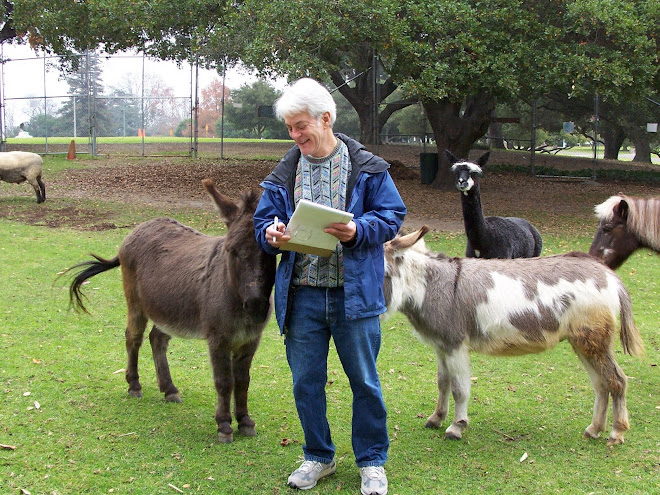
Interviewing the animals at Children's Fairyland in Oakland. L-R: Bobo the sheep, Gideon the miniature donkey, me, Tumbleweed Tommy the miniature donkey, Juan the alpaca, Coco the pony

Tuesday, November 8, 2011

Pigskins and Pianos


(Above: Pappy Below: Audrey)

When Larry Blake's restaurant closed its doors last February, after 70 years as THE hangout for Cal students and alumni, many Old Blues wondered where they could go now.
Fear not: A new eatery is about to open on that site, and it's going to be called Pappy's Grill, which shows the new owners know a thing or two about tradition.
It's going to be blue and gold from top to bottom, from the oversized Cal banner flying in the courtyard to the framed football program covers from the Wonder Team and Thunder Team years on the walls.
The men's basketball team will broadcast its post-game radio show from the restaurant, and Pappy's Boys - the guys who played during the Pappy Waldorf era - are donating memorabilia.
But Pappy's is going to be about more than the Waldorf era, or even Cal football. The giant TV screen will feature videos of The Play that broke Stanford's heart in 1982 (but not, thankfully, Roy Riegels' wrong-way run that lost the Rose Bowl in 1929).
But it will also show the Cal Marching Band doing its signature spell-out at the Big Game, Cecilia Bartoli in a Cal Performances concert at Zellerbach Hall, some of Cal's 22 Nobel Prize winners giving lectures, even Mario Savio speaking on Sproul steps.
"We want to honor the whole spectrum of Cal/Berkeley/Telegraph Avenue history," says owner Alex Popov.
He hopes to have the place open by the end of the month; but you know how pokey the permitting process can be, so it might take another week or two.
* * *
Meanwhile, here's an update on 16-year-old piano sensation Audrey Vardanega, the Oakland girl who has been wowing critics, audiences and seasoned musical pros ever since she made her debut with the Midsummer Mozart Festival at age 13.
At the time, I asked Maestro George Cleve, the festival's artistic director, how good Audrey is for someone her age.
"Her age has nothing to do with it," he said. "You're lucky to find that kind of ability at any age. She has an endless capacity to move me musically. It's a privilege to work with her."
Then I heard her play, and I understood what he was talking about. Beyond her flawless technique and profound understanding of the music, she has the rare ability to bring the audience into the experience. When she plays Mozart, it's an intimate three-way conversation between her, Mozart and you.
And the best part is that none of this has gone to her head. She's still a normal teenager who is eagerly looking forward to attending a Katy Perry concert next month.
On Dec. 2 the Piedmont Piano Company's prestigious concert series will showcase her playing works by Chopin, Mozart, Liszt and Debussy.
And for the occasion, owner Jim Callahan - a big fan of Audrey's - is lending her one of his Fazioli pianos, the Rolls Royce of the piano world.
Faziolis are handmade from the finest materials on the planet. The wood for the soundboards comes from the same forest that Antonio Stradivari used to make his violins. Only 50 are made each year.
The Piedmont Piano Company is located at 18th and San Pablo in downtown Oakland. Suggested donation is $15. Visit www.piedmontpiano.com for more information.

Monday, October 24, 2011

Pigskin Pioneer


Congratulations to Andy Mousalimas of Oakland, who is back from Los Angeles after being inducted as one of the inaugural members of the Toyota Fantasy Football Hall of Fame, along with Scotty Stirling and the late Bill Winkenbach.
Toyota flew Andy and his daughter, Paula, to L.A. for the ceremony, put them up at a posh hotel, wined them and dined them, and gave them the VIP treatment. (You can watch the induction ceremony at http://www.youtube.com/watch?v=sn8YbwpWB1c/)
It's no less than he deserves, because Andy, Scotty and Bill were the guys who invented fantasy football.
It all started in a New York City hotel room on a rainy October night in 1962, when the Raiders were on the tail end of a 16-day East Coast road trip. (In those days, they scheduled all their away games in one stretch because they couldn't afford to fly back and forth to the East Coast.)
Bill, a part owner of the Raiders, was joined by Bill Tunnell, the team's P.R. man, and Scotty, who was covering the team for the Oakland Tribune. As the night progressed and the cocktails flowed, the three men hammered out the basic rules.
When they got back to Oakland they let a few more guys in on the idea, including George Ross, sports editor of the Tribune, and Andy, who was managing the Raiders players' favorite watering hole, the Lamp Post.
Thus was born the Greater Oakland Professional Pigskin Prognosticators League - GOPPPL for short. Bill was named league commissioner.
"You have to understand what it was like back then," says Andy. "Pro football wasn't what it is now; baseball was the big thing. And the lowest of all were AFL fans like us. NFL fans - particularly 49er fans - looked down their noses at us."
The first draft was held on Aug. 22, 1963, in Bill's basement. The first player taken was George Blanda, who was drafted by two different teams: one as a quarterback and the other as a place-kicker.
As word got around, more people signed up the following year - so many, the draft was moved to a local restaurant.
"To give you an idea of how much times have changed," says Andy, "the menu for the 1966 draft dinner offered a choice of New York steak, prime rib or lobster for $6 per person. And that included tax and tip."
Information was harder to come by in those days. There was no ESPN, no sports bars, and the networks gave only the final scores, not who scored the points. "We kept begging them for more details, but they ignored us," Andy says.
The information gap reached its nadir in 1978, when one GOPPPL team drafted St. Louis tight end J.V. Cain - only to discover that Cain had died three weeks before.
In 1969 Andy bought the King's X Tavern at Piedmont & 51st and turned it into fantasy football central. By 1972 the Kings X had 200 participants playing in six different divisions: Kings, X, Taxi, Other (in honor of the old AFL, dubbed "the other league" by NFL snobs), Rookie, and an all-female division called Queens.
Today, fantasy football is a billion dollar industry with more than 30 million players worldwide.
Scotty went on to executive positions with the Raiders, Warriors and Sacramento Kings. Andy sold the King's X and retired in 1991.
Bill died in 1993. His last words to Scotty were "I told you we should have copyrighted the damn thing!

Sunday, October 16, 2011

Rodney King Was Right


(Above: Rodney King at the press conference following the riots that broke out after the cops who beat him up were acquitted.)

Last week I was talking with a woman whose job is handling customer complaints for a local business. I asked if she's noticed any change lately in the tone of the phone calls.
"Absolutely!" she said. "People are angrier - a LOT angrier. Sometimes I go home after work shaking from the abuse."
I've been hearing the same thing from other people who deal with the public: sales clerks, bus drivers, telephone operators - you name it.
On the other hand, I hear from my friends that when they call a business, the people on the other end of the line are getting snippier, too.
I've also noticed this growing testiness in interpersonal relationships - stupid fights over stupid issues that at another time might have been chalked up to a simple misunderstanding and quickly forgotten.
And I see it on Facebook, listservs and other social media, where the rhetoric is getting meaner and more confrontational.
People are quicker to flip you off in traffic or to blast their horn if you're even a split-second late hitting the gas pedal after the light turns green.
In short, we're getting grumpier. A few weeks ago I wrote a column lamenting the rising anger in our political discourse; and, predictably, I got a lot of angry emails in reply.
But I think the problem goes way beyond the current political nastiness, although that isn't helping matters.
We have been suffering from this terrible recession for more than four years, with no end in sight.
Those who have lost their jobs, their homes or their retirement savings are clearly under a lot of pressure. But even those who have been able to hang on to their jobs are filled with anxiety, and with good reason: There's no telling where the next pink slip will land.
It's not hard to figure out. In high school biology class they taught us that if you put rats in a Skinner box under a lot of pressure, they'll start biting each other.
And when people are put under pressure, they react the same way: by turning on each other. Divorce and domestic abuse rates rise, and the scapegoating and finger pointing - usually at the most vulnerable among us - starts. The history books tell us that the national mood was pretty sour during the Great Depression, too.
I'm no exception. I'm becoming too quick to take offense and too slow to let it drop.
It's all very understandable, even excusable. But is it wise? Things are tough enough without us making it worse by being at each other's throats.
Yes, we feel powerless to change the world. But we can still change the tiny part of the world immediately around us.
We can start by realizing that every person we encounter is a human being, too. The next time someone is rude to you, be generous and don't respond in kind. You don't know what kind of awful day they might be having.
We all need to slow down, cut each other some slack and not sweat the small stuff. Otherwise, we end up becoming part of the problem.
I'm sorry this column isn't very profound. The best I can offer is the question posed by Rodney King: Can't we all just get along?

Wednesday, October 12, 2011

The Fire Last Time


On Oct. 19, 1991, I was at the Marines Memorial Club in San Francisco attending a banquet honoring Sam Richards, a 90-year-old Marine aviator who fought in World War I.
He wanted to fight in World War II, too, but the Marines wouldn't let him re-enlist because he was too old. So he joined the Army and became Eleanor Roosevelt's personal pilot, flying her from island to island in the South Pacific to visit the troops.
On the day World War I ended, he and his buddies formed a Last Man's Club. They bought an expensive bottle of French wine and agreed that the last man alive would open it and drink a toast to the others.
The last man turned out to be Richards. That night at the Marines Memorial Club he opened the bottle and let everyone in the room have a sip.
The next morning, his home was burned to the ground by the Oakland Hills firestorm, destroying all the souvenirs of his remarkable life.
Richards was one of thousand of victims of the fire, which killed 25 people, injured hundreds of others and destroyed more than 4,000 homes
Many survivors never went back. "I can rebuild my house, but I can't rebuild my neighborhood," one explained to me. "That's gone forever."
But there were a few miraculous escapes. The nuns at Holy Names College, which was directly in the path of the flames, prayed to the founder of their order, Mother Marie Rose Durocher, to save the school.
You may or may not believe in the power of prayer, but the fact remains: Holy Names was saved, even though the surrounding area was completely devastated.
Then there was Dudley the dog. He was a 10-year-old German shepherd mix owned by Virginia Smith, one of the 25 people who died that terrible day. When firefighters found Dudley in the ruins of Smith's home on Charing Cross Road, he was huddled next to her body.
All four paws were horribly burned, but he wouldn't leave her side. They literally had to drag him away.
Dudley was rushed to Berkeley Dog & Cat Hospital, where Dr. Alan Shriro lovingly treated his burns. But he barely moved. He barely ate. He'd lost the will to live.
Meanwhile, hospital staffers were frantically trying to locate Smith's husband, Stanley, who wasn't home when the fire struck.
Finally, after days of searching, they found him. He was staying with his brother in San Leandro.
"I'll be right there!" he said.
It normally takes at least a half-hour to drive from San Leandro to Berkeley. He made it in 15 minutes.
Dudley was in the back room. But as soon as he got a whiff of his dad's scent, he started crying louder than you've ever heard a dog cry in your life.
"We brought him out, and he went wild with joy," says Shriro. "He started jumping up and down and howling and wagging his tail like crazy. Mr. Smith started crying. Then everyone in the waiting room started crying. And so did I."
But these were rare exceptions. The firestorm was an unqualified disaster, even worse than the Loma Prieta earthquake, which was plenty bad enough.
I told myself, "I will never experience anything as horrible as this again."
Then came 9/11.

Sunday, October 2, 2011

Mary Had A Little Lamb


(Above: Twinkle. Photo courtesy of Children's Fairyland)

Sad faces at Children's Fairyland: Twinkle the sheep died on Sept. 20, and everyone - from Juan the alpaca to Puddles the duck - misses her terribly.
Twinkle was only three and a half when she died, which makes her an anomaly at Fairyland, where the animals usually live way, way beyond their normal life expectancies because of all the TLC.
But poor Twinkle was afflicted by a congenital defect called megaesophagus, which causes bloat, a painful and deadly condition in sheep. For months, the staffers at Fairyland strove heroically to keep her alive, especially animal caregiver Deborah Ramirez, who logged countless hours - often off the clock - comforting her.
But her suffering finally became so acute that they reluctantly decided to have her humanely euthanized. Ramirez was holding her in her arms when she died.
From the moment she arrived at Fairyland in 2008, Twinkle stole everyone's heart. She loved people, especially Ramirez, whom she would follow around all day like Mary and her little lamb.
And she was absolutely wonderful with the kids. She had been rejected by her own mother, and there was something about her that made you think that she somehow knew what it was like to be lonely. Her greatest joy in the world was giving and receiving love from the park's pint-sized patrons.
Twinkle was a Suffolk sheep, and it turns out that breed is especially susceptible to the condition that killed her. So no more Suffolks for Fairyland.
Instead, Ramirez has found a breeder named Jamie Peyton, owner of Elysian Oaks Farm in Winters, who raises a different breed called Babydoll sheep, which are especially resistant to megaesophagus.
And they have a couple of other advantages. They're called Babydolls for a good reason: They never get taller than 24 inches, which means they'll look like lambs for their whole lives.
They'll act like lambs, too. Five of the ewes - Mary, Melonie, Monique, Butterfly and Leia - are pregnant, and they're due to deliver this winter.
"Lambs that are born in cold weather are more gentle, loving and sweet," says Ramirez. "They like to snuggle more, and they get more hands-on treatment from their keepers than lambs born in the summer, who roam outside from a very young age."
Fairyland's new lamb won't be available for adoption until spring, which is just as well because it'll probably take Fairyland that long to pay off Twinkle's medical bills.
Some might wonder why Fairyland, which runs on the tightest of budgets - made even tighter last year by the City of Oakland slashing its contribution by 25 percent - would shell out so much cash on a hopeless cause.
The answer is simple: It's the moral thing to do.
"For the animals, this park is their home," says executive director C.J. Hirschfield. "They live here 24/7. We’re just visitors."
Besides, it's the way the little children - who are, after all, the people to whom Fairyland is ultimately responsible - would want it.
After Jewel the cat died last March, Fairyland set up a fund for unanticipated emergencies like this.
If you, or a child you love, have ever been charmed by Twinkle or one of the other animals at Fairyland, now's the time to say thanks by sending a tax-deductible contribution to Children's Fairyland, 699 Bellevue Ave., Oakland CA 94610.

Monday, September 26, 2011

All That Jazz


The wonderful vocal jazz quartet The Manhattan Transfer will give an all-too-infrequent Bay Area performance this Saturday at a garden party in concert promoter Danny Scher's backyard in Kensington. It's a benefit for the Jazzschool in Berkeley.
"We're doing this concert simply because we believe the Jazzschool is a much-needed musical institution, and we want to make sure it sticks around," says singer Janis Siegel. "The Manhattan Transfer is proud to help in any way we can, and we are looking forward to singing at our old friend Danny's home to aid the cause."
The tickets aren't cheap - $175, most of it tax-deductible - but if you dig the elegant sangfroid with which they swing the classics as much as I do, this is a rare opportunity to hear them up close and personal.
Besides, as she said, it's for a great cause. The Jazzschool is one of most comprehensive schools for jazz, blues, funk, rock, gospel, R&B, Brazilian, world and Afro-Caribbean in the country, offering vocalists and instrumentalists at all ages and skill levels a broad spectrum of performance classes, lectures and workshops ranging from "Exploring the Bebop Scale" to "Personal Financial Planning for Musicians."
It offers two distinct educational programs - the Community Music School, which includes the Adult Music Program and the Young Musicians Program; and the Jazzschool Institute, an academic degree program offering a B.Mus. in jazz studies.
"Although I've never run this analogy by Alice Waters, I like to compare the community music school, where students take classes on an a la carte basis, to the café upstairs at Chez Panisse, and the degree program, where students participate in a program of study, to the fixed-price restaurant downstairs. Either way, they're sure to get a fabulous meal!" says Jazzschool founder and director Susan Muscarella.
Nestled in the basement of the old Kress five-and-dime store on Addison Street, next to the Aurora Theater and Berkeley Rep, the Jazzschool is a little bit of Greenwich Village in the middle of downtown Berkeley.
Among its features: a café, book & CD store, photo gallery, guitar repair shop, and 12 practice rooms with no 90-degree angles.
"That's important because parallel walls aren't good for acoustics," Muscarella explains. "Also, I think being in the basement is cool for jazz."
On one wall of the main hall - Hardymon Hall, named after the late Phil Hardymon, who founded the award-winning jazz program at Berkeley High - hangs a huge, hammered-steel sculpture that replicates, note-for-note, Charlie Parker's "Yardbird Suite," which he composed as a tribute to Stravinksy's "Firebird Suite."
The Manhattan Transfer concert begins at 7 p.m. For tickets and directions, visit www.jazzschool.org or call 510-845-5373. And remember: It's outdoors, so dress warmly.
* * *
Finally, we're in the middle of the Jewish High Holy Days, which began Wednesday night with Rosh Hashanah, the Jewish New Year, and ends next Saturday with Yom Kippur, the day Sandy Koufax refused to pitch the first game of the 1965 World Series.
At this time of year it's customary for Jews to seek out whomever they have offended during the prior 12 months and ask forgiveness. So let me apologize to everyone this column has offended in the past year. I'll try to do better next year.
Happy 5772!

Monday, September 19, 2011

Swingin' Sisters


Ellen Seeling is a woman on a mission. Actually, three missions.
First, she wants to keep playing jazz, the music she has loved since she was a little girl listening to her father's Count Basie and Stan Kenton records.
Second, she wants to take jazz out of the musty, rarefied atmosphere of the academy and put it back where it belongs: on the dance floor.
"A lot of bands take dance gigs and then they play all this obscure stuff that nobody can dance to," she says. "Then they wonder why the audience for jazz is shrinking. Well, duh!"
Last but not least, she wants to end the historic gender discrimination in jazz, which has relegated female instrumentalists to second-class status. (Female vocalists are another story; there have always been opportunities for them.)
It was for all these reasons that Seeling - a virtuoso trumpet player who has played with Slide Hampton, Phoebe Snow and the Thad Jones/Mel Lewis Orchestra, among others - founded the Montclair Women's Big Band in 1998 and the Girls' Jazz and Blues Camp in 2009.
"Women are being denied the professional experience they need," she says. "They don't get a chance to play with people who are better than them, so they have to do it all on their own. It's daunting. It's crushing, actually."
Currently, she leading a boycott of this year's San Francisco Jazz Festival, which features only two female instrumentalists among its more than 35 headlining acts.
(For the record, festival spokesman Marshall Lamm denies any bias, saying, "For nearly 30 years, SFJAZZ has presented many of the most illustrious women in and will continue to do so moving forward. SFJAZZ Education provides extensive outreach and guidance to young female musicians, and the SFJAZZ High School All-Stars has included young female musicians in the band since its inception.")
Seeling says women start bumping up against barriers when they're still little girls.
"I wanted to play the trumpet, but the music teacher told my mother, 'The trumpet is not a good instrument for girls. She'll have deformed lips, and boy's don't like that.' Thank God, my mother said, 'I don't care. Give her a trumpet anyway.'"
The Montclair Women's Big Band has been a success from the start. Music critics strained for superlatives to describe them, including Larry Kelp, who wrote, "See this band and then scratch your head wondering why it hasn't been featured at the big jazz festivals."
But their greatest endorsement came at their very first gig, when the audience paid them the supreme compliment: They got down on the floor and started dancing.
"It was such a rush!" says Seeling. "The band members were thrilled in spite of themselves. Being jazz musicians, they tried to be cool, but I could tell they were excited."
Being a pioneer isn't easy. Seeling has had more than her share of sneers and hate mail.
But times are changing. The band's solo trombonist, Sarah Cline, has been named the first female director of the award-winning Berkeley High School jazz program.
The band's next gigs are at the Women of Taste event at Kaiser Rooftop Gardens in Oakland on Oct. 1; at the Oakland Suffrage Parade, celebrating the 100th anniversary of women gaining the right to vote in California, at Lake Merritt on Oct. 2; and at Yoshi's on Nov. 27.