A columnist of heart and mind

A columnist of heart and mind
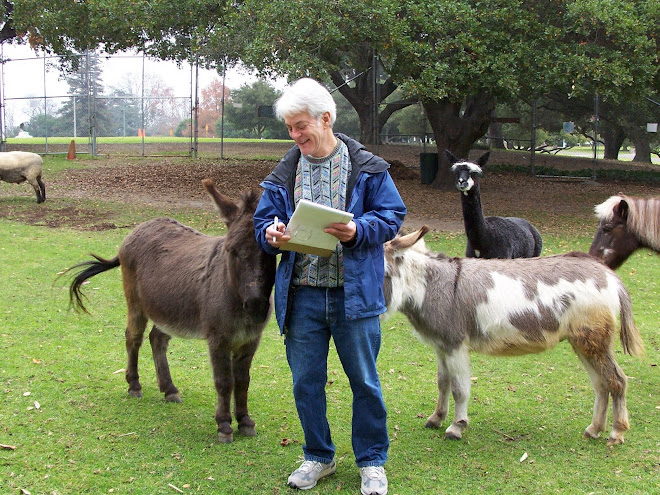
Interviewing the animals at Children's Fairyland in Oakland. L-R: Bobo the sheep, Gideon the miniature donkey, me, Tumbleweed Tommy the miniature donkey, Juan the alpaca, Coco the pony

Friday, June 17, 2011

A Good Dad


This column is a Father's Day present for John Mullarkey of Albany from his nine children, 20 grandchildren and seven great-grandchildren.
It all started when I got an email from his youngest daughter, Elaine.
"I'm sure you receive many letters about people of greatness," she wrote. "Well, my father fits that description. I have attended so many funerals this past year, and I have learned so much about people after they are no longer here. I thought, 'Wouldn't it be nice to learn more about a person before their obituary is printed?' I would like to celebrate my father before that time."
I was intrigued, so I went to visit her dad. And he's even more impressive than advertised.
He quit high school at age 17 to join the Navy after Pearl Harbor, leaving his childhood sweetheart, Agnes Correia, behind. They wrote each other every day.
He served on the USS Hornet in the South Pacific. Then he came home, married Agnes, and worked his tail off as an electrician to support their growing family.
For an extremely humble man, he's proud of a lot of things: proud of serving in the Navy, proud of being Catholic - he's one of the pillars of St. Ambrose Church, doing everything from serving on parish committees to sweeping the floors - and proud of being a member of Local 595 of the International Brotherhood of Electrical Workers for more than 50 years.
"He can recount stories about every job he ever worked on, including the names of the electricians he worked with," says his son, Tom. "He always felt best about helping the women and minority workers. He grew up on the tough side of town, and he has a soft spot for the less fortunate."
Most of all, he's proud of his family, bragging about them every chance he gets.
"One of Dad's greatest qualities is the fact that he does not judge any of us," says his daughter, Cathy. "He tries to be constructive and helpful instead of critical."
A few years ago, he found out that one of his grandchildren is gay. His response was to burst into tears - not because the child is gay, but because of what the poor kid must have suffered from the social stigma.
He and Agnes - an extraordinary person in her own right - were married for 63 years until she died last year.
His kids make sure he's not alone. At least twice a week he has dinner with one of them. After everything he's done for them, they consider it a privilege do a little for him.
Every morning he picks up his granddaughter, Jillian, 9, and takes her to school. Then he gets his daily visit from Jillian's little sister, Callie, 20 months. He reads to her from her favorite book, "Humpty Dumpty," and they play together. She bosses him around, and he eats it up.
After he and Callie have lunch together, he goes to Casper's Hot Dogs on San Pablo Avenue and shoots the breeze with some longtime buddies. Then he spends the rest of the day visiting shut-ins on missions of mercy.
He's the salt of the earth, the kind of person who made America great. Happy Father's Day to him - and to all you other good dads, too.

Thursday, June 9, 2011

How Tweet It Is!


(Above: Caitlin, Theo and Austin performing their winning call)

Austin Kelley, Caitlin Baldridge, Theo Quayle, Jermy Kruger, Augie Grahn, Andrew Gage, Zach Piser, Andrew Moorhead and Tlalli Moya-Smith are back home in Piedmont after flying to New York on May 24 to appear on "The Late Show With David Letterman."
They were the winners of the 46th annual Piedmont High School Birdcalling Contest. Austin, Caitlin and Theo took first place for their mating call of the American Coot; Jeremy, Augie and Andrew placed second for the Trumpeter Hornbill; and Zach, Andrew and Tlalli won third place with their call of the Wood Stork.
It was business as usual, including the stern don't-try-to-be-funny-let-Dave-make-the-jokes lecture from one of the producers before the show. Letterman flirted with the girls and bantered with the boys, as he always does.
While talking with Tlalli about her upcoming jaw surgery, he got into one of his obsessive "Oprah-Uma" moods, when he just can't let something rest. But Tlalli took it all in stride.
And the banter with Augie got so heated, the producers worried that it might look like Letterman was picking on him. So they cut the bit when the show aired - much to Augie's disappointment.
Afterwards, the kids explored Manhattan - turning down a guy who tried to sell them fake Rolexes - bought souvenirs and ate overpriced food.
"Twenty bucks for a burger?" Theo says incredulously.
They flew home with free "Late Show" T-shirts, some unforgettable memories and $200 checks.
The winners' names will also be inscribed on the Leonard J. Waxdeck Trophy, named after the biology teacher who created the contest as a class project in 1963 and guided it until his death in 1994.
The contest went big time in 1975, when Johnny Carson had the kids on "The Tonight Show," beginning a yearly tradition that continued until he retired in 1992.
Waxdeck asked Carson's successor, Jay Leno, to continue the tradition. But Leno was so anxious to get out from under Carson's shadow, he wouldn't touch anything associated with Johnny.
Fortunately, Letterman, who worshipped Carson, was delighted to have the birdcallers on his show. They made their first appearance in 1993, and there they have appeared every year since.
But the rules were a little different. Carson had let Waxdeck decide who would be on the show, and he invariably picked the first, second and third place winners, plus the graduating seniors.
But Letterman insisted on making the choice himself. After viewing a tape of the contest, his producers would select four acts to come to New York. Some years, none of the contest winners were chosen.
Even worse, after the dress rehearsal the producers would cut one of the acts. The kids always put a brave face on it, but they must have been brokenhearted.
But six years ago a new principal named Randy Booker took over at Piedmont High. And one of the first things he did was tell Letterman's producers that from now on, it would be all or nothing.
It was a gutsy thing to do because they could have told him to get lost. But instead, they blinked. And ever since then, the contest winners have been chosen to go to New York. And they all have appeared on the show.
Big props to you, Randy Booker!

Tuesday, May 31, 2011

Good reads for the summer


Perhaps the most eagerly awaited of all my columns each year is the annual summer reading list for children. For years, it was compiled by Helen Dittmer, the beloved librarian at Redwood Day School in Oakland. Since her retirement, the tradition has been continued by her successor, Jen Ammenti. And here are Ms. Ammenti's suggestions for this summer.
For Kindergarten, 1st, 2nd and 3rd graders, she recommends both prose and picture books.
For prose books, anything by Mo Willems, Leo Lionni, Lauren Child, Doreen Cronin, Patricia Polacco, Allen Say, Mac Barnett, Amy Krouse Rosenthal or James Howe would be great.
For picture books, she likes "The Dark Emperor & Other Poems of the Night" by Joyce Sidman, "Interrupting Chicken" by David Ezra Stein, "Dave the Potter Artist, Poet, Slave" by Laban Carrick Hill, "A Sick Day for Amos McGee" by Philip C. Stead, "Chalk" by Bill Thomson, "Hip-Pocket Papa" by Sandra Markle, "LMNOpeas" by Keith Baker, "Guess Again" by Mac Barnett and "Horace and Morris but Mostly Dolores" by James Howe.
For 3rd and 4th Graders, she recommends "The Bat Scientists" by Mary Kay Carson, "Mirror Mirror" by Marilyn Singer, "Spaceheadz" by Jon Scieszka, "The Ninth Ward by Jewell Parker Rhodes, Riding Freedom by Pam Munoz Ryan, The Birchbark House" by Louise Erdrich, "The Mysterious Benedict Society" by Trenton Lee Stewart, "The Memory Bank" by Carolyn Coman, "Growing Patterns Fibonacci Numbers in Nature" by Sarah C. Campbell, "The Night Fairy" by Laura Amy Schlitz, "Tales Dark and Grimm" by Adam Gidwitz, "The Brixton Brothers 2: The Ghostwriter's Secret" by Mac Barnett, "The One in the Middle is the Green Kangaroo" by Judy Blume, "Zorgamazoo" by Robert Paul Weston and "Bunnicula" by Deborah and James Howe.
For 5th and 6th Graders, she suggests "One Crazy Summer" by Rita Williams-Garcia, "90 Miles to Havana" by Enrique Flores-Galbis, "Scat" by Carl Hiassen, "The Strange Case of the Origami Yoda" by Tom Angleberger, "Moon Over Manifest" by Clare Vanderpool, "Summerland" by Michael Chabon, "Shooting Kabul" by N.H. Senzai, "Blubber" by Judy Blume, "Out of my Mind" by Sharon Draper, "Heart of a Samurai" by Margi Preus, "The Secret Life of Ms. Finkleman" by Ben H. Winters, "Cracker! The Best Dog in Vietnam" by Cynthia Kadohata, "The Birchbark House" by Louise Erdrich and "Eat Your Poison, Dear" by James Howe.
For 7th and 8th graders, please note that these books contain mature subject matter, and parents should determine their appropriateness for their child: "Buddha Boy" by Kathe Koja, "The Things a Brother Knows" by Dana Reinhardt, "The Maze Runner by James Dashner, "Graceling" by Kristin Cashore, "Boy Meets Boy" by David Levithan, "Going Bovine" by Libba Bray, "The Firefly Letters" by Margarita Engle, "Ship Breaker" by Paolo Bacigalupi, "King of the Screwups" by K.L. Going, "Yummy: The Last Day of a Southside Shorty" by G.Neri, "Ribbons" by Lawrence Yep, "The Adoration of Jenna Fox by Mary E. Pearson and "Mouse Traps" by Pat Schmatz.
"Some are new award winners, some are old goodies, and some are just my favorites," she says. "Remember, what's right for one doesn't necessarily mean right for all. The important part is that you keep reading this summer. Ask your friends, browse a library, choose from this list - do whatever it takes to find your favorites. Happy summer reading!"

Friday, May 27, 2011

Goodbye, Ms. Claus


One day 25 years ago, Elma Ramirez, consumer affairs manager for the U.S. Postal Service's Bay Valley District (which covers both Alameda and Contra Costa counties), walked into the dead letter office in downtown Oakland and discovered thousands of children's letters to Santa Claus that had ended up there because the post office didn't know what else to do with them.
She started reading them, and she was shaken by what she read. Their desperation, together with their touching faith that somebody, somewhere, might be listening, broke her heart.
So she and a few of her co-workers started answering them. They dug into their own pockets to buy little gifts for the children, but even more important was letting the kids know that somebody out there cares.
It quickly became obvious that they would need help to handle the huge volume, so the next year Elma decided to enlist the public.
That's where I came in. For 24 years, I have printed some of the letters in the newspaper and asked you readers to help. And for 24 years, you have come through with flying colors.
Each of us has our favorite letters. I remember the boy who wrote, "Dear Santa, I'm Jewish and I know I shouldn't believe in you, but I can't help it," and the girl who asked, "Santa, do you know Jesus? Are you friends? Please say hi to him for me."
But the ones that will stay with me always are the ones from desperately poor children who say, "Santa, you don't have to bring me anything, but could you please bring shoes for my little brother?"
These kids are the true spirit of Christmas. Their generosity and faith put us to shame.
Alas, all good things must come to an end, and Elma is retiring after 39 years on the job. Tuesday, May 31, will be her last day.
She has asked me to thank you, the readers, for supporting this program.
"They have been incredibly generous and understanding," she says. "Even in the face of changing regulations, they have always come through for the children."
And she has nothing but praise for her dedicated staff - David Thompson, Janet Ezell, Brenda Presley, Margarita Cristobal, Nina Tan, Toni Harmon and Carmen Bouchet - who have been with her every step of the way.
So will the Santa letters program continue after her retirement? Elma sure hopes so.
"I hope it doesn't stop with me. This has become part of the postal service's tradition, and I hope it lasts forever, even in hard times. ESPECIALLY in hard times."
If you'd like this wonderful program to continue, please drop a note to Kim Fernandez, district manager of the Bay Valley District, at 1675 7th St., Oakland 94615.
He's been very supportive in the past, as has Elma's immediate boss, marketing manager James Tatum. But I have a hunch they could use some positive feedback from the public as evidence to convince their higher-ups back in Washington, DC.
And if you'd like to thank Elma herself, you can drop her a line c/o the consumer affairs division at 201 13th Street, Room 228, Oakland 94612.
She's a great lady, and I'm going to miss her terribly. And the best way to honor her is to keep her legacy going.

Sunday, May 15, 2011

Good Eats


(Above: Paul and Renee)

Whenever my sister, who lives in Los Angeles, comes to visit, the first thing we always do is have dinner at her favorite Chinese restaurant, Renee's Place in Albany. (She's addicted to the rolling lettuce chicken; I usually go for the orange beef.)
The restaurant has been owner Renee Wang's dream ever since she came to this country from China in 1986, leaving behind a promising career as first violin with the Shanghai Chamber Orchestra.
After working in restaurants for 10 years, she finally saved enough to open up her own place in 1996. And she made it exactly the way she wanted it: only the freshest organic ingredients; a peaceful, even serene, atmosphere and, above, all, strict adherence to authenticity.
It's a foodie's paradise. But, unfortunately, not even a great restaurant like this is immune to the recession, and Renee and her staff are struggling hard to keep it going.
Meanwhile, I read in the paper that the A.G. Ferrari chain of high-end Italian specialty food stores has filed for Chapter 11 bankruptcy.
This doesn't mean they're going out of business. But still, it's an alarming sign.
I've known the owner, Paul Ferrari, for 15 years. His story started long before he was born - in 1917, when his grandfather, Annabile, was a teenager in Italy. Annabile's older brother, Camillo, was drafted into the army and killed in World War I.
When their father heard the news, he turned to Annabile and said, "That's it! I'm not giving them another son to kill! Tomorrow, you leave for America!"
Six weeks later, young Annabale arrived in San Francisco. He worked hard and saved his money, and in 1919 he opened his first specialty food store, which eventually grew to 13.
When Paul inherited the business in 1994, his contribution was to take it back to its roots. Paradoxically, the food at A.G. Ferrarri is even more authentic today than it was in his grandfather's day.
Paul gets his pickled green tomatoes from a convent of Trappist nuns who live outside Rome. His olive oil comes from an Italian count named Duccio Corsini, who lives in Tuscany and gives his farm workers their choice: They can be paid either in cash or in olive oil. They always choose the olive oil.
His sunflower honey comes from a beekeeper named Daniele Devalle ("Daniel of the valley") who lives in Piedmont (Italy, not California).
But not every year. Recently, some of the bees started straying to neighboring fields. The honey was still delicious, but it wasn't 100 percent sunflower. For a purist like Devalle, that's an imfamata.
"I won't sell it to you because you're a fellow Italian," he told Paul. "I'll sell it to the Germans; it's good enough for them." (Demonstrating once again that the Italians still haven't forgiven the Germans for World War II.)
But the good news is that the Trappist nuns have promised to pray for the bees. So keep your fingers crossed.
I've written many columns saying we should rally around our local schools and non-profits in these hard times. But local businesses like Renee's Place and A.G. Ferrari are a vital part of our community, too.
Whatever your favorite local business is, it deserves your support. We all need to take care of each other.

Sunday, May 8, 2011

Going For Broke


(Above: Sadeo Munemori, who was awarded the Medal of Honor for throwing himself on a live hand grenade to save his buddies. He had volunteered for the 442nd from the Manzanar detention camp, to which he and his family had been sent shortly after Pearl Harbor. He was only 22 when he died. The date was April 5, 1945 - the day I was born. I don't think it's a stretch to say he died so I could live.)

You've heard the cliché about how the French hate Americans? I don't know if that's true, but I do know one group of Americans they definitely don't hate.
Au contraire, mes amis. They absolutely love these guys. They build statues of them and name their streets after them.
I'm talking about the 442nd Regimental Combat Team, the famous Japanese American World War II regiment that was awarded more medals, man for man, than any other unit in American history.
They liberated city after city in France. And though it happened more than 65 years ago, the French haven't forgotten.
I found this out a few years ago when I accompanied veterans of the 442nd when they went back to France to visit some of the places they liberated.
As we drove into the city of Bruyeres, the banners overhead didn't say, "Welcome to our liberators," as I had expected, but "Welcome to our saviors," instead.
They weren't kidding. The German commandant in Bruyeres, the imfamous Klaus Barbie (aka the Butcher of Lyons), was scheduled to execute hundreds of resistance fighters on the day the 442nd arrived and spoiled his plans.
One of those rescued was a teenager named Francois Mitterrand, who grew up to become President of France.
Official duties prevented him from being on hand to welcome the 442nd veterans back, but another boy who also was rescued that day was present.
His name was Serge Carlesso, and he was only 10 the day the 442nd liberated Bruyeres. His leg had been blown off by a German shell earlier that morning, and the 442nd medics arrived in the nick of time to save his life.
Serge proudly introduced the veterans to his grandson Laurent, who was the same age that he was that fateful day so long ago.
The excitement began even before we arrived, when the mayors of Bruyeres and Biffontaine got into a fistfight over which town would have the honor of having the 442nd guys march in its Bastille Day parade.
Bruyeres won, but the mayor of Biffontaine got even by hosting a gala banquet for the veterans the night before. Not to be outdone, the mayor of Bruyeres retaliated by throwing his own banquet the next day.
The Bastille Day parade itself was like something out of the old newsreels. People were literally weeping for joy, tossing flowers at the veterans from windows and rooftops. Mothers held their babies up for them to bless. And, yes, the street they were marching down was named Rue de 442.
It was one of the happiest scenes of pure, unabashed public joy I've ever seen in my life, right up with the night Obama got elected and the night Bin Laden got killed.
At this stage in their lives, the men of the 442nd don't get back to France very often anymore. But they still come to Oakland every spring to hold a memorial service in Roberts Park to honor their fallen brothers - and, by extension, all veterans of World War II.
This year's service will be held at noon on Saturday, May 21, and they cordially invite you to join them. Roberts Park is on Skyline Boulevard, on the way to the Chabot Space & Science Center.
I hope to see you there.

Long May He Wave


Wavy Gravy, the raspy-voiced 1960s icon who famously announced to the crowd at Woodstock, "What we have in mind is breakfast in bed for 400,000," will turn 75 on Sunday. And what a long, strange trip it's been.
Wavy - whom satirist Paul Krassner calls "a cross between Harpo Marx and Mother Theresa" - will celebrate with a public "Birthday Boogie" Saturday night at the Craneway Pavilion in Richmond, featuring a Who's Who of the Bay Area music scene including Bob Weir and Mickey Hart of the Grateful Dead, Barry Melton of Country Joe and the Fish, Henry Kaiser, Ace of Cups, and Narada Michael Walden.
It's a fundraiser for Wavy's favorite charity, the Seva (a Sanskrit word for "service to humankind") Foundation, which Wavy co-founded in 1978 with spiritual leader Ram Dass and public health expert Larry Brilliant to fight preventable and curable blindness in Asia and Africa.
"Thirty years and three million eye surgeries later, we're still truckin'!" he says.
Wavy, who describes himself as "an activist clown and former frozen dessert" - a reference to Ben & Jerry's naming a flavor after him - was born Hugh Romney on May 15, 1936 in East Greenbush, New York. But soon afterward his family moved to Princeton, New Jersey, where one of his neighbors was a kindly old man named Albert Einstein, who took him on daily walks around the block.
"I was only five, but I still remember that shock of white hair that predated Don King by half a century, the twinkle in his eye, his sneakers with no logo, and, especially, the way he smelled.
"I've never smelled anything like it since; but if I ever do, I'm gonna walk up to the guy and say, 'Hey man, you smell like Albert Einstein!'"
Flash forward 20 years to Greenwich Village in the early 1960s, where he found a job as poetry director at the Gaslight Café.
He shared a room above the café with a fledgling songwriter from Minnesota named Bob Dylan, who wrote the first draft of "A Hard Rain Is Gonna Fall" on an old manual typewriter in that room.
One of the café's steady customers was Marlene Dietrich, who gave him a book of poems by Rilke.
"I still have the book, but I still haven't read the poems," he confesses.
At about this time he embarked on a career as a monologist, "talking about the weird stuff that had happened to me," opening shows for John Coltrane, Thelonious Monk and Peter, Paul & Mary.
His manager was standup comic Lenny Bruce, who gave him a new stage name: Al Dente. Bruce also gave him a yarmulke sewn inside a cowboy hat that once belonged to silent movie star Tom Mix "so I could say, 'Howdy, Goyim!'"
Next, he formed a musical review with Tiny Tim and Moondog at a dubious venue called the Fat Black Pussycat.
"We got front page in the Village Voice and a rave review in the New York Times," he recalls. "The next day the sheriff came and padlocked the joint for back taxes."
So he headed out to San Francisco, where he did a stint with The Committee, then moved to Los Angeles, where he taught improvisational techniques to Hollywood actors by day and neurologically handicapped kids by night.
In 1965, when he and his wife, Jahanara (then called Bonnie Jean), were living in a one-room cabin outside Los Angeles with about 40 friends, including fellow ice cream flavor Jerry Garcia, they all posed for a Life magazine cover photo.
"The landlord freaked out and evicted us, but the next day a neighbor came by and said, 'Old Saul up on the mountain had a stroke, and they need somebody to slop them hogs!' So we were given the mountain top rent-free if we would take care of about 60 hogs the size of Davenports."
And so the Hog Farm was born. Eventually, the Hog Farm moved north to Black Oak Ranch in Laytonville, which boasts a lake - Lake Veronica - with a raft named George and a 350-foot water slide from Marine World.
In 1969 the Hog Farmers were hired by the promoters of the Woodstock Music Festival to build fire trails around the festival grounds.
"But we convinced them to let us set up a free kitchen, too. When we got to JFK Airport a bunch of reporters were there to meet us, and they told us we had been chosen to provide the security, too. I said, 'My God! They made us the cops?'"
By the time the festival was over, Wavy - or as he was still known, Hugh Romney - had become the MC.
A few weeks later, he was performing similar tasks at the Texas Pop Festival, where the great bluesman B.B. King dubbed him "Wavy Gravy." And Wavy Gravy he has remained ever since - except in the pages of the New York Times, which refers to him as "Mr. Gravy."
It was inevitable that the free kitchen concept would be expanded internationally, and when a horrible flood struck Pakistan, Wavy knew what to do.
"We'd had so much attention from the free kitchen at Woodstock, we thought if were in Pakistan with any kind of food, it would embarrass the government into speeding up food relief."
When war broke out between Pakistan and India, the Hog Farmers "hung a left into Kathmandu" and continued their work in Nepal and Tibet, building playgrounds and distributing food and medical supplies on the way. In Nepal they met large numbers of blind people, most of them suffering from conditions that were easily preventable or treatable.
And so the Seva Foundation was born, with help from $10,000 in seed money from rock promoter Bill Graham.
"Bill had no idea what it was all about, so I was flabbergasted when he gave me the check," Wavy recalls. "I asked him, 'Why are you doing this?' And he said, 'Because you did not hit on me, my friend.'"
In addition to fighting blindness in the Third World, the foundation has branched out in recent years to prevent diabetes and other chronic health problems in Native American communities in the U.S.
In 1975 Wavy launched Camp Winnarainbow, a clown camp at the Hog Farm offering sessions for both adults and children, who learn juggling, unicycling, tightrope walking, trapeze, music and art.
"Grownup camp is just like kids' camp, except you get to stay up late and you don't have to brush your teeth," he says. "We're not trying to turn out little professional circus stars. We're trying to produce universal human beings who can deal with whatever comes down the pike with some style and grace."
The camp offers scholarships to homeless children from the Bay Area and Native American kids from a reservation in South Dakota, funded by Wavy's royalties from Ben & Jerry's ice cream sales.
Only one rule at Camp Winnarainbow: No drugs.
"We're very firm about that," he says. "I can do nicely, but lots of people can't get stoned and work."
These days, Wavy splits his time between the Hog Farm and his home in Berkeley, a communal house that he calls the Hippie Hyannisport. Every nook is filled with books, beads, Buddhas, incense, wind-up teeth, moose antlers and Mickey Mouse and Goofy figurines. Dominating the scene is an enormous, larger-than-life portrait of Wavy.
"David Crosby bought it at a flea market. He held on to it for two years, then he mailed it to me. He said he couldn't stand me staring at him any more."
So what's next for Wavy Gravy?
"I don't know. As Tiny Tim always used to say to me, 'Time will tell.'"