A columnist of heart and mind

A columnist of heart and mind
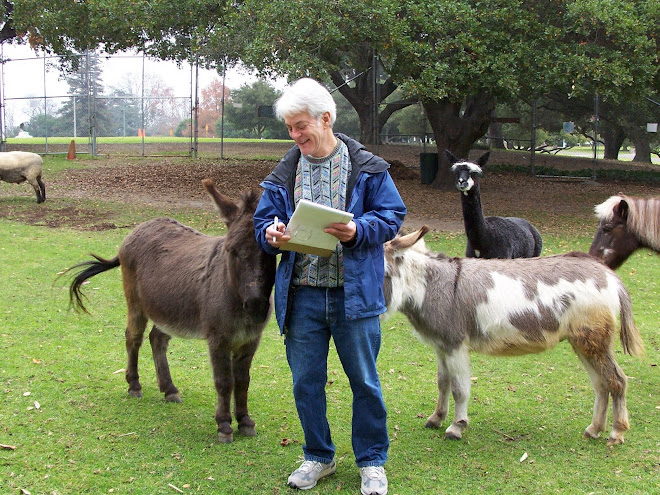
Interviewing the animals at Children's Fairyland in Oakland. L-R: Bobo the sheep, Gideon the miniature donkey, me, Tumbleweed Tommy the miniature donkey, Juan the alpaca, Coco the pony

Monday, March 29, 2010

Wending Your Way Through The Medicare Maze


(Above: Lyndon Johnson signs the Medicare bill)

I'm going to turn 65 next week, which means I'm eligible for Medicare.
That's the good news. The bad news is that I have to choose among a bewildering array of competing Medicare plans.
Do I want a Medigap policy - and there are dozens of different ones to choose from - or do I want an HMO or a PPO? And what happens if I change my mind down the road?
For the last few months, I've been inundated with letters and phone calls from insurance companies, each one claiming their Medicare plan is the best and all the others stink.
I've piled all the letters in a huge heap in my living room that dwarfs the mini-mountain Richard Dreyfuss built on his dining room table in "Close Encounters of the Third Kind."
Two months ago, I got a call from a guy who said, "I represent all the insurance companies offering Medicare policies in Northern California, and I'm here to hold your hand through the application process." Great, huh?
Not really. After asking for a lot of personal information, he said, "Let's you and me call Medicare together. But don't say a word. I'll do all the talking."
Uh oh. Red flag. So I said, "Will I have to give out my Social Security number?"
"Of course," he said.
"I'll tell you what," I said. "I'll call Medicare myself." And I hung up. I don't mind telling the Medicare people my Social Security number, but I sure wasn't going to reveal it to a total stranger.
So I called Medicare and talked to a very nice woman and told her what had just happened.
"Thank goodness you hung up," she said. "He's probably either a scam artist trying to get your personal information for identity theft, or he's an insurance broker trying to steer you toward the company that pays him the highest commission."
Whew! Dodged that bullet. But I was still stuck at square one; namely, how do I decide among all those competing policies?
"Not to worry," she said. "There's a free counseling service called HICAP (short for Health Insurance Counseling & Advocacy Program). It's funded by the state and federal governments, and they can help you sort all this out. Give them a call."
So I did. And it was just as she said. I talked with a friendly and knowledgeable volunteer counselor who cut through all the gobbledygook and helped me choose the plan that will work best for me.
In fact, she knew more about each plan than the insurance salesmen I talked with, many of whom were shockingly misinformed about the details of their own policies.
I only wish I had called HICAP months ago. It would have saved me a lot of frustration.
HICAP has in-person counseling sites throughout Alameda and Contra Costa counties. (There are six in my hometown of Berkeley alone.) If you're approaching 65 or otherwise need help with Medicare, call 800-434-0222 and they'll set up an appointment at a location near you.
And if you'd like to become a counselor yourself, HICAP will hold a series of training sessions next month. Call 510-839-0393 if you live in Alameda County or 925-335-8791 if you live in Contra Costa.
Please consider volunteering to be a counselor. It's an opportunity to do a lot of good for a lot of people.

Tuesday, March 23, 2010

And Yet It Moves


A brave man died last week.
In March 12, UC Berkeley Professor emeritus Charles Muscatine, a renowned Chaucer scholar and one of the best teachers on campus, died at age 89 at the Kaiser Permanente Medical Facility in Oakland.
But his most enduring fame will be for his heroism 60 years ago, when he was a young assistant professor at Cal. It was the height of the McCarthy hysteria, and the Regents of the University ordered every faculty member to sign a loyalty oath swearing that he or she wasn't a communist.
Muscatine refused and was fired, along with 30 others.
Not that he was a communist, of course. But this was an obvious invasion of academic freedom, as well as the Constitution.
"Besides, I had an obligation to my students," he told me years later. "How could I tell them to tell it as it is if I had signed something that went so much against my conscience?"
But he paid a terrible price. When he was fired, his wife Doris was three months pregnant; and it was more than a year before he found another job. She backed him up 100 percent, by the way - "something that wasn't always true, I regret to say, for all my colleagues," he said.
It was four years before Cal finally hired him back, after the California Supreme Court declared the loyalty oath unconstitutional.
So if Muscatine and the other non-signers are the heroes of this story, those who did sign are the villains, right?
Wrong. Many had mortgage payments and kids in school. Often, they were under intense pressure from their families and department chairmen to sign. But they hated doing it.
"The most heart-rending cases were the people who held out almost to the very end, only to crack under the pressure at the last moment," Muscatine said. "They were victims just as much as we were."
As the controversy dragged on, the two groups grew closer and closer.
"The signers passed the hat among themselves and raised more than $100,000, which was real dough in those days, to help us pay our bills," said Muscatine. "Essentially, they supported us during that whole year when we were out of work."
They also got some much-appreciated moral support from St. Albert's Dominican monastery in Oakland.
"One of the most touching and supportive acts of any of our friends was being invited to St. Albert's to give lectures in our academic specialties," said Muscatine, his voice breaking with emotion as he recalled the story 50 years later. "It reaffirmed our membership in the scholarly and intellectual world."
So why didn't he back down? Simple: Nobody likes to knuckle under to a bully.
If the Regents had done their homework, they would have found out that Muscatine was a LST commander in World War II, landing troops on the beaches (and evacuating the wounded on the return trips) in some of the bloodiest Allied landings of the war, including North Africa, Sicily, Salerno and, of course, Omaha Beach.
On D-Day, he went back over and over to rescue men trapped in the burning wreckage of a sinking ship, for which he was awarded the Navy Commendation Medal.
The moral: After he'd already faced down the Nazis, the biggest bullies of them all, what made the Regents think he'd be scared of them?

Saturday, March 20, 2010

Davy Crockett Trivia Quiz


1. What is the greenest state in the country?
2. How old was Davy when he killed his first bear?
3. Aside from guns and knives, what other means did Davy use to kill bears?
4. What was the name of Davy's rifle?
5. Which iconic national symbol did Davy repair when he was in Congress?
6. Why was Davy raised in the woods?
7. Who did Disney originally consider for the role before he hired Fess?
8. What business did Fess go into after his movie career was over?
9. Name three of Fess's acting roles post-Davy.
10. What country did Ronald Reagan offer to appoint Fess ambassador to?

Answers:

1. Tennessee
2. Three
3. He'd grin them to death.
4. Ol' Betsy
5. He patched the crack in the Liberty Bell.
6. So he would learn every tree.
7. James Arness
8. That little old winemaker, him.
9. Daniel Boone, Old Yeller, The Great Locomotive Chase
10. Australia

Sunday, March 14, 2010

Remembering the Waving Man


Even if Joseph Charles had done nothing after he retired, he still would have led a full life.
Born in Lake Charles, Louisiana in 1910, he played in the Negro Leagues as a young man, managing and playing second base for the Lake Charles Black Yankees.
Once, he even batted against Satchel Paige when the great pitcher came through town on a barnstorming tour. He struck out on three straight pitches.
"But I got a foul tip," he told me proudly, "which was better than anyone else did that day."
In 1942 he joined the great African American migration from the deep South to the Bay Area, where he built Liberty ships at the Kaiser shipyard in Richmond. After World War II he worked as a longshoreman at the Oakland Naval Supply Center until his retirement in 1962.
And that's when his legend began. On the morning of Oct. 6, 1962, he stood outside his home on the corner of Oregon Street and Grove Street (now called Martin Luther King Way) and waved to the passing cars.
Some of his neighbors thought he was crazy and called the cops. But when the police arrived, they took one look and said, "Go ahead, Mr. Charles. You just keep on waving for as long as you want."
So he did - every morning, rain or shine, for exactly 30 years until he finally retired from waving on Oct. 6, 1992.
In the process, he became beloved.
"He was a Berkeley legend and a local treasure," said former mayor Shirley Dean. "He brought a smile to everyone who knew him."
Another former mayor, state Sen. Loni Hancock, concurred. "He was a joyful person who loved people, and they loved him right back. Seeing him every morning was a great way to start the day."
But his fans weren't confined to Berkeley. People in Oakland, Albany, El Cerrito and Richmond would drive miles out of their way, just so they could start their day by waving to The Waving Man.
That was just one of the names he was known by. Some called him Mr. Smiles, after one of his trademark greetings, "Keep smiling!"
Others called him Mr. Goodday, after his other greeting, "Have a GOOD day!" Still others called him Charley Wavesalot.
The City of Berkeley issued proclamations honoring him no fewer than seven times during his lifetime. In 1987 the tennis courts across the street from his house were re-christened the "Joseph W. Charles Tennis Courts." (Not that he was a big tennis fan, but at least he could look at the sign every day from his front window.)
Mr. Charles died in 2002, a few days short of his 92nd birthday. He outlived his wife, his children, and two of his doctors. But not his fame, which will endure forever.
Last month, a few of his admirers started a Facebook fan page for him, and within a couple of days it had more than 500 members.
Next Monday, March 22, would have been his 100th birthday, and some of his fans will celebrate by standing in front of his old house at the corner of Oregon and Martin Luther King and waving to the morning traffic.
I'll be one of them, and I hope you'll drive by and wave to us.
Until then, keep smiling. And have a GOOD day.

Thursday, March 4, 2010

Where Fairy Tales Come True


(Above: Willie the Whale)

It seems like all my favorite haunts are popping up on TV these days. Last week, the Travel Channel ran a series called "101 Tastiest Places to Chow Down," and No. 4 in the whole country was Fenton's Creamery in Oakland.
The next day, The Travel Channel ran a repeat of "Man Versus Food," featuring host Adam Richman tackling the humongous, 2-pound Kitchen Sink sundae at the San Francisco Creamery in Walnut Creek.
But the climax came on Tuesday, when the new NBC dramedy, "Parenthood," opened with a scene filmed at Children's Fairyland in Oakland.
It couldn't have come at a better time because Fairyland is celebrating its 60th anniversary this year.
Fairyland was founded in 1950 by William Penn Mott, director of the East Bay Regional Parks system, and the legendary nurseryman, Arthur Navlet. They designed it to be, in their own words, "the dream of every child come true."
A frequent visitor to the park was Walt Disney, who opened Disneyland five years later, basing much of it on what he saw at Fairyland.
But I think the original far exceeds the imitation. Fairyland is everything Disneyland is not.
Disneyland is huge; Fairyland is cozy. Disneyland is frenetic; Fairyland is peaceful.
Most of the attractions at Disneyland are passive experiences; you're literally along for the ride.
But at Fairyland, most attractions are interactive, whether it's climbing down Willie the Whale's gullet, using your Magic Key to make one of the Storybook Boxes tell you a story, or exploring Alice in Wonderland's Tunnel.
It's all in keeping with the iron-clad rule that Mott and Navlet laid down when they founded the park: "No straight lines and a surprise around every corner."
Above all, Fairyland was built for little kids, first and foremost.
"There's a reason why you have to go through the big shoe to enter the park," says executive director C.J. Hirschfield. "It's sending a not-so-subtle message to the adults. They have to duck down while the kids proudly walk through straight and tall."
The target audience is toddlers, but many of them stay connected with Fairyland when they get older by becoming one of the Storybook Personalities. They perform musicals, represent Fairyland at public events, and serve as mentors and role models for the little ones.
My favorite Fairyland memory was the time I saw a Storybook Personality, about 10 years old, painting a flower on the cheek of a little girl, about 5.
I'll never forget the look on that little girl's face - a mixture of gratitude, hero worship and sheer amazement that a big kid was being so kind to her.
And I knew immediately that her goal was to grow up and be a Storybook Personality herself, when she, too, could be kind to a little kid.
But that's just my memory. I'll bet you have plenty of your own. And Fairyland is collecting them as part of its year-long 60th anniversary celebration.
Submit your stories (200 words or less) and photos on Fairyland's website, www.fairyland.org, or call 510-452-2259 to be sent a submission form. There will be prizes for both stories and photos, and all entries will be eligible to be featured on Fairyland's Facebook page, on Fairyland's YouTube channel, and in a giant scrapbook at the park.
I'll tell you more about Fairyland's celebration plans in a future column.

Monday, March 1, 2010

Mind Your Manners


(Above: Emily Post)

I belong to a discussion group, and it's a lot of fun except for one thing: One of our members has started to make nasty personal digs at another member.
It's become so annoying, the rest of us have been talking about how to tell him that he's being rude.
Then I got a brainstorm: This was clearly a case for Sarah Kidder, etiquette expert extraordinaire.
And, of course, she had the perfect advice: "Don't tell him he's being rude. That will just turn it into a power struggle between the two of you. It isn't about him, and it isn't about you; it's about the group. So just say, 'This isn't being helpful. Let's get back to business.'"
So I did. And it worked. The guy behaved himself for the rest of the meeting.
Kidder, who lives in the Grand Lake neighborhood of Oakland, numbers socialites, corporate executives, students and rock stars among her clients. She also does pro bono work with ex-cons.
"Once they realize that the principle that they used to get them through prison - treating others with respect - is the same thing that will get them that first entry-level job, it liberates them," she says.
For Kidder, treating people with respect is the very essence of etiquette, and she says it can be applied to almost every situation.
"People associate etiquette with being prissy or think it’s just table manners, but they've forgotten that it's about each and every interaction you have with every walk of life. There are ways of doing things that are key to relationships whether you are a gangbanger, Mafioso, cop, executive or student. It’s about relationship management, and etiquette is the key to good management."
I was 15 minutes tardy for our interview appointment, so I apologized for being late. I was tempted to explain that I got tied up in a traffic jam, but decided not to.
"You did the right thing," she told me. "Nobody cares why you were late. A simple apology will do. Anything more is over-talking, and it's a bad idea for two reasons.
"First, when you make excuses, you make it all about you, not the apology. Secondly, it can make you sound like you're lying, even if you're not, because that's what people do when they lie: They over-talk."
Other examples of over-talking: "I did not have sex with that woman" and "I was just hiking on the Appalachian trail."
So what did she think of Tiger Woods' apology?
"It was so self-centered - nothing but me, me, me! And it was a classic example of over-talking. He could have accomplished all he needed to do in a few short sentences - 'I had the honor of being a role model, and I blew it.' That's not the same thing as saying, 'You worshipped me and I messed up.'"
Currently, Kidder is putting the final touches on an etiquette book for the 21st Century, with lessons on manners taken from James Bond movies.
"Spies are great examples because they use good manners to blend in and rude behavior when they're trying to cause a scene. And they rarely over-talk"
Until the book comes out, Kidder says that you can't go wrong if you remember to use these four short magic phrases to avoid over-talking: "please," "thank you," "I'm sorry" and "excuse me."
Enough said.

Sunday, February 21, 2010

Reading for fun


On March 2, students at Glenview Elementary School in Oakland will start knocking on doors to ask for donations to the school's annual Read-A-Thon, which funds essentials that have been cut from the school's budget because of the reduction in state funding.
The kids will ask people to sponsor their after-school reading, which they’ll be carefully tracking in their logbooks.
The theme of this year's Read-A-Thon is "Oh, The Places You'll Go!" - the title of Dr. Seuss's final book, which is only fitting because March 2 is Dr. Seuss's birthday. (He would have been 106.)
The fundraising will go on for two weeks until March 16, when the children will celebrate with an all-day reading party at the school. For one day, they'll put aside their regular schoolwork and do nothing but read for sure pleasure.
Some of the littlest kids come to school in their P.J.'s, dragging their sleeping bags and teddy bears behind them.
Using blankets and chairs, they make "forts" in the middle of the classroom. Then they crawl inside and read, read, read to their heart's content. It doesn't get much cuter than that.
Once again, second grade teacher John Miller has made his students an offer they can't refuse: If they log 2,000 hours of reading, he'll let them cut his hair off.
"We won't have to sweep up afterward," he says. "The kids think a clump of my hair would be a great souvenir, so they scoop it up as soon as it hits the ground."
Grownup celebrities will be on hand to read to them, too, including Channel 5 anchor Wendy Tokuda, authors Tracy Johnston and Leah Waarvick, and Oakland City Council President Ignacio De La Fuente.
Local merchants are also helping, such as Ultimate Grounds on Park Boulevard, which is holding "Sponsor A Book Plate" day on March 6. (Buy a book for the school library and you'll get a free bagel and cup of coffee.)
Others - including Head Over Heels Gymnastics, Legoland California, Lindsay Wildlife Museum, Pump It Up, Snapshot Mosaics, Brushstrokes, Boomers, Castro Village Bowl and Bookmark Bookstore - are donating prizes for the students who log the most hours and bring in the most donations.
If you want to help, send a tax-deductible check to Glenview Elementary PTA, 4215 La Cresta Ave., Oakland CA 94602. Or better yet, why not contribute to the school nearest you? Just give them a call and ask what they need. I guarantee: They'll give you a wish list as long as your arm.
A lot has changed since I was the same age as these kids - some for the worse, some for the better.
On the downside, I never had to go door-to-door raising money to keep my school afloat, and it irks me that these kids have to.
True, every effort is made to keep them safe. They have to be accompanied by an adult they know, and they can only knock on the doors of people they know. But still, they shouldn't have to beg for something that should be theirs as a matter of right.
On the other hand, when I was their age, reading was something your teachers made you do when you misbehaved. It was treated as a punishment. Today, it's treated as a reward.
Which approach do you think is more effective?