A columnist of heart and mind

A columnist of heart and mind
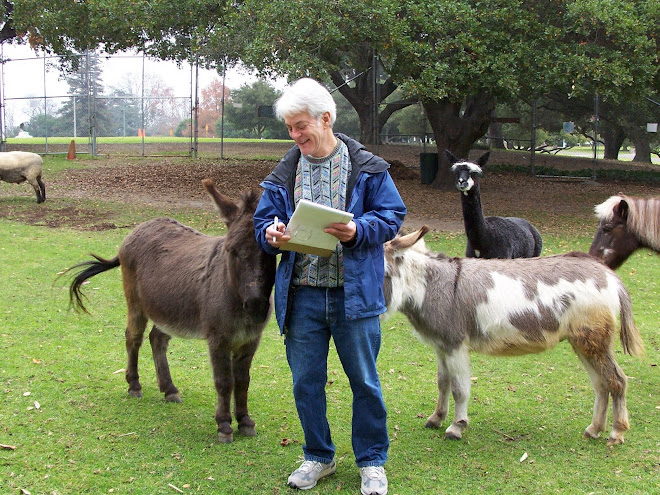
Interviewing the animals at Children's Fairyland in Oakland. L-R: Bobo the sheep, Gideon the miniature donkey, me, Tumbleweed Tommy the miniature donkey, Juan the alpaca, Coco the pony

Sunday, December 13, 2009

Local Boys Make Good By Doing Good


Remember Alex Velez and Nikhil Arora, the 22-year-old Cal grads whose fledgling business, BTTR (pronounced "better") Ventures, beat 1,500 competitors around the world to become one the top 12 finalists in the 2009 World Challenge Competition For Social Ventures, co-sponsored by Newsweek, Royal Dutch Shell and the BBC?
Alex and Nikhil recycle used coffee grounds from Peet's Coffee, which otherwise would be thrown away, and use them to grow organic oyster mushrooms. They were the only American team to make it to the finals, and among the youngest competitors in the whole contest.
I asked you to vote for them online, and you sure did! Three weeks ago they were notified that they had made the top three! But the final order of finish wouldn't be announced until the awards ceremony on Dec. 1 in The Hague, the capital of the Netherlands.
"We couldn't have done it without your readers," said Alex. "It meant a lot to us to have the support of our community."
So a few days after Thanksgiving they were flown to the Netherlands.
They were met at the Amsterdam airport by a sleek black Mercedes sedan and whisked to The Hague, where they met the other two winners - Dr. Wijaya Godakumbura, a surgeon from Sri Lanka who invented a kerosene lamp that won't accidentally ignite an accidental fire when broken or overturned; and Risa Bhinekawati from Indonesia, who invented a process to turn organic waste from village markets into compost.
They were put up at a posh hotel next to the Parliament Building, a 13th Century brick palace that doubles as the headquarters of the International Court of Justice.
The ceremony itself was held at the City Hall, which Nikhil describes as "an insanely futuristic building right out of 'The Matrix.'"
Alex and Nikhil wore suits for the occasion.
"I can't remember the last time I wore a coat and tie," says Alex. "I think it was a wedding or something."
The ceremony was just like the Heisman Trophy presentation. The three finalists sat in the front row, trying not to look nervous, while a series of speakers, including Achim Steiner, Director General of The World Conservation Union, did their best to milk the suspense.
Finally, the winner was announced. It turned out to be Dr. Godakumbura, the inventor of the super-safe kerosene lamp. Alex and Nikhil were the runner-ups.
"He totally deserved it," says Nikhil. "He's devoted his whole life to this lamp. He invented it because a lot of his poor patients were suffering death or severe disfigurement from accidental fires."
Dr. Godakumbura received a $20,000 check. Alex and Nikhil received $10,000, all of which will be ploughed back into the business.
"We want to automate some of the processes," Nikhil said. "Right now, we're doing everything by hand. For one thing, it would be nice to get a hydraulic lift instead of lugging around those big sacks of coffee grounds."
Alex added, "We'd also like to expand our operation, maybe move to a bigger warehouse. We're currently processing 3,000 pounds of coffee grounds each week, but we'd like to process a lot more."
BTTR Ventures (the name stands for "back to the roots") mushrooms are sold at seven Whole Foods stores and four Farmers' Markets in the East Bay. You can also buy do-it-yourself "Gourmet Garden" packs from their website, www.bttrventures.com.

Thursday, December 10, 2009

The Gift of the Magus


Next Friday, volunteers from Professional Firefighters of Contra Costa County Local 1230 will haul more than 150 folk art sculptures up Moeser Avenue to the corner of Moeser and Seaview.
So will begin one of El Cerrito's most beloved traditions - the annual Shadi Sculpture Holiday Display. It will remain there until Dec. 27.
The tradition started in December 1949, when an immigrant from India named Sundar Shadi surprised his neighbors with a Christmas present.
They awoke one morning to find his front yard filled with papier-mâché shepherds, wise men, angels, camels goats, sheep, doves, spires stars, minarets and domes - all lovingly handmade from papier-mâché and chicken wire and painted by hand.
Each year, the display kept growing until it depicted the whole town of Bethlehem.
But there were no statues of Jesus, Mary or Joseph. Mr. Shadi, as everyone called him, was a Sikh, and he came to this country to escape religious persecution from both Hindus and Muslims. So he purposely kept the display non-sectarian.
The citizens of El Cerrito quickly took Mr. Shadi and his creation to their hearts.
"To many people around here, Mr. Shadi was Christmas," says former Mayor Jane Bartke.
And his fame spread far beyond the city limits. The tour busses used to line up, bringing visitors from as far away as Sacramento and San Jose - more than 70,000 each holiday season.
Mr. Shadi kept it up until 1997, when failing eyesight forced him to quit. He died in 2002 at the age of 101.
Then something happened that showed why El Cerrito is such a special place. The people themselves simply refused to let his legacy die.
Under Bartke's leadership, the El Cerrito Soroptomist club took over the sculptures - with the blessing of Mr. Shadi's family - and restored them to their former glory. In 2003 the Shadi sculptures made a triumphant return, and they've returned every holiday season since.
It's a true community effort, including individuals like Gordon White, who prepares the ground for the display; Dick Ritz and Rich Bartke, who do the setup; John Wilson, who operates the music; and Jackson Lusk, who runs the security cameras; as well as El Cerrito firefighters (working on their own time), local businesses, the city government and PG&E, which provides the land.
There are many different ways in which you can participate, too.
Money always helps. All the labor is voluntary, but there's still electricity, insurance, repairing the sculptures and storage during the rest of the year to pay for.
You can "adopt" one of the sculptures - a wise man (including his camel) for $500, a large shepherd for $350, a hookah pipe for $50, or assorted sheep for $25.
Send a tax-deductible check to the El Cerrito Community Foundation, P.O. Box 324, El Cerrito CA 94530.
Even more importantly, you can volunteer your effort. Bartke and her cadre of volunteers, who are from the generation that knew Mr. Shadi personally, aren't getting any younger, and they can't do this forever.
It's time for the next generation, who didn't know him but thrilled to the holiday display when they were little kids, to step up and eventually take over. Call Bartke at 510-235-1315.
The display will be lighted with music every day from 5 to 10 p.m. from Dec. 18 through Dec. 27.

Sunday, December 6, 2009

Dear Santa


"Dear Santa, Starting today I am going to behave." - Rhea

"Dear Santa, I'm going to stop peeing in my bed." - Rohan

"Dear Santa, I have been a good girl, or so says my mom and dad. I will be 5 next week. But you're Santa, so you already know that." - Logan

Every year, thousands of letters like these from all over Northern California wind up at the downtown Oakland Post Office.
And every year, Consumer Affairs Director Elma Ramirez and her trusty elves - Toni Harmon, Tim Wong, Rita Christobal, Brenda Presley, Janet Ezell, David Thompson and Carmen Boeche - separate them into two piles, one labeled "Needy" and the other labeled "Greedy," and ask the public to help answer them. (See below to find out how you can participate.)
Some are heartwarming. Some are heartbreaking. And some are just plain hilarious. Here's what our kids are thinking:

"Dear Santa, I really don't want nothing for Christmas. I would just like my younger siblings to have something to open. My mother tries hard, but she needs help. She doesn't have a job. I would like her to receive something for Christmas because she really tries to take care of all her kids. I hope this reaches Santa. If not, at least I tried." - Brianna

"Dear Santa, Do you have an e-mail address? If you do, please give it to me so we can send messages quicker. And do you have a phone number? If you do, give it to me so I can call you when you are not busy. Love, Bella."

"Dear Santa, I am a good girl in school. I'm going to get 100 persent on my spelling test. Love, Rosalinda."

"Dear Santa, I'm sorry I was bad this year. It's because I'm getting older, but I'll always believe in you. All I want for Christmas is to spend some time with my dad. It makes me sad when I see everyone with their dads and makes me want to cry. I like to write to you because you understand me. Sincerely, Alexis. P.S. Please write back."

"Dear Santa, Could I please get a Big Fat Piggie Bank? Make her pink with white polka dots and as fat as you can. I saw one at Marshall's, but Grandma said they may have a fatter one at Walgreen's. Thank you, Santa. Love, Kayla."

"Dear Santa, I know that at the moment you are stressed because Christmas is coming, but I hope you can read my letter. I have been a good boy all year. At the bottom is a signature that says that my parent/guardian agrees that I have been a good boy. Now that I have gone over the necessaries, her is my wish list. I list them in order of importance." (No signature)

"Hi Santa. I'm writing for my little brother because he is too small to write. He loves soccer. He plays with me every day and he is very good at it. He loves soccer balls and he likes soccer shoes, size 13. He also likes shorts. His size is 7 and his shirt size is large in little boys'. If U can't it's OK. I no you tried. Sincerely, Jesus."

"Dear Santa, I know I was kind of mean to Willow, but I tried my best this year. But I just can't ignore her, even though I know I should. What I want is expensive and very, very cool. I bet it's going to be a big fat NO! I want a mini motorcycle. You know, the kind that Jacqueline has. Merry Chrismas, Summer."

"Dear Santa Claus, My name is Iise. I have a little sister, Lizbeth. I'm 13 years old and she is 11 years old. We are writing this letter because we wish you can bring us something this Christmas. We need clothes and shoes. Thank you for reading our letter. We will be waiting for you. Sincerely, Iise and Lizbeth."

"Dear Santa, I hope you have a safe drive around the world. I've been good this year. I'm still working on being really nice to Eliza. I'm almost there." (No signature)

"Dear Santa, What I want to ask for is if you can give a little donation for our people in El Salvador. Please. These people are sleeping on streets. Kids are alone with no parents. Families are totally alone. Please, if you can send a little donation. Thank you, Rosibel."

"Dear Santa, My little sister is 2 years old. She wants a playhouse that has a kitchen and a fake phone. Can you bring it before 3 p.m. because my parents go to work then? Love, Monserat."

"Dear Santa, I just wanted to tell you we won't be in Monterey for Christmas. We will be at Nanni's house in Genesee, New York. Please leave our presents in Monterey. We only want our stockings filled in Genesee. From Ava."

"Dear Santa, I wish for my two little brothers to have the toys they want and for my mom and us to have food. I hope it's not too much to ask. My mom only works half time. Thank you, Selena."

"Dear Santa, I'm 9 now, and I have a really strict teacher and I try really hard so I won't have to stay on the bench for a week. And when we all go in the classroom at math time, he yells because someone was behaving bad, and I get scared. Santa, if you have time, can you send me a letter back about what to do? Your best friend, Jasmin."

"Dear Santa, I am sorry, but my Christmas list has not been made. I'm not exactly sure how I've been. Overall, I think my record is pretty clean, even though I might have been bad sometimes. Don't worry, I really do believe in you. Lots of love and Christmas spirit, Noah."

"Dear Santa, How are you doing today? I have been a good little boy throughout the year. I would like it if you would send me a gift because my parents don't have a job so they can't afford to buy me one. Santa, I would love it if you can send me some clothes. My size is 2. Thank you Santa! Love, Pedro."

"Dear Santa, It's that time of year again. You know, I've been wanting to ask you some questions. First, do you know God? Second, how do you make your reindeer fly? Third, why do you live in the North Pole? Fourthly, who are your favorite elf and reindeer? Please write back. Love, Tiana."

"Dear Santa Claus, Boy, it's rainy here right now! How are you? Are Mrs. Claus and the reindeer doing well? My family and I are very well, and my puppy's first birthday is coming up soon. If I could have one wish this year, I would like you, Santa, to have a joyous holiday. Love, Sophia."

"Dear Santa, I forgot to tell you I love you. Love, Conner."


Want to be Santa's helper? Thousands of children's letters to the big guy to are waiting for you at the downtown Oakland Post Office.
All you have to do is call the Santa Hotline at 510-622-7420 or stop by the Post Office's Consumer Affairs Division at 201 13th Street, Room 228, in downtown Oakland, and they'll give you as many letters to answer as you want.
You don't necessarily have to enclose a present. "The children appreciate it so much just knowing that someone cares," says Consumer Affairs Director Elma Ramirez. "But if you also want to send a present, that's OK, too."
The need is greater than ever this year because of the recession.
"I've never seen anything like it," says Ramirez. "Lots of children are asking Santa to find a job for their mother or father."
Your reward will be the knowledge that you've made a child's Christmas a little happier. And every once in a while, there's an added plus. Last year, Tracey Haught of Walnut Creek sent a present to a little girl named Angelica, and a few days later she got a call from the shipper saying that Angelica had written Santa a thank-you letter.
That letter is now framed and hanging on Haught's wall. As it happens, Haught's birthday is Christmas Eve. "vest birthday present I ever got," she says.
Finally, if you’d like your own child to receive a letter from Santa, that can also be arranged. Just write a letter to your child, put it in an envelope addressed to your child, and put a stamp on it.
Then stick the envelope inside another one addressed to North Pole Holiday Postmark, Postmaster, 4141 Postmark Dr., Anchorage, AK 99530-9998. (Yes, Santa has his own zip code.)
A special unit at the Anchorage Post Office will stamp your child's letter with a cancellation reading "North Pole" and mail it back.
Merry Christmas!
Sunday, November 29, 2009

Two Righteous Men


(Above: Seymour Fromer Below: Chanan Feld)

Berkeley and the entire Bay Area Jewish community lost two of its strongest pillars a few weeks ago.
The first was Seymour Fromer, who died Oct. 25 at age 87. He and his wife Rebecca founded the Judah L. Magnes Museum, which houses the third largest collection of Judaica in the country.
Let me explain how important this is for Jews like me. My friend Paul Ferrari can go back to his grandfather's hometown, Bogotaro, Italy, and meet dozens of distant cousins who look like him. And his whole culture has been preserved in hundreds of churches, cathedrals and family records.
But I can't. There are no long-lost relatives; they were killed in the Holocaust. And the synagogues were burned to the ground and all records of Jewish life and culture systematically destroyed. The Nazis wanted to wipe out any evidence that we had ever existed.
That's why the Magnes Museum is such a Godsend. Each one of its more than 30,000 centuries-old Torahs, arks, manuscripts, Sabbath lamps, artworks, letters, books, photos and other treasures, lovingly collected over the past 50 years, is like spitting in Hitler's eye.
The museum, named after the first native Californian rabbi, began in 1962 in a $75-a-month loft over the Parkway Cinema in Oakland. One month they fell behind in rent. But when the landlord stopped by to collect it, he fell in love with the place and let them stay there for free.
By 1967 their fortunes had improved and the collection had mushroomed. So the museum moved to its present site in a mansion on Russell Street in Berkeley.
Even after he retired in 1998, Fromer could take practically any artifact in the collection and tell you its entire provenance - its history, the year it was donated, and who donated it. He was one of a kind, alas.
Only a few days later, Rabbi Chanan Feld, the coolest mohel in Berkeley, died Oct. 28 from oral cancer. He was only 53.
A mohel is a guy who performs ritual circumcisions, and Rabbi Feld performed thousands in his time. All the parents I've talked to rave about how good he was at it, and how patiently he explained everything beforehand.
Most of all, they emphasize his kindness. It's a quality that struck everybody who ever met him - an ineffable sweetness that made you feel safe and loved, no matter who you were.
The funeral service was held at Congregation Beth Israel in Berkeley, where his wife, Jodie, read a poem he wrote a few days before he died saying how undeserving he felt of any honors and how lucky he was to have so many great things in his life.
Then the whole congregation, more than 300 strong, spilled out in the street and walked behind the hearse as it drove slowly down the block. When it got to the corner they stopped and waved goodbye.
Rabbi Feld's body was flown to Israel, where he was buried on the Mount of Olives. It's a huge honor reserved for only the most righteous - a perfect description of Rabbi Feld.
Seymour Fromer chose the way of the head, Chanan Feld chose the way of the heart, and they both pretty much ended up in the same place - proof that there are many different paths to God.

Sunday, November 22, 2009

Remembering Mario


(Above: Mario Savio addressing the crowd while atop the police car holding Jack Weinberg at Sproul Plaza. If you look carefully, you'll see he removed his shoes first before climbing up so he wouldn't harm the roof of the car.)

From all over the country, veterans of the 1960s will return to Berkeley next week to celebrate the 45th anniversary of the event that transformed a generation: the Free Speech Movement of 1964.
Dec. 2 is the anniversary of the great sit-in at Sproul Hall, when Joan Baez led 1,000 young people into the building, singing "We Shall Overcome."
Dec. 7 is the anniversary of the movement's tipping point, when campus cops dragged Mario Savio off the stage of the Greek Theater as he was trying to give a speech, shocking and radicalizing the thousands of previously uncommitted middle-class students who saw it.
And Dec. 8 would have been Savio's 67th birthday.
Even today, opinions of the Free Speech Movement - aka FSM - are split. A few months ago, I wrote a story about the new Center on Civility in Public Discourse at Cal, funded by donations from the Class of '68, who were freshmen during FSM.
Half the donors told me FSM was the greatest thing that ever happened, and they were contributing because they considered the new center to be the logical extension of all the good things about FSM.
The other half said FSM was the worst thing that ever happened, and they were contributing to make up for all the bad things about FSM.
Curiously, there has never been a biography of Mario Savio - that is, until now. "Freedom's Orator," by NYU Professor Robert Cohen, has just been published, and it's well worth the wait.
Cohen, who in 2002 co-edited the first scholarly take on FSM - "The Free Speech Movement: Reflections on Berkeley in the 1960s" - with the late Cal history professor Reginald Zelnik, probably knows more about FSM than anyone alive, even though he was only nine when it happened.
It's a warts-and-all biography that doesn't gloss over Savio's personal problems, including the depression he struggled with during the post-FSM years.
But in the end, Savio comes off as a deeply sincere person who did what he did not because it was expedient, but because it was right.
One of the book's most fascinating revelations is that Savio's legendary eloquence may have been the result of a severe stutter that left him virtually mute during his childhood. But when the time came for him to step forward during FSM, the stutter miraculously disappeared.
"He grew up waiting all his life to express himself, and while he was waiting he studied elocution and developed a love of poetry so that when he was finally able to speak, he didn't sound like any one else," Cohen told me last week. "It's such a metaphor for the '60s - people finding their voices."
Savio stepped away from a leadership role after FSM, but he never lost his relevance. His last cause, just before he died in 1996, was supporting students at Sonoma State who were protesting fee hikes - the same issue that led Cal students to sit in at Wheeler Hall last week.
So was he a great man? I don't really know what the term means, but I know this: He tried his best to be a good man. And that led him to do great things.

Sunday, November 15, 2009

A Museum For Little Kids


(Above: Playing at Habitot's Waterworks exhibit)

Child development experts say we learn more in the first five years than we do during the whole rest of our life.
Think about what it must like to be a toddler. You face the daunting task of programming your own brain to create order out of chaos.
You have to learn cause/effect, up/down, in/out, hot/cold, light/dark and thousands of other abstract concepts. And the best way to do this is through unstructured play in an environment rich in these concepts.
These are the make-or-break years. If children don't get this crucial learning experience, they'll be playing catch-up for the rest of their lives.
Curiously, although there's no lack of resources in the Bay Area for older kids, there are pitifully few truly educational places for children five and under.
But there's one shining exception: Habitot, the hands-on children's museum in downtown Berkeley that celebrated its 11th anniversary this year.
Here the little ones can play at their own pace in a variety of stimulating environments. While they're happily finger-painting, making sculptures with clay and creating collages in the Art Studio, they're building their hand and finger motor skills, hand-eye coordination, abstract thinking and symbolic understanding - skills they'll need later when they learn to read and write.
They're also learning concepts like form and shape, which they'll need when they study geometry and science.
At the Waterworks - featuring a river ramp for creating and damming streams, a pumping station and a water table filled with waterwheels, buckets (with holes), pitchers and fishing rods - they learn about gravity, motion and the power of falling water.
In the Back to the Farm exhibit, they learn where their food comes from at a small-scale barn with chicken coop, fishing pond, ride-upon horse, hay bales and child-sized John Deere tractors.
Habitot's one-of-a kind exhibits, including the new Firehouse exhibit, which opened in October, allow children to become heroes in their own imaginary play.
But all this could soon come to an end because Habitot is facing a funding crisis.
The villain, of course, is the recession. Since mid-2008, foundation grants and corporate sponsorships have dried up; and several long-term individual donors have been unable to fulfill their pledges. Executive director Gina Moreland slashed expenditures by 8 percent last year and another 7 percent this year, but Habitot is still facing a $100,000 deficit.
Cutbacks can only carry Habitot so far. What's needed is for the community to step forward to keep it going. If you or someone you know benefited from Habitot's wonderful program, or if you believe we all benefit when family relationships are nurtured as they are at Habitot, now is the time to give back.
You can contribute individually to Habitot's $10-a-Month Club by calling 510-647-1111, ext. 31.
But I'm hoping you readers will get creative. If your company, service club, church group, fraternal organization or just bunch of friends want to invent your own fundraising project - for instance, you could "adopt" one of the exhibits - call Moreland directly. Her number is 510-647-111, ext. 11.
Habitot is a priceless asset for the whole community, whether you have a child or not, because these kids are the only future we have. So it's up to us to step up and save it.

Sunday, November 8, 2009

Bashing Muslims


(Above: The Mosque of the Pearls in Lahore, Pakistan, one of many beautiful examples of Muslim architecture)

My friend Cindy, whom I've known since high school, forwarded an email to me last week. You might have seen it yourself.
The email complains about two Muslim Americans being appointed to posts in the Department of Homeland Security and asks, "Didn't we just have a devout Muslim kill our soldiers at Fort Hood in Texas?"
Now, just because one guy, Nadal Hasan, is a murderer doesn't make all Muslims murderers, any more than Timothy McVeigh's massacre of 168 people in Oklahoma City casts suspicion on all evangelical Christians.
So I wrote Cindy back and said, "This strategy makes sense to me. They speak the language, they understand the culture, and they can win the trust of the target community much faster than an outsider could."
But she wasn't convinced. "I'm sorry, but I don't trust these men," she wrote. "Allah teaches it is permissible to lie, cheat, murder, or do anything they can to destroy their enemy."
But, of course, the Muslim holy book, the Qur'an, says no such thing. You can search high and low, and you won't find a single word that permits lying, cheating or murder.
But you can find plenty of passages that forbid such acts, including "Conceal not evidence; for whoever conceals it, his heart is tainted with sin. And Allah knoweth all that ye do.” (Sura 2, verse 283)
Or this: "Woe to those that deal in fraud, those who, when they have to receive by measure from men, exact full measure, but when they have to give by measure or weight to me give less than due. Do they not think that they will be called to account?” (Sura 83, verses 1-4)
There are dozens of such passages, all of them condemning lying, cheating, stealing, murder and, yes, suicide in no uncertain terms.
As Casey Stengel used to say, you could look it up. So where did Cindy get such a wrongheaded notion?
Probably from an anti-Muslim web site, of which there are scores on the Internet, each one brimming with deliberate misinformation.
I'm not the only one worried about this stuff. On Sunday, Gen. George Casey, Chairman of the Joint Chiefs of Staff, said one of his biggest fears is an anti-Muslim backlash.
"What happened at Fort Hood was a tragedy," he said on ABC's "This Week." "But I think it would be an even greater tragedy if our diversity became a casualty as well."
Now, Cindy isn't a bad person. But she got frightened by 9/11 - as did we all - and she's letting her emotions cloud her judgment.
Look, it might feel good to bash Muslims, but is that helping or hurting our war against Al Qaeda? Muslims, especially Muslim Americans, are our best weapon in this war.
And they're eager to help. After all, hundreds of Muslims were victims on 9/11, too, including Salman Hamdini, a 23-year-old New York City police cadet who gave his life trying to save others from the Twin Towers.
But if we treat every Muslim as an enemy, we throw that weapon away. Where's the sense in that?
Besides, it's a question of basic fairness: Are Muslim Americans citizens are not? If your answer is yes, then let's start treating them as such.