A columnist of heart and mind

A columnist of heart and mind
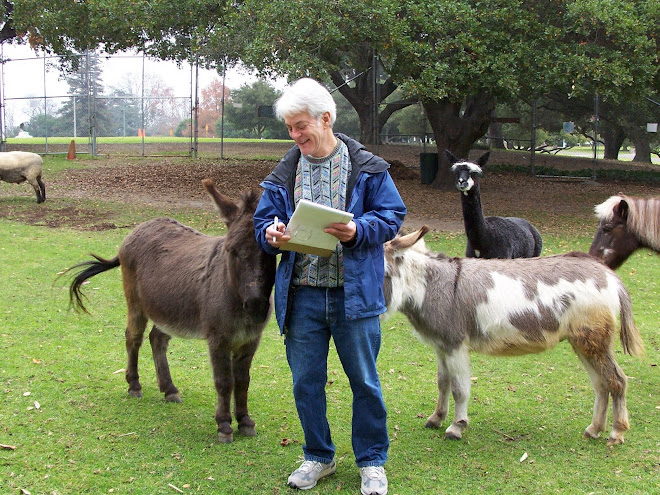
Interviewing the animals at Children's Fairyland in Oakland. L-R: Bobo the sheep, Gideon the miniature donkey, me, Tumbleweed Tommy the miniature donkey, Juan the alpaca, Coco the pony

Saturday, February 21, 2009

The Mean Season


(Above: Bill Brand. Photo taken from his blog.)

Another sign that the economy is going south: Chinese fortune cookies. I had lunch at Hunan Villa in Pinole last week, and my fortune read, "You shouldn't overspend at the moment. Frugality is important."
A few days later I was at Renee's Place in Albany, and the fortune read, "It is time to help a friend in need."
Wise advice on both counts. You know the ancient Chinese curse: "May you live in interesting times." Well, these times sure are interesting.
Growing up in the affluent but boring '50s, I romanticized the era of the 1930s, with its NRA parades and CIO organizing drives featuring Pete Seeger and Woody Guthrie leading striking workers in singing, "We Shall Not Be Moved." It seemed so thrilling compared to my time.
I told my parents I was jealous of them for having lived through such a heroic epoch, and their response was "Don't be. It was horrible."
I didn't understand what they meant then, but I'm beginning to understand now. We are entering a mean season.
Take the recent attempt in Congress to blame the woes of the auto industry on its workers. Or last week's rant on CNBC by business reporter Rick Santelli, who called foreclosure victims "losers" as traders on the floor of the Chicago Mercantile Exchange cheered his every word.
Look, we're all scared. Nobody likes going to bed every night worrying about tomorrow. And when people are under stress, it's tempting to turn on each other. Then things get even worse.
Families disintegrate. Spousal and child abuse increases, just when the social service agencies that could help the victims have their funding slashed.
Crime goes up, and the political pressure builds to spend less money on helping the poor and more on locking them up.
During the 1930s some even gave up on American democracy entirely. On the left, they joined the Communist Party or supported demagogues like Huey Long.
On the right, pro-fascist industrialists plotted to overthrow FDR and replace him with Gen. Smedley Butler, the most decorated Marine in American history. The plot collapsed when Butler, a true patriot, blew the whistle on them.
It's not a pretty picture, and I'm not looking forward to a repeat. So let's buy local, avoid scapegoating and try looking out for each other, OK?
That even includes the guy who gives you the one-finger salute in traffic. As a friend e-mailed me last week, "Be kinder than necessary because everyone you meet is fighting some kind of battle."
Finally, a personal note: My longtime colleague, Oakland Tribune reporter Bill Brand, died last Friday from injuries he sustained earlier this month when he was hit by a streetcar in San Francisco.
Bill was a sweet, gentle man and a great reporter. Whatever he covered, whether it was business, politics or his last beat, writing a beer blog called "What's On Tap," he did it superbly.
I will always think of him as the best Berkeley reporter that ever was, and I speak as someone who covered Berkeley for many years myself. There was nothing going on in this town that he didn't know about. There have been - and still are -some excellent reporters in Berkeley, but Bill was the gold standard.
Several Berkeley Police officers attended his funeral Wednesday, including Chief Doug Hambleton, who said, "Bill quoted me more accurately than any reporter I ever met."
I will miss him. And I'm not alone.

Monday, February 16, 2009

Having a heart


(Above: Dr. Young)
How would you feel if your child had a hole in her heart?
That was the catastrophe facing Elena Senotova of St. Petersburg, Russia, 20 years ago, during the waning days of the Soviet Union. Her little daughter, Maria - better known by her nickname, Masha - was dying painfully from this condition, one of the most common birth defects in the world. She was struggling for every breath, and her skin was turning blue from lack of oxygen.
If they had been living in America, it would have been no problem. Open-heart surgery on children had become routine by then.
But not in the USSR, where medicine was lagging decades behind the West. Every year, Elena begged the doctors to help Masha, and every year they turned her down because such surgery was beyond their ability.
In 1988 she was working as an interpreter at the first Soviet-American film festival, where she met one of the festival's organizers, Jo Ann McGowan of San Francisco, and told her Masha's story.
When McGowan got back home she contacted Dr. Nilas Young, who was chief of cardiac surgery at Children's Hospital in Oakland. Together, they arranged to have Elena and Masha flown here, and Young and his surgical team repaired the hole in Masha's heart.
"It was like night and day," says Masha. "After the surgery, I could run around like any other little girl. Before, all I could do is sit in the corner and read."
And that was that - or so they thought. But a reporter for TASS, the Soviet news agency, wrote a story about the operation, and within weeks Young was inundated with hundreds of letters from desperate parents all over the USSR, begging him to save their children, too.
"It would have been too expensive to bring all these kids over here, so it seemed to us that it would be more efficient for us to go there and teach our Russian colleagues how to do it on their own," says Young, who is now Chief of Cardiothoracic Surgery at UC Davis.
In 1990 Young and pediatric cardiologist Dr. Stanley Higashino led a team of 20 people on their first trip to Russia. The group included surgeons, cardiologists, nurses, technnicians and, of course, McGowan, who was proving to be a genius at cutting through bureaucratic red tape and scrounging state-of-the-art medical equipment.
And they've been back more than 50 times since then, performing surgeries and training their Russian counterparts, using the traditional American side-by-side teaching method.
Each operating room has an American surgeon and a Russian surgeon, an American anesthesiologist and a Russian anesthesiologist, American nurses and Russian nurses, and so on. And expert interpreters are always present to make sure nothing gets lost in the translation.
The program is now a non-profit organization called Heart to Heart. To date, more than 7,000 Russian children have been saved from certain death and, like Masha, are leading healthy and happy lives.
On Saturday night, Heart to Heart celebrated its 20th anniversary at a banquet at the Claremont Hotel. The guests of honor: Elena and Masha, who flew here from St. Petersburg for the occasion.
Sadly, two people were missing: Higashino and McGowan. He died from stomach cancer in 1991, and she died from a stroke in 1996, while she was on the job at a children's hospital in St. Petersburg.
But their legacy lives on in the thousands of children they helped save, starting with the very first.
"Tony Bennett may have lost his heart in San Francisco," says Masha. "But that's where I found mine."
To learn more about Heart to Heart or donate to its lifesaving mission, visit www.heart-2-heart.org.

Hail to the chiefs


C-SPAN just did a poll of 65 historians, asking them to rank the presidents. Here's the top 10:
1. Abraham Lincoln
2. George Washington
3. Franklin D. Roosevelt
4. Theodore Roosevelt
5. Harry Truman
6. John F. Kennedy
7. Thomas Jefferson
8. Dwight D. Eisenhower
9. Woodrow Wilson
10. Ronald Reagan
(LBJ was #11.)

Personally, I think first five are right on, but the I have some quibbles with the second five. Kennedy gets points for the moon shot and the Cuban missile crisis, but does that really compare with what LBJ did on civil rights? Jefferson wrote a helluva declaration, and I give him his props for the Louisiana purchase, but his embargo during the Napoleonic wars ruined the economy. Ike was OK but he didn't really do much. Wilson was a racist who segregated the military and the civil service, and his pig-headed self-righteousness did more to sink the League of Nations than anything his enemies ever did. And Reagan? Well, we're reaping the results of his deregulation of the economy and ignoring of the environmental crisis.
On the whole, we've fared better with our first ladies. Who wouldn't prefer Pat to Dick, Grace to Calvin or, for that matter, Laura to W?
Here's my top 10:
1. Eleanor Roosevelt, of course
2. Dolley Madison (She was the gold standard before Eleanor came along.)
3. Jackie Kennedy
4. Betty Ford
5. Abigail Adams
6. Lady Bird Johnson
7. Grace Coolidge
8. Lucy Hayes
9. Pat Nixon
10. Frances Cleveland
And here's my list of best ex-presidents:
1. George Washington (for becoming an ex-president instead of running for a third term, which he could have won easily. He wanted to hand his office to a live successor, creating the precedent of peaceful succession. Also freed his slaves in his will - the only slaveholding founding father to do so)
2. John Quincy Adams (anti-slavery crusader)
3. Jimmy Carter (peace negotiator and general do-gooder)
4. U.S. Grant (wrote a fantastic memoir that's still a great read, even today, and the gallantry with which he faced his final illness was incredibly moving.
5. Jefferson & Adams (tie for patching up their feud and dying in tandem on such a symbolic date - the 50th anniversary of the Declaration of Independence)
6. William Howard Taft (finally achieving the only office he really wanted, Chief Justice, he did a credible, if conventionally conservative, job)
7. Ronald Reagan (most graceful exit ever)
8. Herbert Hoover (I'm not crazy about his support of the America First movement, but he gets points for the Hoover Commission)
9. Richard Nixon. (OK, so his entire post-presidential career was a shameless attempt to spin his Watergate crimes, and, as Harry Truman said of him, "Every word out of his mouth was a lie, and that includes 'and' and 'the.'" But you have to admit it was entertaining.)
10. George W. Bush (out of sheer relief that he's finally gone. It's like beating your head against the wall: It feels so good when you stop.)
And the three worst:
1. John Tyler (sided with the Confederacy, even getting elected to the first Confederate congress. Where I come from, that's called treason.)
2. Franklin Pierce (also sided with the Confederacy and conducted secret correspondence with Jefferson Davis throughout the war)
3. Millard Fillmore (later ran for president on the ticket of the anti-Catholic American Party, better known as the Know Nothings.)

Thursday, February 5, 2009

Coco R.I.P.


(Above: Bobo and Coco. Photo by Annie Wong.)

Sad news for everyone who has ever loved the animals in the petting zoo at Children's Fairyland in Oakland: Coco the pony died Jan. 17 of old age. She was 38, which is way older than her normal life expectancy.
That's true of most of the animals at Fairyland: They live much longer than average because of all the tender loving care they get there.
And Coco's final months were as happy as human effort could make them. She retired last June, along with her devoted companion, Bobo the sheep. Their caregiver, Yvonne Backman, decided that Coco's arthritis would be helped if she had a new home where she could roam freely all day, which she couldn't do at Fairyland.
It was vital to place Bobo along with her because Bobo was so devoted to Coco, he'd go into a panic whenever he lost sight of her - which happened pretty often, because he's nearly blind. He'd utter pitiful little bleats of terror until somebody led him over to her.
It wasn't easy finding a home that would take them both, but Backman finally found the perfect place: Goats R Us in Orinda, which rents goats to UC Berkeley and the East Bay Regional Park District to clear brush from the hills during fire season.
Goats R Us's owner, Terri Oyarzun, bent over backward to make sure Coco and Bobo's transition to their new home would be as easy as possible.
They had the same food, same supplements, same feeding time, same wakeup time and same bedtime that they had at Fairyland. No detail was overlooked, including placing Coco's feed bucket on the same spot where it had always been.
Coco loved her new home so much, she slept every night outdoors under the stars - another thing she couldn't have done at Fairyland. As always, Bobo kept her company, even though he would rather have been indoors. (Since she died, he's slept inside his shed every night.)
"She got to be a pony again," said Oyarzun. "She didn't have any more responsibilities to the public. But she still got visits every week from Yvonne and the other folks at Fairyland, so she never felt like her old friends had forgotten her. She had the best of both worlds."
Her passing was peaceful, and the ever-faithful Bobo was with her when she died.
That was therapeutic for him because it helped him understand that she was really gone forever, not just moved to another shed or pasture.
Everyone was worried about how he'd take Coco's death, but a minor miracle has occurred: Bobo has made a new friend!
His new buddy is an eight-year old chestnut horse named Piggy B, who lives in the adjoining pen. The two of them spend hours and hours every day at the fence, communing and commiserating with each other. It's a win-win situation all around.
Kudos to Backman. Kudos to Oyarzun. Between them, they made Coco's final days happy ones. It was no less than she deserved.
If you've never been to Fairyland, you've really missed out. It's an oasis of gentleness, peacefulness and calm in the middle of Oakland, where everything is attuned to the scale and sensibilities of a little child.
And now Fairyland is making it less expensive, which is a blessing in this terrible economy. Instead of forking out $7 each time for each adult and child, you now can buy a 12-month pass for only $75 that will give you - plus up to three kids - unlimited admission.
You'll also get free guest passes, special glow-in-the-dark Fairyland Magic Keys for each child, free admission to the Jack O'Lantern Jamboree in October and Fairy Winterland in December, free cotton candy for the kids at the Johnny Appleseed Café and much, much more.
And while you're there, be sure and visit Coco and Bobo's successors, Dori the pony and Twinkle the lamb, in the petting zoo.

Reach Martin Snapp at catman@california.com.

Monday, February 2, 2009

Lincoln the genius


(Above: Elmer Ellsworth)

For years, some academics have been debating about who really wrote Shakespeare's plays. They argue that a country bumpkin from Stratford-on-Avon never could have penned such sophisticated works.
But I think Shakespeare wrote them himself. Genius trumps everything.
The best example is the man whose 200th birthday we're going to celebrate next Thursday, Abraham Lincoln. (Also born on that same day: Charles Darwin. It was the greatest twofer until 1965, when the Chicago Bears drafted Dick Butkus and Gale Sayers in the same round.)
At least Shakespeare made it through high school. But Lincoln had less than a year of formal schooling. Yet he wrote the greatest speeches in American history, including his masterpiece, the Second Inaugural.
I don't mean the most famous passage - " with malice toward none, with charity for all" - as much as the hair-raising language that precedes it:
"Fondly do we hope, fervently do we pray, that this mighty scourge of war may speedily pass away. Yet, if God wills that it continue until all the wealth piled by the bondsman's two hundred and fifty years of unrequited toil shall be sunk, and until every drop of blood drawn with the lash shall be paid by another drawn with the sword, as was said three thousand years ago, so still it must be said 'the judgments of the Lord are true and righteous altogether.'"
It took a lot of guts to tell a country that had just lost 650,000 young men that it deserved to suffer because of the sin of slavery.
But Lincoln knew personally what suffering was like. He lost Elmer Ellsworth. In 1858, at the age of 20, Ellsworth was hired as a clerk in Lincoln's law office.
In no time flat, he moved in with the family and became Lincoln’s surrogate son.
In 1860, with war on the horizon, Ellsworth quit his job and went from city to city, organizing regiments of soldiers.
The day after Ellsworth and his soldiers arrived in Washington, Lincoln invited him to lunch at the White House. Standing on the front porch, they could see a Confederate flag flying atop the Marshall House hotel in Alexandria, just over the river on the Virginia side.
Indignant, Ellsworth took a squad of soldiers to tear it down. They went up to the roof, removed the rebel banner and started back down the stairs.
Suddenly, the hotel’s proprietor, James W. Jackson, stepped out of the shadows and emptied a shotgun into Ellsworth's chest, killing him instantly. Jackson, in turn, was killed by the enraged soldiers.
The whole North went into mourning. Public buildings in every city were draped in black crepe. Hymns and dirges were composed in Ellsworth’s honor.
Lincoln gave him a state funeral in the East Room, sobbing as he stood over the open coffin, tears falling from his cheeks onto the body.
For years, I tried to find out where the Marshall House used to stand. And the last time I visited Washington, I finally found it. There's a Holiday Inn on the site now, but on the wall is this plaque:
"The Marshall House stood upon this site, and within this building on the early morning of May 24, 1861, James W. Jackson was killed by federal soldiers while defending his property and personal rights, as stated in the verdict of the coroner’s jury. He was the first martyr to the cause of Southern independence. The justice of history does not permit his name to be forgotten. Erected by the sons and daughters of Confederate soldiers."
Ellsworth wasn’t even mentioned! As it turns out, he and Jackson were the same age - only 24. Ellsworth was one of the first deaths on the Northern side. Jackson was one of the first on the Southern side.
And there were 650,000 more to come.

Reach Martin Snapp at catman@california.com.

Saturday, January 24, 2009

How Dr. Moyce Spent Inauguration Day


What did you do on Inauguration Day? Dr. Andrew Moyce of Oakland spent the day doing his civic duty: showing up for jury service at the Alameda County Courthouse.
He was ordered to be there by 8:30, with stern warnings about possible fines if he was late.
"The parking lot was full by the time I arrived at 8:15, and I had to find another lot across the street," he says. "That lot required a prepay ticket from a very slow machine, so I joined the line of a dozen or so fellow jurors waiting to pay.
"After that, a hurried walk all the way around the courthouse to find the only open entrance, followed by the security check. I got to the jury room, breathless, at about 8:45 and handed my papers to the admitting clerk."
The potential jurors - about 200 people, ranging in age from 18 to senior citizens - were ushered into the waiting room. Television sets were mounted on the pillars around the room, all tuned to the inauguration.
"The first thing that struck me was the respectful silence of the people in the room. The clerk could be heard checking people in at the door, and an occasional person talked quietly on a cell phone while people in the vicinity frowned disapproval, but overall there was an ecclesiastic silence.
"On television, Diane Feinstein had just started the ceremonies, and she held the rapt attention of everyone in the room. All eyes were on the nearest TV, and the seats with backs to the TV were empty, while several of us stood around the edges. Even during the two musical performances, no one spoke."
When the time for the oath of office arrived, Feinstein asked everyone at the ceremony to stand.
"From across the jury room a middle-aged African American lady - I think she was a clerk - called out, 'C’mon people, this is history! Stand up!'
"As she moved into the crowd, gesturing with her arms, it was plain that she was not to be denied. Within seconds, all of us were on our feet. After the oath was administered, complete with flubs, our room filled with applause, punctuated with loud whoops, and several people were in tears.
"An older white man softly applauded as the new president thanked the outgoing president for his service to the country. During his comments on upholding the Constitution, as the camera focused in on an uncomfortable-looking Mr. Bush, there were scattered outbreaks of derisive laughter. When Mr. Obama acknowledged that we are a nation of various religions - and non-believers, too - a very Berkeley-looking lady in jeans and a flannel shirt clapped alone.
"When the speech was over there was more applause from our group, and not a few handshakes and hugs were shared. All stood in formal attention as the choir sang the National Anthem, and several of us joined in.
"The mood was broken only when the clerk interrupted the broadcast to remind us that we were here for a purpose, and he started the first roll call.
"It finally occurred to me that no court business would take place during the ceremony, as the judges were probably sequestered in chambers with their own TV sets. Time at the courthouse seemed at a standstill until the business of federal government was accomplished.
"After the second roll call my name still had not been called, and those who remained in the room - about a third of the original crowd - were thanked for our service and dismissed.
"I left feeling that I had literally been swept into participation in history. Jury calls have a way of taking us out of our comfortable routines, and, after a frantic start, the day turned out in a way I hadn’t planned. But somehow when it was over, it seemed just right."

Tuesday, January 20, 2009

Hail to the chief!


The 19th Century German Chancellor Otto Von Bismarck once said, "God looks after drunks, little children and the United States of America."
If you ever needed proof of that, look at what happened today. With our whole world unraveling everywhere we look, along comes the perfect guy to deal with it.
Coincidence? I don't think so.
Shortly after Franklin D. Roosevelt was inaugurated in 1933, Justice Oliver Wendell Holmes went to the White House to check out the new president.
He came away much relieved. FDR, he said, had "a second-rate intellect." But, he added, it didn't matter because FDR had a first-rate temperament.
But we're even luckier. Our new president has both a first-rate intellect and a first-rate temperament. The last one we had with that combination was Lincoln. Like Lincoln, he has that rarest of gifts: the ability to step outside himself and look at himself objectively.
He's like a chess master, always thinking two or three moves ahead. Even during the hottest moments of the campaign, he was keeping one eye on how he would govern.
That's why he's able to brush off past slights and surround himself with people who have said really awful things about him. He's not threatened by their intellects, and he's not threatened by their ambitions. All he cares about is whether they can help him save our country.
And that's why the young people love him so much. They think of him as their best hope to move America past the issues of the 20th Century and start dealing with the issues of the 21st.
I don't think they fully appreciate the significance of having our first African American president because they're looking forward, not back. Heck, they don't even see him as black; they see him as multi-racial, which reflects the world they live in.
And they're right. Black father, white mother, growing up in Indonesia and Hawaii - he's our first global president. Everyone in the world can identify with him, and he can identify with them.
For the first time since 1963, the coolest guy on the planet, bigger than any rock star, the idol of every teenager from Beijing to Baghdad, is the President of the United States. How cool is that?
But I can't help one last glance backward to when I was a kid, when separate - but definitely not equal - was the law of the land.
It was worst in the South, where it was open season on blacks. A white could bully, cheat, rape, even kill blacks; and nobody would lift a finger.
But the shame wasn't confined to the South. Even in liberal Berkeley - Berkeley! - the schools weren't fully desegregated until September 1968, five months after Martin Luther King was killed.
That history was implicit in everything that happened Tuesday, especially in Rev. Joseph Lowery's benediction. He was with King from the very start, succeeding him as head of the Southern Christian Leadership Conference.
He began the prayer with a quote from a 109-year-old song that I'll bet every African American in the country recognized immediately: "Lift Ev'ry Voice And Sing," aka "The Negro National Anthem":
"God of our weary years/God of our silent tears/Thou who has brought us thus far on the way/Thou who has by Thy might/Led us into the light/Keep us forever in the path, we pray."
As I heard those words, the images of Emmett Till, Medgar Evers, those four little girls in Birmingham and so many others came flooding through my mind.
Not that racism is dead. As usual, the black guy had to be twice as good to get the job. But something wonderful is happening in this country.
President Obama, as usual, said it best: "What the cynics have failed to understand is that the ground has shifted beneath them."
Our president has given us our marching orders. Be the change.