A columnist of heart and mind

A columnist of heart and mind
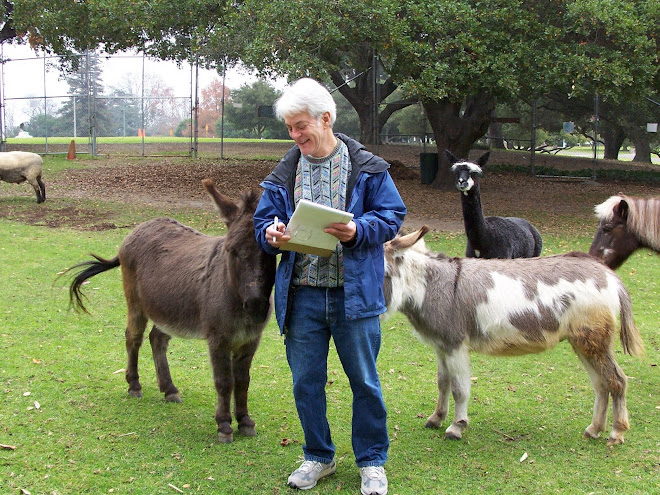
Interviewing the animals at Children's Fairyland in Oakland. L-R: Bobo the sheep, Gideon the miniature donkey, me, Tumbleweed Tommy the miniature donkey, Juan the alpaca, Coco the pony

Sunday, July 22, 2012

Next Generation's Jazzwomen

(Last year's campers after they were told, "Act silly.")
Last March I previewed an event at Berkeley High School called JazzGirls Day, when girls could play with and learn from some of the most prominent women jazz musicians in the Bay Area, including saxophonist Jean Fineberg and trumpeter Ellen Seeling, the founders of the Montclair Women's Big Band.
I'm pleased to report the event was a huge success. Attendance exceeded all expectations, and everyone had a great time.
I know because some of the girls thoughtfully emailed me afterwards and told me about it.
I also heard from their mothers and fathers, who said their daughters were greatly empowered by the experience.
"Not only did she learn more in one day than she did in the past year, it was the first time people told her she can play jazz just as well as boys," said one mom.
Well, girls, if one day was so much fun, how'd you like to do it for a whole week?
Many of the same musicians who participated in JazzGirls Day – including Fineberg and Seeling - will also be on the faculty of the 4th annual Jazzschool Girls' Jazz & Blues Camp, which will take place at the Jazzschool in downtown Berkeley from August 6-10.
From Monday through Thursday, the girls will take a variety of electives, including jazz combo, blues & funk, percussion, songwriting, improvisation, roots (aka gospel), vocalizing, Latin music and big band. Each girl will also get an individual one-on-one lesson.
The student/teacher ratio can't be beat: one professional musician for every three campers. And every day at lunch the faculty – including pianist Victoria Theodore of the Stevie Wonder Band and bassist Ruth Davies of the Elvin Bishop Band – will play an hour-long jam session, and the campers will be encouraged to join in.
The week will climax with an all-band concert on Friday, when the campers will show off their new chops to their families, friends and – most importantly – themselves.
All girls – both instrumentalists and vocalists – grades 6-12 are eligible. All you need is some facility on your instrument (except for vocalists, who can be newbies) and the desire to develop your musical skills in a fun environment with other girls.
The change the experience causes in the campers is extraordinary. They start on Monday as sweet but shy young women. It's only natural for a kid that age to assume that all the other campers are old friends and she's the odd one out.
But Fineberg, who is camp director, dispels that notion on the first moment of the first day, when she says, "Everybody who doesn't know anybody else raise your hand." And they all raise their hands.
By Friday they're still sweet as ever. But shy? Fuggedaboutit! These are girls with attitude! There's nothing more heartwarming than a girl who says, "Yes I can!"
Tuition for the week is $475, although some financial aid is available. And you'll need an audition – not to decide whether you're accepted or rejected (everybody is accepted automatically), but to help them determine which skill level group to put you in.
For more information, call 510-758-2200 or visit jazzschool.org/girlscamp. To register and schedule your audition, call 510-845-5373 or visit jazzschool.org/girlsreg/
Have fun, girls. And don't listen to any moron who says girls can't play jazz. Yours is the "Girls rule!" generation.

Sunday, July 15, 2012

The Case Of The Missing Mallard

(Above: The Ugly Duckling, before and after)


What kind of person would steal a duck?
And not just any old duck, either. Last month, somebody swiped the Ugly Duckling statue that sat atop Aesop's Playhouse at Children's Fairyland in Oakland.
The cheery little blue duckling – really, a swan – is about three feet tall, with a steel framework covered by sculpting epoxy. Fairyland has posted notices asking for its return, no questions asked. But not a peep from the bad guys.
Memo to the thieves: I'm giving you the benefit of the doubt and assuming you did it as a prank. But you might not realize that it had serious consequences.
Fairyland can't afford to replace the duck. The money would have to come out of its basic mission: providing an inexpensive oasis of serenity in downtown Oakland where little kids can run free safely and just be kids.
The bottom line: You stole from children. How does that make you feel?
Not that I'm holding my breath hoping the crooks have a conscience. If the Ugly Duckling is going to be replaced, we'll have to do it ourselves.
The only place to get a new duckling is the same people who custom-made the original one: Scientific Art Studio in Richmond, the wizards who also made the Giant Mitt at AT&T Park and the giant bugs in "Starship Troopers II."
But it won't come cheap. This is a one-of-a-kind sculpture, and the usual price is $10,000 per. Scientific Art Studio is discounting the rate for Fairyland to $7,500, but that's still a considerable chunk of change.
If you'd like to contribute, you can do it online at
http://bit.ly/NzEZGB or by sending a tax-deductible check to Children's Fairyland, 699 Bellevue Ave., Oakland 94610, with "duckling" in the memo field.
                                           * * *
On a happier note, congratulations to The Lamplighters, the Bay Area's own Gilbert & Sullivan company, who are celebrating their 60th anniversary with a sparkling new production of G&S's masterpiece, "The Mikado."
I've said it before, but it bears repeating: The Lamplighters are the best Gilbert & Sulllivan troupe in the world, period.
That became apparent when the International Gilbert & Sullivan Festival was held in Berkeley a few years ago, showcasing G&S companies from around the world. It was almost embarrassing how much better The Lamplighters were than everyone else.
The singing was better, the orchestra was better, and so were the costumes and sets.
Most importantly, the actors actually acted, instead of just standing around waiting for their turn to sing – known in the trade as "park and bark."
If you haven't had the fun of discovering Gilbert & Sullivan yet, this production of "The Mikado" is a perfect place to start. As Robby Stafford of Oakland, who plays Pooh-Bah, says, "Sullivan's music is so beautiful, it makes Gilbert's lyrics even funnier. And Gilbert's lyrics are so tart, they make Sullivan's music seem even sweeter."
"The Mikado" will run July 27-29 at the Lesher Center for the Arts in Walnut Creek, August 4-5 at the Napa Valley Opera House, August 11-12 at the Mountain View Center For The Performing Arts, August 16-19 at the Yerba Buena Center For The Arts in San Francisco, and August 25-26 at the Bankhead Theater in Livermore.  You can get more information and buy tickets at www.lamplighters.org.

Monday, July 9, 2012

Bright College Years


(Above: Karl Marlantes speaking at our reunion)
A few weeks ago I attended my 45th Yale College reunion, and it was the biggest ever.
Literally. My classmates and I received souvenir windbreakers, but we ran out of size XLs within the first few hours.
But our class reunion was big in every sense of the word. We broke all attendance records, and we had the time of our lives.
It stretched over four days, but by day two I knew it was a success because I was starting to feel sad.
Many of my classmates felt the same way – happy because we were having such a great time but sad that it was drawing to an end.
And that's a pretty good metaphor for our lives. We're 67 years old, and while we're still having fun and are grateful that we're still here, we know it won't last forever. The actuarial tables don't lie.
I looked at my friends, and it broke my heart to realize that I'll never see some of them again. I just don't know which ones.
But it was precisely this sadness that made the moment so sweet. Knowing that we're going to die - some sooner, some later - made us more determined to savor the pleasure of each other's company while we still can.
Yale was a very different place the day we first arrived in the fall of 1963.
The most popular record on Billboard's Hot 100 was "My Son, The Folksinger" by Allan Sherman, and there were 16,000 American soldiers in Vietnam.
 On graduation day four years later, the most popular record was "Sgt. Pepper's Lonely Hearts Club Band," and there were half a million American soldiers in Vietnam.
Our class, which was all male, split almost down the middle on Vietnam. Forty percent joined the armed services. The rest of us fought a different fight – to stay out at all costs.
But we never talked about the war at any of our previous reunions. It was the elephant in the room that we all pretended not to notice because it was too painful.
This time, however, we decided to have one of our classmates, Karl Marlantes, as a speaker.
How could we not? He had just won a ton of awards for his novel, "Matterhorn," about his experience as a Marine second lieutenant in Vietnam, and he was already getting rave reviews for his new book, a non-fiction treatment of many of the same themes, titled "What It Is Like To Go To War."
This was the first reunion Karl had ever attended, and before the speech his wife Anne confided to me that he was apprehensive about what kind of reception he'd get.
What he got was a thunderous standing ovation that went on and on and on and on. His eyes brimmed with tears. So did many of ours.
That night, we started passing the hat among ourselves to create a scholarship in honor of Biff McKellip, our only classmate who was killed in the war. We hope to have it in place in time for our 50th reunion in 2017.
It never occurred to me that the reunion would turn out to be about healing the scars of Vietnam. But it did. And it felt so good.

Thursday, July 5, 2012

A Musician Of Note


(Above: Audrey Vardanega)
If you're looking for something really fun to do this month, you couldn't do better than the 38th annual Midsummer Mozart Festival.
Why am I such a fan? Partly, it's because Mozart is the greatest composer who ever lived. That's not meant as a knock on other great composers, from Bach to Ellington. I love their stuff, but nobody can touch Mozart. His music sounds like it was dictated by God. Theirs doesn't.
It's so good, you don't need to know anything about music to "get" it. Like the Beatles, you're hooked from the first note.
I also love the festival because of the quality of its orchestra and soloists. They're some of the best musicians in the world, including pianist Seymour Lipkin, tenor Christopher Bengochea, bass Kurt Eichelberger, and sopranos Rebecca Davis and Christina Major, all under the direction of one of the world's foremost Mozartians, Maestro George Cleve.
But for me, the biggest draw is 16-year-old phenom Audrey Vardanega, who will perform Mozart's Piano Concerto in G, K. 453.
I first heard Audrey play when she was only 13; and even at that age, she blew me away. Her technical proficiency was immaculate, of course, but her artistry went way beyond getting all the notes right.
Audrey is one of those rare musicians who can communicate not only the essence of the music, but also the sheer joy she takes in playing it.
Remember what Wynton Marsalis said about Count Basie in Ken Burns' "Jazz" documentary? "Basie would be swinging before he even played the first note." That's Audrey, too. She and the music – and the audience – are one.
I asked Cleve how good she was for her age. He laughed and replied, "Martin, she's good for ANY age!"
And the best part is that none of this has gone to her head. She's just a really nice kid who happens to have an extraordinary talent.
Make that talents, plural. As good as she is on the piano, she's also fantastic on the violin.
She's also an accomplished composer with dozens of sonatas, suites and musical scores to her credit, including an original ballet called "Zingara," which will be performed this fall with the Academy Orchestra in San Francisco.
And as if this weren't enough, she's also a talented actor who has interned with ACT in San Francisco.
From an early age, people have been pulling her in all directions. The piano people keep telling her to dump the violin and be a pianist. The violin people tell her to dump the piano and be a violinist. And the theater people tell her to dump them both and be an actor.
To her credit, Audrey doesn't want to be any of those things. She has a loftier ambition: She wants to be Audrey. She doesn't want to be defined by her talents.
That's why she goes to College Prep in Oakland instead of a music conservatory. As she told me, "I want people to judge me by my personality, not my piano playing."
But don't take my word for it; go hear her for yourself. The festival will run from July 19-29 at locations in Berkeley, San Francisco, San Jose and Sonoma County. Visit midsummermozart.org to purchase tickets and get information about specific programs.

Monday, June 25, 2012

The Maid Of Gettysburg


(Above: Jennie Wade)
Next Sunday, Monday and Tuesday will mark the 149th anniversary of the Battle of Gettysburg, the turning point of the Civil War.
I visited Gettysburg a few weeks ago, seeing places whose names still resonate in the national memory: The Wheat Field. The Peach Orchard. Little Round Top. Devil's Den.
But the place that moved me the most was the Jennie Wade House at 548 Baltimore Street.
Think how overwhelmed the 2,400 residents of Gettysburg must have felt when their little town was invaded by 93,000 Federals and 75,000 Confederates slugging away at each other in their front yards.
When the battle broke out, 20-year-old Jennie was helping her mother care for her sister Georgia, who was bedridden after giving birth a few days earlier.
The Federals formed a skirmish line behind the house, exchanging fire with the rebels two blocks away.
Moved by compassion and patriotism, Jennie baked bread for them and brought them water. It was dangerous work, but she said, "If there is anyone in this house that is to be killed today, I hope it is me, as Georgia has a little baby."
On the morning of Day Three she was in the kitchen, kneading dough for more bread, when a Confederate bullet smashed through the front door and pierced her heart, killing her instantly.
Her mother, who was taking loaves out of the oven, turned around and saw Jennie sink to the floor.
In shock, she staggered to the bedroom and told Georgia, "Your sister is dead."
Georgia let out a scream, which alerted the soldiers outside. They burst through the door, sized up the situation, and decided they had to get the family out of there as soon as possible.
They led the survivors – Mrs. Wade, Georgia, her newborn baby, Jenny's little brother Harry, and a six-year-old neighbor boy named Isaac - through the rear of the house into the cellar, where they might find some protection from the gunfire.
And there they stayed for the next 18 hours, with Jennie's body lying on a wooden bench beside them, while the battle raged above their heads.
When they finally emerged, the house was pockmarked by more than 150 bullet holes, which are still there today. (So is the hole in the front door from the bullet that killed Jennie.) The horror and terror they must have experienced during this ordeal is unimaginable.
They buried Jennie in the front yard, with dough from the bread she had been making still on her fingers.
The Civil War turned brother against brother, friend against friend. Two Gettysburg boys named Jack Skelly and Wes Culp, best friends since childhood, chose opposite sides – Jack fought for the Union and Wes fought for the Confederacy.
They were reunited two weeks before the battle, when Jack was wounded and captured by Confederate troops. Wes found out and rushed Jack to a hospital, where he nursed him night and day.
But it was no use. Jack died from his wounds. But before he died he asked Wes to deliver a message to his sweetheart in Gettysburg.
Wes tried his best, but he was killed on the second day of the battle before he found her.
But even if he had lived, he wouldn't have been able to deliver the message. Because Jack's sweetheart was Jennie Wade.

Sunday, June 17, 2012

Fun Summer Reads

School's out for the summer, and once again our children are wondering what to read for fun, now that they don't have to read anything for schoolwork.
Wonder no more, kids. Here, courtesy of Jen Ammenti, the librarian at Redwood Day School in Oakland, is our annual Ms. Ammenti's Summer Reading List.
Kindergarten: "The Duckling Gets a Cookie" by Mo Willems, "Chloe" by Peter McCarty, and "A Sick Day for Amos McGee" by Philip Christian Stead.
First Grade: "Toys Come Home: Being the Early Experiences of an Intelligent Stingray, a Brave Buffalo, and a Brand-New Someone Called Plastic (Toys Go Out)" by Emily Jenkins, "Bink and Gollie, Two for One" by Kate DiCamillo, and "I Want My Hat Back" by J. Klassen.
Second Grade: "The Hero's Guide to Saving Your Kingdom" by Christopher Healy, "Bad Kitty for President" by Nick Bruel, and "Wonderstruck" by Brian Selznick.
Third Grade: "The Trouble with Chickens: A J.J. Tully Mystery" by Doreen Cronin, "The Year of the Book" by Andrea Cheng, and "Tua and the Elephant" by Randal Harris.
Fourth Grade: "The Birchbark House" by Louise Erdrich, "Winterling" by Sarah Prineas, and "Summer of the Gypsy Moths" by Sara Pennypacker.
Fifth Grade: "The Game of Silence" and "The Porcupine Year," both by Louise Erdrich, and "It Happened on a Train" by Mac Barnett.
Sixth Grade: "Wonder" by R. J. Palacio, "One Crazy Summer" by Rita Williams-Garcia, and "Breaking Stalin's Nose" by Eugene Yelchin.
Seventh Grade: "Shooting Kabul" by N. H. Senzai, "Middle School: Get Me Out Of Here!" by James Patterson, and "Crow" by Barbara Wright.
Eighth Grade: "Between Shades of Gray" by Ruta Sepetys, "The Hobbit" by J.R.R. Tolkien, and "The Girl Is Murder" by Kathryn Miller.
And here are her top picks:
For Emerging Readers: "The Trouble with Chickens: A J.J. Tully Mystery" by Doreen Cronin. "Cronin's stories are always so much fun to read aloud because the giggles never stop. You can't help but love the characters immediately and wonder what will happen next."
For Middle Readers: The Birchbark House series by Louise Erdrich. "You cannot help but feel transported back in time to the westward expansion of the United States through the eyes of a young Ojibwa girl. For lovers of 'Little House of the Prairie,' these books will offer another perspective of the same time period."
For Young Adults: "Between Shades Of Gray" by Ruta-Sepetys. "Definitely not a light read, but one that will move you to tears and open your eyes to the true horrors of war. Sepetyus does an incredible job of keeping hope alive throughout the novel. Just when you think the characters can't take any more, they endure."
Incidentally, I talked with N.H. Senzai, the author of "Shooting Kabul," which tops Ms. Ammenti's seventh grade list.
Her real name is Naheed Senzai. "Shooting Kabul" is based on her husband's experiences as a little boy growing up in war-torn Afghanistan.
So why does she bill herself as "N.H." instead of Naheed?
"It's a branding thing," she explained. "Why do you think J.K. Rowling is called J.K. instead of Joanne? Because studies have shown that little boys are reluctant to pick up a book if they think it's been written by a woman."
We've come a long way, but we still have a long way to go.

Tuesday, June 12, 2012

You're A Mean One, Mr. Grinch


Uh oh. The Grinch has struck again.
This time, the victim is a reader who wrote me about an incident last Wednesday in their quiet neighborhood in the Berkeley hills.
Her husband was cleaning out the garage, and when it came time for lunch he left some of the stuff in the driveway while he ducked inside for a snack.
When he came back, everything was gone.
Most of the stolen items can be replaced, but not the most precious possessions of all – the family Christmas ornaments, lovingly handmade and collected over three generations.
Gone was a whole village of little ceramic buildings, little people, little angels and, of course, a little Santa.
Gone were the intricate locomotive ornaments (her husband is a train buff) and miniature musical instruments. (He also plays the clarinet.)
Gone was the lobster ornament they brought from New England and the extremely fragile 19th Century ornaments that their former landlady gave them back in the 1960s.
"They had come with her parents on a ship around the Cape, before there was a Panama Canal," she wrote me.  "We always took such care to avoid dropping those."
But what hurt the most were the simple little ornaments that she made over the years with her children, and then her grandchildren.
"They were homely little ornaments made with love, and they have no value to anyone but us," she wrote. "I don't think I can bear this any longer, so I'll stop now."
She managed to keep it together when she called the kids to tell them what happened.
"But later, when my granddaughters called to say how sad they were for what had happened, I just burst into tears over the phone. I thought of all the traditions we had built up over the years, and I felt that's what had really been stolen."
None of the neighbors saw or heard anything, so it's doubtful the police will be able to catch the crook. So her 8-year-old granddaughter Casey is appealing to a higher authority:
"Dear Santa Claus, I need you to do a favor for me . . . And it's not a present for me. It's a present for someone else. My grandma and grandpa. And it's a special gift. So they were cleaning out their garadge and they put EVERY single Christmas thing out side and then in just one hour it was all gone. So hears the favor. If you can get most of it back that would be soooooooooooo AMAZEING!  Love, Casey
"P.S. Please!"
Meanwhile, Casey's grandma is turning to somebody more mundane: me.
"If the person who took our things is reading this, would you let Martin Snapp know if there is any way we can get back that one box of ornaments?" she wrote. "It would mean the world to me, our children, and our grandchildren."
Memo to the thief: Email me at the address below or call 510-748-1666 and leave a message. Here's a rare chance to right a wrong you've done.
And the next time you think of stealing something, ask yourself: Is the piddling little money you might get really worth having something like this on your conscience?