A columnist of heart and mind

A columnist of heart and mind
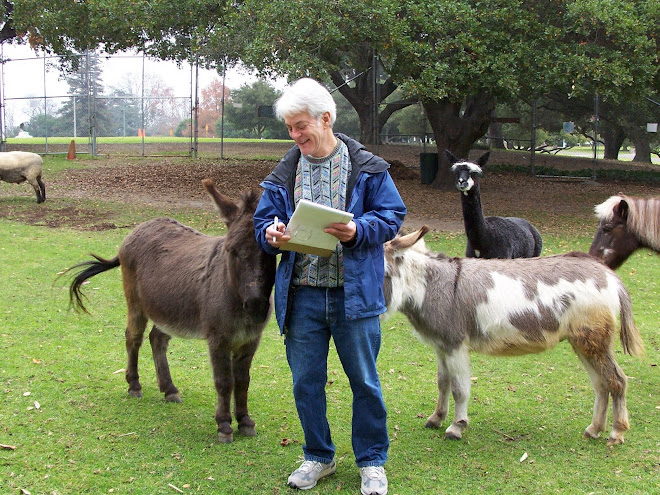
Interviewing the animals at Children's Fairyland in Oakland. L-R: Bobo the sheep, Gideon the miniature donkey, me, Tumbleweed Tommy the miniature donkey, Juan the alpaca, Coco the pony

Sunday, February 10, 2013

Reading For Fun


When I was a kid, the standard punishment if you misbehaved in school was to make you do extra reading. And it sent a clear message: Reading is a drag.
But times have changed. These days at Glenview Elementary School in Oakland, reading is treated as a reward. And the message is equally clear: Reading is fun.
On March 1 (Dr. Seuss's birthday), Glenview will celebrate its 15th annual Read-a-Thon. For one day the kids will be allowed to put aside their schoolwork and do nothing but read for pleasure.
Some kids will bring their favorite books from home; others will choose books from the school library.
Many of the youngest ones will come to school in their pajamas, dragging their teddy bears, sleeping bags and books behind them. They'll make "forts" in the middle of the classroom out of blankets and chairs, then climb inside and read, read, read to their little hearts' content. It's beyond cute.
Every year some outsiders, including Chronicle columnist Jon Carroll and me, are invited to come in and read aloud to the children; although if truth be told, the kids are far more impressed by the people they consider REAL celebrities: Oakland firefighters and paramedics (who bring their search-and-rescue dogs for the kids to pet) and student-athletes from Cal.
 As usual, I'll read from one of my Freddy the Pig books, which I consider to be on a par with "Charlotte's Web" and "Stuart Little," only not as dark. (Nobody dies in a Freddy book.)
The Read-a-Thon is the culmination a two-week period that starts now, during which the kids will fan out through the surrounding neighborhood and ask people to sponsor them by making donations to the school PTA. The kids will keep careful logs of how much they read each night, and the sponsors will donate accordingly.
Every effort is made to protect the kids' safety: They must be accompanied by an adult they know personally, and they can only knock on doors of people they know personally.
Once again, third grade teacher John Miller is offering his students an extra incentive: If every kid in the class reads at least 30 minutes a day, and if the class as a whole raises at least $3,000 for the PTA, he'll let them watch while he gets his head shaved.
And once again, several neighborhood businesses are rallying around the Read-a-Thon. On Sunday, Feb. 24, Ultimate Grounds will give away free coffee and a bagel to anyone who makes a donation. And Savemore Market will sell coffee at the school during the Monday morning drop-offs and donate the proceeds to Glenview.
The fundraiser is more desperately needed than ever this year because the school district has just announced that it's going to cut Glenview's budget by $124,000.
That would eliminate such vital programs as music, drama, science, physical education, field trips, computer upgrades, playground supervision and emergency preparedness, unless the PTA can come up with enough money to fill the gap.
It's a shame our kids have to beg for money to fund their education. But that's what happens when you starve the schools, as we have since 1978, when Prop. 13 was enacted and California's public schools went from the best in the country to among the worst.

Love Stories


(Above: Sarah and John Churchill, the first Duke and Duchess of Marlborough)


I really like Valentine's Day. I mean, how cool is it that we have a holiday that celebrates romantic love?
Love is the most powerful emotion there is. When it's going right, it can send you to the heights of exaltation. When it isn't, it can send you to the depths of despair.
For some people, love lasts only a moment. But for the lucky ones, it can last a lifetime.
Take John Churchill, the first Duke of Marlborough (and ancestor of Winston Churchill), and his Duchess, Sarah Jennings Churchill. They were the original power couple: He was the greatest military hero of his day, and she was the queen's best friend.
They fell madly in love the instant they met in 1655 and stayed that way until the Duke's death 50 years later, their passion undiminished. After the Battle of Blenheim in 1704, when they had been married for more than 30 years, Sarah wrote in her diary, "The Duke returned from the wars today and did pleasure me in his top-boots."
He couldn't even wait to take his boots off!
Then there was Harry Truman and his beloved Bess. In 1945, shortly after the Nazi surrender, Truman held a summit conference with Churchill and Stalin in Potsdam, Germany. After one session, the president got in his car to ride back to the castle where he was staying, and he gave a lift to a young Army public relations officer.
The officer said, "Mr. President, if there's anything you need, just let me know. Anything, you know, like women."
Truman glared at him and said, " Listen, son. I married my sweetheart. She doesn't run around on me, and I don't run around on her. I want that understood. Don’t ever mention that kind of stuff to me again."
"By the time we got home," remembered the driver, "he got out of the car and never even said goodbye to the guy!"
Another faithful husband was Paul Newman, who explained why he never cheated on his wife, Joanne Woodward: "Why go out for hamburger when you can get steak at home?"
Ditto for 19th Century British Prime Minister Benjamin Disraeli, who remarked to his wife, Mary Ann, on their 25th anniversary, "My dear, you've always been more of a mistress to me than a wife."
And I have a special place in my heart for American colonial poet Anne Broadstreet and her husband, Simon. In 1678 she wrote this poem:
If ever two were one, then surely we,
If ever man were loved by wife, then thee.
If every wife was happy with a man,
Compare with me ye women if you can.
But my favorite pair of lovers is Jerry and Betty Ford. One night, a few years after Betty kicked her longtime alcohol addiction and founded the Betty Ford Clinic, Jerry came home from a plane trip.
 "A nightcap will help relax you," she said. "Let me make you one."
"No thanks," he said.
"No, really, I don't mind," she said.
"I don't want one," he repeated.
"But we always used to have a nightcap before we went to bed," she reminded him.
"Yeah, and I never enjoyed it."
"Then why did you do it?" she asked, puzzled.
"Because," he said, "I didn't want you to drink alone."

Thursday, January 31, 2013

Walking Softly

 
The most popular resident of Oakland's Uptown district is Ballari the dog.
Ballari (Sanskrit for "walking softly") is a Siberian husky who lives with his owner, Sarah Kidder; her roommate, Uriah Duffy; and a black-and-white cat named Enkidu.
Everyone in the neighborhood looks forward to a visit when Sarah takes him on his daily rounds, including the firefighters at Fire Station No. 15; Jori, Justin and Mike at Inkwell Tattoo; Pete Ajemian, owner of Soja Martial Arts; Jeff Lee, co-owner of Oakland Mitsubishi; and the toddlers at Broadway Early Head Start, who jump up and down, wave and call, "Hi, Bell-Bell!" because "Ballari" is still too hard for them to say.
"He's the mascot of 24th Street," says neighbor Oscar Ayala. "Everyone loves him."
"He's turned this neighborhood into a really warm place," says Sophia Chang, owner of Kitchener, a commercial kitchen for food startups. "We’ve all become much better friends because of him."
One of Ballari's favorite stops is Oakland Mazda, where service advisor Helen Bermudez always has a stash of doggie treats waiting for him.
"He stops first at my colleague Jack Barbieri's desk to get his daily scratches," she says. "Then he marches over to the drawer where I keep my stash and leans his nose against it to tell me it's snack time."
But his favorite stop of all is the trendy restaurant/bar Mua, where he's the center of attention on Friday and Saturday nights,
"He's the biggest chick magnet in town," says bartender Dave Buckner.  "He brings joy to my co-workers, and the customers absolutely adore him. My security guard likes to pretend Ballari is his pet, he loves him so much."
All this is especially gratifying because Ballari was a very different dog when Sarah rescued him a year and a half ago.
He had spent the first six years of his life tied by a rope to a stake in somebody's backyard, completely neglected 24/7.
When Sarah first got him he wouldn't look you in the eye, didn't know how to play, and got confused whenever anyone tried to pet him.
Today, he's a sweet, gentle bundle of love, especially with little kids.
Sarah and Uriah had a lot to do with it, but so did the neighbors, who have watched him come out of his shell and blossom into the charmer he is today.
You've heard people say it takes a village to raise a child? It took a whole neighborhood to heal this dog.
And Ballari has returned the favor. When Sarah moved into the neighborhood three years ago, a cop warned her it was "borderline sketchy."
Not anymore it isn't, because everybody knows each other and watches out for each other. Uptown is like a small town in the middle of Oakland. And Ballari deserves some of the credit.
If this were fiction I'd stop here. But this is real life, and I regret to report that the owner of Sarah's apartment building has decided to move in himself, which means they'll have to find another place to live.
But that doesn't mean Ballari will lose his support system, or that they'll lose him.
"Hey, I still have a car," Sarah says. "We might not be able to get over here every day, but we'll definitely be here every week."

Monday, January 21, 2013

All Creatures Great and Small


(Above: Alan (l), Rick (r) and a happy patient)
Q: Why are veterinarians the best doctors?
A: Because they can't ask the patient, "Where does it hurt?"
It's an old joke, but there's more than a grain of truth in it. And the best vet I know is Dr. Alan Shriro, co-owner (with another great vet, Dr. Rick Benjamin) of Berkeley Dog & Cat Hospital, the oldest veterinary practice in the East Bay.
Berkeley Dog and Cat was founded in 1878 as an unnamed livery stable for Oakland Police and Fire Department horses. In 1907 it changed its mission to small animal practice and assumed its current name.
It's also the Tiffany's of local veterinary practices. It's no accident that some of the finest veterinarians in the Bay Area, including Dr. Gary Richter of Montclair Veterinary Hospital and Dr. Rene Gandolfi of Companion Animal Care Hospital in Castro Valley, got their start there.
Alan and Rick bought the practice from the legendary Dr. Fred Farr in 1976, and I started taking my cats to them a few years later. And they kept all of them alive far longer than I had any right to expect.
Partly it's because Alan is such a brilliant diagnostician. He diagnosed a tumor in my first cat, Eliza, without even seeing her. I happened to run into him at a party, and he asked how she was.
When I said she was meowing a little more than usual, he said, "Hmmmm. Better bring her in. That can be a sign of a thyroid tumor." Sure enough, it was. And because he caught it so early, it was easy to fix.
Best of all, he treats the patient, not the disease. He's guided by what's best for the animal, not what will make an interesting article in a medical journal.
And when the time finally comes to let go, as inevitably it must, he'll look you in the eye and level with you. And then he'll grieve with you afterward.
I've learned many things about animals from Alan, but the most important one is this: Go with the flow. I learned it by watching the way he treats his own pets, especially his late cat, Nigel.
Nigel was the fattest cat I ever met, and I mean obese - 30 lbs. at least.
"But you're a doctor, Alan" I said. "Aren't you afraid he'll get diabetes or a heart attack?"
"I figure it this way," he said. "I can have him absolutely miserable every day for 15 years. Or I can have him a year or two less, with every day a joy. It's a no-brainer."
Nigel died a few years later - of cancer, which meant Alan was right again: Putting him on a diet wouldn't have helped a bit.
Last week, Alan quietly retired without any fanfare. As much as he loved working, he's discovering how much fun it is to hang out with his wife Lorna, indulge his twin hobbies – skin diving and underwater photography – and play with the love of his life, his little granddaughter Flora.
But for me, it's the end of an era. I can never thank him enough for everything he's done for me, especially the kindness he showed me last spring when my cat Phoebe was dying. But let me say it anyway: Thank you, Alan.

Saturday, January 19, 2013

Big Sisters

            (Above: Kaia and part of her fan club)

Kaia Block Shepard of Richmond is a lucky little girl.
Her dad, Darren Shepard, is a marriage and family therapist intern. Her mom, Karen Block, is the former director of the Children's Theater program at Children's Fairyland in Oakland. She's the center of their world and the light of their lives.
And to top it off, Kaia, who is 20 months old, has a whole slew of surrogate big sisters who adore her. They're the kids who were in the program when her mom was running it. Now they're her babysitters.
I talked with five of them: Katie Roy, a sophomore at Merritt College; Alyssa Houston, a freshman at the University of Hawaii; and the Love sisters – Ana, a junior at Cal Poly; Alli, a senior at Oakland Tech; and Katie, a sophomore at Oakland Tech. And they all love Kaia to pieces.
"I have a whole album of pictures of her on my phone that I show to people all the time because she's so cute," says Alyssa. "She's just a little ball of joy."
And Kaia returns the sentiment. When Alyssa was back home over Christmas break, Karen drove Kaia to Fairyland for a reunion, and Kaia kept chanting, "Alyssa! Alyssa! Alyssa!" all the way to the park.
The girls – now young women – are also grateful to Fairyland, especially the Children's Theater program, for the difference it made in their lives.
"So much of what I am today goes back to Fairyland," says Ana. "It gave me the confidence to be who I am."
"It allowed me to imagine and believe, and without that I would not have the motivation I now have to go into teaching," says Katie Roy.
Every year, Fairyland chooses 30 kids ages 8 to 10, both boys and girls, for the Children's Theater program.
They perform fairy tales at Fairyland's Aesop's Playhouse, greet visitors to the park ("Hi. I'm Snow White. Welcome to Children's Fairyland.") and serve as Fairyland's ambassadors to the outside world by marching in the Oakland Holiday Parade and the Piedmont July 4th Parade.
"They always warned us to watch our step when we walked behind the horses," recalls Katie Love.
"But my favorite thing was the jobs you got to do between rehearsals and on your lunch breaks," says Allyssa. "Some of us helped feed the animals in the Corral, some of us painted flowers on the little kids' faces, and some of us volunteered at the puppet shows to make sure the little kids didn't cross the Magic Pink Line in front of the stage."
Why?
"We told them that if they got too close, the puppets would get scared and run off the stage, but the real reason was if they got any closer they'd be able to see the strings."
And that, to me, is the heart of the Children's Theater program: Big kids being nice to little kids.
"We just treated them the way Karen treated us," says Alli.
Fairyland will hold auditions for this year's Children's Theater program on Jan. 26 and 27. You can register online at www.fairyland.org, and call 510-452-2259 for more information.
Your child will learn a lot of performing skills. But more importantly, he or she will be entering a culture where it's cool to be kind.

Monday, January 7, 2013

Lift Every Voice and Sing


As we look forward to another Martin Luther King Jr. holiday, celebrate the 150th anniversary of the Emancipation Proclamation, and prepare to inaugurate our first African American president to a second term, I'd like to talk about the Civil Rights Movement and what it meant to my generation.
It was the inspiration for everything that followed, including the Latino, Asian, peace, women's, student, environmental and LGBT movements.
Our country is immeasurably better for all of them, but the Civil Rights Movement was the most important of all because it tackled America's original sin – the sin of slavery and its successor under a different name, Jim Crow.
Unlike other immigrants, Africans didn't come here looking for freedom or opportunity. They were kidnapped and transported here in slave ships.
As many as half died during the voyage, but the slavers still made a handsome profit. And if there was a storm, so much the better: They could simply toss the slaves overboard and get full reimbursement from the insurance companies for their lost "cargo."
Here in America, the slaves were at their master's mercy. If he wanted to rape them, kill them or sell their children, he could. And the government would back him up.
That was supposed to end with the Civil War, but it didn't. Historians like to say that the North won the war but the South won the peace.
When I was a kid in the 1950s segregation was the law of the land, and not just in the South, either.  Even liberal Berkeley didn't desegregate its schools until 1968.
But it was worst in the South. Working hand-in-hand with the elected authorities, the Ku Klux Klan was conducting a reign of terror against any African Americans who had the temerity to ask for their rights.
But, as Dr. King said, the arc of the moral universe is long but it bends towards justice. With no weapons to counter the KKK's armed terror, the brave pioneers of the Civil Rights Movement turned to the only tools they had: marches, sit-ins and anything else they could think of to hold a mirror up to the country and force the American people to watch what was being done in their name.
There was a terrible cost: beatings, bombings, arsons and countless murders. And instead of going after the Klan, the FBI went after Dr. King, even trying to drive him to suicide by threatening to reveal evidence of his extra-marital affairs.
But, like the early Christians, the blood of the martyrs was the seed of the church. On election night 2008, 40 years after Dr. King died, Barack Obama was elected our first African American president. And I cried tears of joy.
"I can't help it," I explained. "I've waited so long for this (expletive deleted) to be over."
I was ridiculously naive, of course. The hateful reaction to Obama's presidency over the last four years shows that racism is very much alive in America.
But he still won in spite of it. And that means racism might still be alive but it's far from well, especially among the younger generation.
So God bless Martin Luther King's memory. He not only made life better for African Americans, he made my life better, too.
Thanks, Dr. King.

Thursday, December 27, 2012

Have A Nice Day

In a New Year's tradition that goes back to 1976, the Unicorn Hunters, a group of language conservationists at Lake Superior State University in Michigan, have released their annual List of Words Banished From the Queen's English for Mis-Use, Over-Use and General Uselessness.
And the number one banished word of 2012 is - slight drum roll, please - "Amazing!"
"LSSU was surprised at the number of nominations this year for 'amazing' and surprised to find that it hadn't been included on the list in the past," say the Unicorn Hunters. "It seemed to bother people everywhere, as nominations were sent from around the US and Canada and some from overseas, including Israel, England and Scotland. A Facebook page – 'Overuse of the Word Amazing' – threatened to change its title to 'Occupy LSSU' if 'amazing' escaped banishment this year."
Coming in a close second was "baby bump," followed by "shared sacrifice," "occupy," "man cave," "the new normal," "pet parent," "win the future," "trickeration," "ginormous" and "thank you in advance." "
The Unicorn Hunters were founded by W.T. "Bill" Rabe, the school's public relations director, as a publicity gimmick to put LSSU on the map. And he succeeded beyond his wildest dreams. Over the years, the list has been expanded to include such groaners as "more bang for the buck" (1996), "bring the evil-doers to justice" (2002), "don't even go there" (1997), "teachable moment" (2010), "back in the day " (2008), "BFF" (2011), "chill out" (1980), "if ____, then the terrorists win" (2002), "no problem" (1980), "in my humble opinion" (1992), "baddaabing!" (1994), "politically correct" (1994), combined celebrity names such as "Brangelina" (2007), and "your call is very important to us" (1996).
After Rabe retired in 1987 the university, which knew it had a good thing on its hands, copyrighted the name and continued the tradition.
The very first phrase on the very first hit list in 1976 was "Have a nice day."
"It's not that we wish anyone ill," Rabe explained. "But this has become so overused, telephone operators use it even when people call funeral homes."
                                   * * *
Meanwhile, looking for a fun read to gratify your inner techno-geek? Have I got a book for you!
It's "Mad Science: Einstein's Fridge, Dewar's Flask, Mach's Speed, and 362 Other Inventions and Discoveries That Made Our World," featuring 365 of the most amusing anecdotes from Wired Magazine's popular "This Day In Tech" column.
The editor and author of many of the entries: San Francisco journalist Randy Alfred.
"Mad Science" ranges chronologically from January 1 (1538: First New Year of the Gregorian Calendar) to December 31 (1938: First breathalyzer test – just in time for New Year's Eve!).
In between are such gems as February 14 (1929: Al Capone uses cutting-edge technology – the Tommy gun – to wipe out the Bugs Moran mob), May 4 (1538: First use of the "@" symbol), August 24 (2006: Pluto demoted from planet status), and September 21 (1982: First use of the smiley-face emoticon).
The earliest entry is April 24, 1184 BCE: Greeks Use Wooden Horse to Defeat Trojans' State-of-The-Art Security.
"'This isn't a book meant to be read all at once from cover to cover," says Alfred. "Ideally, it should be read in short amounts while sitting down in the smallest room in the house."