A columnist of heart and mind

A columnist of heart and mind
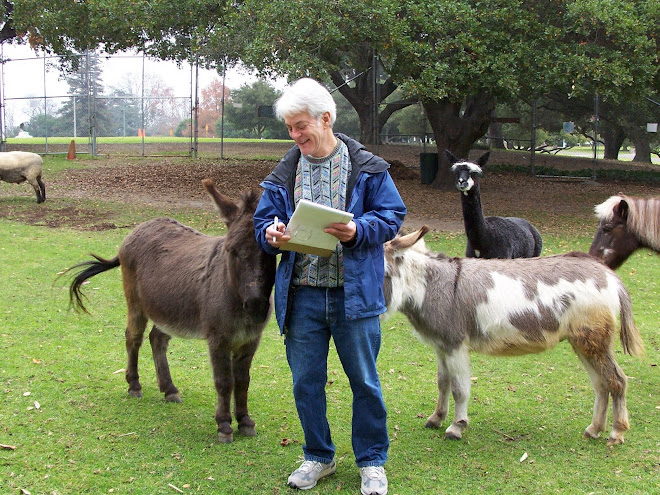
Interviewing the animals at Children's Fairyland in Oakland. L-R: Bobo the sheep, Gideon the miniature donkey, me, Tumbleweed Tommy the miniature donkey, Juan the alpaca, Coco the pony

Monday, January 17, 2011

Never Again


On Feb. 19, 1942, President Roosevelt signed Executive Order 9066, authorizing the military to arrest Americans of Japanese descent and force them into prison camps.
Practically overnight, 120,000 people on the West Coast - men, women, old people and little children - were ripped from their homes and sent to hellholes in the middle of nowhere.
They froze during the winter and broiled during the summer. And always there were men on gun towers with their machine guns pointed inward, ready to shoot anyone who tried to escape.
The government justified this on military necessity, claiming that these Americans couldn't be trusted not to help the enemy.
Of course, this was completely bogus. And the best proof is that the roundups were mostly confined to Japanese Americans on the mainland. Almost none of those living in Hawaii were interned, and for a simple reason: There were just too many them. They comprised a whopping 1/3 of Hawaii's population.
So with all those people running around scott-free in Hawaii, how many of them committed espionage or sabotage during the war? A big fat zero.
To the contrary, more than 15,000 Japanese Americans volunteered to fight for Uncle Sam. They formed the 442end Regimental Combat Team, which went on to earn more medals than any other unit in American history. But their families continued to languish in the camps.
But one man stood up against the internments. His name was Fred Korematsu, and he used a particularly American weapon: He took the government to court.
The case went all the way to the Supreme Court, which upheld his conviction for resisting internment. But 40 years later a UC San Diego professor uncovered a secret memo written in 1941 by none other than J. Edgar Hoover, who said there never was any danger from Japanese Americans.
Based on this revelation, Korematsu's conviction was overturned in 1983. During the trial the government offered him a pardon if he'd drop the case, but he turned them down.
"He always felt it was the government who should seek a pardon from him," his wife, Katherine, explained.
And history has vindicated him. In 1988 President Reagan signed a law that officially apologized for the detentions and gave each living survivor $20,000 in token reparations. In 1988 President Clinton awarded Korematsu a Presidential Medal of Freedom.
Fred Korematsu died in 2005, but not before he had the pleasure of seeing several schools throughout the state named after him.
Last fall, Gov. Schwarzenegger signed a law officially recognizing Korematsu's birthday, Jan. 30, as Fred Korematsu Day of Civil Liberties and the Constitution. It's the first day in history named after an Asian American.
The inaugural Fred Korematsu Day celebration will take place Jan. 30 at UC Berkeley's Wheeler Auditorium. Rev. Jesse Jackson will be the keynote speaker. Tickets can be purchased at tickets.berkeley.edu/
This isn't ancient history. Though Korematsu's criminal conviction was overturned, the 1944 Supreme Court decision is still on the books, ready to be dusted off and used against some other minority group someday.
And there are plenty of people out there - including some in positions of power - who would love to do the same thing to Muslims or Mexican Americans.
Philosopher George Santayana was right: Those who ignore history are condemned to repeat it.

Monday, January 10, 2011

Checkmate!


(Above: Josiah doing his thing)

Things looked bleak for Josiah Stearman of Martinez as he competed in the Grade-Level State Chess Championship at the University of the Pacific in Stockton on Dec. 4 and 5. After only three moves, he was already two pawns down.
But Josiah's opponent didn't realize that he was using a cleverly disguised version of the Danish Gambit. He was trading pieces for position.
On move number five Josiah pounced, taking a pawn. Then he took a bishop, and on the move after that he put his opponent's king in check.
Ten moves later it was all over. Josiah had won in a rout.
Now get this: Josiah is only seven years old. He went on to defeat four more opponents, winning the 2nd Grade State Championship.
Josiah was competing for the Berkeley Chess School, and he wasn't the only BCS student walk away with first prize. Ben Rood of Walnut Creek won at the 1st grade level, Joel Alcaraz of Vallejo won the 6th grade, Tudor Muntean of Danville won the 8th grade, Gabriel Lee of San Ramon won the 10th grade, and Rusian Bulguchov of Alamo won the 12th grade.
Besides the first place winners, many BCS students placed in the statewide top 10 for their grade.
The Berkeley Chess School serves students at 150 schools throughout the Bay Area. Of the 41 schools whose teams were made up of BCS students, eight teams placed in the top 10 at the state championship.
Ho hum. Just another day for the Berkeley Chess School, which has routinely dominated the state competition every year since it was founded 29 years ago.
So what's their secret?
"They make it fun," says Josiah's mother, Sarah Stearman. "So many kids are weighted down with so much pressure, but not at the Berkeley Chess School."
David Kornguth of Orinda, whose daughter, Lindsay, competes at the 4th grade level, agrees.
"Chess is can be incredibly intense, and some parents are very overbearing with their kids. The one thing that's completely different with the Berkeley Chess School is that they make it rewarding, not punitive, so the kids maintain their interest for years and years."
Chess traditionally has been a male-dominated game. Even at the Berkeley Chess School, the boy/girl ratio is 80/20. But girls like Lindsay are changing that.
"Boys are confident that they can beat girls, and she uses that to her advantage to psych herself up," says her dad. "She loves to beat boys who are highly rated."
Lindsay, whose sweet demeanor masks a killer instinct, hones her skills by purposely playing more experienced opponents.
"I hate games that are too easy," she explains. "It's no fun to do the same thing over and over again."
The Berkeley Chess School was founded in 1982 by Elizabeth Shaughnessy, a former Irish Women's Chess Champion and former Berkeley school board president, who started by volunteering to teach chess to children in her son Stephen's elementary school.
"There was a great deal of interest, as you can imagine in a university town like Berkeley," she says. "Seventy-two children showed up for the first class."
Today, the Berkeley Chess School teaches more than 5,000 students in after-school sessions at their own schools, including three Title One schools in Oakland and Richmond.
It also offers daytime classes for home schoolers and Friday evening classes at the former Hillside School in Berkeley and the Contra Costa Jewish Community Center in Walnut Creek.
A 2006 study at J.O. Ford, a Title One school in Richmond, showed that students whose classes included chess instruction did 20 percent better than their peers in math and 15 percent better in English.
The school also offers camp sessions every summer, both full day and half day, Monday through Friday in Berkeley, Walnut Creek, Fremont and San Carlos.
Classes are held at four levels: Novice, Intermediate, Intermediate/Advanced, and Advanced. The program includes daily instruction and play, first time membership in the US Chess Federation, prizes and a T-Shirt that reads, "Just Say Chess."
The teachers come from all walks of life. Over the years they have included Cal professors, a UPS driver, a church custodian and a bagel maker.
The school has a lengthy etiquette list of dos and don'ts, including no trash talking, no intimidating, and players must shake hands before each game.
"We tell them that Berkeley Chess School students first and foremost are good sports, and chess is between friends for fun," says Shaughnessy's son, Stephen, one of the school's most popular teachers. "Our primary purpose is to instill the joy of chess."
And you're never too young to learn. Ben Rood, who won the 1st grade trophy at the state championship, has been called one of the top six-year-olds in the world by no less than International Grandmaster Sam Collins.
And waiting in the wings is Josiah's little brother, Micah.
"He's only four," says Josiah. "But he can already play entire games in his head, without looking at the board!"
The Berkeley Chess School is a 501(c)3 non-profit organization, and ¼ of its students are on partial or full scholarships. For more information about its programs or to donate to the school, call 510-843-0150 or visit www.berkeleychessschool.org.

Saturday, January 8, 2011

Mart Twain and the N-word


When I was in high school, I had a history teacher named Salvatore Occhipinti who would announce at the beginning of every school year that any student who wrote what he considered an "intelligent" book report on "Huckleberry Finn" would get an automatic A in the class and be exempted from all exams and papers for the rest of the year.
But, he added, nobody had ever done so.
I was too chicken to take Mr. Occhipinti up on his challenge, and a good thing, too. I probably would have said that the book is a picaresque novel about the adventures of Huck and a runaway slave named Jim as they travel on a raft down the Mississippi.
All of which is true, of course, but it completely misses the point. There's a reason why every great American writer since Twain's time - including Ernest Hemingway, F. Scott Fitzgerald and T.S. Eliot - has called "Huckleberry Finn" the best American novel ever.
"All modern American literature comes from one book by Mark Twain called 'Huckleberry Finn,'" said Hemingway. "There was nothing before. There has been nothing as good since."
But now comes word that a publishing company called NewSouth Books is coming out with an expurgated version of the novel, and it's hired Alan Gribben, chairman of the English department at Auburn University, to do the censoring.
At issue: Twain's liberal use of the N-word, which offends a lot of people.
But not in Professor Gribben's version. The N-word has been replaced by "slave."
Only one problem with this approach: It completely negates what the novel is all about.
"Huckleberry Finn" is about racism. It's the story of how somebody who has been a racist all his life - namely, Huck - unlearns his racism, told by the racist himself.
OF COURSE he's going to use the N-word! That's how racists talk! (Or, at least, think.)
Huck is a racist because he's been taught since childhood that slavery is a good thing, that God approves of it, and that if he helps a runaway slave like Jim, he'll go straight to hell.
As he gets to know Jim, he realizes that Jim is a human being just like him, and a very good human being at that.
But his conscience keeps gnawing at him, and finally he resists the sinful temptation to help Jim and writes a letter to Miss Watson, Jim's owner, telling her where her "property" can be recovered.
Then comes the most sublime moment in American literature:
"I took it up, and held it in my hand. I was a-trembling, because I'd got to decide, forever, betwixt two things, and I knowed it. I studied a minute, sort of holding my breath, and then says to myself: 'All right, then, I'll go to hell' - and tore it up."
I still can't read that paragraph without weeping for joy. If there's hope for Huck, there's hope for all of us.
But the magic doesn't work if you mess with Twain's words. He knew what he was doing. Despite the use of this disgusting word - or maybe because of it - "Huckleberry Finn" is a profoundly anti-racist work.
I'm sure Professor Gribben is well intentioned. But I'll tell you one thing: He would have gotten an F from Mr. Occhipinti.

Tuesday, January 4, 2011

Pilgrims' Progress


(Above: Cardinal Newman)

On September 19, John Henry Cardinal Newman, one of the most prominent churchmen of the 19th Century, was beatified by Pope Benedict XVI in a ceremony in Newman's home town, Birmingham, England, that was attended by more than 60,000 pilgrims.
Two of those pilgrims were John Cummins, Bishop emeritus of the Diocese of Oakland, and Rev. George Crespin, pastor emeritus of St. Joseph the Worker parish in Berkeley.
The two have been friends since the early '60s, when Crespin was the very first priest ordained in the newly-formed Diocese of Oakland, which was split off from the Archdiocese of San Francisco in 1962. Cummins was the diocese's first chancellor and Crespin's mentor.
Cummins has been a Newman fan since his seminary days, when he read Newman's famous Advent sermon, "Unreal Words."
"His point was that when you talk about God you're talking about mystery, no matter what you say," says Cummins. "I never forgot it. It made a heck of an impression on me."
As Bishop, Cummins used to quote Newman so much, people would tease him about it. Naturally, he wanted to attend the beatification.
"But I knew how much he hates to travel alone," says Crespin. "So I said, 'OK, I'll go with you.'"
Before traveling to England, they stopped in Rome for a few days to visit some old friends who work at the Vatican.
"That was our only mistake - going to Rome before we went to England," says Crespin. "We should have gone to England first because after Rome, the food in England was a big comedown."
But food aside, Birmingham turned out to be everything they hoped for - and more.
"We had been worried that people might think the Pope was trying to poach followers from the Church of England because Newman left the Anglican Church to become a Roman Catholic," says Crespin. "But there was no resentment at all. In fact, I noticed a number of Anglican bishops at the beatification."
Cummins adds, "The streets were lined with people. They still have a very positive memory of him, even after all these years. They're very proud that he was one of them, and they were very flattered that the Pope came. It was a big deal."
It was a four-day love-fest of welcoming speeches by the Lord Mayor, prayers, scholarly seminars, receptions, and a performance of Edward Elgar's "Dream of Gerontius" (inspired by a famous Newman poem of the same name), performed in the same concert hall where it had its first performance 100 years ago.
But, ironically, they never made it to the beatification ceremony itself. On the morning of the ceremony it started raining cats and dogs, and Crespin suddenly suffered an excruciating flare-up of gout. So, rather than facing the prospect of standing for four hours or more in the rain, Cummins sensibly suggested they watch on TV in their hotel room, instead.
"It turned out to be the right decision," he says. "The Pope speaks with a heavy German accent; and with outdoor speakers and the rain, we would have missed most of what he had to say. This way, we got to hear every word."
Besides, as even non-Catholics like me know, the point of any pilgrimage isn't the destination, it's the journey. And the real journey is the journey inward.

Monday, December 27, 2010

All Things Must Pass


I'll never forget the day Donald Crisp died.
More precisely, I'll never forget the look on my mother's face when I said, "Who's Donald Crisp?"
He was an English character actor who specialized in kindly grandfather roles. (He won an Oscar in 1942 in "How Green Was My Valley.")
But I didn't know that then. So when he died in 1974, my blank stare hit my mother like a sledgehammer.
She was 63 - two years younger than I am now - and at that age you're beginning to feel your own mortality.
For a while, you try to console yourself with the thought that even if you won't last forever, at least the world you've known and loved will.
But then something comes along to remind you that your entire world, too, will pass and be forgotten.
That's what happened to my mother. Donald Crisp someone she grew up watching. He was part of the cultural air she breathed. So my ignorance felt like a death knell for everything she loved.
And that's how I felt a couple of weeks ago when a young friend said, "Who's Don Meredith?"
There's no reason why she would have heard of him. He broadcast his last game on "Monday Night Football" in 1984, long before she was born.
But to me, it was a sign that my world, too, is rapidly fading.
Part of me wants to grab every young person I meet by the lapels and shout, "No! No! Don't forget Dandy Don and Humble Howard! Don't forget Don Sherwood, Tommy Saunders and Russ the Moose!"
But, of course, they will be forgotten. And that's the way it should be.
The younger generations need to make space for their own cultural icons. They don't have room for all the leftovers from my era, any more than my generation had room for Rudy Vallee, Emil Coue or the Clicquot Club Eskimos.
And there's no way we can predict what posterity will judge important. Bach was forgotten for almost a hundred years after his death until he was rediscovered in the 19th century. Ditto for Vermeer.
Then there's that Christmas classic I watched on TV last week, "It's A Wonderful Life."
Believe it or not, it was a huge flop on its first release. When the director, Frank Capra, wrote his autobiography in 1971, he lamented that he would be remembered for "Lost Horizon," "Mr. Smith Goes To Washington" and "It Happened One Night," but not for his favorite film, "It's A Wonderful Life."
"Lost Horizon" was a movie that resonated powerfully for my father and every other man of his generation. But today it's almost forgotten, while "It's A Wonderful Life" is regarded as a masterpiece.
What happened? Simple: The copyright on "It's A Wonderful Life" expired, which freed TV stations all over the country to broadcast it every Christmas. And a new generation of viewers saw it with new eyes.
Incidentally, remember the scene where Jimmy Stewart and Donna Reed are dancing on the high school basketball floor, and it opens up and the fall into a swimming pool underneath?
That was my high school. We used to open it up 20 feet and have tug-of-wars, with the losers falling in.
I hope that's one tradition that won't fade.

Monday, December 20, 2010

No Room At The Inn


Remember those ads for Levy's Rye Bread that read, "You don't have to be Jewish to love Levy's?"
Well, you don't have to be Christian to love Christmas, either.
I'm evidence of that. I'm not a Christian, but I love everything about the holiday - the carols, the food, the decorations, the excitement of little children, strangers wishing each other "Merry Christmas" on the street.
Most of all, I love the Christmas story. And I've felt that way since I was a kid.
How can you not? It has everything a kid could want.
Adventure: An innocent young couple on the run, desperately trying to stay one step ahead of the evil king's soldiers.
Suspense: Will the soldiers catch them and kill the baby before they can escape to Egypt?
Intrigue: Who is this baby's father, anyhow?
Irony: If only those innkeepers knew whom they were turning away!
Best of all, the hero of the story is a child.
And not just any child, either. He's a true hero - wise, strong, loving and self-sacrificing.
Over the years, we've done our best to ruin Christmas. We've commercialized it, politicized it and smothered it with kitsch, including a talking snowman, a mutant reindeer and an overweight elf.
But try as we might, the true message of the still manages to shine through, despite everything.
You can see it in the families who spend part of their Christmas day working in a soup kitchen.
And the volunteers who build homes for the homeless.
And the kind souls who take time out of their Christmas celebrations to feed feral cats who otherwise would go hungry.
And the Meals on Wheels volunteers who bring food - and some human contact - to people who are imprisoned in their own homes by illness or infirmity.
And the cops, firefighters, PG&E linemen, doctors, nurses and paramedics who give up their Christmases to work that day to protect the rest of us.
Christians would call this generosity proof of the power of the Holy Spirit, and who am I to say differently?
This hasn't been the easiest of Christmas seasons. The recession keeps dragging on, and people are still hurting.
At the same time, donations to local charities and food banks are down. Many organizations that help the most vulnerable among us are in serious danger of going under.
It's not that people are ungenerous. It's just that we're all so hard-pressed, we feel obligated to look after our own families before we can think about helping anyone else.
And yet we must help them, because there's no one else. There's something worse than not having the latest flat-screen TV; namely, knowing that your neighbor is suffering when you could have prevented it.
And make no mistake: The poor ARE our neighbors. There's a mean spirit abroad in the land, with some people blaming the poor for their own plight.
But I'd rather listen to the man whose birthday we're celebrating this weekend. He said, "Whatever you did for one of the least of my brothers and sisters, you did for me."
So even though we're all feeling the pinch, let's remember that there's always someone out there who is hurting even worse. We truly are our brothers' and sisters' keepers.

Sunday, December 12, 2010

Eat At Larry's


Yes, Virginia, there really was a Larry Blake.
The legendary restaurant owner died in 1992, but his fun-loving spirit still rules the eponymous Berkeley eatery that bears his name.
Larry sold it to one of his old waiters, Harry Kealey, in 1978. And although the name was changed in 2002 from Larry Blake's to Blakes On Telegraph, Larry would have no trouble recognizing it.
He founded the place in 1940, financed by $700 he won in a high-stakes poker game from a gambler named Porterhouse Pete - so called because he could devour two 2-lb. porterhouse steaks in a sitting.
Porterhouse Pete became one of Larry's best customers, always ordering the same thing: the 20-oz. "He-Man Steak" ("It takes a man to carry it in, and it takes a man to carry it out," read the menu); two baked potatoes with bacon, sour cream and chives; a double order of salad; a loaf of bread with plenty of butter; three slices of apple pie a la mode; and a pitcher of iced tea sweetened with saccharine because, as he explained, "I'm trying to lose weight."
But Larry's most loyal customers were the generations of Cal students who made his joint their home away from home.
Many were jocks, from Jackie Jensen to Joe Kapp, who held their training tables at Larry Blake's for decades until the cafeteria at Haas Pavilion opened in 1999.
Others were counter-cultural icons such as Abbie Hoffman and Jerry Rubin - both lousy tippers, by the way - and Timothy Leary, who spent the entire meal asking for antacids.
Larry was a character, even by Berkeley standards. As a publicity stunt during the 1949 Big Game, he hired a real-life Arab sheik - who was a grad student at Cal at the time - to ride a circus elephant across the Bay Bridge holding a huge sign reading, "I'm going to Larry Blake's for a good steak!"
Back then, a Blakeburger cost $1.25. Today, it'll set you back $5.49. It's called a Blakes Burger now; and, as a concession to changing tastes, it's made from hormone-free Niman Ranch beef.
But the famous Blake's salad dressing is unchanged from the secret recipe Larry invented during World War II, when he was a cook in the U.S. Army.
That secret has been divulged only once: back in the 1950s, when the wife of a local Mafia boss requested the recipe.
"I said no as nicely as I could," Larry told me years later. "Then her husband came to see me and said, 'Suppose I give you this for the recipe?' and handed me a C-note.
"That was a lot of dough in those days, but I refused. So he said, 'Suppose I gave you this?' and offered me two C-notes.
"But I still refused, so he pulled open his jacket to reveal a huge pistol stuck in his waistband and said, 'How about if I give you THIS?' I gave him the recipe."
A few things have changed over the years. For instance, the sawdust on the Rathskeller floor was removed in the 1980s when they installed new sound equipment for the live music acts.
But in every important way, it's still the same old Larry Blake's. Happy 70th anniversary, and may it prosper for another 70 years!