A columnist of heart and mind

A columnist of heart and mind
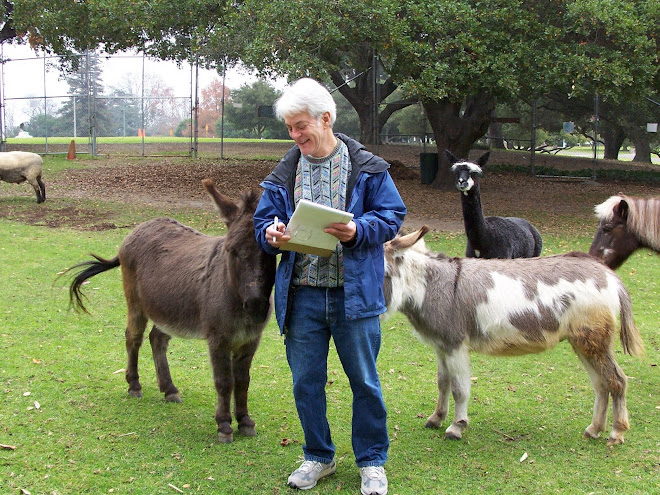
Interviewing the animals at Children's Fairyland in Oakland. L-R: Bobo the sheep, Gideon the miniature donkey, me, Tumbleweed Tommy the miniature donkey, Juan the alpaca, Coco the pony

Monday, December 6, 2010

The Spirit of Christmas Past


Ten years ago, the people of El Cerrito confronted a crisis. Sundar Shadi, the man who created the city's most beloved Holiday tradition, was forced by age and failing eyesight to call it quits.
The tradition started in 1949, when Mr. Shadi's neighbors awoke one morning to find a single star in his front yard. It was his way of wishing them a merry Christmas, even though he wasn't a Christian himself.
Every year after that he kept adding shepherds, wise men, angels, camels goats, sheep, doves, spires stars, minarets and domes - all lovingly handmade by Mr. Shadi from papier-mâché and chicken wire and painted by hand.
The display kept growing until it finally numbered more than 150 figures, depicting the town of Bethlehem.
But there were no statues of Jesus, Mary or Joseph. Mr. Shadi was a Sikh, and he came to this country from India to escape religious persecution from both Hindus and Muslims. So he purposely kept the display non-denominational.
The people of El Cerrito quickly took Mr. Shadi and his creation to their hearts.
"To many people around here, Mr. Shadi WAS Christmas," says former Mayor Jane Bartke.
And his fame spread far beyond the city limits. Tour busses used to line up, bringing visitors from as far away as Sacramento and San Jose - more than 70,000 every Christamas time.
Mr. Shadi died in 2002 at age 101. But despite the sadness, something wonderful happened that showed why El Cerrito is such a special place.
From its beginning, El Cerrito has struggled uphill. I mean, how you like to have a busy thoroughfare like San Pablo Avenue as your main street, effectively slicing your town in half?
But despite this, I know no other city that can match El Cerrito's down-home, small-town flavor. It may be in the shadow of bigger cities like Berkeley and Oakland, but its people love it dearly.
So it was no surprise that when Mr. Shadi died, they refused to let his legacy die with him
Under Bartke's leadership, the El Cerrito Soroptomist Club took over the sculptures - with the blessing of the Shadi family - and restored them to their former glory.
In 2003 the Shadi sculptures made a triumphant return, and they've been brightening our Holidays ever since. This year they'll be on display at the corner of Moeser and Seaview every day until 10 p.m. from Dec. 18 to 27.
It's been a true community effort, with individual volunteers joining forces with local businesses; PG&E, which provides the land; and Professional Firefighters of Contra Costa County Local 1230, who, working on their own time, haul the sculptures up the hill every year and return them to storage when Christmas is over.
But now the Shadi sculptures face a new crisis.
"We're getting too old to do this much longer," says Bartke, who is 72. "We need to start training the next generation to take over from us. If we don't get someone to step up, this tradition is going to die."
It's up to you, El Cerritans. The Shadi sculptures have been an important part of our Christmases since we were little kids. Are we going to deny our own children and grandchildren the same experience?
E-mail shadidisplay@aol.com if you want to volunteer.
Merry Christmas.

Sunday, December 5, 2010

Dear Santa

"Dear Santa,
"Last year I asked for a pony. I did not get a pony. Do you know what I got? Do you? Guess! Guess!
"I GOT A STUFFED ANIMAL PONY!
"When I say pony, I mean REAL! Do you know the meaning of this word?
"Well, just letting you know that I am a very upset individual. I hope you do better this year!
"With hope and dreams, Emily."

"Dear Santa, Thank you for all the stuff you gave me last year! How did you find the American Girl Chrisa swimsuit? I love it! You rock! Love, Camille."

"My name is Octavio and I am 10 years old. My brother Emilio is 9 years old and Danny is 3. My mom is very sick, so we won't be able to celebrate Christmas this year. My brother Emilio and I are disabled. Danny is OK. I like Transformer toys, and Emilio and Danny like remote control cars. Please Santa come to visit us. And make my mommy well."

Once again, thousands of letters like these are pouring into the downtown Oakland Post Office from children all over Northern California. Some are heartwarming, some are heartrending, and some are simply hilarious.
And once again, the post office is inviting the public to become Santa's helpers for a day and answer some of these missives.
"You don't necessarily have to send a present," says Consumer Affairs Director Elma Ramirez, who founded the Santa's Mailbag project 24 years ago. "Sometimes they're happy just hearing from someone who cares."
On the other hand, if you are moved to send a present, nobody's going to stop you.
To become a Santa's helper, call the Santa hotline at 510-622-7420 and leave your number. They'll call you back and sign you up.
In the meantime, here are this year's batch of letters. As always, the kids never fail to surprise:

"Dear Santa, What do you do after Christmas? My mom thinks you go to Hawaii. How is Mrs. Claus? I was surprised when I saw the golf clubs. I wanted them, but I didn't tell anyone. How do you know that stuff? Love, Caroline. P.S. Tell Comet I said hi. He's my favorite."

"Dear Santa, How are you? How is Mrs. Claus? Did you have a good summer? I did, and now I'm in the 6th grade. I just got my first report card, and you know what I did? My GPA was 3.75, and my report card showed my rad skills. I got 6 As and 2 Bs, so I did awesome! Your friend, Silas. P.S. I will never stop believing in you."

"Dear Santa, I was good because I didn't use bad words. Love, Ritwick."

"Dear Mr. Santa Claus, I have been nice sometimes. I was nice after school today, and I was nice last Thursday. Love, Jennifer."

"Dear Santa, I think I've been a good girl. But I can be rude or mean, so please forgive me. For Christmas I want my family to be happy. Sincerely, Madi-Moo (Madison)."

"Dear Santa, My grandma says I've been good, but my auntie says I've been bad. You be the judge. Signed, Richard."

"Dear Santa, I hope all is well at the North Pole. How are the reindeer doing? I'd really like a horse trailer with a red truck and tons of horses for Christmas. I'd also like to say happy birthday to Jesus. Love, Luke."

"Dear Santa, I have some good news and bad news. I'm sure you already know, but it would be nice to tell you. My mom and brother and I have to move, and we have no idea where we are going. All the money Mom made waitressing she spent on socks and toothbrushes and stuff for us. She is really doing bad this year, so I am asking you for stuff for her. Anything will do. I know she will be so happy. Thank you, Santa. I know you know everything because you are Santa. I know God will help us as well. Love, Jaida."

"Dear Santa, I really like your Macy's store. It's big and full of good stuff. Thanks, Anna."

"Dear Santa, I need supplies for school because I am constantly running out of pencils and paper because my dog, Choco, keeps chewing them. Sincerely, Jose."

"Dear Santa, My name is Choco, and I am a Chihuahua. I really need a chew toy that squeaks because all the toys I have are ripped because I keep chewing them. My owner, Jose, gives me his socks to chew but I really don't like them. Sincerely, Choco."

"Dear Santa Claus, My name is Ashley and my twin brother's name is Chris. We are both 9 years old. My mom is disabled due to spine surgery in 2002, and my dad is 80% disabled due to an injury at work in 2009. We are barely making it with only my dad's disability check two times a month. One check is always for the rent and the other is for food and bills. So maybe you can bring me and my brother some gifts this year. I would like some books to read, and my brother would like a Nintendo game. Thank you very much, Ashley."

"Dear Santa, I know this is a little silly, but may I have a gift card from Abercrombie or Hollister? I've been trying hard to be an extra good girl, but sometimes I am naughty, I have to admit. But I will be fantastic next year! Love, Juliette. P.S. Thanks for the card last year."

"Dear Santa, Hello, my name is Neylan. I wish there were peace in the world. I don't like violence."

"Dear Santa, What kind of cookies do you like? I like chocolate chip, don't you? Hey, why don't you send me back a letter? Then you can put questions and answers on it! Isn't that a great idea? See? See? See what I mean? Man, please? Oh, never mind. My wish list is on the back. Sincerely, Nicole."

"Dear Santa, This year I would like a last generation iPod Nano and a $50 gift certificate to iTunes. If you can't get it I'll understand; but could you, like, try hard? Sincerely, Connor."

"Dear Santa Claus, All I want for Christmas is a Meyer lemon and a plasma screen TV. Love, Brynli."

"Dear Santa, Can you please bring me some warm clothes? You know how much it has been raining and how cold it gets here. Santa, I will be waiting for you and your helpers. Please don't forget about me. Sincerely, Zaira."

"Dear Santa, The North Pole is very cold. If you need help with any toys, come get me. Love, Olivia."

"Dear Santa, My family is a family of six. This year has been a rough year, and we might lose our house. So I don't want something for me this Christmas, I want something, even if it's a small thing, for my whole family. Merry Christmas, Priscilla."

"Dear Santa, I am in the 2nd grade. I do my homework, I help my mom, I'm nice to my family. Thank you for reading my letter. Love, Carlos."

"Dear Santa, I am eleven years old. Some people I meet say you aren't real, but I still believe in you. Please write back Santa. Sincerely, Alysia."

"Dear Santa Claws, I would like my two front teeth and other gifts. Sincerely, Lydia."

"Dear Santa, Thank you for being there watching over us all year. My sister and I are trying to get along as best as possible. I will try to be a better boy until you come see us on Christmas, I will leave you some cookies and milk. Love you, John."

"Hello Santa. I have a question for you. Do you celebrate any other holiday besides Christmas? Please write back. From Christopher."

"Dear Santa Claus, I've done good things. I helped my friends from mean kids. I also got As and Bs. You are the greatest man in the worrrrrrrrrrrld! Love, Geronimo."

"Dear Santa, For Christmas I would like an i-Carly video set, a big ring for my mom, and some money for the Humane Society." (Unsigned.)

"Dear Santa, what would YOU like for a present? Love, Maggie."

"Dear Santa, This year I don't really want anything. I feel so lucky that I have a roof over my head, food and water, and so many great family and friends to talk to.
"I lied - there is one thing I would love. It would be so nice if you could give something extra to families less fortunate than others. Merry Christmas and Happy New Year, Hattie."

Sunday, November 21, 2010

Toy Story


Every town should have a toy store like Mr. Mopps'.
You know what I mean: an old-fashioned mom & pop store with friendly vibes, nooks and crannies to explore, and aisle after aisle piled from floor to ceiling with wonderful toys of all shapes, sizes and prices.
Since 1962, Mr. Mopps' has been a veritable Mecca for the children of Berkeley. Generation after generation have grown up and brought their own children - and now their grandchildren - to Mr. Mopps'.
So when word spread last April that longtime owner Eugene Yamashita was planning to retire and close Mr. Mopps', the whole city went into mourning.
But I have great news: Mr. Mopps' isn't closing after all. At the last second, somebody stepped forward to buy the store.
And here's the best part: THEY'RE GOING TO KEEP IT EXACTLY THE WAY IT IS!
"Well, almost exactly," says new owner Devin McDonald, who bought the place with his girlfriend, Jenny Stevenson. "We'll still have swords and laser blasters, but that's about it as far as military stuff. No more cap guns or realistic-looking weaponry."
On the other hand, they'll keep stocking a few Barbie Dolls, much to Jenny's discomfort.
"We were torn about it because of what they say about body image," she says. "But our rep really twisted our arm."
Owning Mr. Mopps' has been a lifelong dream for Devin, who grew up in Berkeley. (His father is singer/songwriter and antiwar/veterans' rights activist Country Joe McDonald.)
Devin has been a loyal Mr. Mopps' customer since he was a toddler, when his grandmother, the late City Councilwoman Florence McDonald, took him there and bought him his favorite teddy bear, Mr. Choo-Choo.
(Incidentally, Mr. Choo-Choo is still with us, albeit a little worse for wear, resting in a place of honor in Devin and Jenny's living room.)
In a related story, one longtime customer, Gabriella Raymond, is spearheading a campaign to refurbish the huge Mr. Mopps' Lion, who has kept watch from his special window on Martin Luther King Way for more than 30 years.
"He's getting awfully mangy, and his head doesn't turn to greet you as you walk by anymore," she says.
You can contribute by visiting the "Fans Of The Mr. Mopps' Lion" page on Facebook or by dropping a few coins in the lion-shaped piggy bank on the counter in the store.
Ever since word got out that Mr. Mopps' isn't going to close after all, the tears have turned to cheers.
"We get hugged by strangers and thanked every day," says Jenny. "People come in all choked up, thinking they're going to be shopping here for the last time, and then their faces light up when they find out it isn't true."
Mr. Mopps' will be open through the Holiday season, then will close for a few days while Devin and Jenny brighten it up with a new paint job and get rid of decades of dust.
"I wouldn't have sold it to anyone but them," says Yamashita. "I was prepared to shut it down, but I saw this young couple who really understand what it's all about and want to continue the tradition. I hope they can do better than I did."
That's a tall order because he did it to perfection. But I think Devin and Jenny are up to the job.

Monday, November 15, 2010

Dear Santa


The Holidays are almost here, which means it's almost time for me to write my favorite story of the year - the annual "Kids' Christmas Letters to Santa Claus."
The story will run in a couple of weeks, but I wanted to give you a head's up so you'll be on the lookout for it, and also because the Oakland Post Office's consumer affairs director, Elma Ramirez, who founded the Santa letters project 24 years ago, needs volunteers this year more than ever.
But they don't make it easy for you. Last year, the Postal Service instituted some new rules to protect the children's privacy. No kids have ever been harmed because of this project, and they want to keep it that way.
In the old days, all you had to do was call Ramirez, and she'd send you as many letters as you wanted.
But now you have to show up in person at the main post office at 2091 13th Street in downtown Oakland (corner of 13th and Alice), Room 226, so they can check your I.D. as a security precaution.
Then they'll give you letters with the kids' contact information redacted, which means if you write back or buy any presents, you'll have to bring them back to the post office to be mailed.
It's a hassle, but it has to be done. A sad commentary on the times we live in.
"But there's been one unexpected upside," says Ramirez. "Before last year, we never got to meet any of our volunteers. It wasn't until they started bringing the presents here that we realized just how generous they were. They showed up with bicycles, hundreds of dollars worth of gifts, and so many toys! And they were high end toys, too!"
And that's the final reason why I'm writing this column: Ramirez asked me to thank you all on her behalf.
In addition to letter writers, she also needs some people to help her staff sort the letters, which are already piling up in her office.
The letters will be separated into two stacks - needy and non-needy. And the kids never lose their capacity to surprise. One year, a little girl wrote, "Dear Santa, Do you know Jesus? Are you friends? Please tell him I said hi."
And a little boy wrote, "Dear Santa, I'm Jewish and I know I shouldn't believe in you, but I can't help it."
And, of course, there's always a wiseacre who writes, "Dear Santa, Can you please make my little brother go away?"
But overwhelming majority of letters aren't funny at all. They're from desperately poor children who are facing another bleak Holiday season. Some have never had a Christmas present in their lives.
What really breaks your heart is when they say, "Santa, you don't have to give me anything, but could you please bring something for my little sister?"
And you'd be stunned by the number of kids who ask Santa to find Mom or Dad a job.
So if you can help sort letters, or buy a present for a needy child, or answer a letter from a non-needy child, please call Ramirez at 510-622-7420 and leave your phone number. It'll be the best Christmas present you ever gave yourself.

Saturday, November 6, 2010

It Ain't Necessarily So


(Above: Oakland's newest council member, Libby Schaaf)

What will the historians of the future say when they write about the Great Shellacking of 2010?
Conservatives will say it was a voter revolt against big government and big spending.
Liberals will say it was an outbreak of mass hysteria stoked by cynical politicians who knew how to manipulate people's fears and prejudices.
And those in the middle will say, "It was the economy, stupid."
All three will have a kernel of truth. But it's equally true that the Democrats still might have pulled it out, despite everything, if John O'Connor hadn't been diagnosed with Alzheimer's 25 years ago.
By 2005 his condition had deteriorated to the point where his wife Sandra decided she had to give up her job to take care of him.
Her job was Associate Justice of the Supreme Court; and that seat was filled by Sam Alito, who turned out to be the critical fifth vote in Citizens United case, which opened the floodgates of corporate money and decisively tipped the playing field in favor of the Republicans.
As the old proverb puts it, "For want of a nail, the horseshoe was lost; for want of the horseshoe, the rider was lost; for want of the rider, the battle was lost - all for the want of a nail."
One of the biggest mistakes we make about history is to assume everything was inevitable. It wasn't.
What if St. Paul hadn't survived that shipwreck off the Maltese coast? Would Christianity still have become the world's dominant religion?
What if Robert E. Lee's Special Order No. 191, describing his plans and troop dispositions in detail, hadn't accidentally fallen into the hands of Union soldiers before the battle of Antietam? Would the North still have won the Civil War?
History is full of such what-might-have-beens. The moral, which we keep ignoring all the time, is that nothing is predetermined.
Yes, large overarching historical trends are important. But so are the choices that individuals make. Our actions do make a difference.
To paraphrase Shakespeare: The power is not in our stars, it's in ourselves - for better or worse.
And to paraphrase Scoop Nisker: if you don't like history, go out and make some of your own.
Meanwhile, I was glad to see that Libby Schaaf won the race for Oakland City Council from District 4.
She has a resume as long as your arm, including working as a top aide for once-and-future Governor Jerry Brown. But I remember her as that adorable little girl who was Raggedy Ann at Children's Fairyland in 1976.
The Raggedy Andy was her BFF Leslie Zimmerman, who, years later, was the maid of honor at her wedding. (They were seriously tempted to wear their big red yarn wigs at the ceremony, but they finally decided against it.)
Libby has always given Fairyland the credit for launching her political career.
"It taught me how to speak in front of large groups and to be responsible for the commitments I make," she told me. "But most of all, it taught me to be kind."
Congratulations Libby. Here's hoping you and your generation take over and kick us old folks out of power as soon as possible. I know you'll do a better job than we did.
You could hardly do worse.

Monday, November 1, 2010

Best Boss Ever


(Above: Admiral Clark in his dress uniform.)

A good boss is worth his/her weight in gold.
And the best boss I've ever heard of was Admiral J.J. Clark, who commanded Task Force 58 in the South Pacific during World War II. His flagship was the aircraft carrier USS Hornet, which is now a floating museum docked at Alameda Point.
He was the ideal leader, a guy you would follow anywhere, and he was a second father to every man on the ship.
He didn't stand on ceremony. Everyone down to the lowliest sailor called him by his nickname, "Jocko." And they adored him.
"There was nothing we wouldn't do for the Old Man," said Frank MacDonald of Oakland, "because there was nothing he wouldn't do for us."
There are so many classic Jocko stories, I hardly know where to begin. Like the time a young sailor swung open a door that Jocko was standing behind and knocked the admiral flat on his kiester. A lieutenant commander grabbed the kid and started screaming at him.
"The next thing I saw was a gigantic hand as it reached over and placed itself on the shoulder of the still shouting lieutenant commander," the sailor recalled. "In a loud voice, I heard Admiral Clark say, 'Go back to your work station and leave this boy alone! I was just standing in the wrong place!'"
Or the time another young sailor fell asleep while on watch - a hanging offense in wartime - only to be awakened by a gentle tugging on his arm. Standing over him was Jocko, murmuring, "Boy, boy, boy. You know you're not supposed to sleep on watch."
The kid spent the next few days in abject terror, expecting to be arrested at any moment. But nothing happened. Jocko hadn't even put him on report.
But my favorite Jocko story is the time a typhoon caved in the Hornet's bow, making it impossible to launch planes the normal way, off the front. Jocko simply turned the shop around and sailed backwards at full speed, launching the planes from the rear.
"The guys on the other ships must have thought the Old Man had finally lost his marbles," said MacDonald.
Jocko was unique in so many ways. He overcame prejudice to become the first Native American to graduate from Annapolis. And, since many of his battles were fought at night, he slept on a cot on the bridge so he could spring into action at a moment's notice.
It was a common sight to see him directing the battle wearing his polka-dot pajamas and fuzzy slippers - but with his admiral's hat firmly clamped on his head.
Next Friday would have been Jocko's 117th birthday. He died in 1971 and was buried with full honors at Arlington National Cemetery.
But his real monument is the Hornet itself. Stepping onto the ship is like stepping back into history. So many things - the radar room, where they tracked incoming enemy planes; the ready room, where the pilots got their final briefings before battle; the mess hall; the living quarters - are in perfect working order. This isn't an amusement park ride. This is the real deal.
If you're looking for a good way to observe Veterans Day next week, I can't think of a better place to do it.

Saturday, October 30, 2010

Cal's Greatest Generation


(Above: G.I.s hit the beach on D-Day)

Rosamond Castle '43 remembers Dec. 7, 1941, like it was yesterday.
"I was walking through Sather Gate toward Wheeler Hall, and I saw people huddling around, staring at newspapers. By the time I got to Doe Library I heard something about Pearl Harbor. Then inside the library everyone was talking about what had happened."
The news was so incredible, Catherine "Cappy" Vail Bridge '42 didn't believe it at first.
"I thought it was a hoax, like Orson Welles' 'War of the Worlds' broadcast a few years before."
So began America's entry into World War II, which ended 65 years ago this summer. To celebrate the end of that terrible war, we talked with some of the Golden Bears who lived through it.
The days after Pearl Harbor were a mix of uncertainty and fear.
"It was the middle of finals," says Jean Heying Rusmore '42. "We didn't have blackout curtains yet, so we couldn't study in our rooms because you couldn't have any light showing outside. So we sat on the floor in the hallways and studied there, instead."
"The great fear was for the young men of our class," adds Rosamond. "The young man I was dating invited me to the Class of '42 graduation ball at the Palace Hotel, even though we were both Class of '43, because he knew he probably wouldn't make it to our real graduation in 1943. And he was not alone."
It didn't take long for tragedy to strike home. In April 1942, Ed Tackle '41, who had been editor of the Daily Cal, was killed on the infamous Bataan Death March.
Four months later, Rosamond's beloved older brother, Gordon Craig, was killed off Guadalcanal when an enemy bomb blew apart the bridge of his ship, right were he was stationed.
"My last image of him was the day he went away, when he turned and saluted me and my mother at the door," she says. "I still miss him every day."
Jean Marchant '45 adds, "Our class had a flag made, and we hung it from the Campanile. Every time we got word that someone from Cal had been killed, we added another star."
A few weeks after Pearl Harbor, tragedy struck the campus in a different way.
"One day, my best friend, Grace Imamoto, who was also Class of '42, asked me if I would keep her tennis racket for her," says Jean Heying Rusmore '42. "I didn't know what she was talking about. I said, 'Grace, don't you like to play tennis anymore?' And she said, 'Jean, I have to go away.'"
Grace and all the other Japanese-American students were sent to detention camps for the duration of the war.
"We wanted to help them," says Clavel Fender '43. "The day before they were taken away, we held a tea party for them, with everyone dressed in pastel evening gowns. How innocent we were!"
As the men went off to war, the women threw themselves into supporting the home front.
"We would pick tomatoes or wrap bandages or make Bundles for Britain," says Jean Marchant '42. "Whatever we could do to help."
"There was such a shortage of men on campus, many of us sorority girls used to go to the USO in downtown Berkeley," adds Gwyneth Caster Page '45. "I asked a Marine captain to escort me to the senior ball. I went out and bought a beautiful black taffeta-and-lace formal and little pearl earrings. I thought I looked very chic. The doorbell rang, and there was my date in full dress Marine uniform. He was prettier than I was!"
Many of the younger faculty also went off to war, which meant the remaining undergrads had the cream of the crop as their professors.
"We had all the big guns," says Margaret Cooney Walton '47. "Glenn Seaborg was my section leader in chem!"
Army Capt. Charlie Fender '41 and his wife, Clavel '43, wrote each other every single day of the war, without fail. Whenever his outfit liberated a new city, Charlie would buy a little charm and send it to Clavel, who put them all on a bracelet that remains her most treasured possession.
Charlie was the military governor of the devastated town of Cerignola, Italy, where he rebuilt the social infrastructure from the ground up, establishing a new judicial system, schools, food supplies, and fire and police protection.
"Every day was a lot of fun because I was being useful," he says. And the locals really appreciated it.
"Twenty-seven years later he took me back," says Clavel. "When we checked into the hotel, the man behind the desk took one look at Charlie and said, "I remember you!" He whisked us to the city hall and shouted to the chief of police, 'Get out of that chair! The governor's here!' You can imagine how that impressed me."
Gordon Binder '40 was an Army field surgeon in Europe, operating under enemy fire only a few hundred yards behind the front lines.
"We didn't have an operating room, not even a tent. Just a field somewhere where we'd put up a sign saying, 'Battalion Aid Station.' We'd just park there and receive the casualties."
Many of the casualties were beyond saving. The best he could do was shoot them full of morphine to ease their agony.
"Nobody can imagine how awful it was. It was just horrible. You assumed you weren't going to make it. You knew you were going to get killed. It was just a question of when."
Bob Breuer '43 served on the U.S.S. Wichita, a heavy cruiser in the Pacific. At 22, he was the old man of the group of 18 and 19 year olds whom he supervised.
"We were like family, and I was their uncle. One day, two of them were killed and several others badly wounded by friendly fire from one of our own ships. I just sat down and cried like a baby."
Chuck Auerbach '42 fought with Patton's Third Army in the Battle of the Bulge.
"Some of the things George C. Scott said in the movie I heard Patton say in real life. Unlike Scott, his voice was high and squeaky, but the pearl-handled revolvers were real. He'd race around in a jeep with a machine gun mounted on it, and he really tore down the road. I said to one of my buddies, 'That man's going to die in an automobile accident,' which is exactly what happened."
Not all the heroes were men. Catherine "Cappy" Bridge '42 was a member of the Women Air Service Pilots, or WASPs. Their job was to ferry fighters and bombers from the factory to the airfields, freeing up male pilots for the actual fighting.
"Gosh, it was fun! We just loved it. But it was still dangerous. Thirty-eight of our girls were killed on the job - mostly accidents, not pilot error. One of us would take the body home to her parents, and we would pass the hat among ourselves to cover the expenses."
There weren't many happy days in the war, but one of them was Aug. 25, 1944, the day Paris was liberated.
We've all seen the pictures of ecstatic Parisians swarming over the American tanks, showering the G.I.s with flowers and kisses.
One of the people in that crowd was Tito Moruza '43, who had already been in Paris for three weeks, waiting for the troops to arrive. Tito was an American special agent on a secret mission: As soon as the city was liberated, he was to make his way to Gestapo headquarters and seize all the documents so they could be used in war crimes trials after the war. Which he did.
Tito had landed in France on the morning of D-Day with the 82nd Airborne. Their canvas-and-plywood glider was ripped open by one of "Rommel's Asparagus" - wooden logs driven into fields along the Normandy coast. The three soldiers sitting next to Tito were mortally wounded.
"The youngest, who was only 18, cried for his mama. The second called for the medics, and the third cussed. That was when I lost my religion. I still haven't gotten it back."
While the others were fighting, Tito's job was to contact the French Resistance so they could smuggle him into Paris. He narrowly escaped capture several times, thanks to a heroic couple named Paul and Marcelle Dufour, who operated a safe house for Resistance fighters and escaping American prisoners of war. After the war, he named his first two children after them.
To this day, Tito refuses to watch a war movie. But he does have one happy memory of the war.
"My greatest blessing was that I never had to kill anybody. I'm not belittling those who did; that was their job. I was just lucky."
The war finally ended on Aug. 14, 1945. Jay Jacobus '43 heard the news as his ship was headed from San Francisco to the Pacific for the expected invasion of Japan.
"We all shouted, 'Turn the ship around!' So the ship made a left turn and headed for the Philippines, instead."
Gwyneth Page Caster '45 heard the news when she was in Cowell Hospital with a raging case of mono.
"Somebody sneaked me a bottle of something alcoholic to celebrate," she says. "It made me sick as a dog."
They have been called The Greatest Generation, a term that makes them distinctly uncomfortable.
"It bothers me a lot," says Dave Stewart '43. "I'm no hero. I just did my duty, like thousands of others. The real heroes are the guys who didn't come back."
Dave is being modest. He was awarded the Bronze Star, two combat medals and two Purple Hearts, the second for wounds suffered when he was hit by a German Panzerfaust anti-tank grenade.
"But I still have all my body parts," he says. "So I got out of it lucky."
But the last word belongs to Tom Mulcahy '43, who served on a Navy tanker in the Pacific.
"My two best friends were killed in the war," he says. "One was my best friend from high school, Danny Hurst. The other was Norm Hennessey, whom I rowed with on the Cal crew. I had a chance to get married to the greatest girl in the world, have kids and grandkids, and have a full life. They didn't."

(This story originally appeared in the Summer 2010 issue of California magazine.)