A columnist of heart and mind

A columnist of heart and mind
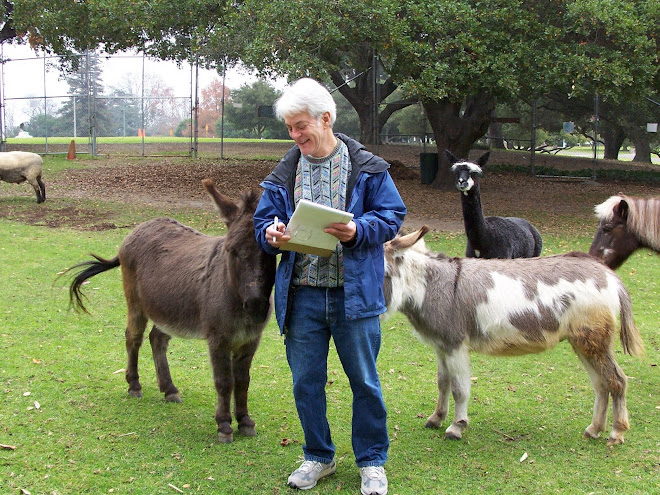
Interviewing the animals at Children's Fairyland in Oakland. L-R: Bobo the sheep, Gideon the miniature donkey, me, Tumbleweed Tommy the miniature donkey, Juan the alpaca, Coco the pony

Saturday, September 19, 2009

Kindness to Kittens


(Above: Tamerack and Roxana, one of her kittens)

When Sarah Kidder adopted a 12-year-old female Siberian husky named Tamerack last year, she knew she was getting a loving, friendly, playful dog. But she never suspected that Tamerack had a hidden talent: as a foster kitten raiser.
It all started three weeks ago, when Kidder, who lives in the Grand Lake area, was taking Tamerack for a walk.
"About a block away, I saw this beautiful, blue-eyed, chocolate point Siamese adult and two little black kittens playing in a driveway," she says. "I was like, 'Why would those little kittens be there?'"
After talking with the neighbors, Kidder found out that that the family who lived there had moved away and abandoned the Siamese - who she assumed was the mom - and the two kittens. So she decided to take them home with her.
"It wasn't safe for them to be out there. And we don't need any more feral cats in the neighborhood because they would keep on breeding. Plus, they were just ridiculously cute."
That's when Tamerack unveiled her hidden talent.
"She was like, 'Oooh! Kittens!' I was a little concerned at first because she was so excited, but then I realized she was excited because she wanted to mother them. She would follow them around and lick their heads and make sure they were OK. After 24 hours, they started following her around. Whenever she sat down, they sat down, too."
By the next day, Tamerack was sharing her food with her little feline friends.
"Even when she was gnawing on a bone, she'd let them munch on it, too! I just sat there, slack-jawed, for a week."
Now Tamerack and her kittens are inseparable. They sleep together, eat together and play together.
"She understands that she's a lot bigger than they are, so she's very gentle with them. If they're gone too long, she searches for them and hangs out wherever they are. If I'm looking for them, I just look for her because I know she'll be where they are."
She named the mommy cat Choco Kitty and the kittens Roxana and Stetaria, after Alexander the Great's wives. (Kidder is the product of a classical education.)
The next order of business was to get Choco Kitty and the kittens fixed, so Kidder called Island Cat Resources and Adoption, who arranged and paid for the surgeries.
That's when Kidder got another surprise: Choco Kitty isn't the kittens' mother. He's their father!
"It's not unusual for adult male cats to be a great guardian for kittens," says ICRA's Gail Churchill. "When his owners moved away, he must have realized the kittens were helpless and took it upon himself to be their guardian."
It's also not unusual for large dogs like Tamerack to be kind to kittens, as Churchill can attest. Her golden retriever, Rosie, was in the news last June for fostering homeless kittens, too.
"Gentle, sweet dogs will take to anyone," says Churchill, "especially young ones."
Now that they've been spayed or neutered, all three cats are available for adoption.
"They're all incredibly sweet and friendly, says Kidder. "I'd love to adopt them myself, but I can't. It wouldn't be fair to my cat, Enkidu."
But what will Tamerack do when her kittens are finally adopted?
"I'm going to take her up to the snow as a reward," says Kidder. "If she's still missing them after that, I'll guess I'll have to start fostering more kittens."
To adopt these cats, either singly or in combination, call ICRA at 510-869-2584 or visit www.icraeastbay.org.

Sunday, September 13, 2009

Glamour girl


(Above: Lily on the Capitol steps. Photo by Tina Raheem/Orphan Foundation of America)

Good news for Lily Dorman-Colby fans, and that includes Berkeley school board President Nancy Riddle, state Senator Loni Hancock, everyone who went to Berkeley High from 2000 to 2004, and me.
Lily, who is now a senior at Yale, has just been named one of the top 10 college women of 2009 by Glamour magazine.
It's a very big honor. Martha Stewart was one of the winners back in 1961.
I first met Lily during her senior year at Berkeley High, when her fellow students elected her to be their representative on the Berkeley school board.
It's usually a nominal position, sort of a glorified civics lesson. But Lily turned it into something substantive, successfully lobbying the board on a wide range of issues affecting students.
"State law forbids us from counting her vote," Riddle told me. "But we have such respect for Lily's judgment, we always pay very careful attention to everything she says."
Lily was also getting great grades, despite suffering from dyslexia, and starring on the wrestling team. But she was so down-to-earth and unpretentious, her fellow students weren't jealous. They rooted for her, instead.
Even more impressively, she accomplished all these things despite a truly horrific childhood. She was in the foster car system since she was 12 because her parents were unable to care for her due to drug use and mental illness.
She bounced from one foster home after another. Some were good, but others were right out of Dickens. But she never felt sorry for herself. Instead, she latched onto education as her ticket out.
But she never forgot where she came from. As one of the lucky survivors of the foster care system - only 2 percent of foster children graduate from college - Lily has made it her life's mission to reform foster care so other kids won't have to go through what she did.
Between high school and college she interned in Hancock's office, where her suggestions helped Hancock draft a law that made it easier for kids to find foster homes.
"While the official title was 'Child Welfare Services: Resource Family Pilot Program,' I always referred to this bill as 'Lily's Bill,'" Hancock says.
Every time I run into Hancock, her first words to me are always "Have you heard from Lily? How's she doing?"
Answer: Very nicely, thanks. She spent last summer interning in Washington D.C. with the American Bar Association, doing legal research on laws affecting foster children.
She was back in Washington again this summer, interning with both the Child Welfare League of America and Sen. Chris Dodd of Connecticut. Her next step: law school.
She has also written a how-to guidebook, based on her own experiences, to teach foster kids how to get into college.
For Lily, the best part of the Glamour award was hanging out with the other winners, including a chanteuse from USC, Stanford basketball star Jayne Appel, the inventor of a folding wheelchair from MIT, and a future doctor who is first in her class at West Point.
"They’re awesome!" she says. "We're hoping to stay in touch with each other and work with each other on projects."
The issue is on the stands now; Gwen Stefani is on the cover. The article about Lily is on page 240.

Saturday, September 12, 2009

Black cats make the best pets


Above: Midnight the Cat and Andy Devine, two of the stars (along with Froggy the Gremlin) of "Andy's Gang." Do you remember what Midnight said when she meowed? Answer at the bottom of the column.

The English are different from us. They drive on the left, and their steering wheels are on the right. And in England, a black cat is a sign of good luck, not bad - which is why black cats have no problem getting adopted over there.
But it's a different story over here. Black cats usually have to wait two or three times as long for a new home as other felines.
It's a stupid superstition. As Groucho Marx observed, "A black cat crossing your path signifies that the animal is going somewhere." But people still believe it.
That's why Island Cat Resources and Adoption is holding a special Black Cat Adoption Day on Saturday, Sept. 26, at Petco, 2310 South Shore Center in Alameda, from Noon until 4 p.m.
Many of the cats will be kittens - specifically, former ferals that ICRA rescued when they were so young, they were able to be socialized.
Older ferals usually can't be socialized because they are too set in their ways. So they are humanely trapped, spayed and neutered, and returned to their cat colonies, where they don't produce any more kittens.
But feral kittens, on the other hand, make terrific pets. And I ought to know because my own cat, Phoebe, was a feral kitten.
She was scared of me for the first few days; but once she figured out that I wasn't going to eat her, she did a complete flip-flop. Now I couldn't ask for a sweeter, more attentive, more affectionate kitty.
ICRA will have 30 black cats and kittens ready for adoption on the 26th, including Daryle and Kenda, a pair of little cuties who were born across from the Raiders' practice facility, and Choco, who is remarkably loving and trusting despite the fact that one of his eyes was gouged out by an abusive so-called human being.
And if you can't make it to Petco, you can view the kittens at ICRA's web site, www.icraeastbay.org. You can also use the site to donate money or volunteer your services.
ICRA cares for homeless cats in Alameda and Oakland. Its counterpart in Berkeley, Albany, Emeryville, Piedmont, El Cerrito and Richmond is another group called Fix Our Ferals.
FOF is kicking off its fifth annual Winter Campaign for Cats this weekend, and it's seeking volunteers to help trap and spay or neuter homeless neighborhood cats in all these cities, as well as provide foster homes to socialize them.
There will be a volunteer orientation this weekend, on Saturday, Sept. 12, at the Berkeley-East Bay Humane Society, 2700 9th Street in Berkeley, from 10 a.m. to noon. If you can't make the meeting, you can still volunteer. Just call 510-908-8515 or e-mail rebeccamarshallfof@yahoo.com. For more information about volunteering or donating, visit www.fixourferals.org.
I've been writing about ICRA and FOF for years, and I'm constantly amazed by how much they accomplish with so little. There is no paid staff; everyone is a volunteer.
There's also no shelter - which, paradoxically is an advantage. Instead of living in cages, the cats are fostered in private homes, many with dogs or kids, so they're well accustomed to life in the real world.
If you're thinking of adopting a new cat or kitten - or, better yet, a pair of cats or kittens - this is the first place I'd look.

(Answer: Midnight said, "Nice!")

Sunday, August 30, 2009

How to really honor the victims of 9/11


(Left: Cat Right: Mark and his mom)


As the eighth anniversary of the September 11, 2001 terrorist attacks approaches, my thoughts keep turning back to those who died.
I didn't know any of them, but I have two close friends who did.
The first is George Lazarus, a pediatrician in Manhattan. On that day he lost his favorite patient, Catherine "Cat" MacRae. She was only 23.
Her father called her "bright and beautiful, gentle and kind, the epitome of all that is good in the world," and that's a pretty fair description.
She would surprise her friends with unexpected gifts and notes to remind them that she loved them. And whenever she was invited to a party, she made sure all her friends got invitations, too.
Cat was sitting at her desk on the 93rd floor of the North Tower, in the direct path of the first hijacked plane. She never had a chance.
My other friend is Alice Hoglan of Los Gatos. She lost her only child that day - her son, Mark Bingham. He was only 31.
Mark was one of the passengers on United Flight 93 who attacked the hijackers and prevented them from crashing the plane into the Capitol – at the cost of their own lives.
That came as no surprise to anyone who knew him. A strapping 220-lb., 6'5" rugby star who led Cal to national titles in 1991 and 1993, he was always quick to jump in and protect the weak from bullies.
Once, when he and some friends were accosted by an armed robber in San Francisco, Mark tackled the guy, took his gun away and held him until the police arrived.
Alice had a chance to say goodbye before he died. He called her from the plane and said, "I want you to know that I love you."
They talked for a while. Then she heard Todd Beamer, who was sitting next to Mark, say, "OK, let's roll." Then the line went dead.
Cat and Mark were our best and brightest. Who knows what wonderful things they would have gone on to accomplish if they hadn't been cheated so brutally out of their future?
In the days following 9/11 it seemed that we might be able to salvage some good out of this evil by transforming our country into one that was worthy of their sacrifice.
And yet, if I could talk to them today, I would have to confess that we have failed.
The "Spirit of 9/11" lasted about five minutes. Then it was back to business as usual - tearing the country apart for partisan advantage.
We are turning into two Americas. One watches Fox News and thinks Obama is an enemy alien who wants to kill our grandparents. The other watches MSNBC and thinks the Republicans are cynically exploiting the darker aspects of human nature.
Neither side remembers the advice Ted Kennedy gave his son: "Teddy, Republicans love this country just as much as I do."
This is a very dangerous road we're going down. Sometimes, in my gloomier moments, I fear we've already passed the point of no return.
But, as with global warming, we have no choice but to act as if there's still time to step back from the abyss. But we'd better get going before it really is too late.
Otherwise, Cat and Mark will have died in vain.

Friday, August 21, 2009

Vick - as in sick


(Above: one of the dogs rescued from Michael Vick's Bad Newz Kennels)

Ever since Michael Vick signed a $6.875 million contract with the Philadelphia Eagles on August 13, the reaction from the sports media has been overwhelmingly positive. The only debate has been whether he'll be rusty from the year-and-a-half layoff.
Hello? HE KILLED DOGS!
Some he hanged, some he shot, some he electrocuted, some he drowned, and some he simply beat to death.
And what was their crime? They wouldn't fight because they were too gentle.
During his trial, one of his co-defendants said he suggested that dogs who wouldn't fight should be given away, but Vick replied, "They got to go." Translation: Kill them.
At the time, Vick denied everything.
"It's a property where I'm never there. I'm never at the house," he said. "I take these charges very seriously and look forward to clearing my good name."
Now, flash forward to his interview on "60 Minutes" last week.
He said he cried many nights thinking about how he had let down his fiancée, his kids, his teammates, his fans, even Atlanta Falcons owner Arthur Blank. Most of all, "I let myself down, you know, not being out on the football field, being in a prison bed, in a prison bunk, writing letters home."
The only ones he didn't apologize to were the victims of his crimes. Interviewer James Brown tried his best to prompt him, repeating, "But what about the dogs, Michael?" But the most he would say was, "It was wrong."
In short, he doesn't get it, and he never will. He's a classic sociopath: someone who is completely unconcerned about the effects of his actions on others.
And make no mistake: He did it for the sheer sadistic pleasure.
"I thought it was cool," he told Brown. "And I thought it was, you know, it was fun, and it was exciting at the time."
His defenders say everyone deserves a second chance, but is that necessary true? What if he had been convicted of child molesting instead of killing dogs? Does anyone think the NFL would - or should - give him a second chance then?
Of course not, because child molesting is just too icky. So all we're really debating is whether a given offense passes the ickiness threshold. And I think killing and torturing dogs does.
Like children, dogs are innocent, trusting, completely dependent and utterly vulnerable. They feel love, fear and pain, just like us. And they don't want to die.
Besides, the dogs aren't the only victims. Do you know how they are trained to fight? By giving them smaller animals, like puppies and kittens, to "practice" on. A large number of family pets that go missing from the backyard turn out to be kidnapped by organized dogfighting rings.
NFL Commissioner Roger Goodell has conditionally suspended Vick through October 18, although Vick could play as early as Week 1, pending a final decision by Goodell.
By coincidence, the Eagles' game on October 18 is against the Raiders, here at the Coliseum. Kickoff time is 1:05 p.m.
If Vick is reinstated by then, I hope the Coliseum will be ringed by peaceful picket lines of dog lovers and their pooches. Wear your Raiders jerseys if you have them.
And if you attend the game, let the boos echo to the top of Mount Davis. Let Vick know that football fans love their dogs, too.

Sunday, August 16, 2009

Happy Day


(Photo from the George C. Marshall Foundation)

August 25 will be the 65th anniversary of one of the happiest days in history: the liberation of Paris after four years of Nazi occupation.
We've all seen the newsreels showing millions of deliriously ecstatic Parisians swarming around the Allied tanks, with pretty girls showering bouquets and kisses on the G.I.s.
In the crowd that day was an American intelligence agent from Berkeley named Tito Moruza, who had already been in Paris for three weeks, waiting in hiding for the troops to arrive.
He landed in France with the 82nd Airborne the night before D-Day, riding in a flimsy glider made of canvas and plywood. When the glider landed, its belly was ripped open by one of "Rommel's Asparagus" - wooden logs driven into open fields along the Normandy coast.
The three soldiers sitting next to Moruza were mortally wounded.
"The youngest, who was only 18, cried for his mama," he says. "The second called for the medics, and the third cussed. That was when I lost my religion. I still haven't gotten it back."
The paratroopers immediately went to work fighting Germans. But Moruza had a different assignment.
His job was to change into civilian clothes - which would have gotten him shot as a spy if had been caught - and make contact with the French Resistance, who would smuggle him into Paris.
Then, as soon as the city was liberated, he was to go to Gestapo headquarters and seize all the files before the retreating Germans could burn them, so they could be used as evidence after the war at the Nuremburg war crime trials.
And that's exactly what he did.
"I found only three Germans there, and they were just clerks, not SS," he says. "They'd made a half-hearted attempt to burn some documents, but the most they did was singe them around the edges."
He has nothing but admiration for his comrades-in-arms in the French Resistance - especially an extremely brave couple named Paul and Marcelle Dufour, whose farm outside Beauvais was a safe house not only for Resistance fighters sneaking into Paris, but also for escaped Allied prisoners going the other way, making their way via a network of safe houses to neutral Spain and safety.
He admires the Dufours so much, he named two of his children after them.
But he has nothing but contempt for the Johnny-come-lately "patriots" who were nowhere to be seen when the fighting was going on but came out of the woodwork after the liberation to "prove" their patriotism by shaving the heads of women who had slept with German soldiers.
"We hated them, and they hated us," he says. "It doesn't take much courage for a mob to torture and humiliate a defenseless woman."
His greatest honor was being chosen to deliver certificates of gratitude, each personally signed by General Eisenhower, to the French and Spanish families who smuggled escaped American prisoners to safety.
And what was his greatest blessing?
"The fact that I never had to kill a single person. I'm not belittling those who did have to kill; that was their assignment. I'm the lucky guy."
He narrowly escaped capture and death many times, but he bristles when anyone calls him a hero.
"The real heroes," he says, "are lying in the 9,000 graves at the American cemetery above Omaha Beach."

Sunday, August 9, 2009

Nixon pro and con


Today is the 35th anniversary of Richard Nixon's resignation. It's typical of my obsession with him that on the day he died, I wrote not one but two columns about him, each disagreeing with the other. I ran them side by side. Here they are:

Tricky Dick And Me: OK, I know you’re wondering: After trashing Nixon all these years, am I finally going to say something nice about him now that he’s dead?
Forget it. I just hope they remembered to pound in the wooden stake.
This is the man who disgraced the presidency, remember? For true Nixon-haters like me, Watergate came as no surprise: It just confirmed what we had known all along. As Harry Truman put it, “Nixon can lie out of both sides of his mouth at the same time, and even if he caught himself saying the truth, he’d lie just to keep his hand in.”
Or Adlai Stevenson: “Nixon is the kind of politician who would cut down a redwood tree and then mount the stump to make a speech about conservation.”
Or Wilfred Sheed: “Nixon without his sanctimony is a man half-dressed.”
Why did I despise him so? Not because of ideology: I never felt that way about Reagan, who was much more of a true believer.
It was because Nixon fought dirty. Starting with his first election, against Jerry Voorhis in 1946, he got what he wanted by accusing whoever stood in his way of treason.
He did it in every campaign he ever fought, from the notorious “Pink Lady” leaflets he used against Helen Gahagan Douglas in 1950 to his running mate Spiro Agnew’s charge that Hubert Humphrey was “squishy soft on communism” in 1968.
Ironically, Watergate revealed that the real traitor was Nixon himself. (And if you think “traitor” is a bit strong, what else would you call someone who conspires to subvert the Constitution?)
You could always tell when Nixon was getting ready to stick a knife in someone’s back: His eyes would shift and his face would take on that look of unctuous sanctimony that made him the Uriah Heep of American politics.
I know, I know, I’m irrational about him. It started in childhood. My parents were staunch New Dealers, and Nixon was the bogeyman my mother threatened me with if I didn’t eat my lima beans.
And it wasn’t just propaganda. One of the janitors in my father’s warehouse was a man named Hal Smith. He had been a successful Hollywood screenwriter -- he won an Oscar for writing “The Defiant Ones” -- before he got hauled before Nixon and his pals on the House Un-American Activities Committee. After that, he was lucky to get a janitor’s job.
Since then, it’s turned into a full-blown obsession. I find myself compulsively collecting Nixon trivia, including:
• When he was at Whittier College, he got turned down by the “in” club, the Franklins. So he formed his own club, which he named the Orthogonians (squares). Their motto, invented by Nixon himself: “Beans, Brawn, Brains and Bowels.” (Freudians make of that what you will.)
• His nickname during those college years was “iron butt.” (Starting to see a pattern here?)
• While he was courting Pat, he’d drive her on her dates with other men.(Such delicious masochism!)
• When he was in the Navy, he was known as “Nick Nixon,” the best poker player in the South Pacific. Legend has it that he came out of the war with a $5,000 roll, which he used as seed money for his first congressional campaign.
Incidentally, did you know you can listen to the Watergate tapes? They’re in a nondescript building in Alexandria, VA, where the National Archives stores all its Nixon material. They’ll let you listen to whatever you want, and let me tell you, it’s a revelation.
It’s still a shock to hear the President of the United States plotting crimes in the Oval Office. (And contrary to popular myth, he never said “but it would be wrong.”)
And if you’re really nice, they’ll let you see the warehouse next door, where they store the official gifts that Nixon got as president.
Remember the warehouse in the last scene of “Raiders of the Lost Arc”? That’s what it looks like. On one shelf, I saw a pair of nickel-plated revolvers (given to him by Elvis Presley) right next to one of those plastic praying hands that light up when you plug it in.
And next to that is a priceless, 5,000 year-old gold statue that was given to Nixon by Anwar Sadat.
“They were taking a tour of the Cairo Museum,” explained curator Sue Ellen Stanley, “and as they were passing a case, Sadat said, ‘See anything you like?’ Nixon said, ‘Yeah, third from the right.’ So Sadat reached in, pulled it out, and said, ‘Here.’”
So why don’t I feel happier? Why aren’t I dancing in the streets, singing “Ding Dong, the Witch is Dead”? Why am I feeling -- oh no! -- nostalgic?
I hate to admit it, but I think I’m going to miss the old crook.
After all, I won’t have Dick Nixon to kick around anymore.


Requiem For A Lonely Man:
I just read the column on the left, and a meaner, pettier piece I’ve never read. It has a bitterness worthy of Nixon himself.
The fact that I also wrote it makes it even worse. Mind you, I meant every word I said. But it’s typical of this gifted, troubled man that, having trashed him in one column, I feel compelled to write another one taking it all back.
What was it about him that made people like me go off the deep end? I think it was because, as much as we hate to admit it, he was the true mirror of our national soul.
We want to think we’re like Jack Kennedy -- handsome, graceful, a hit with the girls. But the truth is, most of us are like Nixon -- insecure, resentful, and compulsively self-destructive.
I think of that picture of him, circa 1970, walking alone along the beach at San Clemente, the waves washing over his perfectly-polished black wing-tips. How we laughed when we saw that.
Or the night of the Kent State shootings, when he tried to talk with protesters at the Lincoln Memorial by making chitchat about football. How we laughed when we heard that.
Or of his college days, when the only way he could make the football team was to let them use him as a human tackling dummy. How we laughed when we read that.
It feels good to make fun of the class nerd. It makes you feel like part of the “in” crowd, even if you aren’t.
Especially when you can feel so self-righteous doing it. After all, this was Nixon the red-baiter, second only to Joe McCarthy as the arch-villain of the 1950s. He deserved all the bad things that happened to him, didn’t he?
Yes and no. Sure, he looked silly talking about touchdowns and field goals to students who wanted to talk about war and peace. But it was the closest he could come to extending a hand. And we slapped it away, laughing at his lame style.
To a paranoid like Nixon, it must have been another confirmation of what life had been teaching him since childhood: He really was surrounded by enemies.
“What starts the process, really,” he wrote about his passion for winning, “are the laughs and slights and snubs when you are a kid. But if your anger is deep enough and strong enough, you learn that you can change those attitudes by personal gut performance.”
And make no mistake about it, Nixon had a childhood that would make anyone paranoid. When he was 12, his younger brother Arthur died of meningitis.
Then his older brother Harold was stricken with tuberculosis. The only way their mother could pay the doctor bills was to run a clinic for other children with TB. She nursed them all, watching them die one by one, until Harold died five years later.
Harold's illness ate up what little money the family had. As a result, Nixon had to turn down a scholarship offer from Harvard and save money by attending little Whittier College instead. (No wonder he was so jealous of the Kennedys.)
At law school, he shared a one-room shack that had no plumbing or electricity. He shaved in the men's room of the library. He never once went out on a date; he couldn’t afford it. Later, when he married Pat, she had to use her own savings to buy the wedding ring.
And yet this loser, through sheer effort of will, transformed himself into a winner. A lot of us thought he sold his soul in the process. But who among us are without sin? Our beloved Jack Kennedy’s record isn’t so hot when it comes to the McCarthy era, either. (Jack gave money to McCarthy’s Senate campaign, and Bobby was chief counsel for McCarthy’s committee.) And remember, it was the Kennedys, not Nixon, who authorized the FBI wiretaps on Martin Luther King.
Ironically, in the last few weeks some secret KGB files have come to light, and it turns out that some of the people Nixon accused of espionage really were spies, after all. The list may even include that hallowed liberal icon, J. Robert Oppenheimer. Nixon never admitted he went overboard, but I don’t hear any liberals admitting that maybe where there was smoke there was fire.
And whatever Nixon’s public sins, in private he stacks up pretty well against other recent presidents.
There was no womanizing, like JFK. No sadistic humiliation of underlings, like LBJ.
And look at the sincere, unfeigned grief Nixon’s daughters are showing. Can you imagine Patty Davis feeling that way about Ronnie or Nancy?
I know, it doesn’t make up for Watergate. All I’m saying is that Nixon was speaking for us all when he pronounced his own epitaph the day he resigned: “Others may hate you, but those who hate you don’t win unless you hate them. And then you destroy yourself.”
Honor him for his accomplishments. And as for his dark side, there but for the grace of God go we.