A columnist of heart and mind

A columnist of heart and mind
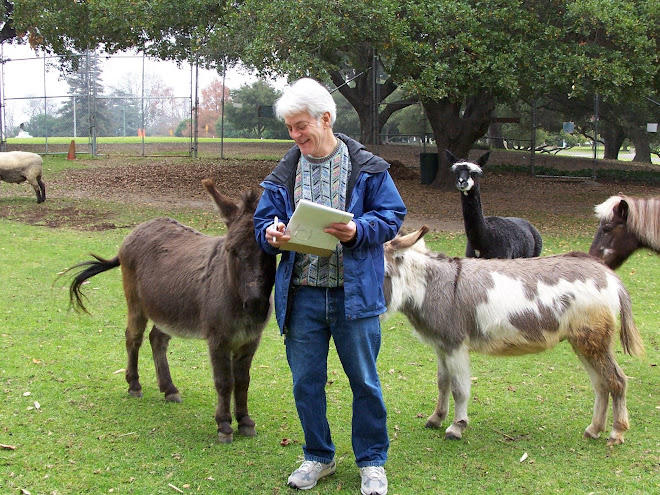
Interviewing the animals at Children's Fairyland in Oakland. L-R: Bobo the sheep, Gideon the miniature donkey, me, Tumbleweed Tommy the miniature donkey, Juan the alpaca, Coco the pony

Tuesday, June 2, 2009

A long life well lived

(Above: Hillside Club Poster by David Lance Goines)


Berkeley lost its oldest resident, and the historic Hillside Club lost its longest-serving member, when Marjorie Robinson died April 25 at her home on Fresno Street, where she lived for the last 70 years. She was exactly 104 ½ years old.
I had the pleasure of meeting her at her birthday party last Oct. 25 at the Hillside Club, and it was like a guided tour through local history.
Think what this area was like when she was growing up: no Bay Bridge and no Golden Gate Bridge. And everything north of Berkeley was nothing but farmland.
She graduated from Berkeley High in 1923, and it was a very different place.
"When young men got in trouble, the principal used to put them in a barrel and roll it down the stairs for punishment. You couldn't get away with that today."
But the most memorable event of her youth was the 1923 Berkeley Hills fire, which destroyed nearly 600 homes, including the house next door to hers.
"My mother and I had gone to Oakland to do a little shopping. We were coming home on the Grove Street streetcar and suddenly saw hundreds of cars coming the other way. Nearly all the hills were on fire."
When they got to Grove Street - now known as Martin Luther King Jr. Way - and University Avenue, the conductor suddenly announced, "This is far as we go," and her mother told her, "You go ahead and save what you can; I'll try to catch up with you later."
She dashed up Shattuck Avenue, circling around the police barriers until she got to Cedar Street, a block away from her home.
"A policeman was holding people back, so when he turned the other way I ducked under the rope and ran to our house."
When she got there, it was full of looters.
"People were ransacking the place, helping themselves to things like my parents' crystal decanters. They were piling stuff on a tablecloth on the dining room table, getting ready to take everything away.
"One man came up to me, thinking I was another looter, and handed me one of my father's old shoes filled with my mother's jewelry. He said, 'Here. There's enough for everybody.'
"I yelled, 'This is my home!' at the top of my lungs. And for some reason, it worked. They dropped everything and ran away."
That night, a new hazard appeared: Hundreds of rubber-neckers, who had come from as far away as Marin County to view the fire.
"The problem was that they were driving over the fire hoses, cutting the water off. So a firemen said to me, 'Stand here in the middle of the street and don't let anyone run over the hoses.' I stood there all night until 5 a.m., when the National Guard arrived and told me, 'We'll take over now.'"
But there was much more to her life, including two husbands, two children, 10 grandchildren and 19 great-grandchildren.
She was active in the First Congregational Church of Berkeley, which she joined in 1939. She was also president of the Athene of California, Northbrae Women’s Club, Alameda District Federation of Women’s Clubs and - at age 99 - Chapter LG of the PEO Sisterhood, one of the pioneer societies for women.
Hers was a long life, well lived. And a lot of people miss her already.

Friday, May 22, 2009

Mrs. Dittmer's Summer Reading List


(Above: Mrs. Dittmer)

Of all the columns I write each year, none is anticipated so eagerly by my readers as the annual Mrs. Dittmer's Summer Reading List.
Mrs. Dittmer is Helen Dittmer, the librarian at Redwood Day School in Oakland.
For two decades, she has made a more profound difference in many people's lives than any other teacher they ever had, including high school, college and grad school.
Many of them still go back to her for help with their research assignments, long after they graduated from Redwood.
She tries to know each child personally, so she can recommend books they'll like. And, when necessary, she'll also recommend a book they need.
For instance, if your parents are getting divorced, she might recommend "Charlotte's Web," so you'll learn that people don't stop loving you just because you're separated from them.
If it's your first day of school and you're worried about making friends, she might suggest "Amos and Boris" by William Steig, about a mouse and a whale who become close friends despite their obvious differences.
When Mrs. Dittmer reads aloud to the kids you can hear a pin drop. They hang on every word - partly because she chooses great stories, but also because she acts out all the characters in their own voices.
Elise Gonzalez, now a junior in college, remembers how her parents would drop her off an hour before school started, as many working parents have to do. She'd make a beeline for the library, along with about a dozen other kids in the same situation.
"Mrs. Dittmer would hand out knitting needles, and all of us – boys as well as girls – would sit around her on the floor, knitting away, while she read to us," she said. "It was a really fun way to start the day."
I've talked to many, many Redwood grads, and they all told me the same thing: They all carry a book with them wherever they go, they all read like crazy, and they all say it's due to Mrs. Dittmer.
All of them are happy that I'm writing this column. More than one said, "She's so modest, it's about time she got some recognition."
In fact, there's only one person who isn't thrilled – Mrs. Dittmer, of course.
One day, I stumbled on something about her that 99 percent of the people at Redwood don't know: She has a PhD in Russian history.
I called her up and said, "Mrs. Dittmer, you've been holding out on me. You have a PhD."
"Do you have to print that?" she said. "I don't want this to be about me; I want it to be about the school."
That's Mrs. Dittmer in a nutshell.
But she would be the first to say that even the best stories have to come to an end, and it's my sad duty to report that she is retiring. Typically, she's already been training her successor.
"Redwood will get along just fine without me," she says, but the truth is that she is irreplaceable.
But she's left us with one final summer reading list, and it's her best yet.
And here it is:

Kindergarten:

"Yoko Writes Her Name" by Rosemary Wells
When Yoko entered kindergarten she knew how to write her name in Japanese but not in English. Two students teased her and warned that she’d never graduate from kindergarten at that rate. Yoko felt such a failure that she hid under the tale. Her classmate, Angela, found her and wanted to learn how to write his name in Japanese. If she would teach him Japanese characters he would teach her English letters. From that moment on, Yoko gained confidence and found her place in the class.

"One" by Kathryn Otoshi
In this title, Otoshi takes aim at the subject of bullying, using colors as characters. Blue was a quiet color and he had friends: yellow, who was sunny; green, who was bright; and so on. But red always picked on blue and made him miserable. Red bullied the other colors into silence, which made things worse. Finally one day the number one appeared and stood up for blue, which gave courage to the other colors to do the same, and at that moment the atmosphere for everyone improved one hundred per cent.

First Grade:

"Willow" by Denise Brennan-Nelson and Rosemarie Brennan
Young Willow goes to her art class and encounters a teacher who believes that she alone knows the right way to draw and the students must emulate her. The students follow directions and they all produce the same tree - all except Willow, who creates a tree as she imagines it. The class paints an apple and again everyone’s apples are the same except for Willow’s, for she imagines a blue apple. A clash of personalities between student and her teacher is inevitable.

"Bugs In My Hair" by Catherine Stier
Here’s perfectly groomed Ellie, who goes to the school office to talk to the nurse about her itchy hair and finds to her horror that she has head lice. How awful! How humiliating! How shameful! But Ellie and her mother become much calmer and smarter as they learn about lice and the methods for dealing with them. The author offers humor and information to deal with what could be an embarrassing situation.

2nd Grade

"Library Lion" by Michelle Knudsen
When a lion enters the local public library no one knows what to do. There seem to be no rules excluding the lion, and he was actually on his best behavior. He particularly enjoyed story hour, and once he understood the rules the lion helped the librarian. He dusted, he licked envelopes for the mail room, and when an accident occurred he became a library hero!

"Planting the Trees of Kenya: The Story of Wangari Maathai" by Claire A. Nivola
Wangari Maathai grew up in the highlands of Kenya, where she developed a love and respect for the beautiful land she called home. When Maathai finished her education in America, she returned to Kenya and found that the landscape had been transformed. The hills were dry, streams no longer flowed with water and fish, trees had been chopped down and the individual farmily farms that had sustained the people were gradually disappearing. replaced by corporate farms that produced goods for export. Wangari set out to restore an environment that could feed the population.

3rd Grade:

"Crossing Bok Chitto: A Choctaw Tale of Friendship and Freedom" by Tim Tingle
Back in he 1830s, a young Choctaw girl does the forbidden - she crosses the river Bok Chitto from Choctow territory onto slave land to find blackberries for her mother’s cooking. She finds the berries but gets lost on her way home. She wanders onto the slave plantation, where she encounters a church service and then a man who has his grandson, little Mo, take her back to the river. But the boy is worried. Slave owners have threatened to punish all the family of anyone who is seen near the river. The grandfather says, "there is a way to move amongst them where they won’t even notice you: You move not too fast and not too slow, eyes to the ground, away you go.“ This is the beginning of a story of friendship and of freedom.

"Ivy And Bean" by Annie Barrows
This is the first of a delightful series (five books have been published thus far) about Ivy, who moves in across the street from fun-loving, mischievous Bean. Bean knows she’ll never be friends with quiet, bookish Ivy; but of course you know about how first impressions can be misleading, and in this book they definitely are. Bean gets herself into a “situation,” and Ivy comes to her aid, and soon Bean discovers that far from being dull, Ivy, the reserved shy girl wants to become a witch. And this is only the beginning.

4th grade:

"How To Steal A Dog" by Barbara O’Connor
Georgina Haynes faces a dismal family situation. Her father left home, and the remaining family members - mother, brother and Georgina - have been evicted and are living in the family car. Georgina is desperate to help her mother and decides the way out is to steal a rich person’s dog and then collect the money when a reward is offered. But our heroine is confronted with the fact that all her planning has been a waste of time. The dog’s owner, who she thought looked wealthy, has no money!

"Each Little Bird That Sings" by Deborah Wildes
Meet ten-year-old Comfort Snowberger and her family. The Snowbergers have owned the funeral parlor in their town for decades, and Comfort has attended 246 funerals. She works with her brother Tidings, her dog Dismay and her parents to make funerals both dignified and beautiful for the community. But she runs into a major challenge when her cousin, Peach, who is afraid of death (and all too ready to express his feelings in public) ruins Great Aunt Florentine’s funeral as well as Comfort's friendship with her friend, Declaration. This is a story about how messy life can be and how the Snowbergers accept the mess with understanding and love.

5th grade:

"We Are The Shop: The Story or Negro League Baseball" by Kadir Nelson
Kadir has brought together in this book the history of and the heroes of Negro League Baseball. Once the sport was developed in the late nineteenth century, it quickly gained nation-wide popularity. Though African Americans were excluded from the major leagues, Rube Foster - along with many players - created their own league. Kadir describes the conditions players in the Negro League faced: the inadequate equipment, the terrible umpires and rampant segregation. Despite constant hardships and harassment, fabulous baseball emerged, led by players like Josh Gibson, Grant “Home Run” Johnson and William Julius “Judy” Johnson.

"Emmy and The Incredible Shrinking Rat" by Lynne Jonell
Emmy is a good girl with a big problem. She’s working hard in school to get A’s, she eats her vegetables and does all the chores her tyrannical nanny assigns her. She hopes in this way to please her parents, who are always traveling and barely notice her when they are at home. None of these maneuvers seem to have any effect and at school the way the teacher acts and the way students treat her, she might as well be invisible. What is happening? What has she done wrong?

6th grade:

"The Road to Paris" by Nikki Grimes
Beautifully written, this book describes the plight of a young African American girl named Paris and her older brother, Malcolm, who are abandoned by their mother. The children are first put in foster care with the Boone family, where they are mistreated and finally run away. Family Protective Services then splits the pair up, with Paris going to the Lincoln family and Malcolm going who knows where. Paris isn’t told. The Lincoln family turns out to be a blessing. They are kind and thoughtful, they know how to give Paris space for herself, and they nurture her. Even the two Lincoln boys take to her. But just as Paris becomes comfortable, her birth mother returns to claim her.

"Emma Lazarus Fell Out Of A Tree" by Lauren Tarshis
Emma Jean is a smart 7th grader who tries to be a rational thinker while her classmates act illogically and emotionally. Students are often mean and tease one another for no reason, so Emma prefers to keep her distance. But one day she heads for the girls bathroom and finds a classmate, Colleen, sobbing into the sink. And why is she crying? Her best friend has ignored Colleen and invited another seventh grader to go skiing with her. Emma Jean wants to help Colleen and so she gets involved, a most irrational decision on her part.

7th Grade:

"Graveyard Book" by Neil Gaiman
Imagine a family of four sitting comfortably at home when suddenly a man, “Jack” invades the premises, kills both parents and the seven-year old child. The three-year-old boy manages to escape. He heads for a nearby cemetery and is discovered by the Owen family, two ghosts who are buried there. They and the rest of the ghost community decide to raise the boy and give him the name, “Nobody Owen” - Bod for short. Bod manages to acquire some ghostly talents. He ventures beyond the cemetery to see what life in the outside world is like - not a good idea, for he is ill equipped to deal with the real world. Meanwhile, in the background is “Jack,” the man who murdered his family and is still determined to kill him.

"Ties That Bind, Ties That Break: A Novel" by Lensie Namioka
The time is 1911; the place is China. The main character, Ailin, is about to marry the son of an upper class family, but she protests loudly and vigorously about having her feet bound, a common tradition for the Chinese elite but one that seems brutal and senseless to Ailin. So Ailin loses her chance at this marriage because of her obstinacy, and her family warns her that she has ruined her life and caused them shame beyond repair.

8th grade:

"Trouble" by Gary Scmidt,
In this novel, a young teenager (perhaps 14-years-old) deals with loss, grief and prejudice. Henry Smith, had a father who always said, “If you build your house far enough away from trouble, then trouble will never find you.” This book is proof that the adage is wrong. Henry and his older brother, Franklin, are students at a very upscale private school and seem safe from the insecurities that hover over most of us. One night, Franklin was riding with friends in a car when Chay Choun, a Cambodian immigrant, hits Franklin's car and leaves him hospitalized in critical condition. The Smith family is in shock, the town is infuriated and uses the accident to attack the Cambodian community. How can Henry handle his grief? How can Chay Choun deal with his guilt?

"The Boy In the Striped Pajamas" by John Boyne
Nine-year-old Bruno and his family lived in Berlin until 1941, when his father was appointed commandant at a place Bruno calls “outwith.” (Auschwitz). The famly moves from an elegant place in Berlin to a smaller and more ordinary house in “outwith,” and the children (Bruno has a sister) get no explanation of where they’re going. There is a barbed wire fence separating the family home from a bleak area filled with ramshackle huts, and smoke stacks and thousands of people wearing striped pajamas. Bruno wants to go and explore, but his parents have made it clear that such activity is forbidden. But what’s a nine-year-old to do for adventure? He goes exploring anyway.

Thank you, Mrs. Dittmer.
Thursday, May 14, 2009

Of The Tweens, By The Tweens, For The Tweens


It had to happen: Now there's a blog called the Malia and Sasha Fan Club.
It was created by two sisters in Memphis, Tennessee, named Kailysia and Kaila, who are 10 and 8 respectively - about the same age as the Obama girls. And their grandma is their webmaster.
It's a blog by Tweens for other Tweens, and it reports every story from a Tween perspective. For instance, when the President and First Lady visited Buckingham Palace, the headline read, "Malia and Sasha's mom and dad meet the Queen."
Needless to say, they've been all over the Bo the Dog story from the very beginning. Even before he was chosen, they were conducting an online poll on what he should be named. ("Moose" was the favorite with 50 percent of the votes, followed by "Frank" and "other.")
Every time Malia or Sasha is spotted taking Bo for a walk, or another one of Bo's siblings pops up somewhere in the country, you'll read about it first at the Malia and Sasha Fan Club.
There's a dictionary icon you can click on to look up words you don't know. And if you're so young that you haven't learned to read yet, you can click on another icon to hear an audio version of the text. (That was Kaila and Kailysia's idea.)
There are also a lot of fun facts to learn and games to play, but when you click on the "Games" link you have to read a Bible verse first. (That was Grandma's idea.)
And there's another link you can click on to donate to Kailysia and Kaila's favorite charity, StandUp For Kids, which helps homeless children.
During March Madness they asked everyone to root for Memphis because, as they explained, "Our dad is going to have a fit if they don't win!" (Alas, the Tigers lost.)
Now, one of the nice things about being a newspaper columnist is that I have absolutely no hesitation about calling up perfect strangers.
So I called them when they were at Grandma's house. And they were a total delight: smart, sweet, enthusiastic and extremely polite - just like Malia and Sasha.
"The only reason we started the fan club was that we couldn't find a kid-based website on the Obama girls," said their grandma. "They were fascinated when I told them they could start their own fan club, where other kids could read about America's First Daughters."
The whole experience has been incredibly empowering, and it's had an unexpected bonus for Kaila, who previously disliked her birthday: July 4th.
"I could never get my friends to come over and celebrate with me because they were busy celebrating the holiday with their families," she explained.
Then, while doing research for the blog, she discovered that Malia's birthday is July 4th, too.
"It made me feel awesome! Now I LOVE being born on July 4th!"
Their fondest hope, of course, is to meet the Obama girls in person. But what will they say to them when they do?
"I'm just going to treat them like real people," said Kailysia. "A lot of people say, 'Oh gosh, you're the president's daughter!' But I'm going to treat them like we've been friends forever."
You can visit the Malia and Sasha Fan Club at http://kailysiakaila.blogspot.com/

Sunday, May 10, 2009

No Greater Love


(Above: Sen. Daniel Inouye, D-Hawaii, as a 19-year-old serving with E Company of the 442nd RCT. He was awarded the Medal of Honor for his heroism.)

Did you know that no private monuments are allowed in the East Bay Regional Park District? It's been a strict rule ever since the district was founded 75 years ago.
But there's one exception: In Roberts Park there's a memorial to the 442nd Regimental Combat Team, the Japanese American World War II unit that was awarded more medals, man for man, than any other unit in American history.
Their heroism is even more impressive when you remember that they were fighting and dying for our country at the same time that their families were imprisoned in detention camps back here.
Never mind that they were American citizens, or that there were no similar mass roundups of German Americans or Italian Americans.
If I had been in their position, I would have told Uncle Sam to take a hike. But the men of the 442nd were made of better stuff. They not only agreed to serve, they volunteered.
The longtime general manager of the park district, the late William Penn Mott, was so moved by the 442nd's patriotism, he waived the rule against private monuments.
That's why there's a plaque and memorial bench in Roberts Park, right beneath the historic Blossom Rock Navigation Trees, a pair of towering redwoods that ships sailing into San Francisco Bay used to get their bearings during the Gold Rush days.
And the best time to visit the monument is at noon onMay 16, when the men of the 442nd gather for their annual memorial service to honor their friends who made the ultimate sacrifice.
One of them was Sadao Munimori, a 22-year-old who was the first member of the 442nd to receive the Medal of Honor. He was killed when he threw himself on a live grenade to save his friends. The date: April 5, 1945.
When I first read that, it gave me a start, because that was the day I was born.
It brought home to me the fact that Munimori - and all the other 500,000 Americans who lost their lives - died so you and I could live. They gave up their futures so we could have ours.
All of Mott's successors as general manager, including the current incumbent, Pat O'Brien, have followed his tradition of treating the 442nd with honor. The park staffers knock themselves out each year to make the memorial service as easy as possible for these heroic veterans. They even waive the parking fees!
For years, the men of the 442nd have asked me to thank the park district for them, but for one reason or another I never got around to it. So let me correct that now: Thanks, Mr. O'Brien, to you and all your people. The men really appreciate it, and I know Mr. Mott would approve.
Over the years, the ceremony has been broadened to honor all World War II veterans. And the men of the 442nd cordially invite you to join them.
Roberts Park is located on Skyline Boulevard in Oakland. Just follow the signs for the Chabot Space & Science Center and look for the turnoff to Roberts Park, about a mile before you get to the observatory.
Drive through the first parking lot and park in the second lot behind it. You'll find the 442nd monument just past the picnic area.
I look forward to seeing you there.

Monday, May 4, 2009

Shakespeare In The Park


Children's Fairyland will echo to the words of the Bard this weekend when the Young Actors Workshop presents Shakespeare's "Love's Labor's Lost."
Director Amanda Ditmore, a senior at Maybeck High School in Berkeley, says the young thespians chose this play because of its uncanny parallel with their own lives.
"It's about a group of young people who, at the end of the play, find themselves heading off into the world. It's the end of their adolescence, and that's very meaningful to us," she said.
"Many of us have been together since middle school, and now we're seniors going off to college. This play is one last time for us to get together and have some fun and put a fitting close to our friendship and hard work for the last six years."
This is the first production by an outside group in Fairyland's new Aesop's Playhouse, a 200-seat amphitheater that is also the venue for Fairyland's own performance troupe, the Children's Theater.
"And they've already found ways to use it that never occurred to us," said C.J. Hirschfield, Fairyland's executive director, "such as opening the doors at the back of the stage and using the vista beyond as a backdrop. I'm thrilled."
Sooz Worthing, who directs the Young Actors Workshop, returns the compliment.
"It's a very whimsical space. I love the fact that there are all these doors, which give us great opportunities for all kinds of fun stage business, with everyone running around and making entrances and exits like a Keystone Kops movie."
She and Amanda have set the play in Europe during the ominous years leading up to World War II, which gives the actors the chance to wear some great period costumes, makeup and hairstyles.
The Young Actors Workshop, an after-school enrichment program at Park Day School in Oakland, is celebrating its 20th anniversary. The actors, ages 11 to 18, come from middle and high schools throughout the Bay Area.
From the start, they have run the show.
"Amanda is not my assistant," said Worthing. "She really is the co-director. She did most of the cutting and staging, and she was really great working with the actors. She's very intuitive and patient, and she knows how to get the best work out of them."
Amanda, who is looking forward to studying at Emerson College in Boston next year, is already a prize winner, having won the Gerald A. Larson award for excellence in directing at this year's Lenaea Festival at Cal State Sacramento.
But, like the characters in the play, she's finding that parting is such sweet sorrow.
"I know it's a cliché, but I feel like I'm saying goodbye to my family. These are some of my closest friends."

If You Go:
What: "Love's Labor's Lost" by William Shakespeare, performed by the Young Actors Workshop. Suitable for children 10 and older.
Where: Aesop's Playhouse at Children's Fairyland, 699 Bellevue Avenue in Oakland
When: May 8 and 9 at 7 p.m. May 10 at 5 p.m.
Tickets: $13 for adults, $9 for students and seniors. Available at the door.
Info: 510-923-0505 x102

What Might Have Been


(Above: Bret)

Over the last few weeks it's been my great pleasure to write about three teenaged prodigies - classical pianist Audrey Vardanega and jazz virtuosos Samora and Elena Pinderhuges.
It's exhilarating to behold so much talent in someone so young, especially when they're such nice kids, as all three are. And it's so much fun to imagine what wonderful things they're going to accomplish as they wend their way through life.
But that's why it's also so painful when a young person with such promise gets cut off before he or she has barely had a chance to begin. You're forever left wondering: What might have been?
That's how I've felt since March 21, 2005, when Bret Harte was killed by a hit-and-run driver on Highway 680 near Concord. He was only 25.
Bret - no relation to the 19th century author - was a theatrical wunderkind who had already directed several local productions, including "Inherit The Wind" and "The Man Who Came To Dinner."
"He was destined to be one of the great theatrical directors of his generation, said Davis Robinson, his theater professor at Bowdoin College in Maine.
Campbell Hunter, his history teacher at Miramonte High School in Orinda (where he graduated in 1998 with a straight-A average), went even further: "If I had a son, I'd want him to grow up to be just like Bret."
Bret's death devastated his parents, Dennis and Juanita Harte, two of the nicest people I've ever met. He was their only child, and they had a wonderfully warm, loving relationship. All their hopes and dreams were wrapped up in him.
Since then, they have tried to keep his spirit alive by founding an internship for up-and-coming young directors at Berkeley Rep, where Bret worked as a stagehand after college.
And their friends have rallied around them. Led by Greg Walker and Lee Bressette, whose daughter was one of Bret's closest friends, they hold annual plant sales to augment the internship fund.
This year's plant sale is taking place this weekend at 73 Coral Drive in Orinda, from 9 to 3 on Saturday and 10 to 2 on Sunday.
"We've never had such a diversity or quantity of plants," says Lee. "They are all looking their best and ready to go to new homes."
The plants include herbs, veggies, orchids, perennials, exotics, drought-resistant landscape plants and catnip, which I intend to pick up for my cat, Phoebe.
And it couldn't be for a better cause. There have already been two Bret Harte Directing Interns at Berkeley Rep - Marissa Wolf, now the artistic director of the Crowded Fire Theater Company in San Francisco, and the current incumbent, Mina Morita.
"I never met Bret; I only know what his friends here at Berkeley Rep have told me about him," said Mina. "There's an extreme sense of loss here, even now. He was well loved by everyone on the staff. It's really an honor to carry on his name in this way. I'll try to live up to it."
If you can't get to the plant sale, you can still contribute by sending a check to the Bret C. Harte Young Directors Fund, Berkeley Repertory Theatre, 2025 Addison St., Berkeley CA 94704.

Sunday, April 26, 2009

Mozart for Majors and Minors


(Above: Audrey playing at the Crowden School in Berkeley, where she is in the 8th grade. Photo by David Weiland.)

Last spring, Maestro George Cleve, founder and musical director of the annual Midsummer Mozart Festival, got a brilliant idea.
"I was coaching some very young musicians, and it reminded me how much I enjoy working with young people. But I don't get a chance to do it often enough."
So he decided to create the Mozart Youth Camerata, a chamber orchestra that pairs professional musicians from the Midsummer Mozart Festival orchestra with some amazingly talented teenagers, playing side-by-side.
The youth camerata will premiere May 9 at the El Cerrito Community Center, performing a concert titled "Mozart for Minors and Majors."
The concert includes selections from the sparkling "Eine Kleine Nachtmusic" and the gorgeous Symfonia Concertante in E flat, featuring soloits Robin Hansen, first violin with the Midsummer Mozart Festival, and Victor Romasevich, first violin with the San Francisco Symphony.
But the highlight will be the Piano Concerto #21 in C, starring an astounding 13-year-old prodigy, Audrey Vardanega of Oakland, an 8th grader at the Crowden School in Berkeley.
"It's hard to believe she's so young because she plays with an astonishing beauty and maturity beyond her years," Cleve raves. "She's really an extraordinary talent and a genuinely nice kid, absolutely unspoiled."
The occasion calls for a really first-rate piano; so Cleve turned to Jim Callahan, owner of the Piedmont Piano Company in north Oakland, thinking to rent a Steinway or maybe a Bechstein or Bosendorfer.
He was floored by Callahan's reply: "How about a Fazioli?"
Faziolis are known as the Ferraris of the piano world. Concert pianists get misty-eyed talking about them, like middle-aged baseball buffs talking about Willie Mays.
Faziolis are handmade in a factory near Venice, Italy, and only a half-dozen are turned out each year. The Piedmont Piano Company is the only place in this country west of the Mississippi where you can get one.
No stone is unturned to make each piano as close to perfect as humanly possible, including making the sounding boards with wood from the same trees that Antonio Stradivari used to make the sounding boards for his violins.
Cleve immediately called Audrey and told her the good news. Within 15 minutes, she and her mom were at the Piedmont Piano Company, and Audrey sat down to play.
"You should have seen the look on her face," says Cleve. "She was in ecstasy, and so were we, listening to her."
Everyone in the store, sales clerks and customers alike, stopped dead in their tracks and stood, open-mouthed, for the next hour and a half as melody after exquisite melody poured from Audrey's fingertips.
"I was only going to play for a couple of minutes, but I just couldn't stop," she says. "All the subtleties I practice every day, every scale, every note, came out pristine and clear and exactly how I imagined them in my mind."
But Faziolis don't come cheap. The piano Audrey will be playing on May 9 sells for $129,000. But Callahan isn't even charging her rent; he's generously letting her use it for free.
You can hear her playing this amazing instrument from 11 a.m. to noon. The El Cerrito Community Center is at 7007 Moeser Lane. Tickets are $10 for adults, $5 for children. All proceeds will go to the El Cerrito Recreation Program's scholarship fund and the Midsummer Mozart Festival.
(You can see Audrey playing Bach's F minor concerto at http://www.youtube.com/watch?v=XgXjDUgpBJM)