A columnist of heart and mind

A columnist of heart and mind
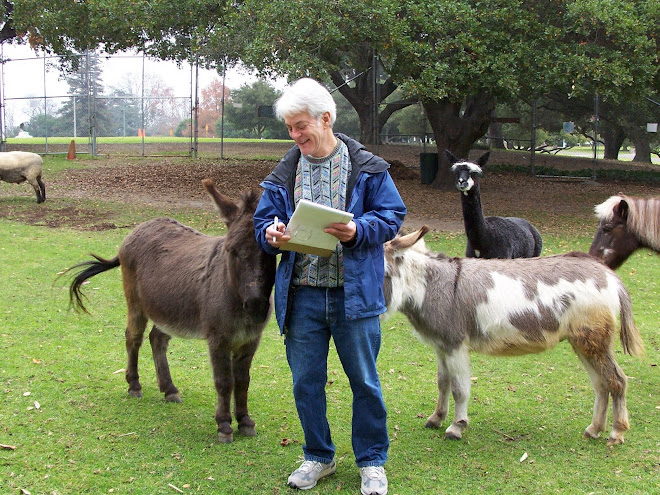
Interviewing the animals at Children's Fairyland in Oakland. L-R: Bobo the sheep, Gideon the miniature donkey, me, Tumbleweed Tommy the miniature donkey, Juan the alpaca, Coco the pony

Thursday, February 5, 2009

Coco R.I.P.


(Above: Bobo and Coco. Photo by Annie Wong.)

Sad news for everyone who has ever loved the animals in the petting zoo at Children's Fairyland in Oakland: Coco the pony died Jan. 17 of old age. She was 38, which is way older than her normal life expectancy.
That's true of most of the animals at Fairyland: They live much longer than average because of all the tender loving care they get there.
And Coco's final months were as happy as human effort could make them. She retired last June, along with her devoted companion, Bobo the sheep. Their caregiver, Yvonne Backman, decided that Coco's arthritis would be helped if she had a new home where she could roam freely all day, which she couldn't do at Fairyland.
It was vital to place Bobo along with her because Bobo was so devoted to Coco, he'd go into a panic whenever he lost sight of her - which happened pretty often, because he's nearly blind. He'd utter pitiful little bleats of terror until somebody led him over to her.
It wasn't easy finding a home that would take them both, but Backman finally found the perfect place: Goats R Us in Orinda, which rents goats to UC Berkeley and the East Bay Regional Park District to clear brush from the hills during fire season.
Goats R Us's owner, Terri Oyarzun, bent over backward to make sure Coco and Bobo's transition to their new home would be as easy as possible.
They had the same food, same supplements, same feeding time, same wakeup time and same bedtime that they had at Fairyland. No detail was overlooked, including placing Coco's feed bucket on the same spot where it had always been.
Coco loved her new home so much, she slept every night outdoors under the stars - another thing she couldn't have done at Fairyland. As always, Bobo kept her company, even though he would rather have been indoors. (Since she died, he's slept inside his shed every night.)
"She got to be a pony again," said Oyarzun. "She didn't have any more responsibilities to the public. But she still got visits every week from Yvonne and the other folks at Fairyland, so she never felt like her old friends had forgotten her. She had the best of both worlds."
Her passing was peaceful, and the ever-faithful Bobo was with her when she died.
That was therapeutic for him because it helped him understand that she was really gone forever, not just moved to another shed or pasture.
Everyone was worried about how he'd take Coco's death, but a minor miracle has occurred: Bobo has made a new friend!
His new buddy is an eight-year old chestnut horse named Piggy B, who lives in the adjoining pen. The two of them spend hours and hours every day at the fence, communing and commiserating with each other. It's a win-win situation all around.
Kudos to Backman. Kudos to Oyarzun. Between them, they made Coco's final days happy ones. It was no less than she deserved.
If you've never been to Fairyland, you've really missed out. It's an oasis of gentleness, peacefulness and calm in the middle of Oakland, where everything is attuned to the scale and sensibilities of a little child.
And now Fairyland is making it less expensive, which is a blessing in this terrible economy. Instead of forking out $7 each time for each adult and child, you now can buy a 12-month pass for only $75 that will give you - plus up to three kids - unlimited admission.
You'll also get free guest passes, special glow-in-the-dark Fairyland Magic Keys for each child, free admission to the Jack O'Lantern Jamboree in October and Fairy Winterland in December, free cotton candy for the kids at the Johnny Appleseed Café and much, much more.
And while you're there, be sure and visit Coco and Bobo's successors, Dori the pony and Twinkle the lamb, in the petting zoo.

Reach Martin Snapp at catman@california.com.

Monday, February 2, 2009

Lincoln the genius


(Above: Elmer Ellsworth)

For years, some academics have been debating about who really wrote Shakespeare's plays. They argue that a country bumpkin from Stratford-on-Avon never could have penned such sophisticated works.
But I think Shakespeare wrote them himself. Genius trumps everything.
The best example is the man whose 200th birthday we're going to celebrate next Thursday, Abraham Lincoln. (Also born on that same day: Charles Darwin. It was the greatest twofer until 1965, when the Chicago Bears drafted Dick Butkus and Gale Sayers in the same round.)
At least Shakespeare made it through high school. But Lincoln had less than a year of formal schooling. Yet he wrote the greatest speeches in American history, including his masterpiece, the Second Inaugural.
I don't mean the most famous passage - " with malice toward none, with charity for all" - as much as the hair-raising language that precedes it:
"Fondly do we hope, fervently do we pray, that this mighty scourge of war may speedily pass away. Yet, if God wills that it continue until all the wealth piled by the bondsman's two hundred and fifty years of unrequited toil shall be sunk, and until every drop of blood drawn with the lash shall be paid by another drawn with the sword, as was said three thousand years ago, so still it must be said 'the judgments of the Lord are true and righteous altogether.'"
It took a lot of guts to tell a country that had just lost 650,000 young men that it deserved to suffer because of the sin of slavery.
But Lincoln knew personally what suffering was like. He lost Elmer Ellsworth. In 1858, at the age of 20, Ellsworth was hired as a clerk in Lincoln's law office.
In no time flat, he moved in with the family and became Lincoln’s surrogate son.
In 1860, with war on the horizon, Ellsworth quit his job and went from city to city, organizing regiments of soldiers.
The day after Ellsworth and his soldiers arrived in Washington, Lincoln invited him to lunch at the White House. Standing on the front porch, they could see a Confederate flag flying atop the Marshall House hotel in Alexandria, just over the river on the Virginia side.
Indignant, Ellsworth took a squad of soldiers to tear it down. They went up to the roof, removed the rebel banner and started back down the stairs.
Suddenly, the hotel’s proprietor, James W. Jackson, stepped out of the shadows and emptied a shotgun into Ellsworth's chest, killing him instantly. Jackson, in turn, was killed by the enraged soldiers.
The whole North went into mourning. Public buildings in every city were draped in black crepe. Hymns and dirges were composed in Ellsworth’s honor.
Lincoln gave him a state funeral in the East Room, sobbing as he stood over the open coffin, tears falling from his cheeks onto the body.
For years, I tried to find out where the Marshall House used to stand. And the last time I visited Washington, I finally found it. There's a Holiday Inn on the site now, but on the wall is this plaque:
"The Marshall House stood upon this site, and within this building on the early morning of May 24, 1861, James W. Jackson was killed by federal soldiers while defending his property and personal rights, as stated in the verdict of the coroner’s jury. He was the first martyr to the cause of Southern independence. The justice of history does not permit his name to be forgotten. Erected by the sons and daughters of Confederate soldiers."
Ellsworth wasn’t even mentioned! As it turns out, he and Jackson were the same age - only 24. Ellsworth was one of the first deaths on the Northern side. Jackson was one of the first on the Southern side.
And there were 650,000 more to come.

Reach Martin Snapp at catman@california.com.

Saturday, January 24, 2009

How Dr. Moyce Spent Inauguration Day


What did you do on Inauguration Day? Dr. Andrew Moyce of Oakland spent the day doing his civic duty: showing up for jury service at the Alameda County Courthouse.
He was ordered to be there by 8:30, with stern warnings about possible fines if he was late.
"The parking lot was full by the time I arrived at 8:15, and I had to find another lot across the street," he says. "That lot required a prepay ticket from a very slow machine, so I joined the line of a dozen or so fellow jurors waiting to pay.
"After that, a hurried walk all the way around the courthouse to find the only open entrance, followed by the security check. I got to the jury room, breathless, at about 8:45 and handed my papers to the admitting clerk."
The potential jurors - about 200 people, ranging in age from 18 to senior citizens - were ushered into the waiting room. Television sets were mounted on the pillars around the room, all tuned to the inauguration.
"The first thing that struck me was the respectful silence of the people in the room. The clerk could be heard checking people in at the door, and an occasional person talked quietly on a cell phone while people in the vicinity frowned disapproval, but overall there was an ecclesiastic silence.
"On television, Diane Feinstein had just started the ceremonies, and she held the rapt attention of everyone in the room. All eyes were on the nearest TV, and the seats with backs to the TV were empty, while several of us stood around the edges. Even during the two musical performances, no one spoke."
When the time for the oath of office arrived, Feinstein asked everyone at the ceremony to stand.
"From across the jury room a middle-aged African American lady - I think she was a clerk - called out, 'C’mon people, this is history! Stand up!'
"As she moved into the crowd, gesturing with her arms, it was plain that she was not to be denied. Within seconds, all of us were on our feet. After the oath was administered, complete with flubs, our room filled with applause, punctuated with loud whoops, and several people were in tears.
"An older white man softly applauded as the new president thanked the outgoing president for his service to the country. During his comments on upholding the Constitution, as the camera focused in on an uncomfortable-looking Mr. Bush, there were scattered outbreaks of derisive laughter. When Mr. Obama acknowledged that we are a nation of various religions - and non-believers, too - a very Berkeley-looking lady in jeans and a flannel shirt clapped alone.
"When the speech was over there was more applause from our group, and not a few handshakes and hugs were shared. All stood in formal attention as the choir sang the National Anthem, and several of us joined in.
"The mood was broken only when the clerk interrupted the broadcast to remind us that we were here for a purpose, and he started the first roll call.
"It finally occurred to me that no court business would take place during the ceremony, as the judges were probably sequestered in chambers with their own TV sets. Time at the courthouse seemed at a standstill until the business of federal government was accomplished.
"After the second roll call my name still had not been called, and those who remained in the room - about a third of the original crowd - were thanked for our service and dismissed.
"I left feeling that I had literally been swept into participation in history. Jury calls have a way of taking us out of our comfortable routines, and, after a frantic start, the day turned out in a way I hadn’t planned. But somehow when it was over, it seemed just right."

Tuesday, January 20, 2009

Hail to the chief!


The 19th Century German Chancellor Otto Von Bismarck once said, "God looks after drunks, little children and the United States of America."
If you ever needed proof of that, look at what happened today. With our whole world unraveling everywhere we look, along comes the perfect guy to deal with it.
Coincidence? I don't think so.
Shortly after Franklin D. Roosevelt was inaugurated in 1933, Justice Oliver Wendell Holmes went to the White House to check out the new president.
He came away much relieved. FDR, he said, had "a second-rate intellect." But, he added, it didn't matter because FDR had a first-rate temperament.
But we're even luckier. Our new president has both a first-rate intellect and a first-rate temperament. The last one we had with that combination was Lincoln. Like Lincoln, he has that rarest of gifts: the ability to step outside himself and look at himself objectively.
He's like a chess master, always thinking two or three moves ahead. Even during the hottest moments of the campaign, he was keeping one eye on how he would govern.
That's why he's able to brush off past slights and surround himself with people who have said really awful things about him. He's not threatened by their intellects, and he's not threatened by their ambitions. All he cares about is whether they can help him save our country.
And that's why the young people love him so much. They think of him as their best hope to move America past the issues of the 20th Century and start dealing with the issues of the 21st.
I don't think they fully appreciate the significance of having our first African American president because they're looking forward, not back. Heck, they don't even see him as black; they see him as multi-racial, which reflects the world they live in.
And they're right. Black father, white mother, growing up in Indonesia and Hawaii - he's our first global president. Everyone in the world can identify with him, and he can identify with them.
For the first time since 1963, the coolest guy on the planet, bigger than any rock star, the idol of every teenager from Beijing to Baghdad, is the President of the United States. How cool is that?
But I can't help one last glance backward to when I was a kid, when separate - but definitely not equal - was the law of the land.
It was worst in the South, where it was open season on blacks. A white could bully, cheat, rape, even kill blacks; and nobody would lift a finger.
But the shame wasn't confined to the South. Even in liberal Berkeley - Berkeley! - the schools weren't fully desegregated until September 1968, five months after Martin Luther King was killed.
That history was implicit in everything that happened Tuesday, especially in Rev. Joseph Lowery's benediction. He was with King from the very start, succeeding him as head of the Southern Christian Leadership Conference.
He began the prayer with a quote from a 109-year-old song that I'll bet every African American in the country recognized immediately: "Lift Ev'ry Voice And Sing," aka "The Negro National Anthem":
"God of our weary years/God of our silent tears/Thou who has brought us thus far on the way/Thou who has by Thy might/Led us into the light/Keep us forever in the path, we pray."
As I heard those words, the images of Emmett Till, Medgar Evers, those four little girls in Birmingham and so many others came flooding through my mind.
Not that racism is dead. As usual, the black guy had to be twice as good to get the job. But something wonderful is happening in this country.
President Obama, as usual, said it best: "What the cynics have failed to understand is that the ground has shifted beneath them."
Our president has given us our marching orders. Be the change.

Thursday, January 15, 2009

None So Great


More than 320 members of the Class of 1958 (class motto: "None so great as '58") attended their 50th reunion Oct. 3-5, the largest 50th reunion in Cal history.
They cheered when basketball captain Earl Robinson led them in the Cal spell-out, cried when they sang "Hail To California" and reminisced about what Cal was like back in the day.
"One difference is that Telegraph Avenue went all the way to Sather Gate," said reunion chairman Roger Samuelsen. "There were restaurants across the street from the Administration Building (now known as Sproul Hall), where the student union is today."
The most popular was Jules' Coffee Shop, where everyone met for a mass kaffe klatch every day at 10 a.m.
"You arranged to not have a 10 o'clock class; and if you couldn't avoid one, you'd take one for which Fybate notes were available," said Gail Follett Hughes. "I don't know why, because the coffee was terrible. It tasted like metal."
At Sather Gate the students bought ice cream from the Crunchy Munchy Man ("Cruncy Munchy/Great after lunchy," the jingle ran). And before football games at Memorial Stadium they bought frozen fruit ices called Gremlins, which the guys in the men's rooting section laced with vodka.
(Yes, there were separate rooting sections for men and women.)
Social life revolved around fraternities and sororities, with elaborate ceremonies and rigid rules.
"You couldn't wear blue jeans or Bermuda shorts in public, or you'd be 'campused' the next weekend," recalled Sharon Foster Strong. "And if you weren't inside your sorority house by curfew, you'd be locked out.
"If you were 15 minutes late, the house president would be wakened. Fifteen minutes later, the housemother would be wakened. And if you still weren't there 15 minutes after that, they'd call the dean of women, and she'd send the police out looking for you."
One of the most elaborate rituals was the pinning ceremony.
"They always took place on Monday nights, which was dress-up night at the sororities, with everyone wearing high heels and hose," said Lynn Springer Pettit. "We would sit around the dining table, trying to guess who was getting pinned.
"A lighted candle, in the color of the boy's fraternity, would be passed from girl to girl until it came to the one who was being pinned. She'd blow it out, and the rest of us would start screaming and congratulating her, and her sorority big sister would pin the pin on her sweater."
Libby Sutton Middleton added, "Then, if she were lucky and her boyfriend belonged to a local fraternity, the boys from his house would gather on our front porch and serenade us."
Strong interjected, "Another difference between then and now: Notice the correct use of the subjunctive."
Meanwhile, Jack Saroyan and Don Kosovac fondly recalled tearing down the goal post after the 1953 Big Game (a 21-21 tie that knocked Stanford out of the Rose Bowl), rushing the crossbar out of Stanford Stadium just ahead of a mob of angry Stanford fans, and driving it back to their fraternity house, Pi Kappa Alpha, in Berkeley.
"And that crossbar is still hanging from the ceiling of the dining room!" Kosovac said proudly.
But it wasn't all hijinks. Then, as now, Cal was blessed with some of the finest professors in the world, including Armand Rappaport teaching American diplomatic history, Raymond Sontag teaching European cultural history, Josephine Miles and Charles Muscatine teaching English, and Richard Aiken teaching embryology.
"Aiken was a consummate artist," said Pate Thompson. "He would create these gorgeous drawings on the backboard that I admired so much, I would come an hour before class and watch him do it."
Patricia Pereira Nielson added, "Rappaport once gave me back a paper and said, 'You didn't tell me anything I didn't already know.' It was the first time I realized that learning is more than regurgitation."
So what does Cal 1958 think of Cal 2008?
"Well, Telegraph Avenue looks dreadful, but the essence of the university is still in great shape," said Strong. "We might not agree with everything that's happened since we graduated, but remember what Clark Kerr said: 'The university isn't here to make ideas safe for the students; it's here to make the students safe for ideas.'"

(This story originally appeared in the Jan/Feb 2009 issue of California Magazine.)

Tuesday, January 6, 2009

The Man Who Put The Water In Watergate


(Above: Reds when he was serving in the Navy during World War II)

And now, in honor of the presidential inauguration, an interview with an honest-to-goodness White House plumber.
No, not one of Richard Nixon's burglars. I mean the man who actually fixed the White House plumbing.
His name was Howard "Reds" Arrington, and I met him in 1993, when I was in Washington covering the first Clinton inauguration.
Reds died last spring, but before he retired in 1979 he served every president from Harry Truman to Jimmy Carter.
He's the guy who fished John-John's diapers out of the john after Jackie's nanny inadvertently flushed them.
He's the guy who retrieved Julie Nixon's contact lens from a sink trap when she lost it right before a big party.
He's the guy who rescued Bess Truman's mother's false teeth from the toilet. (Don't even ask how they got there.)
But the president he remembered most vividly was Lyndon Johnson.
"The first day President Johnson moved in he called me and said he wanted a few changes made to his shower. He wanted six nozzles installed: two overhead - one for the front and one for the back - three at waist level, and one about two feet off the ground pointing upward, so it would send water up his backside.
"But the most unusual thing about that shower was the pressure. I put in a special pump, but he wanted it stronger. I added a second pump, but he still wasn't satisfied. I added a third pump, but that still wasn't strong enough for him.
"By the time I finished, I had four pumps going at the same time, putting out more than 100 lbs. of nozzle pressure. To give you an idea how strong that is, the average shower puts out only 10 to 15 lbs.
"But before the Secret Service let the president use it, they insisted on giving it a trial run. An agent put on a bathing suit and stepped inside. It pinned him to the wall."
Five years later, when Richard Nixon moved in, the first thing he said to Reds was, "Take that thing out of here!"
President Kennedy, on the other hand, never took showers.
"He took baths," said Reds. "I think they helped his bad back. He had his valet run the water the night before so in the morning, all he had to do was run a little hot water to heat it up. He hated waiting for anything.
"He also liked to shave sitting in the tub. I made a little tray that fit over the sides of the tub for him, to hold his razor and things. And we put mirrors on all the walls around the tub so he could see what he was doing."
President Eisenhower put Reds to some unorthodox uses, too.
"We built a full-sized putting green for him in the Oval Office. And he liked to go out on the porch and hit golf balls into the south fountain, and it was my job to fish them out for him. So he bought me a pair of waders to wear. They came up to right under my armpits."
But they aren't all pleasant memories. On Nov. 22, 1963, Reds was working in the Oval Office, helping the carpenters lay a new carpet that Jackie Kennedy had ordered as a surprise for her husband.
"All of a sudden, all hell broke out, and we were ordered to stop what we were doing and haul out all the furniture right away so the new president, President Johnson, could move in. I was OK until the time came to haul out President Kennedy's rocking chair. That's when I really lost it."
Jackie didn't forget him, either. She invited him to the funeral. You can see him in the photographs, sitting right behind Charles De Gaulle.

Thursday, January 1, 2009

The Barber Of Civility


Memo to President-elect Obama: Don't change your hair style.
Sez who? The late Milt Pitts, barber to the presidents. He cut every chief executive's hair from Richard Nixon to the first Bush, and he knew Carter was a goner in 1980 the moment Carter changed his part from right to left.
"You never change your style so dramatically overnight," Milt told me shortly before his death in 1995. "It unsettles people. It indicates a vacillating nature."
Milt was the barber at the old Sheraton-Carton Hotel (now called the St. Regis) in Washington. Twice a month, the Secret Service would chauffeur him to the White House, where there was a tiny, one-chair barbershop in the basement, right underneath the Oval Office.
When I first met Milt in 1985, he showed me a cigar box containing a lock of Ronald Reagan's hair.
"Look!" he said proudly. "Completely natural! You can tell it hasn't been dyed!"
Though he claimed to have liked all the presidents, it was obvious that Reagan was his favorite.
"The first thing I did was get rid of that pompadour. I gave him a layered cut, about 2 inches long, pretty even all around. Nancy walked in and said, 'Ronnie, don't you look good!' I knew right then and there, if Nancy liked it, I was a winner."
So what did he do with Nixon's hair?
"When Nixon first came to see me, his hair was much too long, about 8 inches, and it was dripping with Brylcreem. I took out all the grease and cut it back to 3 inches, longer in the back and fuller on the sides. It looked a lot better."
Mostly, Milt and his celebrated clients indulged in small talk. (Reagan, for instance, loved to reminisce about his old movies.) But there was one time when a president shared his inner feelings: It was Nixon, the night before he resigned.
"When I brushed him off and helped him on with his coat, he said, 'We did a lot of things right, but we've made some mistakes, too. No question of that. I'll see you sometime, perhaps at the Carlton.' Needless to say, there were tears in both our eyes."
And what was Ford like?
"The first Sunday after Ford took office, I was in the back yard mowing the lawn. My wife came out the back door and said, 'The Secret Service is calling you!' They said the president wanted his hair cut right away, and they were sending a car out to get me.
"When I got to the White House, in came Ford in his shirt sleeves, accompanied by a bunch of aides. He looked at me and said, 'Milton, I need a little haircut. Let me explain a few things to you. My hair is thinning and light, and if you cut the sideburns too short, it'll look like I have no sideburns at all. And I use Vitalis.' I said, 'Mr. President, everything you're doing is wrong.'
"All the aides started laughing, so I said, 'Excuse me, Mr. President, it's your hair I'm referring to.' And he said, 'I'm sure glad to hear that!' I gave him a shampoo, a razor cut, blow dry and a little hair spray. That way, it made his hair look thicker and fuller."
And the elder Bush?
"I've been cutting his hair for 18 years and it's never changed: shampoo, a layered cut while wet, sides short, blowdry, and a little spray. Just the way he likes it."
Milt had a shot at cutting Clinton's hair, too. He was recommended by another one of his customers, George McGovern, but he blew it a few weeks before the inauguration.
"A newspaper reporter interviewed me, and I said that Clinton looks like he has the same barber as Don King. After that, my chances went out the window."
So which president was the biggest tipper?
"To tell the truth" said Milt, "none of them has ever given me a tip."