A columnist of heart and mind

A columnist of heart and mind
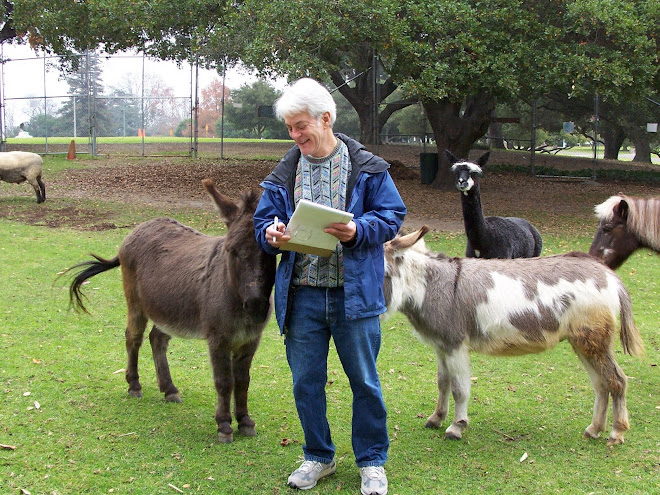
Interviewing the animals at Children's Fairyland in Oakland. L-R: Bobo the sheep, Gideon the miniature donkey, me, Tumbleweed Tommy the miniature donkey, Juan the alpaca, Coco the pony

Thursday, June 26, 2014

Oktobertheft

What's it like when a network television show comes to town and does a program about you?

That was the plot of "Bye Bye Birdie," but it happened it real life to Cindy Kahl, co-owner of Speisenkammer, a restaurant in Alameda that serves authentic German food and beer with authentic Bavarian Gemütlichkeit.

In the 12 years since it opened on Lincoln Avenue, Speisenkammer – the name means – "pantry" - has become an Alameda fixture and a home-away-from-home for the East Bay's sizable German community, including the mechanics at the local German auto dealerships; a Bavarian dance troupe that meets there every week; and a stammtisch, a group of men (plus a few women) who have a reserved table every Wednesday night where they can hang out and speak German together.
Right now, the place is packed with soccer fans who watch the World Cup on huge television screens that have been set up (cheering for the German team, of course).
But last fall, Cindy and her business partner started hearing rumors that the "Dirndl Girls" – who had been hired to liven up the atmosphere during Oktoberfest – were behaving improperly with the customers.
Enter Charles Stiles, an international security expert, and his reality show on the Food Network, "Mystery Diners." He set up an elaborate sting operation, with four cameras in the dining room, three more in the bar, one in the kitchen, and one in the front patio where a temporary beer garden had been set up for Oktoberfest.
He also sent two undercover "Mystery Diners" (hence the show's name) to infiltrate the place, one as a waiter-in-training and the other posing as a customer.
Then Cindy, her partner and Stiles sat in a control room next door and observed the goings-on in real time on 11 different screens.
They watched in amazement as it turned out to be even worse than they thought. Two of the Dirndl Girls were drinking on the job, charging customers for shots that they should have been giving away (and pocketing the money), rigging contests in favor of their own friends, and even stealing tips from the waiters.
And as a bonus, they also discovered that one of the waiters was playing the two owners against each other to leave work early.
Naturally, it was "auf wiedersehen" for the Dirndl Girls. (The waiter got off with a reprimand.)
So what was the upshot? A public relations disaster.
Reason: Over Cindy's protests, the show said Speisenkammer is in Oakland instead of Alameda, and Alamedans are very particular about not living in Oakland's shadow.
"People were furious!" says Cindy. "I got hate mail. People assumed it was our fault and said they'd never come here again."
But please don't blame her her, folks. She tried to warn Stiles, and she thought her message got across. So she was as shocked as everyone else when the program finally aired, using the dreaded O-word.
"We love Alameda!" she says. "That's why we moved here. We wanted to live here, and we still do."
Besides, how can you pass up the most authentic German food this side of Munich? The wiener schnitzel, the sauerbraten, the schewieinebraten – Oh, Mein Gott!
If you want to see this episode, you can watch it at Comcast On Demand under the title "Oktobertheft."

Saturday, June 21, 2014

FSM Revisited

How time flies! This fall will be the 50th anniversary of the Free Speech Movement, and FSM veterans will return to campus for a reunion that will feature the usual events, plus some others you might not have anticipated.
For instance, are you ready for FSM: The Musical? Produced by Stagebridge in association with Berkeley Repertory Theatre, the full-length musical production will have its first performance September 27 on Berkeley Rep’s Thrust Stage, with two additional performances the following day.
But wait! There’s more! The musical was composed by none other than Mario Savio’s son Daniel in collaboration with two veterans of The San Francisco Mime Troupe, Joan Holden, M.A. ’64, and Bruce Barthol ’68. Bruce sat in at Sproul Hall when he was a 16-year-old freshman.
“I feel a great responsibility to get it right for my father’s sake, and also for Michael Rossman and Reggie Zelnik and my mom,” says Daniel, who looks just like his dad. “I grew up with this history. I know it as well as anybody who was there.”
Daniel’s mom, Lynne Hollander Savio ’65, is the show’s creative advisor and a member of the 50th reunion committee.
The FSM began on September 14, 1964, when the University of California at Berkeley, under pressure from Senate Majority Leader William F. Knowland ’29, who was angered by Civil Rights sit-ins, announced that existing University regulations banning political activity on campus would be “strictly enforced.”
The resulting protests, unprecedented in scope, were the harbinger of the student power, civil liberties, and antiwar demonstrations that convulsed college campuses throughout the country for the next decade. They also triggered a voter backlash that many believe led to the election of Ronald Reagan, who campaigned on a promise to “clean up the mess at Berkeley,” as governor of California in 1966.
In the five decades since that memorable autumn, FSM has become part of the popular culture. In 2006, an episode of Battlestar Gallactica featured a character closely paraphrasing Mario Savio’s “bodies upon the gears” speech.
“I got an email from the producer wanting to know if he could use it,” says Lynne. “He said his wife was at Cal at the time, and they were both admirers. He gave the Mario Savio Memorial Lecture Fund a nice contribution in exchange.”
This year’s annual Savio lecture—to be given by Saru Jayaraman, director of the Food Labor Research Center at Cal—will be the last one sponsored by Savio’s friends and admirers, who created the lecture series after his death in 1996. From here on, it will be sponsored by the Social Sciences Division in the College of Letters & Science.
“The timing seemed right to both its organizers and campus leaders to ensure it would continue in perpetuity as a part of our academic landscape and as a commemoration of a very important part of campus history,” says Carla Hesse, Dean of Social Sciences and a member of the campus coordinating committee for the 50th anniversary. Dean Hesse’s father, Siegfried Hesse, J.D. ’50, was one of the lawyers for the Sproul Hall arrestees.
After decades of ambivalence, UC Berkeley is finally embracing this important part of its history. “Though I cannot presume to speak for our current administration, I think it is fair to say that the attitude of campus leaders to the Free Speech Movement has evolved over the past 50 years, from fear to pride in what the students at that time stood up for and what they accomplished,” says Dean Hesse.
The official celebrations will start even before the fall quarter begins, with freshman and new students in the On The Same Page program being asked to read Freedom’s Orator, a biography of Mario Savio written by NYU professor Robert Cohen, M.A. ’81, Ph.D. ’87. The celebrations will continue throughout the fall, including a concert by Mavis Staples, a hootenanny at Ashkenaz, exhibits at the Bancroft Library and the Berkeley Historical Society, documentaries at the Pacific Film Archive, a political poetry night at the FSM Café, freedom-of-speech symposia at the law school, and the Academic Senate’s commemoration of their historic vote on Dec. 8, 1964.
The reunion itself will take place Sept. 26–Oct. 3, climaxing with a rally at Sproul Plaza on Oct. 1, anniversary of the arrest of former grad student Jack Weinberg—the man who said, “Never trust anyone over 30.” Robert Reich, Dolores Huerta, and FSM veterans will deliver speeches from the Sproul steps, which were officially renamed the Mario Savio Steps in 1997.
Though FSM took place half a century ago, those who were there remember the events as if they happened yesterday: the thousands of students on Sproul Plaza surrounding the police car holding Weinberg; the mass sit-in at Sproul Hall and the mass arrests that followed; the cops jumping on Mario Savio as he attempted to speak at the Greek Theater; and the climactic Academic Senate resolution.
“Jack and I set up the card table at 11:30 on that fateful day when he was arrested,” recalls John Sutake ’68. “The reason he was arrested and I wasn’t, was that he was not a currently registered student and I was. It sort of hurt my feelings.”
Many of the FSM leaders were veterans of the Mississippi Freedom Summer, where they were deeply influenced by the nonviolent militancy of Bob Moses and Martin Luther King, Jr. But FSM drew support from across the political spectrum, including fraternity boys, sorority girls, even Young Republicans. Most had never before taken part in a demonstration.
“We were all sitting there, shivering for our careers,” the late Michael Rossman ’63, one of the first people to sit down around the police car, told me before his death in 2008. “We had just come out of the McCarthy period, when people’s lives were destroyed for walking a picket line, let alone sitting around a police car in the middle of a plaza of a great university.”
“I had to make a choice,” says Lee Felsenstein ’72. “Was I a scared kid who wanted to be safe at all costs? Or was I a person who had principles and was willing to take a risk to follow them? It was like that moment in Huckleberry Finn when Huck says, ‘All right, then, I’ll go to hell.’”
“I was coming out of class and saw them take him into the car,” says Jeremy Bruenn ’65, Ph.D. ’70. “Somebody said we should surround the car, and we did. I remember wondering whether they would drive over us, and being happy when they didn’t. I thought they showed fairly good judgment in not creating more of a situation than was necessary.”
“I was sitting by the front bumper,” remembers Damon Tempey ’66. “Weinberg was in the back of the car for more than a day, so he peed into a Coke bottle and ate sandwiches. He had a ringside seat for the speeches as people mounted the police car and spoke.”
But not everyone on the plaza that day was a supporter.
“The vast majority of us were simply walking across campus and stopped to find out what all the commotion was about,” says Phil Litts ’66, who was elected Head Yell Leader later that year on a platform that mocked FSM. “I was on my way back to Unit Three for lunch.”
Although he opposed their goals, Litts was still impressed by the way they went about it.
“Mario Savio was very respectful of people with opposing views. There was no name calling. And when people climbed up on the police car, they took their shoes off first. There was no intent to damage. It was all done civilly, and that’s something you don’t hear a lot about.”
That night, some fraternity boys started heckling the seated protestors and flipping lighted cigarettes at them.
“A bunch of us formed a cordon line with our backs to the frat boys and let them beat on us to protect the people sitting on the ground,” Sutake told me. “Later, when we realized we had to reach out to these people, we went to the frats and sororities giving little talks explaining what we were all about. I don’t know if it changed any minds, but we were trying to build a mass movement, and that included people who disagreed with us.”
The confrontation escalated in fits and starts over the next two months, with rallies, sit-ins, cancelled classes, and picket lines urging students to boycott the few classes that were still going on. Litts, who crossed the picket lines, arrived at his lecture hall and found only two people there: him and the professor.
“So I had a one-on-one tutorial. I sat in the front row, he sat on top of his desk, and we talked, and it was great.”
Ginger Lapid-Bogda ’68 (née Snapp), on the other hand, was an FSM sympathizer who wouldn’t have dreamed of crossing a picket line. But some classes remained open by pre-arrangement between the professor and the FSM leadership, including her anthropology course in Wheeler Auditorium.
“There were movie cameras in the room, and for some reason I could tell one of the cameras was doing a close-up of me. I thought, ‘Can they do this without my permission?’ But I didn’t think any more about it until a few weeks later, when I was back home in L.A. having Thanksgiving dinner with my parents. We were watching Walter Cronkite, and one of the stories was a report from Berkeley. The reporter was saying, ‘Students are crossing picket lines in droves, like this coed.’
“Lo and behold, it was my anthro class, and the coed the camera was zeroing in on was me! I was watching myself being misused by the media to state something that was totally untrue about what was going on at Berkeley. It was my radicalizing moment, and I have never trusted the media ever since.”
Aside from Mario Savio, the best-known FSM leader was Bettina Aptheker ’66, whom the media portrayed as an intransigent hardliner because she was a Communist.
“The irony is that Bettina was one of the moderates,” says Sutake. “She was always saying, ‘Go slow’ and ‘Be reasonable.’ But she was a convenient target.”
The nightly FSM executive committee meetings often lasted into the next morning because everyone had to be heard.
“I sometimes went nuts listening, but you had to do it, and some of the speechifying was great,” declares Kate Coleman ’65. “Like the time we were trying to decide if Mario should lead us into a sit-in—I forget which one—and Barbara Garson in her Brooklynese said, ‘I don’t believe in the cult of the personality … (pause) … but if you have one—use him!’ We all laughed, because of course it was fitting that Mario lead us that day.”
The crisis finally came to a head on December 2, when Joan Baez led about a thousand students singing “We Shall Overcome” into Sproul Hall for a mass sit-in.
 Some passed the hours by doing homework, some sang Civil Rights songs, some watched Laurel and Hardy movies, and a sizable group of Jewish students celebrated Hanukkah by dancing the hora.
“I ran into my Anthro 1 T.A., who was just a wonderful guy,” recalls Bob Kroll ’68. “I asked him how I did on the midterm, and he said, ‘Terrible. I was going to give you a D, but since you’re here in Sproul, I’m going to raise it to a B.’”
At 3:05 a.m. on Dec. 3, Chancellor Edward Strong ordered the building locked and gave the students an ultimatum: Get out now or be arrested.
A few avoided arrest by climbing down a rope from the second floor balcony, including Sutake. “I was only 18 and already on probation from an arrest from a previous Civil Rights demonstration, so the sit-in leaders told me I could do more good on the outside by raising bail money and organizing transportation to Santa Rita,” he says.
But as soon as he climbed down the rope, others on the ground outside started climbing up.
“I heard on the radio that the arrests had started, so I got on my bike and rode to campus as fast as I could,” says Paula Shatkin ’67 (then Kogan). “Now, I am no athlete, but somehow I got hold of that rope and was pulled up to the balcony. That was the most physically daring act of my life, before or since. But, goddammit, I was not going to miss getting arrested after all that work and sitting in and demonstrating!”
The arrests began at 3:45 a.m. It took more than 12 hours to arrest them all.
“The cop who arrested me said, ‘Do you want us to carry you out? Or do you want to leave like a gentleman?’” says Malcolm Zaretzky, Ph.D. ’71. “They were dragging people down those marble steps, so I elected to walk.”
“Some were being dropped, so they would go bump, bump, bump as they were dragged,” Linda Rosen ’66 remembers. “It was so frightening.”
The arrestees were cheered by onlookers as they were put on busses and driven to Santa Rita. But the feeling wasn’t unanimous.
“As we got to the corner of Telegraph and Channing I looked out the window and saw this little old lady, who was probably younger than I am now,” says Glenn Lyons ’65, Ph.D. ’71. “I flashed her the peace sign, and she shook her fist at me. That was my first inkling that not everyone in the world thought we were doing a great thing.”
Neither did some of their fellow students.
“I belonged to a politically conservative group called Students For Law And Order. We had funding from one of the UC regents,” explains Bruce Roberts ’68. “Our job was to go onto campus with flyers and talk about why [FSM] was an inappropriate thing for the University.”
Their families weren’t always supportive, either.
Linda Rosen says, “My parents down in Orange County were so mad at me, they took away the Mustang they had bought me for graduation and gave it to my sister,”
“My parents’ reactions were classic,” remembers Susan Peterson, a grad student in literature back in the day. “My father said, ‘They’re just a bunch of Commies!’ My mother said, ‘You’re our daughter, and we love you no matter what.’”
Jentri Anders ’67 (then Barbara Samuels) returned home from Santa Rita the next morning to be greeted by her husband, who hugged her and said, “Take a bath. You stink.”
“We split up and were officially divorced two years later,” Anders says.
On Dec. 7, President Clark Kerr attempted to defuse the crisis with a kiss-and-make-up convocation at the Greek Theater. All seemed to go well until the end, when Savio approached the microphone. He was jumped by campus cops who wrestled him to the ground, ripping his suit to shreds and turning the convocation into an uproar.
Indeed, the regents, at Kerr’s urging, rejected the Academic Senate vote. But after another month of moves and countermoves, the first legal political rally finally was held at Sproul Plaza on Jan. 4.
Some of the arrestees suffered repercussions for years afterwards; others didn’t.
Jentri Anders was puzzled why she kept getting turned down for federal jobs until somebody referred her to an FBI agent who told her, “You have an arrest record and a file with us because of your participation in the Free Speech Movement in Berkeley. I am going to fix it so that you will never work for the federal government.”
On the other hand, Susan Peterson tells me, “Every time I apply for a new teaching job and have to go through a criminal background check, I delight in giving them more information than they want about FSM.”
Bob Kroll adds, “When I applied for the bar years later, they asked me, ‘Have you ever been arrested?’ I said, ‘Twice. Once for sitting in at Sproul Hall, and once for coming through LAX with a joint in my pocket. They wrote me back and said, ‘No problem.’”
And famed poster artist David Lance Goines, who would have graduated in 1967, insists that “FSM changed my life. I was studying classics and headed for an academic career. Instead, I was expelled from school and became an apprentice printer, which led to my artistic career, which would never have come to pass had I not been forcibly removed from the arms of my alma mater.”
So was FSM a good thing or a bad thing? Fifty years later, they’re still debating that.
“On the night I graduated, I went to Sproul steps and screamed at the top of my lungs, ‘You screwed our University!’” says Bruce Roberts about the protests. “I was so angry. The things I wanted to do, the fun I wanted to have, were taken away from me. And not just from me—from the entire student body.”
Paul Coopersmith ’68 disagrees. “For all that happened at Berkeley in the ’60s and early ’70s subsequent to the FSM, it never approached the pure, non-egotistical, lets-make-the-world-a-better-place idealism of that movement. I attribute much of that to Mario, who, looking back from this distance of half a century, strikes me as the most selfless leader this country has produced in a very long time. Without Mario, there may have been a Free Speech Movement. But it would not have been the FSM we came to know and so fervently believe in.”
“FSM was not a hate-filled movement, and so much of what came after was,” says Kate Coleman. “And a lot of it has to be credited to Mario. A lot of guys in the movement were arrogant jerks, but not him. He was so humble. I don’t think I really appreciated that until later, as the left got ugly and started to eat its own.”
But I think the late Reggie Zelnik, a junior faculty member in 1964 who became chairman of the Department of History and co-editor (with Robert Cohen) of a great history of FSM called The Free Speech Movement: Reflections on Berkeley in the 1960s, summed it up best when we talked about FSM shortly before his untimely death in 2004.
“As a historian, I always like to remind people that nothing is as beautiful as it appears on the surface,” he said. “But FSM was as good as it gets. It certainly never got that good again.”
For more information and updates on the FSM reunion, check the FSM Archives website at fsm.berkeley.edu (Twitter hashtag #FSM50), the campus FSM website at fsm.staging.wpengine.com, and the On The Same Page website at onthesamepage.berkeley.edu.
Sunday, June 8, 2014

Music Hath Charms

(Above: Luciano Chessa, one of the performers at this year’s Garden of Memory concert at the Chapel of the Chimes, playing the musical saw at the 2012 concert. Photo by Michael Zelner.)

Sarah Cahill is a woman of many parts: writer, music critic, radio show host, and a concert pianist specializing in contemporary classical music, aka New Music, who has had works composed for her by such luminaries as Terry Riley and John Adams.
One day 20 years ago she happened to wander into the Chapel of the Chimes, a columbarium on 51st Street, next to Mountain View Cemetery in North Oakland.
What's a columbarium? A repository for the ashes of the dead. But this is no ordinary columbarium. The Chapel of the Chimes was designed by the great architect Julia Morgan, and it's one of her masterpieces.
She filled it with gardens, cloisters, fountains, alcoves, vaulted ceilings and her trademark, stained glass. And she put the glass everywhere: not just the walls, but the ceilings, too. Result: a shimmering ballet of ever-changing lights and colors.
Cahill took one look, and the inspiration hit her: Wouldn't this be a great place for a concert of New Music?
So she enlisted her friends in the New Music community, and in 1995 the first "Garden of Memory" concert was held. She placed a different musical act in each room. The idea was to listen to as much of each act as you like, then wander to the next room for something completely different.
And with all that stained glass being such an important part of the experience, what better day to hold the concert than June 21, the longest day of the year?
This year's concert will feature 38 different acts in 38 different rooms or alcoves. In the Meditation Chapel, professional whistler Jason Serinus – aka "the Pavarotti of Pucker" – will be whistling Mozart and Puccini arias.
In the Garden of St. Mark, kids and adults can help Mills College music professor Maggi Payne play her supercharged Theremin. (Think of the Beach Boys' "Good Vibrations.")
"The movement of your hands towards and away from the two antennas affects the sound of the Theremin and the two synthesizers that it controls," she explains.
You can also hear Orchestra Nostalgico playing the music Nino Rota wrote for the Fellini movies, Tim Phillips playing his Bubble Organ (blowing bubbles into a variety of acoustic chambers filled with water), Gretchen Jude playing the photo-koto (which uses light sensors to translate the koto player's gestures into digital sounds), quin master Wang Fei performing one of the world's oldest surviving written music (1400 years old), and much, much more.
"This year, June 21 falls on Saturday, so I hope that will make it easier for people to come," says Cahill, who purposely keeps the ticket price low - $15 general admission, $10 for students and seniors, $5 for kids under 12, and free for kids under 5 – to make it accessible as possible.
The music starts at 5 p.m. and lasts as long as the sunlight does – usually around 9 p.m.
"People should definitely bring their kids," says Cahill, "and let the kids decide where you're going to go next, rather than vice versa."
I know people who wouldn't dream of missing this concert and show up faithfully every year. (One of them, Lucy Mattingly, recently signed on as Cahill's co-producer.) But whether you go every year or only once, Garden of Memory is definitely something for your bucket list.

Sunday, June 1, 2014

Fun Reads For The Summer

(Above: Ms. Price Patel reading to the students at Redwood Day School)

No column is more eagerly awaited than our annual summer reading list for kids, courtesy of Liz Price Patel, the librarian at Redwood Day School in Oakland. And here it is:

Grades K-1

The Day the Crayons Quit by Drew Daywalt. The crayons have spoken. In a series of clever letters to their child artist/owner, Duncan’s crayons tell him exactly how they feel about their jobs.
Maria Had a Little Llama by Angela Dominguez. A bilingual version of Mary Had a Little Lamb is set to lovely Peruvian-inspired illustrations.

Grades 1-3

Battle Bunny by Jon Scieszka and Mac Barnett. Young Alex “redesigns” Birthday Bunny, the book his Gran Gran gives him for his birthday. This playful reinterpretation of a youngster’s picture book is also the story of fleeting childhood.
Little Sister Is Not My Name by Sharon M. Draper. Thanks to her special shiny sack, her spunk—and her grandmother—Sassy learns that being the youngest in the family isn’t always a bad thing.
Journey by Aaron Becker. Wordless picture books like Journey help our early readers grow. Join a young girl on a trip through a fantasyland of her own artistic creation.

Grades 3-5

Nelson Mandela by Kadir Nelson. A reader can lose himself in Kadir Nelson’s rich illustrations of the life of South African leader Nelson Mandela.
Magic Treehouse Fact Trackers by Mary Pope Osborne. Take the Jack and Annie stories to the next level by reading the facts behind their adventures.
Flora and Ulysses by Kate DiCamillo. Families can be tricky, and sometimes even dangerous, to navigate. Nobody knows this better than Flora and Ulysses. Part chapter book, part graphic novel, this Newbery Medal book about a girl and her superhero squirrel sidekick is curiously believable in all the right ways.

Grades 4-6

One Crazy Summer and P.S. Be Eleven by Rita Williams-Garcia. In Oakland, 1968, sisters Delphine, Vonetta, and Fern, meet their poet mother, Cecile; go to summer camp with the Black Panthers; and make unexpected friends. In the sequel, the girls carry on back home in Brooklyn, changed by their experience in Oakland and their new relationship with their mother.
How to Catch a Bogle by Catherine Jinks. Ten-year-old Birdie is apprentice to a bogler, or monster catcher. While some folks don’t believe in the spirits that Birdie and Alfred face down regularly, monsters are very real to the bogle-catching team as they investigate the disappearance of several orphan children. This book is an interesting combination of chilling and sweet.

Grades 5-8

Doll Bones by Holly Black. A childhood game of pretend turns into a coming-of-age adventure as Zach, Poppy, and Alice run away to solve a murder mystery and fulfill the destiny of a ghost who takes the form of an antique china doll.
The Giver by Lois Lowry. If you have not yet read this book, do yourself a favor and read it now, before the movie comes out in August. If you already read it as a younger student, try it again with a new lens.
Better Nate than Ever by Tim Federle. With the help of his best friend/drama coach - and behind his parents’ backs - 13-year-old Nate sets off for a Broadway audition. He hits speed bumps and total roadblocks along the way, but his humor and heartfelt nature see him through.

Have fun, kids!

Thursday, May 29, 2014

All Dogs Go To Heaven

A few weeks ago, I wrote about the death of Ballari the Siberian husky, who won the hearts of an entire community in the Uptown district of Oakland, including the children at Broadway Head Start, who would stick their little hands through the fence on their playground to pet him when he made his daily visits.
That moved Jean Royson of Albany to write me about her golden/lab mix, Disa, who held a similar place in the affections of the children at Oceanview Elementary School.
Disa, whose name means "Goddess of Love" in the Icelandic language, died last fall at the venerable age of 17, and the kids are still mourning.
"Since we live a block from the school, all the children and parents walking to and from school always passed by our gate and petted Disa," says Jean. "She touched the hearts of a whole generation of children.
"When she died of natural causes, we were all so bereft. And I couldn't imagine how to tell hundreds of children that she had died. So I placed a sign and small memorial on the gate.
"The feelings of the neighborhood and community were filled with such grief, I put up a poster lined with pink ribbon on the gate for the kids to emote. I also attached four colored markers with long cotton string.
"When I came home from work that evening, the poster was covered twice over with loving sentiments! For example, 'She was soft and furry and always let me pat her'  'Our daughter got over her fear of dogs from Disa,'  'She taught our family how to love,' etc.
"Then I put another blank poster out the next day, edged with baby blue satin ribbon, and again it was covered with childhood scribbles expressing their love for Disa.
"That still didn't seem to be enough. I had many talks with small children about death and dying, which was not easy. They all wanted more.
"So I had 50 wallet-sized photos made of her lying in the front garden. I affixed a plastic holder onto the gate and placed them inside. They were gone the first day! So I made another 50, and another 50, and so on until 250 photos were taken.
"This went on for weeks! It was beautiful and so touching."
But not surprising. To a little kid, a dog like Ballari or Disa is a real-life Cookie Monster: big and strong and hairy, but totally gentle, loving and kind.
A dog will give you unconditional love no matter how you did on your last test or how unpopular you are in school.
A dog will never be cruel.
A dog will do anything to protect the people it loves.
We might have it over them intellectually, but morally they are our superiors in every way.
It reminds me of Mark Twain's advice on the proper etiquette to observe when you go to Heaven:
"Leave your dog outside," he said. "Heaven goes by favor. If it went by merit, you would stay out and your dog would go in."
Rest in peace, Disa. Rest in peace, Ballari. Thank God there are so many more like you out there, waiting in shelters and rescue groups for a new home where they can spread their love.

For A Good Dog


You could almost see the grief rippling through Oakland's Uptown district, like a wave on the ocean, as word spread that Ballari the Siberian husky was dead.
"Oh no!" cried the salesmen at Audi Mazda of Oakland.
"Damn!" said tattoo artist Jori Douglas, owner of Inkwell Studio.
It was a common reaction – overwhelming sadness mixed with anger at fate for not allowing him more time with his owner, Sarah Kidder.
He was Sarah's dog, but he also belonged to the entire community.
"Everybody knew him and everybody loved him," says Douglas. "For those of us who don't have pets at home, he was the community pet. He would roll over, play all the dog games – just a great dog."
Ballari's first nine years were sheer hell. He was tied to a stake in somebody's backyard and ignored 24/7. Recent X-rays strongly suggest he was badly beaten, too.
 When Sarah adopted him two years and eight months ago he was sweet, but damaged. He wouldn't look you in the eye, didn't know how to play, and got confused when anybody tied to pet him.
So she set out to change all that. He felt unloved? She and her housemate, Uriah Duffy, showered him with affection.
He didn't know how to relate to people? She took him for daily walks around the neighborhood, where he quickly made new friends, including the children at Broadway Head Start, who would stick their little hands through the chain link fence on their playground to pet him; Pete Ajemian, owner of Soja Martial Arts; Sophia Chang, owner of Kitchener; Jeff Lee, owner of Oakland Mitsubishi; and all the firefighters at Fire Station No. 15.
And they watched and cheered as he gradually came out of his shell.
"I remember the first time he licked my hand," says Oakland Fire Captain Howard Holt. "It was such a breakthrough!"
He kept improving until the day he died. This formerly depressed dog now smiled all the time with a smile that lit up the whole room.
Perhaps his favorite place was Mua, the trendy restaurant on Webster Street, where he would hang out on Friday and Saturday nights.
"He was the biggest chick magnet in town," says bartender Dave Buckner. "He brought joy to my co-workers, and the customers absolutely adored him. This is a sad day for the restaurant and the whole neighborhood."
Or maybe it was Oakland Audi Mazda, where office clerk Helen Bermudez kept doggy treats in her desk drawer for him.
"He'd stop first at my colleague Jack Barbieri's desk to get his daily scratches, then he'd march over to my drawer and lean his nose against it to tell me it's snack time," she says. "He got me through some very tough times, and I miss him terribly already."
In those two years and eight months Ballari learned to play, cuddle, chase squirrels, get along with his cat brother Enkidu, run for Pet Mayor of Piedmont, frolic at the beach, hang out with rock stars and politicians, serve as unofficial mascot of Oakland First Fridays, and win the hearts of an entire community. He very much had his own friends, whom he loved dearly.
He passed away peacefully on May 5. Sarah and Uriah were with him when he died.
Go to sleep now, Ballari. Good dog.

American Heroes

(Above: Veterans of the 442nd on their visit to Bruyeres in July, signing autographs for a starstruck G.I. They have that effect on a lot of people, including me.)

I've been writing this column for almost 30 years; and if you asked me what was my favorite story, I wouldn't have to think twice.
It's the 442nd Regimental Combat Team, the all-volunteer Japanese-American World War II unit that was awarded more medals, man for man, than any other unit in American history.
They were fighting two wars simultaneously: against the Nazis abroad and against racial prejudice here at home. Many of them volunteered while imprisoned behind barbed wire in detention camps, where they and their families had been sent in the anti-Japanese hysteria that followed Pearl Harbor.
More than 110,000 Japanese Americans were rounded up on the west coast. Most were American citizens, born right here in the USA. None, repeat none, of them ever did or said anything to suggest that they were anything less than 100 percent loyal.
And yet these men – boys, actually – responded by volunteering to fight for the same government that had done this to them. Is there any greater example of returning good for evil?
And boy, did they fight! They were the ones the Army called on to do the impossible, whether it was rescuing the Lost Batallion, a Texas national guard unit trapped behind enemy lines in the Alsace region of France, or breaking through the Gothic Line in Italy in only one night, after other American troops had been unable to make a dent in it for six months.
And boy, did the French appreciate it - and they still do. Many of the main streets in the cities and towns of Alsace are named "Rue de 442," and when I accompanied some 442 veterans in 1994 to some of the cities they liberated, the banners that greeted us didn't say "Welcome to our liberators," they said "Welcome to our saviors."
That's because the German commandant, Klaus Barbie, the notorious "Butcher of Lyons," was planning to execute thousands of resistance fighters, including a 16-year-old boy named Francois Mitterrand, who grew up to become President of France. But the 442 showed up a few hours before the scheduled execution and spoiled his party.
Twenty-one years ago the men of E Company, 2nd Battalion, 442nd Regimental Combat Team planted a redwood sapling in Oakland's Roberts Park to honor their buddies who never came back. And every year on Armed Forces Day - the third Saturday in May – they return for a memorial service for their fallen friends and, by extension, all veterans of World War II.
This year's service will be on May 17 at noon, and the men of Easy Company invite you to join them. Roberts Park is on Skyline Boulevard. Just follow the signs for the Chabot Space & Science Center and take the turnoff on the right to Roberts Park about 1.3 miles before you get to Chabot.
Drive through the first parking lot to the second lot, then follow the sounds of patriotic music a few hundred yards into the park, where the service will be held.
Today, that little sapling has grown into a mighty tree. Not many of the 442 veterans who attended that first memorial service are left; but a few are still here, and it will be a joy to see them again and say thank you, thank you, thank you.