A columnist of heart and mind

A columnist of heart and mind
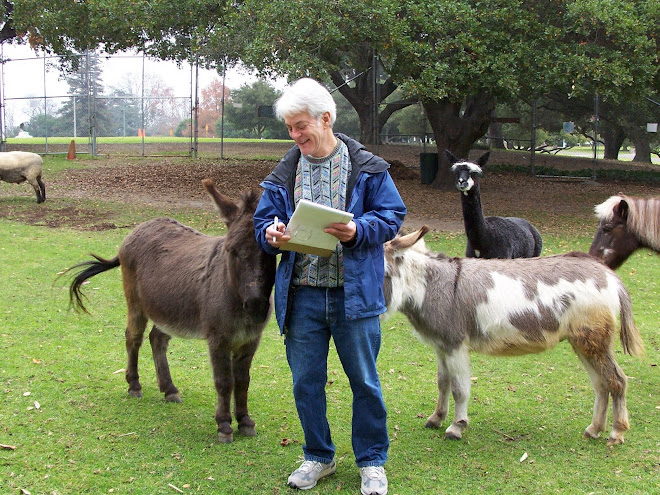
Interviewing the animals at Children's Fairyland in Oakland. L-R: Bobo the sheep, Gideon the miniature donkey, me, Tumbleweed Tommy the miniature donkey, Juan the alpaca, Coco the pony

Wednesday, April 10, 2013

Santayana Was Right

                                                 (Above: Nell Gwynn)

With all due respect to President Obama, I think he's forgetting something when he calls for more emphasis on math and science in the schools.
Yes, they're important. They will be crucial to our kids competing successfully in the global market.
But will it also make them better citizens? Not necessarily. For that, they'll need to be well grounded in another subject, one that is getting almost no resources at all: history.
How can they tell where our country is going if they don't know where it's been? How will they be able to see through demagogues' lies if they don't know the real story?
George Orwell's Big Brother said, "He who controls the past controls the future, and he who controls the present controls the past." That was true while I was growing up in the 1950s, when the textbooks taught us the "Gone With The Wind" version of the Civil War: namely, that the slaves were happy with their lot, and the Ku Klux Klan were the good guys.
That myth made it much harder for everyone to face the truth about race relations in this country, and it delayed the march of justice for many generations.
The only protection against politicians' lies is a well-informed public. That means citizens who understand that the United States is NOT a "Christian country," as some claim; it's a country that was founded by Christians who were deeply skeptical of allowing any church, even their own, to dictate how everyone should act.
The Founding Fathers had read their history, and they knew all too well what had happened in Europe, where religious wars devastated the population.
They also knew their ancient history, and they knew that the Roman republic was destroyed when it abandoned the rule of law, leaving Rome at the mercy of competing generals.
That's why they created three different branches of government and balanced them carefully so that none of them could overpower the other two.
But when a society forgets its past, it's forced to reinvent the wheel, re-fighting battles that everyone assumed were won decades ago.
Don't believe me? Look at the current efforts to undermine abortion rights, access to contraception, the 1964 Civil Rights Act and the 1965 Voting Rights Act.
Pernicious special interests are trying to undo these dearly won freedoms, and the greatest weapon they have going for them is our collective historical amnesia.
But apart from such practical considerations, there's one more reason to study history, which was best expressed by one of my college professors, John Morton Blum. He said, "When you come down to it, the best reason to is that it's so much fun!"
And he was right. What human mind, even Shakespeare's, could come up with stories that are as fascinating as those that happened in real life?
Take Nell Gwynn, the mistress of King Charles II, who balanced the rival interests in his kingdom by having two official mistresses: one Catholic and one Protestant.
An angry Protestant mob surrounded Nell's coach as it was entering the palace, howling, "Hang the King's Catholic whore!"
"Wait, good people!" cried Nell. "I am the King's Protestant whore!"
And they carried her into the palace on their shoulders, cheering all the way.
You can't make stuff like this up.

Monday, April 8, 2013

Thumbs Up

The Vatican might as well convert the Papal Apartments – a euphemism for a palatial 10-room suite featuring sumptuous furnishings and priceless works of art - into a museum and make some money off the tourists, because no pope is ever going to live there again.
They wouldn't dare, not after Pope Francis has set a precedent by refusing to move in and living instead in a simple, unadorned 2-room flat elsewhere on the Vatican grounds. It would seem too immodest.
You have to hand it to Pope Francis. Refusing to move in was a masterpiece of symbolism, in line with his theme of fewer regal trappings and more humility. He's clearly a very smart guy, but what else would you expect from a Jesuit?
Which brings me to my favorite Catholic joke, which I first heard the late Harry Reasoner tell on the CBS Evening News: A Dominican, a Benedictine and a Franciscan are arguing good-naturedly about which order is the holiest, and they finally decide to submit the question to prayer.
Suddenly, the heavens open up, and down flies a pure white dove with a slip of paper in its beak, which it lays at the feet of the three monks. It reads, "You are all equally favored in my sight. Signed, God S.J."
* * *
Meanwhile, the Westboro Baptist Church – that vile group of homophobes who picket the funerals of fallen American soldiers – have announced plans to picket the funeral of film critic Roger Ebert, who died last week after a heroic battle against cancer.
I knew Roger slightly, and let me tell you: He would have considered it an honor.
We were introduced by my college classmate, Gene Siskel, with whom Roger partnered in their groundbreaking movie review TV show for two decades until Gene's death – also after a heroic battle against cancer – in 1999.
What Gene and Roger did was amazing: no less than conducting a running, 20-year debate about art.
Granted, it's a popular art – the movies – but their debate was a serious one. Gene and Roger may have been partners on their TV show, but they were also rivals, working for rival newspapers. And they had very different ideas about film, which they expressed with a passion that sometimes made viewers think they disliked each other.
They didn't. Yes, they argued; but they argued like brothers. They had great respect for each other, both professionally and personally, and they both were right.
Now Gene has company in the Great Balcony in the Sky. Thumbs up to both of them.
                            * * *
Finally, a sad farewell to Annette Funicello, every Baby Boomer boy's first crush and an iconic figure to everyone my age, boy or girl. The most popular by far of all the Mousketeers, Annette grew up to become a gracious adult who bore the multiple sclerosis that eventually took her life with a dignity that surprised none of her fans.
She was called "America's Sweetheart" because she always seemed to be even prettier on the inside than she was on the outside. No scandal, no story of diva-like behavior, ever attached itself to her name. The only consolation is that her suffering is over. So long, Annette.
M-I-C. See you real soon.
K-E-Y. Why? Because we like you!
M-O-U-S-E.

Monday, April 1, 2013

The Kids Are All Right


I was driving home to Berkeley last Saturday night with George Cleve, the artistic director of the Midsummer Mozart Festival, and his wife, flutist Maria Tamburrino. We were coming back from Alameda, where we attended a retirement party for our mutual veterinarian, Dr. Alan Shriro of Berkeley Dog & Cat Hospital.
As we approached the corner of Dwight and Martin Luther King Way, a bus right in front of us suddenly hit an 18-year-old boy riding a bicycle, sending him crashing to the pavement.
The kid was lying crumpled on the ground, crying from pain and fear. Both he and the bus driver were in a state of shock. The victim struggled to get up, but he couldn't.
Quick as a flash, Maria jumped out of my car and rushed over to him. Putting her arms around him, she comforted him, warning him not to move and reassuring him that he was going to be OK because he was responding clearly to her questions.
It worked. He calmed down and waited for the paramedics to arrive, which didn't take long thanks to some other heroes on the scene.
They were half a dozen guys from In-And-Out Burger, not much older than the victim. They were wearing their In-And-Out Burger shirts and hats and riding in their In-And-Out Burger cookout trailer.
As soon as they arrived on the scene they immediately took charge. One young man called 911, while the others fanned out, laying flares and directing traffic away from the accident.
Thanks to their quick action, the paramedics soon showed up and took over. They ascertained that the boy wasn't hurt too badly, but they decided to take him to the hospital anyway just in case.
And me? What did I do to help?
Absolutely nothing. While the guys from In-And-Out Burger were taking care of business, I was still fumbling with my cell phone, trying to figure out how to call 911. I had panicked, and I was useless.
I'm not trying to beat myself up – I think my discombobulation was a common reaction – I'm just trying to say that if you have any doubts about the younger generation, don't. As the Who used to sing, the kids are all right.
* * *
OK, having said that, let my warn you: Don't drive anywhere near Berkeley High School at noontime or 3 p.m., when school lets out.
You could find yourself trapped for a half hour – and often even longer - in a sea of students who keep crossing the street nonstop, regardless of the traffic lights. And there's nothing you can do about it. They just keep coming. And coming. And coming. And you keep waiting. And waiting. And waiting.
I don't blame the kids; I blame the school administrators. They've received tons of complaints, especially from local merchants, but they haven't lifted a finger to try to solve the problem.
I don't know if it's because they lack jurisdiction over what the kids do once they step off campus, or if it's because they don't have the money to hire crossing guards. But would it be asking too much for them to hold a school assembly and educate their students on the importance of being good neighbors?

Monday, March 18, 2013

So Let It Be Written, So Let It Be Done


It's time again for that annual Easter event, the marathon 4½-hour showing of Cecil B. DeMille's "The Ten Commandments" Easter weekend on ABC.
Why ABC shows it on Easter is beyond me, since the story really is about Passover. Fortunately for the network, Passover and Holy Week overlap this year; but that doesn't usually happen.
This year, I propose a drinking game: Every time a character utters an outlandish line, you take a drink. For instance:
"Catch a lotus and you catch a wish!"
"Are you a master builder or a master butcher?"
"A charging chariot knows no rank!"
And my favorite: "Oh, Moses, Moses, you stubborn, splendid, adorable fool!"
Needless to say, "The Ten Commandments" doesn't have anything to do with religion. It's about what most Hollwood religious movies are about: sex, sex and more sex, all dressed up in Biblical trappings. And DeMille was the master.
The most elaborate scene is the big orgy going on at the foot of Mount Sinai while Moses is up on the summit getting the tablets. It took more than three weeks to film, and according to Charlton Heston's autobiography, the process was so grueling, one of the female extras was overheard complaining, "Who do I have to [sleep with] to get OUT of this movie?"
Incidentally, Heston wasn't DeMille's first choice to play Moses. He wanted William Boyd, television's Hopalong Cassidy, but Boyd turned him down.
Anne Baxter wasn't the first choice to play Nefretiri, either. Audrey Hepburn was slated for the role, but DeMille vetoed her at the last moment for being "too slim."  (Cecil liked his leading ladies voluptuous.)
The movie is a treasure trove of bad acting, and the worst has to be Heston himself.
"That Chuck Heston is a nice guy," said fellow actor Aldo Ray, "but what a hamola!"
There's a longstanding rumor that one of the 25,000 extras was a young man named Fidel Castro, playing an Egyptian soldier. In her autobiography, Shirley MacLaine said she asked Castro about it when she met him, and she received an ambiguous answer.
So how did DeMille achieve the movie's crowning special effect, the parting of the Red Sea? Simple: They poured 300,000 gallons of water into a tank and then played the film backwards.
Incidentally, you won't be seeing the entire movie Sunday night. Even 4½ hours (including commercials) aren't long enough for the whole thing, so ABC always cuts a few minutes here and there to squeeze it into the time frame, leading one critic to quip, "It's been trimmed to seven commandments."
I don't mean to pick on DeMille. Sex-and-sandal movies have been a Hollywood staple since the silent era.
But if you're in the mood for a truly religious film, a handful do exist. Among them: "Monsieur Vincent" (about Saint Vincent de Paul), "Francis of Assisi" (which affected actress Dolores Hart, who played Saint Claire, so deeply that she quit Hollywood and became a nun), "The Passion of Joan of Arc,"  "The Passion According to Saint Matthew" by Pier Paolo Pasolini, and – believe it or not – "Monty Python's Life of Brian," which has more true spirituality in any given five minutes than "The Ten Commandments" has in 4½ hours.
Happy Easter, and happy Passover, too.

Sunday, March 10, 2013

Keep smiling!


I've been writing this column for more than 25 years, and if you were to ask me who was the most memorable person I've written about in all that time, it's easy: the Berkeley Waving Man.
His real name was Joseph Charles, but most people called him "The Waving Man," "Charley Wavesalot" or, simply, "Mr. Charles."
Everyone in Berkeley loved him like a beloved grandfather. And we still do, 13 years after his death.
Mr. Charles was born March 22, 1910, in Lake Charles, LA. When he was young he played in the Negro Leagues as second baseman for the Lake Charles Black Yankees. He even batted once against Satchel Paige when the great pitcher came through town on a barnstorming tour.
He struck out on three straight pitches.
"But at least I got a foul tip," he always said proudly, "which was better than anyone else did that day."
During World War II he joined the great African American migration out of the South to the Richmond shipyards, where he helped build the ships that won the war. After the war he worked as a stevedore at the Oakland Naval Supply Center until he retired on Oct. 5, 1962.
That was when he embarked on his true calling. The next morning he donned yellow construction worker's gloves, stood on the corner in front of his house at Oregon Street and Martin Luther King Jr. Way, and for an hour and a half – 7:30 to 9 a.m. – he waved to the passing cars.
And he kept that up every morning for exactly 30 years, from Oct. 6, 1962 to Oct. 6, 1992 (Mr. Charles was very precise about these things).
"Keep smiling!" he'd call out to them. "Have a GOOD day!"
And they did smile. And they waved back.
"He was a joyful person who loved people, and we loved him right back," says state Senator Loni Hancock. "Seeing him every morning was a great way to start the day."
In fact, many people would drive miles out of their way, just so they could start their day off waving to the Waving Man.
He also served as surrogate grandfather to the neighborhood children, who used his front yard as their playground – much to the relief of their parents, who knew they could count on Mr. Charles to watch over them and keep them safe from harm.
It may seem like a small thing, but how many of us have done as much? The Bible says, "Love your neighbor," and that's exactly what he did: He wished them a good day. And he meant it.
When he died, I figured that was the end of the story. But I was wrong.
Remember I said he was a kindly surrogate grandfather to the neighborhood children? They're all grown up now, but they haven't forgotten him.
Next Friday, March 22, on what would have been his 103rd birthday, several of his fans will stand in front of his old house from 7:30 to 9 a.m. and wave to the morning traffic, just as he did. They've been doing it every year since he died, and they have no plans to quit.
Look for them if you drive by there that morning. Keep smiling. And have a GOOD day.
 

Sunday, March 3, 2013

I Got The Horse Right Here


"When you see a gent/Paying all kinds of rent/For a flat that could flatten the Taj Mahal/When a bum buys wine like a bum can't afford/It's a cinch that the bum/is under the thumb/of some little broad/When a lazy slob/takes a good steady job/And he smells from Vitalis and Barbasol/Call it sad, call it funny/But it's a better than even money/That the guy's only doing it for some doll."
Yes, "Guys And Dolls," one of the classics of the golden age of Broadway musicals, is coming to Berkeley's Julia Morgan Theater in a new production from Berkeley Playhouse.
When it premiered in 1951 it won the Pulitzer Prize for Drama; but the award was yanked at the last minute because of scriptwriter Abe Burrows' troubles with the House Un-American Activities Committee, and no Pulitzer for Drama was awarded that year.
"Guys And Dolls" is a comic topsy-turvy world where the bad guys are the good guys, sporting names like Big Jule, Harry the Horse, Nathan Detroit and Nicely Nicely Johnson. It features classic songs like "Fugue For Tinhorns," "Sit Down, You're Rocking the Boat" and "The Oldest Established Permanent Floating Crap Game In New York."
Since the hoodlums are the good guys, it follows that the bad guys are the cops – in the person of Lt. Brannigan, who keeps trying to bust Nathan Detroit's crap game. In a case of life imitating art, the role is being played by a real-life cop: Berkeley Police Sgt. Tom Curtin.
"I'm the heavy," he says. "I'm the guy trying to put flies in the ointment."
Curtin has loved musical theater ever since he played Jesus in a high school production of "Godspell," but he put his theatrical career on hold after college to concentrate on catching crooks.
Now he's back. This is his second stint with Berkeley Playhouse, having previously played a Nazi in "The Sound of Music."
"Guys And Dolls" will run from March 21 to April 28, but the songs will linger in your memory a lot longer than that.
Meanwhile, happy birthday to Oatmeal and RaIsin, the two Babydoll lambs at Children's Fairyland in Oakland, who turned one year old last week, which means they've officially graduated from lamb to sheep status.
Fairyland celebrated with a big party featuring a birthday cake made of lamb chow and hay, which Oatmeal and Raisin scarfed up in a nanosecond. And all the little children serenaded them with a lamb song ("Mary Had A Little Lamb") a sheep song ("Baa Baa Black Sheep") and, of course, "Happy Birthday."
Adorable doesn't even come close to describing it.
Finally, remember Audrey Vardanega, the 17-year-old piano virtuoso from Oakland who has been getting raves from classical musicians and critics since she was a tween?
She's leaving for college next fall, so one of your last chances to catch her will be on March 17, when she gives her senior recital at the Crowden School of Music in Berkeley, playing pieces by Liszt, Chopin, Scriabin, Haydn and Bach.
I first heard Audrey when she was only 13, playing at the Midsummer Mozart Festival, and I was blown away. I asked the festival's artistic director, Maestro George Cleve, how good she was for her age. And he laughed out loud.
"Martin," he said, "She's great for ANY age!"

Monday, February 25, 2013

All That Jazz


Hey, all you jazz girls out there!
Tired of being one of the only girls in your band?
Wondering where all the other girls are?
Want an alternative to the boy-dominated jazz world?
Thinking about joining a jazz group, but you're feeling shy or discouraged by the lack of other women?
Then get yourself over to Berkeley High School next Saturday, March 9, for the second annual JazzGirls Day. You'll rub shoulders with (and be taught by) a Who's Who of professional jazz musicians, including pianist Susan Muscarella, founder and executive director of the JazzSchool, vocalist Pamela Rose, trombonist Sarah Cline, and trumpeter Ellen Seeling and saxophonist/drummer Jean Fineberg, founders of the Montclair Women's Big Band.
"We'll play some tunes, have a jam session, break into groups by instrument, and talk about our experiences as women and girls in the jazz world," says Cline, who directs the award-winning Berkeley High jazz program.
This event is for girls only, age 10 and older, who sing or play an instrument. And it's ABSOLUTELY FREE!
I wrote about the first JazzGirls Day last year, and I got more feedback from the girls who attended (and their parents) than I've ever received from any other story I've written. Their reviews ranged from favorable to ecstatic.
"My daughter learned more about music in that one day than she had in all the rest of her life," said one mom. "But she learned even more about herself. It was tremendously empowering."
"The best part was finding out that she wasn't alone," said another. "To be exposed to that many women and girls playing jazz was a real eye-opener."
It grieves me to say it, but jazz has been a bastion of male chauvinism from the very start. Unless you're a vocalist, it's almost impossible for women to be get jobs in bands or booking in clubs, despite ample evidence, from Mary Lou Williams to Esperanza Spaulding, that women can play jazz just as well as men.
When Cline herself was a student at Berkeley High, playing in the same jazz ensemble she now directs, there was only one other girl in the program. This year, there are still only three girls in the ensemble, so there's still a long way to go.
That's why JazzGirls Day is so important: To say to girls, "Yes, you can."
The event will be held in Room A201 at Berkeley High from 1 to 4 p.m., followed by a screening only a few steps away at the high school's Little Theater of "The Girls In The Band," a new film about women and jazz. Admission is free, and so is the popcorn.
Not coincidentally, next Friday is International Women's Day. To celebrate, the JazzSchool (only a short block from the high school) is offering three special concerts next weekend: the Tammy L. Hall Chamber Ensemble Friday night, a concert and discussion of John Coltrane’s music and spirituality Saturday night, and Grammy-nominated violinist and composer India Cooke Sunday afternoon. Every girl who attends JazzGirls Day will get a 20 percent discount on admission for each concert.
Please let them know if you'll be joining them by e-mailing BerkeleyHighJazz@gmail.com. Above all, have fun!
"And bring all your friends," says Cline, "even if they don't play jazz yet."