A columnist of heart and mind

A columnist of heart and mind
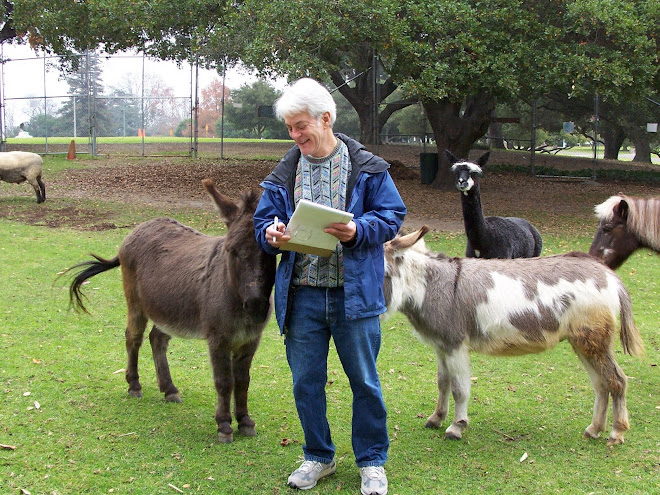
Interviewing the animals at Children's Fairyland in Oakland. L-R: Bobo the sheep, Gideon the miniature donkey, me, Tumbleweed Tommy the miniature donkey, Juan the alpaca, Coco the pony

Monday, September 10, 2012

Tumbling After

Seated in her office with signs on the door reading, "Warning: I have flying monkeys and I'm not afraid to use them!" and "What happens over the rainbow stays over the rainbow," C.J. Hirschfield, executive director of Children's Fairyland, beamed as she looked out the window last week and watched toddlers cavorting on the park's newest attraction, Jack & Jill Hill, a six-foot, gently sloped mound covered with high quality AstroTurf.
Some kids slid down the hill on squares of recycled cardboard and ran giggling into their parents' arms. Others raced back up the hill to do it all over again. Three little boys rolled down the hill. And one daring little girl slid down headfirst. All were having the time of their lives.
"There hasn't been a single moment since Jack & Jill Hill opened (on July 27) that it hasn't been in constant use," said Hirschfield, who cheerfully admits she stole the idea from the Santa Barbara Zoo.
"I was visiting there two years ago with my daughter, and I saw kids playing on an AstroTurf-covered mound called The Ant Hill, and I thought, 'Oh boy! It's simple and physical and low-tech and interactive! It would be perfect for Fairyland!'"
As usual, the main obstacle for Fairyland, which perpetually runs on a shoestring budget, was finding the money to pay for it.
"But that was no problem for C.J.," said Ron Zeno, a member of Fairyland's Board of Directors. "She knows everyone in town."
In this case, it was Councilwoman Jane Brunner, who came up with a grant to buy the AstroTurf, and Mike Hester, president of McGuire & Hester, who donated the labor.
"Oakland and Fairyland have been an important part of my life, both personally and professionally, so it seemed like the natural thing to do," said Hester, who spent many happy hours at Fairyland as a child.
Hirschfield is celebrating her 10th anniversary as Fairyland's executive director, having assumed the reins in 2002 after an extremely successful 25-year career in the cable television industry. But she had to take a huge salary cut to make the move.
"I happened to be in New York on 9/11, and it had a profound effect on me," she explained. "I thought about the people who died, and I said, "I hope they were doing what they loved.' And then it hit me: I'm not doing what I love!
"So when I got back to the Bay Area I saw a job listing on Craigslist for Fairyland's executive director, and I thought, 'What greater challenge could there be than to go to work every day at a place I've loved since my daughter was a kid and make it better for the next generation?'"
But she had her work cut out for her.
"Things weren't going very well here," said Zeno. "In a word, they were bad. But she came in here and went right to work."
The first thing order of business was repairing the Pirate Ship, which had been blocked off with yellow police tape for years due to safety concerns.
"I happened to be talking to then-state Senator Don Perata, whom I'd known from my previous life in the cable industry," said Hirschfield. "And he said, 'I love Fairyland. Let me know if there's anything I can to do to help,' and I said, 'Well, since you asked, we need a sizable sum of money to install safety features on the Pirate Ship.'
"The next day he called me and said, 'I think I may have someone who wants to help you.' It was Diane and Ed DaSilva, whose son Doug had recently passed away. Doug had loved playing on the Pirate Ship when he was a little boy, so they donated the funds to fix it up in his memory."
Next up: building the long-delayed Old West Junction.
"I saw a sign saying, 'Old West Junction coming soon,' and, being new on the job, I said, 'Wonderful!' The staff started cracking up, and someone said 'C.J., that sign has been there for 20 years!'"
Next came the transformation of the Thumbelina Tunnel, which had been boarded up and unused for more than two decades, into the Fairy Music Farm, featuring one-of-a-kind  interactive musical instruments that kids make sounds on as they go through the tunnel.
Then came restoration of the Puppet Theater and the Chapel of Peace, followed by construction the Little Red Hen House for Fairyland's newest residents, three "heirloom" chickens named Woodstock, Violet and Polyanna.
But Hirschfield's pride and joy, which she labored seven  long years to bring about, is Aesop's Playhouse, the region's only children's performing arts theater, a popular venue for groups like the Oakland-East Bay Symphony's Music in the Schools Program as well as home base for Fairyland's own children's theater program.
She's the first to admit she couldn't have done any of this without her loyal staff who, like her, are working for a fraction of what they could be earning elsewhere.
"She doesn't micro-manage," said Zeno. "When she first came here, her attitude toward the staff was 'You know what you're doing, so go do it. I'm going to do what I need to do as executive director to make this park improve.' And that's what she did."
Hirschfield's goal is to remain faithful to the original vision of Fairyland's founders, horticulturalist Arthur Navlet and William Penn Mott, director of the East Bay Regional Parks district, whose motto was "no straight lines and a surprise around every corner."
"They had a very clear concept of what they wanted the park to be, and we're trying hard to channel that intent. We think they'd approve of what we're doing to make Fairyland a sweet, safe place for families."
 

Sunday, September 9, 2012

Pizza Girls 2.0

                                                 (Above: Sterling)
First, let me thank all who sent condolences when my cat Phoebe died May 1 and congratulations when I adopted my two new little kittens, Pepe and Sally, three weeks ago.
Many of you, however, asked why I gave Pepe a boy's name, since they're both girls.
It's even worse than you think. Sally is a boy's name, too.
Let me explain. New Haven, Connecticut, where I spent my college years, has the largest Neapolitan population in the country.
Which means it has the best pizza in the country. After all, Naples is where pizza was invented, right?
And the two iconic pizzerias in New Haven are Pepe's, which was founded by Frank Pepe in 1925, and Sally's, which was founded just down the street by his nephew, Salvatore "Sally" Consiglio, nine years later.
Both places have fanatical customer bases. Pepe's fans never set foot inside Sally's, and Sally's fans wouldn't be caught dead inside Pepe's.
Frank Sinatra, for example, was a huge Sally's fan. Whenever he played a gig in Manhattan, he's send his chauffeur up to New Haven before the show to buy a couple of Sally's  "apizzas" and rush them back so they'd be waiting for Frank when he stepped offstage.
Bill and Hillary, on the other hand, were big Pepe's fans when they were at Yale Law School.
But to answer your question: The reason I gave my kittens boys' names is that pizza transcends gender.
So who makes the best pizza - Sally's or Pepe's?
To tell the truth, I have a hard time telling any difference. But I do know that they're better pizzas than any other I've ever encountered.
And that's pretty much the same way I feel about my new kittens.
Every day is a quantum leap over the day before. They love their new home and me, and I love them back. And to see how much they love each other just makes my heart sing. I feel happy in a way I haven't felt since my first cat, Eliza, died 16 years ago.
Don't get me wrong; I loved Phoebe very much. But she was a deeply traumatized, even paranoid, cat. It was my pleasure to take care of her, but there was little joy in it. Most of it consisted of my doing my best to make sure each day wasn't as terrifying for her as it might have been.
But my two Pizza Girls' joie de vivre is giving me a new lease on life. I am once again available for dancing in the streets.
But I'm still looking for a home for their brother Sterling, who in many ways is the most remarkable of all. He's absolutely gorgeous - a pure silver tabby – sweet, friendly and full of fun.
 I would have loved to adopt him, too, but my apartment is barely big enough for two cats, let alone three.
If you're interested, Sterling can be visited and is up for adoption at Berkeley Dog & Cat Hospital, 2126 Haste Street. He's already been neutered and had all his shots, and he would fit right in a home with dogs, other cats or kids.
If you adopt him, please let me know. It would make me feel better to know he found a good home.

Sunday, September 2, 2012

Hope On Ice


 (Above: Peggy Fleming)
On Tuesday, the Berkeley City Council will decide whether to re-zone Berkeley Iceland, the historic Art Deco skating rink where Olympic champions Peggy Fleming, Brian Boitano and Kristi Yamaguchi honed their skills, from recreational to retail use, allowing the building to be sold to a big-box retail sporting goods store. And a coalition of skaters and their parents called Save Berkeley Iceland will be there to try to stop them.
It's been a long, long struggle for the skaters, who have been raising money to buy Iceland and rehabilitate it since 2007, when it was closed by its owners after a series of caustic anhydrous ammonia leaks from the refrigeration system.
I've been covering this story though its many twists and turns since 1998, when the first gas leak was detected. And while I certainly understand the city's desire to get rid of what it considers a crumbling white elephant and turning it into a revenue-producing retail establishment, deep down I'm rooting for the skaters to win.
A designated historic landmark on both the city and national levels, Iceland was one of the West Coast's premier skating venues practically since the day it opened in 1940.
It hosted the Ice Capades, Ice Follies and, in 1947, the first U.S. Figure Skating Championships west of the Mississippi. It was home to the St. Moritz Skating Club (the oldest in California), the Berkeley Bulldogs of the California Junior Hockey League, the official practice facility for the California Golden Seals, home ice to the UC Berkeley hockey team and the site of the annual "Big Freeze" hockey game against Stanford.
Most importantly, it was home away from home for generations of Berkeley children.
"For many kids, it was the first place where they go and feel independent but still be safe," says Tom Killilea, whose daughter Marie, 16, started skating there when she was four. "And that's so important, especially for girls."
It was the site of innumerable birthday parties – all the local pizzerias made constant deliveries there - 3-on-3 kids' hockey games and boisterous games of broom ball (no skates, a bouncy rubber ball instead of a puck and brooms instead of hockey sticks).
Everyone fit in, no matter what their skill level. The skating surface was big enough to accommodate the best figure skaters doing their leaps and twirls in the middle, the novices hugging the boards on the edges, and the speed skaters and hockey players darting in between, all at the same time.
And skating through the streams of natural light filtering through the iron lattice 40 feet above the ice was a magical experience.
To date, the skaters and their families have raised more than $100,000 through grants, donations, neighborhood fundraisers and street fairs. That's pretty good in these hard times, but it's only a fraction of the millions they'll need to buy Iceland and restore it to its former glory.
But isn't it worth giving them time to make the effort? With a new baseball diamond currently under construction in the same neighborhood, Iceland could become part of a much-needed recreation district.
And with childhood obesity a national concern, what sense does it make to replace a recreational facility, where kids can actually run around and get exercise, with a store that will merely sell them athletic gear?

Monday, August 27, 2012

Shoot The Moon

Like every other Baby Boomer, I'll never forget where I was when Neil Armstrong landed on the Moon. The word "hero" is thrown around loosely these days, but he was the real thing.
Only in the last few years have we found out just how risky that landing was – and how gallantly he overcame them.
But the thing that puts him in the pantheon of America's greatest heroes, from George Washington to every World War II veteran I've ever met, is that after his moment of glory he walked away.
Instead of trading on his celebrity to make a fortune or run for political office, he taught college students and spent the rest of his life quietly enjoying the company of his family and friends.
His heartbroken family issued this statement: "For those who may ask what they can do to honor Neil, we have a simple request. Honor his example of service, accomplishment and modesty, and the next time you walk outside on a clear night and see the moon smiling down at you, think of Neil Armstrong and give him a wink."
Having said that, I also feel compelled to point out the painful truth: That the era of manned space exploration, of which he was the greatest exemplar, is over. All the action is now in robotics, like the self-propelled laboratory on wheels called Curiosity that is now exploring Mars.
Manned flights are simply too expensive. You not only have to lift the astronaut into space, you have to send food, water, oxygen, extra clothing, laundry facilities, exercise equipment (to combat the deteriorating effects of weightlessness), heating/air conditioning and, of course, toilets.
But not with robots.
And if worst comes to worst and a disaster occurs – and history teaches that they occur pretty frequently – all you've lost is a robot, not a human being.
Back in the day, there were three reasons for using human astronauts.
First, there were things humans could do that machines couldn't, such as determining which rock should be analyzed further. But today, Curiosity can perform sophisticated on-the-spot scientific experiments that humans can only dream about.
Second, there was the Cold War. For some reason, we got it into our heads that the way to win the hearts and minds of people in the Third World was to build better rockets than the Russians. Only later did we find out that they're more interested in our blue jeans and iPods instead.
Finally, it was thought that the way to get public support for the space program was to give them human astronauts to identify with - exemplified by the motto "No Buck Rogers, no bucks."
The problem was that NASA's public relations department has done its best to make the astronauts as bland as possible. As a result, how many can anyone name today? The only current one I can think of is Mark Kelly, and that's only because he's married to Gabby Giffords.
As for being relatable, who is the most beloved of all the Star Wars characters? Luke? Leia? Han Solo? Obi-Wan Kenobe?
No, it's R2D2! And it isn't even close.
So rest in peace, Neil Armstrong, and thanks for a job extremely well done. But the next time we need someone to do a man's job, let's send a machine.

Friday, August 17, 2012

Pizza Girls!


On June 16 some boys in a rough part of West Oakland were spotted throwing rocks at two little homeless kittens.
Fortunately, the person who spotted them - and saved the kittens - was Ronald Spann, a volunteer with Island Cat Resources and Adoption, which rescues homeless felines in Alameda and Oakland.
If the cats are too old to change their ways, they are vaccinated, spayed or neutered, and returned to their colonies, where they live out their lives under the eyes of ICRA volunteers.
But most homeless kittens, like these two, make great pets, so they are placed in new homes after being socialized first.
ICRA doesn't have a shelter, which is its greatest asset. It means every kitten is placed in a foster home, where it's loved and snuggled until it learns to trust people and become the happy, playful kitty it was always meant to be.
Some ICRA foster families have kids, so kittens fostered with them do well when placed in homes with children.
Others have adult cats, so kitties fostered there do great in homes that already have resident felines.
Still other homes have dogs, so kittens fostered there tend to be dog-friendly.
That's what happened to these two kittens. After being rescued by Spann, they were fostered by Jody McKevitt of Alameda and her Rottweiler, Keeper.
It's impossible to overstate Keeper's devotion to her little girls. Every night she'd insist on sleeping underneath their kitty condo, and every day she's play with them and keep a constant vigil to make sure they didn't wander off.
Under her guidance, the kittens blossomed into mischievous little love bugs.
Unfortunately, Keeper was dying of cancer. As she got weaker and weaker, she slowly lost interest in her favorite pastimes, such as going for walks or even eating. But whenever she heard the kittens crying her head would perk up, and she'd do her best to comfort them.
Keeper died on July 17. She was humanely euthanized near her beloved kittens.
After her death they went to the home of another ICRA foster mom, Gail Churchill, where her Golden Retriever, Rosie, took up where Keeper left off.
When she was in a calm mood she let them climb all over her and play with her feet. When she was feeling playful, she'd gently roll them across the floor with her nose. If they started nipping at her paws, she'll glance up at Churchill with a look that said, "Mommy, help!" But she still let them do it.
Finally, last weekend the kittens were ready to be adopted.
And the person who adopted them was me.
Because they were born around the time I was attending my college reunion in New Haven, I decided to name them Pepe and Sally, after the two iconic pizza parlors in downtown New Haven, Pepe's and Sally's, where I misspent so many of my college days.
As I write this, the pizza girls are happily chasing each other around the bedroom. They are incredibly cute and incredibly sweet, and I owe it all to Spann, McKevitt, Churchill, Rosie and, of course, Keeper.
If you'd like to adopt an ICRA cat, or if you'd like to volunteer or donate to their lifesaving work, visit www.icraeastbay.org.
Tell 'em Keeper sent you.

Monday, August 13, 2012

You Go, Girls!


Well, the Olympics are over, and the big winner is. . . Betty Friedan!
Never before have so many American stars been women, from Kerri Walsh and Misty May to the U.S soccer team to the Fabulous Five. What we're witnessing is the full fruition of Title IX, forty years later.
And we're a better country for it. Instead of utilizing only half our population, now we can draw on the whole talent pool. And athletics are just the tip of the iceberg.
So who was the biggest male star? With respect to Michael Phelps, it's Usain Bolt's world, and the rest of us are just living in it.
I don't mean to denigrate what Phelps accomplished, but his medal count tells only part of the story. Unlike Phelps, Bolt could compete in only three races. But in a sport where the finishers are usually separated by fractions of an inch, he crossed the finish line yards ahead of his challengers.
So who were the biggest losers? It's a tie between NBC and the International Olympic Committee.
The IOC loses for refusing a moment of silence in memory of the Israeli athletes who were murdered at the 1972 Munich Olympics.
At a meeting with the athletes' families, IOC Chairman Jacques Rogge lamely explained, "There are now more than 40 Arab delegations…my hands are tied" - to which one of the widows replied, "Your hands were tied? No. My husband's and his teammates' hands were tied. Also their feet. To the furniture. Then they came home in coffins."
As for NBC, how come it took them eight hours to bring us images 3,000 miles from London when NASA was able to deliver images 250 million miles from Mars in less than twice the time?
NBC was following a model invented in the 1960s, which assumed people are too busy at work to watch events live during the daytime, so give them a package of reruns disguised as live coverage during prime time.
That might have worked back then, but not in this age of the Internet.
I also hated the exclusive concentration on American athletes. One of the chief pleasures of the Olympics is identifying with people all over the world. (Remember how we all fell in love with Olga Korbut in 1972?)
So why did NBC broadcast only the American medal ceremonies? Mo (short for Mohammed) Farah, running for Britain, won both the 5,000 and 10,000 meters. He's become a national hero, which is causing a real cultural change: Brits aren’t used to rooting for people named Mohammed.
So I would have loved to see how the crowd reacted when they played "God Save The Queen" at the medal ceremony. But we never got a chance.
Finally, don't believe all the Olympic hype. For instance, which ancient Greek came up with the torch relay and the Olympic flame? Pericles? Socrates? Alcibiades?
Answer: None of the above. It was Joseph Goebbels, who invented it for the 1936 Nazi Olympics.
And the Marathon: 26 miles, 385 yards. That's the distance from Marathon to Athens, right?
Wrong. It's the distance from Windsor Castle to Wembley Stadium in London. For the 1908 Olympics, King Edward VII wanted his grandchildren to be able to watch the start of the race from their nursery.

Monday, August 6, 2012

Murder in Wisconsin

(Above: Guru Tegh Bahadaur)
First there was the midnight movie massacre in Colorado. Now it's the mass murder of Sikhs in Wisconsin. What is happening to our country?
You can point the finger in a lot of different directions.
At the NRA, for torpedoing all attempts to stem the glut of weapons that is drowning our society in violence.
At the politicians, who lack the guts to stand up to the gun lobby.
At the hate mongers, who keep preaching that some religions (namely, theirs) are better than others and that our fellow Americans are enemies to be feared.
And most of all at ourselves, for allowing things to come to such a pass. How many more deaths will it take before we come to our senses?
Sikhs have been targeted ever since 9/11 by self-styled patriots who pick on anyone who looks "foreign." As one distraught young Sikh said on Sunday, "What have we done to deserve this?"
Answer: Nothing. I can't think of a less threatening religion.
Sikhism was founded in India around 1500, at a time when the country was being torn apart by Hindu-Muslim violence.
So a guru named Nanak decided to start a new faith that combined the best parts of both religions.
Preaching, "There is no Hindu, there is no Muslim," he welcomed members of both faiths. He advocated equality for women – a rarity in those times – and denounced idol worship, empty ritual and religions that justify oppression.
His message was simple: There is only one God, who is the essence of a beautiful universe. Our duty is to meditate on this oneness and be kind to each other.
When Nanak died in 1539, a dispute broke out among his followers: The Hindus wanted to cremate him, while the Muslims wanted to bury him.
The next morning, they discovered a huge pile of beautiful flowers where his body had been. They decided to divide the posies and dispose of them, each side according to its own tradition.
Perhaps the most famous guru after Nanak was the Ninth Guru, Tegh Bahadur, who lived in the late 17th Century. India was ruled by a bloodthirsty religious bigot named Aurangzeb, who ordered all the Pundits - a caste of scholarly Hindus - to convert to Islam or be killed.
The Pundits asked Tegh Bahadur for help. His response was to go to Aurangzeb and offer himself in their place.
Aurangzeb didn't much care who he killed. So Tegh Bahadur and his followers were put to death, instead.
It is the only instance in history of a religious leader sacrificing his life on behalf of another religion.
Tegh Bahadur was succeeded by his son, Gobind Singh, who decreed that there were to be no more gurus. From then on, the Sikh holy book, Granth, would be the guru. And Sikhs have tried to lead their lives according to its humane teachings ever since.
It is hard to imagine a kinder, gentler religion. And for this they are being shot?
Sikh Americans are our brothers and sisters, and it's time we let them know it. If you spot any – they're not hard to miss in their distinctive turbans – please take the trouble to go up to them and tell them you support them in their time of grief.
It's the American way.