A columnist of heart and mind

A columnist of heart and mind
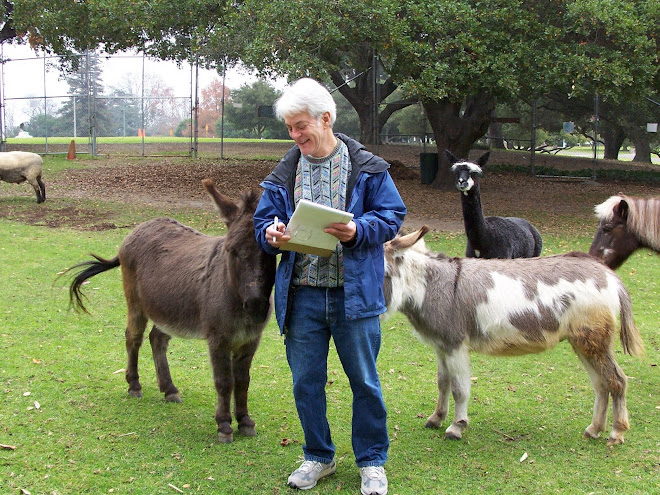
Interviewing the animals at Children's Fairyland in Oakland. L-R: Bobo the sheep, Gideon the miniature donkey, me, Tumbleweed Tommy the miniature donkey, Juan the alpaca, Coco the pony

Friday, August 17, 2012

Pizza Girls!


On June 16 some boys in a rough part of West Oakland were spotted throwing rocks at two little homeless kittens.
Fortunately, the person who spotted them - and saved the kittens - was Ronald Spann, a volunteer with Island Cat Resources and Adoption, which rescues homeless felines in Alameda and Oakland.
If the cats are too old to change their ways, they are vaccinated, spayed or neutered, and returned to their colonies, where they live out their lives under the eyes of ICRA volunteers.
But most homeless kittens, like these two, make great pets, so they are placed in new homes after being socialized first.
ICRA doesn't have a shelter, which is its greatest asset. It means every kitten is placed in a foster home, where it's loved and snuggled until it learns to trust people and become the happy, playful kitty it was always meant to be.
Some ICRA foster families have kids, so kittens fostered with them do well when placed in homes with children.
Others have adult cats, so kitties fostered there do great in homes that already have resident felines.
Still other homes have dogs, so kittens fostered there tend to be dog-friendly.
That's what happened to these two kittens. After being rescued by Spann, they were fostered by Jody McKevitt of Alameda and her Rottweiler, Keeper.
It's impossible to overstate Keeper's devotion to her little girls. Every night she'd insist on sleeping underneath their kitty condo, and every day she's play with them and keep a constant vigil to make sure they didn't wander off.
Under her guidance, the kittens blossomed into mischievous little love bugs.
Unfortunately, Keeper was dying of cancer. As she got weaker and weaker, she slowly lost interest in her favorite pastimes, such as going for walks or even eating. But whenever she heard the kittens crying her head would perk up, and she'd do her best to comfort them.
Keeper died on July 17. She was humanely euthanized near her beloved kittens.
After her death they went to the home of another ICRA foster mom, Gail Churchill, where her Golden Retriever, Rosie, took up where Keeper left off.
When she was in a calm mood she let them climb all over her and play with her feet. When she was feeling playful, she'd gently roll them across the floor with her nose. If they started nipping at her paws, she'll glance up at Churchill with a look that said, "Mommy, help!" But she still let them do it.
Finally, last weekend the kittens were ready to be adopted.
And the person who adopted them was me.
Because they were born around the time I was attending my college reunion in New Haven, I decided to name them Pepe and Sally, after the two iconic pizza parlors in downtown New Haven, Pepe's and Sally's, where I misspent so many of my college days.
As I write this, the pizza girls are happily chasing each other around the bedroom. They are incredibly cute and incredibly sweet, and I owe it all to Spann, McKevitt, Churchill, Rosie and, of course, Keeper.
If you'd like to adopt an ICRA cat, or if you'd like to volunteer or donate to their lifesaving work, visit www.icraeastbay.org.
Tell 'em Keeper sent you.

Monday, August 13, 2012

You Go, Girls!


Well, the Olympics are over, and the big winner is. . . Betty Friedan!
Never before have so many American stars been women, from Kerri Walsh and Misty May to the U.S soccer team to the Fabulous Five. What we're witnessing is the full fruition of Title IX, forty years later.
And we're a better country for it. Instead of utilizing only half our population, now we can draw on the whole talent pool. And athletics are just the tip of the iceberg.
So who was the biggest male star? With respect to Michael Phelps, it's Usain Bolt's world, and the rest of us are just living in it.
I don't mean to denigrate what Phelps accomplished, but his medal count tells only part of the story. Unlike Phelps, Bolt could compete in only three races. But in a sport where the finishers are usually separated by fractions of an inch, he crossed the finish line yards ahead of his challengers.
So who were the biggest losers? It's a tie between NBC and the International Olympic Committee.
The IOC loses for refusing a moment of silence in memory of the Israeli athletes who were murdered at the 1972 Munich Olympics.
At a meeting with the athletes' families, IOC Chairman Jacques Rogge lamely explained, "There are now more than 40 Arab delegations…my hands are tied" - to which one of the widows replied, "Your hands were tied? No. My husband's and his teammates' hands were tied. Also their feet. To the furniture. Then they came home in coffins."
As for NBC, how come it took them eight hours to bring us images 3,000 miles from London when NASA was able to deliver images 250 million miles from Mars in less than twice the time?
NBC was following a model invented in the 1960s, which assumed people are too busy at work to watch events live during the daytime, so give them a package of reruns disguised as live coverage during prime time.
That might have worked back then, but not in this age of the Internet.
I also hated the exclusive concentration on American athletes. One of the chief pleasures of the Olympics is identifying with people all over the world. (Remember how we all fell in love with Olga Korbut in 1972?)
So why did NBC broadcast only the American medal ceremonies? Mo (short for Mohammed) Farah, running for Britain, won both the 5,000 and 10,000 meters. He's become a national hero, which is causing a real cultural change: Brits aren’t used to rooting for people named Mohammed.
So I would have loved to see how the crowd reacted when they played "God Save The Queen" at the medal ceremony. But we never got a chance.
Finally, don't believe all the Olympic hype. For instance, which ancient Greek came up with the torch relay and the Olympic flame? Pericles? Socrates? Alcibiades?
Answer: None of the above. It was Joseph Goebbels, who invented it for the 1936 Nazi Olympics.
And the Marathon: 26 miles, 385 yards. That's the distance from Marathon to Athens, right?
Wrong. It's the distance from Windsor Castle to Wembley Stadium in London. For the 1908 Olympics, King Edward VII wanted his grandchildren to be able to watch the start of the race from their nursery.

Monday, August 6, 2012

Murder in Wisconsin

(Above: Guru Tegh Bahadaur)
First there was the midnight movie massacre in Colorado. Now it's the mass murder of Sikhs in Wisconsin. What is happening to our country?
You can point the finger in a lot of different directions.
At the NRA, for torpedoing all attempts to stem the glut of weapons that is drowning our society in violence.
At the politicians, who lack the guts to stand up to the gun lobby.
At the hate mongers, who keep preaching that some religions (namely, theirs) are better than others and that our fellow Americans are enemies to be feared.
And most of all at ourselves, for allowing things to come to such a pass. How many more deaths will it take before we come to our senses?
Sikhs have been targeted ever since 9/11 by self-styled patriots who pick on anyone who looks "foreign." As one distraught young Sikh said on Sunday, "What have we done to deserve this?"
Answer: Nothing. I can't think of a less threatening religion.
Sikhism was founded in India around 1500, at a time when the country was being torn apart by Hindu-Muslim violence.
So a guru named Nanak decided to start a new faith that combined the best parts of both religions.
Preaching, "There is no Hindu, there is no Muslim," he welcomed members of both faiths. He advocated equality for women – a rarity in those times – and denounced idol worship, empty ritual and religions that justify oppression.
His message was simple: There is only one God, who is the essence of a beautiful universe. Our duty is to meditate on this oneness and be kind to each other.
When Nanak died in 1539, a dispute broke out among his followers: The Hindus wanted to cremate him, while the Muslims wanted to bury him.
The next morning, they discovered a huge pile of beautiful flowers where his body had been. They decided to divide the posies and dispose of them, each side according to its own tradition.
Perhaps the most famous guru after Nanak was the Ninth Guru, Tegh Bahadur, who lived in the late 17th Century. India was ruled by a bloodthirsty religious bigot named Aurangzeb, who ordered all the Pundits - a caste of scholarly Hindus - to convert to Islam or be killed.
The Pundits asked Tegh Bahadur for help. His response was to go to Aurangzeb and offer himself in their place.
Aurangzeb didn't much care who he killed. So Tegh Bahadur and his followers were put to death, instead.
It is the only instance in history of a religious leader sacrificing his life on behalf of another religion.
Tegh Bahadur was succeeded by his son, Gobind Singh, who decreed that there were to be no more gurus. From then on, the Sikh holy book, Granth, would be the guru. And Sikhs have tried to lead their lives according to its humane teachings ever since.
It is hard to imagine a kinder, gentler religion. And for this they are being shot?
Sikh Americans are our brothers and sisters, and it's time we let them know it. If you spot any – they're not hard to miss in their distinctive turbans – please take the trouble to go up to them and tell them you support them in their time of grief.
It's the American way.

Sunday, July 29, 2012

Mightier Than The Sword

Like me, you're probably still horrified by the massacre in Aurora, Colorado; and you probably wish there was something you could do to ease the victims' pain.
Well, there is something you can do for one victim.
Her name is Petra Anderson. She's an extremely gifted young violinist, conductor, composer and poet who graduated last spring from the University of Pacific Conservatory of Music.
I don't know her personally, but I do know her friend, Caroline McCaskey of San Pablo.
You might remember Caroline. She's the young musical saw virtuoso from San Pablo I wrote about last spring. She met Petra at UOP when she was a senior and Petra was a freshman.
"What really impressed me was how much she had her stuff together – much more than I did when I was her age," Caroline says. "I always used to tell her how much I like her style. When I graduated, she made gifts for all the seniors, and mine was a little necklace. She said, 'Here's a piece of my style to take with you.'"
Over the past week I've heard from many of Petra's friends and teachers, all of whom made the same point: As good as she is as a musician – and she's very, very good - she's even better as a human being.
"Aside from her considerable talents as a writer and thinker, what set her apart was her selfless dedication to a visually impaired student who was also in the class," says Professor Eileen Camfield, who taught her Freshman English. "Petra made sure he found his way across campus from class to class until he could do so on his own, and she explained/translated any visual instructions to him. She made his transition to college – and ultimate success there – that much easier. Such kindness was an inspiration to us all!" 
Petra was hit by a shotgun blast – three times in the arm and once in the head. The pellet struck her in the face and entered her head, its trajectory crossing the left hemisphere of her brain, which generally controls speech, language and memory.
Amazingly, the pellet missed the brain's many blood vessels and key sections controlling vital functions. If it had wavered a millimeter in any direction, she probably would have died or been severely injured.
Dr. Michael Rauzzino, the neurosurgeon who performed the surgery said, "It is a miracle that she is alive."
Petra is still in pain, and her recovery is going to be long and expensive. Her family can't contribute much because her mom is battling terminal breast cancer, which has eaten up their savings.
A fund has been set up to help defray the expenses. You can contribute by going to www.indiegogo.com/readytobelieve/
The first $100,000 will go to Petra's surgery, medical, and recovery costs. Any money after that will be divided between her mom's cancer treatment and the Colorado Organization for Victim Assistance (COVA), a non-profit tasked by the Aurora Police Department to gather and distribute aid in response to the Aurora shooting.
François Rose, Petra's music composition professor, who supervised many of her student projects, says, "I profoundly regret to see her name associated with this horrific tragedy, but I have faith that sooner or later you will hear her name again – but this time associated with another successful musical event."

Sunday, July 22, 2012

Next Generation's Jazzwomen

(Last year's campers after they were told, "Act silly.")
Last March I previewed an event at Berkeley High School called JazzGirls Day, when girls could play with and learn from some of the most prominent women jazz musicians in the Bay Area, including saxophonist Jean Fineberg and trumpeter Ellen Seeling, the founders of the Montclair Women's Big Band.
I'm pleased to report the event was a huge success. Attendance exceeded all expectations, and everyone had a great time.
I know because some of the girls thoughtfully emailed me afterwards and told me about it.
I also heard from their mothers and fathers, who said their daughters were greatly empowered by the experience.
"Not only did she learn more in one day than she did in the past year, it was the first time people told her she can play jazz just as well as boys," said one mom.
Well, girls, if one day was so much fun, how'd you like to do it for a whole week?
Many of the same musicians who participated in JazzGirls Day – including Fineberg and Seeling - will also be on the faculty of the 4th annual Jazzschool Girls' Jazz & Blues Camp, which will take place at the Jazzschool in downtown Berkeley from August 6-10.
From Monday through Thursday, the girls will take a variety of electives, including jazz combo, blues & funk, percussion, songwriting, improvisation, roots (aka gospel), vocalizing, Latin music and big band. Each girl will also get an individual one-on-one lesson.
The student/teacher ratio can't be beat: one professional musician for every three campers. And every day at lunch the faculty – including pianist Victoria Theodore of the Stevie Wonder Band and bassist Ruth Davies of the Elvin Bishop Band – will play an hour-long jam session, and the campers will be encouraged to join in.
The week will climax with an all-band concert on Friday, when the campers will show off their new chops to their families, friends and – most importantly – themselves.
All girls – both instrumentalists and vocalists – grades 6-12 are eligible. All you need is some facility on your instrument (except for vocalists, who can be newbies) and the desire to develop your musical skills in a fun environment with other girls.
The change the experience causes in the campers is extraordinary. They start on Monday as sweet but shy young women. It's only natural for a kid that age to assume that all the other campers are old friends and she's the odd one out.
But Fineberg, who is camp director, dispels that notion on the first moment of the first day, when she says, "Everybody who doesn't know anybody else raise your hand." And they all raise their hands.
By Friday they're still sweet as ever. But shy? Fuggedaboutit! These are girls with attitude! There's nothing more heartwarming than a girl who says, "Yes I can!"
Tuition for the week is $475, although some financial aid is available. And you'll need an audition – not to decide whether you're accepted or rejected (everybody is accepted automatically), but to help them determine which skill level group to put you in.
For more information, call 510-758-2200 or visit jazzschool.org/girlscamp. To register and schedule your audition, call 510-845-5373 or visit jazzschool.org/girlsreg/
Have fun, girls. And don't listen to any moron who says girls can't play jazz. Yours is the "Girls rule!" generation.

Sunday, July 15, 2012

The Case Of The Missing Mallard

(Above: The Ugly Duckling, before and after)


What kind of person would steal a duck?
And not just any old duck, either. Last month, somebody swiped the Ugly Duckling statue that sat atop Aesop's Playhouse at Children's Fairyland in Oakland.
The cheery little blue duckling – really, a swan – is about three feet tall, with a steel framework covered by sculpting epoxy. Fairyland has posted notices asking for its return, no questions asked. But not a peep from the bad guys.
Memo to the thieves: I'm giving you the benefit of the doubt and assuming you did it as a prank. But you might not realize that it had serious consequences.
Fairyland can't afford to replace the duck. The money would have to come out of its basic mission: providing an inexpensive oasis of serenity in downtown Oakland where little kids can run free safely and just be kids.
The bottom line: You stole from children. How does that make you feel?
Not that I'm holding my breath hoping the crooks have a conscience. If the Ugly Duckling is going to be replaced, we'll have to do it ourselves.
The only place to get a new duckling is the same people who custom-made the original one: Scientific Art Studio in Richmond, the wizards who also made the Giant Mitt at AT&T Park and the giant bugs in "Starship Troopers II."
But it won't come cheap. This is a one-of-a-kind sculpture, and the usual price is $10,000 per. Scientific Art Studio is discounting the rate for Fairyland to $7,500, but that's still a considerable chunk of change.
If you'd like to contribute, you can do it online at
http://bit.ly/NzEZGB or by sending a tax-deductible check to Children's Fairyland, 699 Bellevue Ave., Oakland 94610, with "duckling" in the memo field.
                                           * * *
On a happier note, congratulations to The Lamplighters, the Bay Area's own Gilbert & Sullivan company, who are celebrating their 60th anniversary with a sparkling new production of G&S's masterpiece, "The Mikado."
I've said it before, but it bears repeating: The Lamplighters are the best Gilbert & Sulllivan troupe in the world, period.
That became apparent when the International Gilbert & Sullivan Festival was held in Berkeley a few years ago, showcasing G&S companies from around the world. It was almost embarrassing how much better The Lamplighters were than everyone else.
The singing was better, the orchestra was better, and so were the costumes and sets.
Most importantly, the actors actually acted, instead of just standing around waiting for their turn to sing – known in the trade as "park and bark."
If you haven't had the fun of discovering Gilbert & Sullivan yet, this production of "The Mikado" is a perfect place to start. As Robby Stafford of Oakland, who plays Pooh-Bah, says, "Sullivan's music is so beautiful, it makes Gilbert's lyrics even funnier. And Gilbert's lyrics are so tart, they make Sullivan's music seem even sweeter."
"The Mikado" will run July 27-29 at the Lesher Center for the Arts in Walnut Creek, August 4-5 at the Napa Valley Opera House, August 11-12 at the Mountain View Center For The Performing Arts, August 16-19 at the Yerba Buena Center For The Arts in San Francisco, and August 25-26 at the Bankhead Theater in Livermore.  You can get more information and buy tickets at www.lamplighters.org.

Monday, July 9, 2012

Bright College Years


(Above: Karl Marlantes speaking at our reunion)
A few weeks ago I attended my 45th Yale College reunion, and it was the biggest ever.
Literally. My classmates and I received souvenir windbreakers, but we ran out of size XLs within the first few hours.
But our class reunion was big in every sense of the word. We broke all attendance records, and we had the time of our lives.
It stretched over four days, but by day two I knew it was a success because I was starting to feel sad.
Many of my classmates felt the same way – happy because we were having such a great time but sad that it was drawing to an end.
And that's a pretty good metaphor for our lives. We're 67 years old, and while we're still having fun and are grateful that we're still here, we know it won't last forever. The actuarial tables don't lie.
I looked at my friends, and it broke my heart to realize that I'll never see some of them again. I just don't know which ones.
But it was precisely this sadness that made the moment so sweet. Knowing that we're going to die - some sooner, some later - made us more determined to savor the pleasure of each other's company while we still can.
Yale was a very different place the day we first arrived in the fall of 1963.
The most popular record on Billboard's Hot 100 was "My Son, The Folksinger" by Allan Sherman, and there were 16,000 American soldiers in Vietnam.
 On graduation day four years later, the most popular record was "Sgt. Pepper's Lonely Hearts Club Band," and there were half a million American soldiers in Vietnam.
Our class, which was all male, split almost down the middle on Vietnam. Forty percent joined the armed services. The rest of us fought a different fight – to stay out at all costs.
But we never talked about the war at any of our previous reunions. It was the elephant in the room that we all pretended not to notice because it was too painful.
This time, however, we decided to have one of our classmates, Karl Marlantes, as a speaker.
How could we not? He had just won a ton of awards for his novel, "Matterhorn," about his experience as a Marine second lieutenant in Vietnam, and he was already getting rave reviews for his new book, a non-fiction treatment of many of the same themes, titled "What It Is Like To Go To War."
This was the first reunion Karl had ever attended, and before the speech his wife Anne confided to me that he was apprehensive about what kind of reception he'd get.
What he got was a thunderous standing ovation that went on and on and on and on. His eyes brimmed with tears. So did many of ours.
That night, we started passing the hat among ourselves to create a scholarship in honor of Biff McKellip, our only classmate who was killed in the war. We hope to have it in place in time for our 50th reunion in 2017.
It never occurred to me that the reunion would turn out to be about healing the scars of Vietnam. But it did. And it felt so good.