A columnist of heart and mind

A columnist of heart and mind
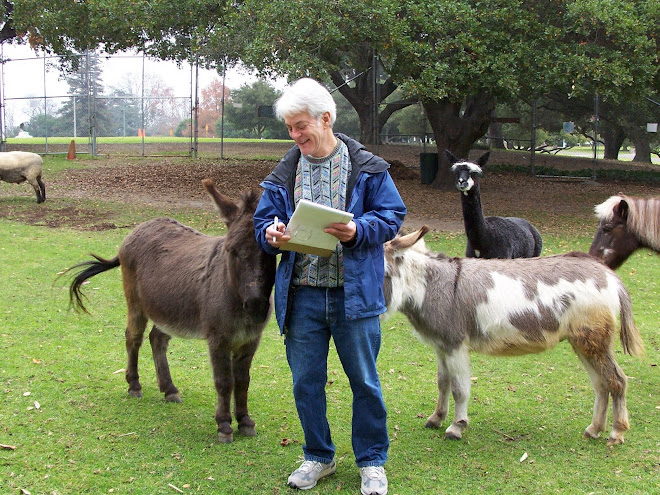
Interviewing the animals at Children's Fairyland in Oakland. L-R: Bobo the sheep, Gideon the miniature donkey, me, Tumbleweed Tommy the miniature donkey, Juan the alpaca, Coco the pony

Sunday, May 20, 2012

Baa Baa Black Sheep


                                        (Above: one of the new lambs)
Ever since Twinkle the sheep died last September, everyone at Children's Fairyland in Oakland, from Juan the alpaca to Puddles the duck, has missed her terribly.
But today there are nothing but smiles because this weekend Fairyland will welcome Twinkle's successors: a pair of 4-month-old lambs.
The lambs – both males – are Olde English Babydoll Southdown Sheep, and that's important because Baybdolls are resistant to megaesophogus, the congenital defect that killed Twinkle.
They're called Babydolls for good reason: They're only 18 inches high. And that's as tall as they're ever going to get, so they'll look like lambs for the rest of their lives.
And they'll always act like lambs, too, because sheep born in the wintertime are especially gentle, loving and sweet. They like to snuggle more and get more hands-on treatment from their keepers than sheep born in the summer, who roam outdoors from an early age.
"They've been hand-held and coddled and adored and smothered with love," says Deborah Ramirez, the animal caregiver at Fairyland. "And they've been raised with alpacas, llamas and goats, so they should fit right in with the other animals in our corral."
The little guys, who were donated by Dr. Jamie Peyton of Elysian Oaks Farm in Winters, are chocolate colored with black faces and stockings. And their wool is the same grade as cashmere - Class C.
They haven't been named yet, and that's where you come in. Fairyland is celebrating their arrival with a naming contest. Submit your suggestions in special boxes located throughout the park or at www.facebook.com/childrensfairyland.
The winner will get lunch for four people, plus a behind-the-scenes V.I.P. tour of Fairyland's animal area.
Speaking of animals, you've probably heard of therapy dogs and therapy cats who visit hospitals and nursing homes. But would you believe a therapy camel?
Get ready to meet Hump-Free, an honest-to-goodness dromedary - that's a camel with only one hump – who does animal-assisted therapy at a ranch for troubled kids.
He and his buddies – Quill-Amina the hedgehog, Interrogator the alligator, Scooter the Macaw, Scarlett the cockatoo, and Galindo the jungle cat – will visit Fairyland next Saturday, June 2, for a special guest appearance.
And there's still more animal news! On June 12 Fairyland will re-open its Little Red Henhouse, which has been closed for decades.
The new residents will be three heirloom chickens, so called because they look like chickens used to look before the food industry started producing freaks that can barely walk because of their enormous breasts and thighs.
One is a blond Silkie – think of Snoopy's pal, Woodstock – one is a reddish-colored Orpington, and the third is a black Cochin.
They are being donated by Allison Lindquist, executive director of the Oakland-East Bay SPCA, who raises heirloom chickens as a hobby.
"They're crazy beautiful," says Fairyland's executive director, C.J. Hirschfield. "And she hand-raised them, so they're very docile and friendly."
If you'd like to help support this precious local treasure, the most enjoyable way I can think of is to attend Fairyland's major fundraiser of the year, the annual gala dinner on June 7. Fairytale attire is optional.
If you don't have children, it's a rare chance to see Fairyland in person because at other times the park has a safety rule: No child admitted without an adult, and no adult admitted without a child.
Visit www.facebook.com/childrensfairyland for details.

Thursday, May 10, 2012

Remembering Phoebe


When my first cat, Eliza, died 16 years ago, I wrote that I would never love anyone or anything as much again.
And I didn't get another cat for many months, until my veterinarian's office called and said they had a kitten I might like.
She was a little gray fluffball. I named her Nelly and took her home. But after about a month I realized she needed a playmate.
As luck would have it, the next day one of my co-workers brought in a little feral kitten she had humanely trapped in Moss Beach.
I named her Phoebe and took her home. She and Nelly got along great.
But five months later Nelly got outside and was killed.
Phoebe mourned bitterly for about 15 or 20 seconds. Then I saw the proverbial light bulb over her head go "click!"
And ever since that day she made it clear, as only a very stubborn former feral can: NO MORE CATS!
Also, no dogs, rabbits, hamsters or, especially, people. Just her and me.
That was Rule Number One. She trusted me not to eat her, but she wasn't so sure about anyone else.
Rule Number Two was: I'm supposed to be home 24/7, paying attention to her.
The penalty for violating Rule Number One was her hiding under the bed for hours after the visitor had gone.
The penalty for violating Rule Number Two was The Glare.
All cat owners know The Glare. It means "Stop paying attention to that %*&#@^&! book (or telephone or computer) and pay attention to ME!"
She also had different meows for "Feed me," "Play with me," "I am ready to go outside," "I am ready to come inside,"  "I am about to vomit" and "Are you a moron?"
Having said all that, she was the best-behaved cat I ever had. She ate only dry food, and she never trashed the furniture - not even once.
I had something to do with that. When she was little, I'd give her a kitty treat every time she used the scratching post.
Being no fool, she quickly figured out that the way to get kitty treats was to use the post. Which she did – many, many times a day. And God help me if I was late with the kitty treat. I'd get The Glare.
I was proud of myself for having trained her so well. Then one day I finally realized: She had trained me!
But my favorite time was bedtime. She would climb up on the bed, curl up beside me, lay her little head in the palm of my hand and, using it as a pillow, fall asleep. And we'd stay that way all night. It warms my heart just to think about it.
Two years ago Phoebe's health started to fail. It was one ailment right after another. Her doctors, Alan Shriro and Rick Benjamin of Berkeley Dog & Cat Hospital, performed miracle after miracle, but they finally ran out of rabbits to pull out of the hat.
I had her put down on May 1. She went quickly and peacefully. The last thing she saw, the last touch she felt, and the last voice she heard was me.
Did I say I'd never love anyone or anything as much as I loved Eliza? I was wrong.

Sunday, May 6, 2012

Go For Broke!


As I mentioned last week, I've been writing this column for 27 years, and in that time I've had the pleasure of meeting more wonderful people than I can count and the honor of telling their stories. 
But if you were to ask me which story is my favorite, it's easy: the men of the 442nd Regimental Combat team, the Japanese American World War II unit that was awarded more medals, man for man, than any other military unit in American history.
Put yourself in their position on Dec. 7, 1941. You're a typical 18-year-old American boy, focused on baseball, cars and girls (not necessarily in that order).
You hear the news about Pearl Harbor and immediately march down to the recruiting office to volunteer.
But they turn you down. Suddenly, you're not an American citizen anymore, even though you were born right here. Overnight, you've been reclassified as 4-C – "enemy alien."
The next thing you know, you and your family have been arrested and shipped off to a Godforsaken hellhole, euphemistically called a "relocation camp," leaving your home, your business and all your possessions behind, never to see them again.
But you still want to defend your country, even though it has treated you so shabbily. You keep volunteering, and you keep getting turned down.
Finally, by 1943, the Army is so desperate for manpower it creates a segregated all-Japanese American unit called the 442nd Regimental Team. All the officers are white, of course.
A few of them are decent human beings. But most, especially the general in charge, think of you as nothing better than cannon fodder. So they throw you into the most dangerous battles rather than risk white soldiers' lives.
That's partly how you and your buddies got so many medals. A lot of them were purple hearts.
After the war, you come back, get your parents and your little brothers and sisters out of the camps, and begin the process of rebuilding your life. And for the rest of that life, you live in a way that brings honor to the memory of your dead comrades.
Twenty-five years ago, the veterans of E Company of the 442nd RCT planted a redwood sapling in Oakland's Roberts Park and placed a memorial plaque next to it to honor their buddies who never came back.
And every year on the third Saturday in May – Armed Forces Day - they come back to Roberts Park for a memorial service. Over the years, that service has been broadened to include all the heroes of World War II.
This year's service will be held May 19. And, as they do every year, the men of Easy Company invite you to join them.
Roberts Park is easy to find. Take Skyline Boulevard and follow the signs for the Chabot Space & Science Center. About a mile before you get to the Center, you'll see a turnoff to Roberts Park on your right.
Go though the first parking lot to the second lot beyond it, and you'll spot me and a bunch of other people. We'll gather there at 11:45 a.m., then walk about a hundred yards  into the park to the memorial sapling, which by now has grown into a towering tree.
The service begins at Noon. I'm looking forward to seeing you there.

Sunday, April 29, 2012

You Go, Girl!


I've been writing this column for 27 years, and in all this time I have never endorsed a candidate.
Until now, that is. Today I'm breaking my streak and asking you to vote for the candidate of my choice.
Who is it? Sheena Monnin, Miss Pennsylvania USA, who will be competing for the Miss USA title in Las Vegas on June 3.
I know some people take a dim view of beauty pageants, but once you get to know Sheena, she'll blow all your preconceptions out of the water.
She's smart, funny and focused; and she has a huge, huge heart. She isn't pushing a political agenda, she doesn't hate anyone, and she doesn't want to be a movie star.
Her ideal isn't Kim Kardashian; it's Elizabeth Bennett, the heroine of Jane Austen's "Pride and Prejudice."
Sheena has a B.A. in human services and a Master's in psychology, and her next step is a PhD in theology. She's also a certified etiquette instructor, with certification in corporate etiquette and international protocol.
For years, her goal has been to found a school for at-risk girls called Pemberly (which Austen fans will recognize as Mr. Darcy's estate in "Pride and Prejudice").
Now she has another one: To counsel people of all ages, ethnicities and religions on a deeper, more sensitive and comprehensive level – especially children.
For the last ten years she's been teaching little kids etiquette, and I don't mean which fork to use.
"Etiquette is learning about respect," she says. "Showing respect to others through our actions is empowering and increases our own level of self-respect."
I could go on and tell you about the hours she spends with a charity called Christmas Child, stuffing shoeboxes with pencils, notebooks, toys and other goodies for kids who otherwise wouldn't have a Christmas.
Or how she uses her celebrity to raise funds for Bethlehem Haven, a shelter for homeless women in Pittsburgh.
But what impresses me most is not what she does, it's the way she does it. She's one of those rare people who, when they're talking with someone, are totally in the moment.
Especially when she's talking with children. She tunes out of the rest of the world and does nothing but listen to them with every fiber of her being.
Now, put yourself in the place of one of those little girls. Here's this beautiful older woman – she's only 27, but to a little kid that must seem ancient - wearing a crown and a big sash reading, "Miss Pennsylvania USA," and she's listening to you as if you're the most important person in the world.
She looks like a princess, but what she's really saying to you is "No, YOU are the princess. And you can be anything and do anything you want."
And the look on their little faces is just priceless. Talk about empowerment!
Check them out on Sheena's Facebook page, "Miss Pennsylvania USA." You'll find yourself being charmed in spite of yourself.
Then please vote for her at either www.missusa.com or www.nbc.com.
And if, after all this, you still take a dim view of beauty pageants, she won't mind.
"When I meet someone who doesn't like pageants, that's OK," she says. "There are lots of other areas where we can find common ground and make a genuine connection."
Online balloting starts May 1.

Sunday, April 22, 2012

Investing In The Future


In the 16th Century the Protestant Reformation, led by John Knox, swept through Scotland.
Knox wanted every person to be able to read the Bible, so he instituted a broad program of public education.
Two hundred years later, three out of four Scotsmen could read and write, making Scotland the most literate nation in Europe.
The result was a flowering of art, science, technology, economics and literature known as the Scottish Enlightenment, with philosopher David Hume, poet Robert Burns, economist Adam Smith and inventor James Watt all living in Edinburgh at the same time.
And that intellectual flowering triggered the industrial revolution that made Britain the greatest empire the world had ever known.
Something similar happened here in the United States in the mid-19th Century, when reformers passed new public education laws making school compulsory through the age of 16.
The result was a highly educated workforce that built the world's biggest economic powerhouse and became the great arsenal of democracy during two world wars.
After World War II we did it again, passing the G.I. Bill of Rights that sent millions of returning vets to college, forming the basis of the Eisenhower '50s, the greatest period of prosperity our country has ever known.
The lesson is clear: Education equals prosperity.
But it's a lesson we have forgotten over the last 50 years. We have allowed our public schools, from kindergarten to college, to whither from lack of funds.
Nowhere is that more apparent than the West Contra Costa Unified School District, where teachers have to pay out of their own pockets for such basics as paper and pencils for their students.
Some people say you can't solve problems by throwing money at them, but public education has been starved for so long, a massive infusion of funds would be a life-saver.
In this political climate, that's not going to happen anytime soon. Until then, private individuals are trying to give the schools emergency transfusions to keep them alive until the public wakes up and forces the politicians to do the right thing.
One such effort is the West Contra Costa Public Education Fund – The Ed. Fund, for short – which bestows small monetary awards on outstanding teachers, staff and volunteers to continue their good work. This year alone it has awarded 77 grants to schools and 75 college scholarships to graduating high school seniors.
This year's awardees are Joshua Hastings, a history teacher at Richmond High; Maria Saxton, a dual immersion teacher at Washington Elementary; Abigail Sims-Evelyn, a history and leadership teacher at LoVonya DeJean Middle School; Tracy Singh-Poole, a special education teacher at DeAnza High; and Todd Groves, volunteer par excellence at El Cerrito High and Portola Middle School.
The awards will be presented May 18 at the Ed. Fund's annual Excellent In Education gala at the Craneway Pavilion in Richmond. It's the Ed. Fund's major fundraiser of the year.
Tickets are $100 for adults, $75 for WCCUSD teachers and $30 for students. To purchase tickets – or to donate if you can't attend - visit www.edfundwest.org or send a check to The Ed. Fund, 217C W. Richmond Ave., Richmond 94801.
Granted, this is tantamount to slapping a Band-Aid on a gaping wound. But a Band-Aid is better than nothing until we can get the patient to surgery.

Friday, April 13, 2012

Mea Culpa


It's one of the most famous scandals in local journalism: The Critic Who Wasn't There. For 25 years, I've been repeating it as a cautionary tale for young reporters.
It all started one day in the mid-1980s, when I got a call from the San Francisco Ballet.
They were angry because their performance at Stern Grove had gotten a negative review from one of the San Francisco Chronicle's music and dance critics, Heuwell Tircuit. What really frosted them, they said, was that he hadn't even attended the performance!
Their proof: He severely criticized one of the ballerinas, but unbeknownst to him she had been called away on a family emergency, and another ballerina danced instead.
The Chronicle fired Tircuit on the spot. The executive editor even took the unprecedented move of publishing a front-page retraction the next day that completely threw him under the bus.
Needless to say, I gleefully piled on for all it was worth. And so did every other columnist in town.
Great story, huh? Only one problem: I just found out it's not true.
Last week I talked with Robert Commanday, who was the Chronicle's chief music critic, and Janos Gereben, who was covering the Stern Grove event for another paper. And they both said Tircuit was there the whole time. The reason he didn't know about the substitution of ballerinas was that the flyer announcing the switch hadn't been inserted in his program.
He made a mistake, but it was an honest one, undeserving of the death penalty.
To his credit, he refused to feel sorry for himself and bravely soldiered on, freelancing for local music magazines. But he was never able to land a job with a major newspaper again. At one point, he was reduced to operating an elevator.
Tircuit died two years ago, so I can't even call him and apologize for my part in ruining his career. The only thing I can do is try to set the record straight.
This was not journalism's finest moment. We all should be ashamed of ourselves. I certainly am.
                                                    * * *
But Tircuit, who loved to encourage talented young performers, would have adored Audrey Vardanega, the 16-year-old piano sensation who has been wowing critics and professional musicians since she was a little girl.
When Audrey was 13, I asked George Cleve, the artistic director of the Midsummer Mozart Festival, how good she is for her age. He laughed and said, "Martin, she's good for any age!"
Audrey will be a featured performer at the Midsummer Mozart Festival in July, playing Mozart's gorgeous piano concerto No. 17 in G Major.
But you can see her April 29 when she performs at the Berkeley City Club with the California Chamber Players, which includes several members of the San Francisco Symphony.
The concert is a benefit to raise money to refurbish the City Club's two pianos – a Steinway and a Bechstein – which are in a sad state of disrepair.
"The action is uneven, and they're badly out of tune," she says, "which is a shame because they're really nice pianos."
Tickets are only $35, a steal considering the quality of the performers. Seating is limited, so visit www.eventbrite.com and search for "Mozart Youth Camerata."
Don't miss this chance to hear Audrey before she becomes world famous. You'll be able to brag that you saw her when.

Monday, April 9, 2012

Shake, Rattle & Roll


Did you know that during the 1906 San Francisco earthquake– whose 106th anniversary we'll observe on Monday -  a five-foot-high tsunami wiped out the lumber wharves in west Berkeley?
Only one person – a man named B.J. Rose – was on the wharf at the time. The wave knocked him into the water, along with half a million feet of lumber. But somehow he miraculously survived.
Never heard of it? Neither did anyone else, including the U.S. Geological Survey. The tsunami was a one-inch story in the next day's Berkeley Gazette; but with everything that was happening, it was quickly forgotten.
But in 2005 a local historian named Richard Schwartz rediscovered the story and notified the USGS. They ran the numbers and decided the tsunami probably was caused by part of Yerba Buena Island falling into the Bay.
"Now here's the scary part," says Schwartz. "The Hayward Fault would cause a much bigger tsunami. Which means all of the flatlands are at risk, not just west Berkeley."
This is just one of the hundreds of great stories in Schwartz's book, "Earthquake Exodus, 1906: Berkeley Responds to the San Francisco Refugees."  You can't turn a page without stumbling over another fascinating factoid. For instance:
The ROTC cadets at Cal were mustered into service and ferried to San Francisco to prevent looting.
"At first, they treated it like a joke," says Schwartz. "But all the laughing stopped when boxes of live ammunition were brought out on deck, and they realized they might be forced to shoot their fellow citizens."
Many French Americans from San Francisco found refuge in Berkeley's booming French Quarter on Fourth Street, which featured some of the finest French restaurants in the Bay Area.
"But the next year, the city passed an ordinance banning the consumption of alcohol, and that put an end to Berkeley's French Quarter," Schwartz says. "The restaurant owners closed their establishments rather than compromise their culture."
And, of course, there's the Italian American fishing boat captain who was ferrying frightened refugees from North Beach to Berkeley.
"As they were crossing the Bay he noticed a young woman who looked really scared. He put his hand on her shoulder and said, 'It's going to be OK.' They fell in love, got married, and had a son. That son's name was Joseph L. Alioto, the future mayor of San Francisco."
Schwartz himself is as interesting as the stories he tells. He's not a professional historian; he's a building contractor.
One day in 1996 he happened to be visiting the Berkeley Historical Society when he spotted a two-foot stack of old Berkeley Gazettes from 1900 to 1909 that they were about to throw out.
"Hey, I'll take them," he said. The newspapers became the basis of his first book, "Berkeley 1900: Daily Life at the Turn of the Century," published in 2000. That was followed by "Earthquake Exodus" in 2005 and "Eccentrics, Heroes and Cuttthroats of Old Berkeley" in 2007.
Not being an academic historian, he didn't know that you're supposed to leave out all the interesting stuff and put in only the boring parts. So he did the opposite.
All three books are available not only at local bookstores, but at local hardware stores, too - he's a building contractor, remember? – as well as at http://www.RichardSchwartz.info/