A columnist of heart and mind

A columnist of heart and mind
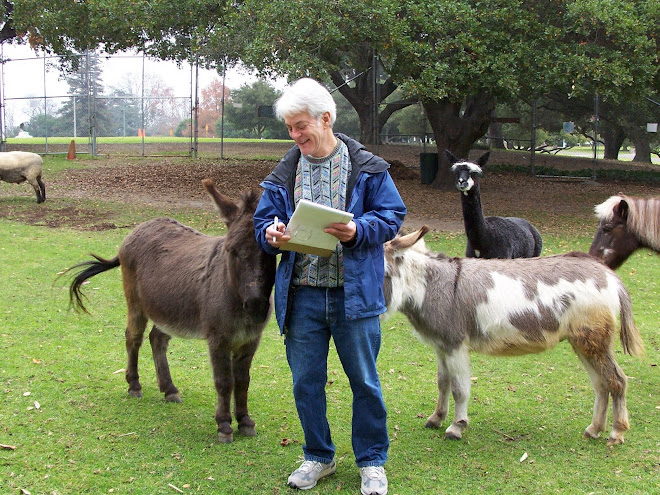
Interviewing the animals at Children's Fairyland in Oakland. L-R: Bobo the sheep, Gideon the miniature donkey, me, Tumbleweed Tommy the miniature donkey, Juan the alpaca, Coco the pony

Friday, April 13, 2012

Mea Culpa


It's one of the most famous scandals in local journalism: The Critic Who Wasn't There. For 25 years, I've been repeating it as a cautionary tale for young reporters.
It all started one day in the mid-1980s, when I got a call from the San Francisco Ballet.
They were angry because their performance at Stern Grove had gotten a negative review from one of the San Francisco Chronicle's music and dance critics, Heuwell Tircuit. What really frosted them, they said, was that he hadn't even attended the performance!
Their proof: He severely criticized one of the ballerinas, but unbeknownst to him she had been called away on a family emergency, and another ballerina danced instead.
The Chronicle fired Tircuit on the spot. The executive editor even took the unprecedented move of publishing a front-page retraction the next day that completely threw him under the bus.
Needless to say, I gleefully piled on for all it was worth. And so did every other columnist in town.
Great story, huh? Only one problem: I just found out it's not true.
Last week I talked with Robert Commanday, who was the Chronicle's chief music critic, and Janos Gereben, who was covering the Stern Grove event for another paper. And they both said Tircuit was there the whole time. The reason he didn't know about the substitution of ballerinas was that the flyer announcing the switch hadn't been inserted in his program.
He made a mistake, but it was an honest one, undeserving of the death penalty.
To his credit, he refused to feel sorry for himself and bravely soldiered on, freelancing for local music magazines. But he was never able to land a job with a major newspaper again. At one point, he was reduced to operating an elevator.
Tircuit died two years ago, so I can't even call him and apologize for my part in ruining his career. The only thing I can do is try to set the record straight.
This was not journalism's finest moment. We all should be ashamed of ourselves. I certainly am.
                                                    * * *
But Tircuit, who loved to encourage talented young performers, would have adored Audrey Vardanega, the 16-year-old piano sensation who has been wowing critics and professional musicians since she was a little girl.
When Audrey was 13, I asked George Cleve, the artistic director of the Midsummer Mozart Festival, how good she is for her age. He laughed and said, "Martin, she's good for any age!"
Audrey will be a featured performer at the Midsummer Mozart Festival in July, playing Mozart's gorgeous piano concerto No. 17 in G Major.
But you can see her April 29 when she performs at the Berkeley City Club with the California Chamber Players, which includes several members of the San Francisco Symphony.
The concert is a benefit to raise money to refurbish the City Club's two pianos – a Steinway and a Bechstein – which are in a sad state of disrepair.
"The action is uneven, and they're badly out of tune," she says, "which is a shame because they're really nice pianos."
Tickets are only $35, a steal considering the quality of the performers. Seating is limited, so visit www.eventbrite.com and search for "Mozart Youth Camerata."
Don't miss this chance to hear Audrey before she becomes world famous. You'll be able to brag that you saw her when.

Monday, April 9, 2012

Shake, Rattle & Roll


Did you know that during the 1906 San Francisco earthquake– whose 106th anniversary we'll observe on Monday -  a five-foot-high tsunami wiped out the lumber wharves in west Berkeley?
Only one person – a man named B.J. Rose – was on the wharf at the time. The wave knocked him into the water, along with half a million feet of lumber. But somehow he miraculously survived.
Never heard of it? Neither did anyone else, including the U.S. Geological Survey. The tsunami was a one-inch story in the next day's Berkeley Gazette; but with everything that was happening, it was quickly forgotten.
But in 2005 a local historian named Richard Schwartz rediscovered the story and notified the USGS. They ran the numbers and decided the tsunami probably was caused by part of Yerba Buena Island falling into the Bay.
"Now here's the scary part," says Schwartz. "The Hayward Fault would cause a much bigger tsunami. Which means all of the flatlands are at risk, not just west Berkeley."
This is just one of the hundreds of great stories in Schwartz's book, "Earthquake Exodus, 1906: Berkeley Responds to the San Francisco Refugees."  You can't turn a page without stumbling over another fascinating factoid. For instance:
The ROTC cadets at Cal were mustered into service and ferried to San Francisco to prevent looting.
"At first, they treated it like a joke," says Schwartz. "But all the laughing stopped when boxes of live ammunition were brought out on deck, and they realized they might be forced to shoot their fellow citizens."
Many French Americans from San Francisco found refuge in Berkeley's booming French Quarter on Fourth Street, which featured some of the finest French restaurants in the Bay Area.
"But the next year, the city passed an ordinance banning the consumption of alcohol, and that put an end to Berkeley's French Quarter," Schwartz says. "The restaurant owners closed their establishments rather than compromise their culture."
And, of course, there's the Italian American fishing boat captain who was ferrying frightened refugees from North Beach to Berkeley.
"As they were crossing the Bay he noticed a young woman who looked really scared. He put his hand on her shoulder and said, 'It's going to be OK.' They fell in love, got married, and had a son. That son's name was Joseph L. Alioto, the future mayor of San Francisco."
Schwartz himself is as interesting as the stories he tells. He's not a professional historian; he's a building contractor.
One day in 1996 he happened to be visiting the Berkeley Historical Society when he spotted a two-foot stack of old Berkeley Gazettes from 1900 to 1909 that they were about to throw out.
"Hey, I'll take them," he said. The newspapers became the basis of his first book, "Berkeley 1900: Daily Life at the Turn of the Century," published in 2000. That was followed by "Earthquake Exodus" in 2005 and "Eccentrics, Heroes and Cuttthroats of Old Berkeley" in 2007.
Not being an academic historian, he didn't know that you're supposed to leave out all the interesting stuff and put in only the boring parts. So he did the opposite.
All three books are available not only at local bookstores, but at local hardware stores, too - he's a building contractor, remember? – as well as at http://www.RichardSchwartz.info/

Sunday, April 1, 2012

Nostalgia Ain't What It Used To Be

I'm going to observe – at my age, "celebrate" is too strong a word – another birthday on Thursday, and one thing that amazes me is how I grew from a young man to an old man in the blink of an eye.
The other thing that amazes me is that nothing turned out the way I thought it would.
Who would have imagined that there would be more Rolling Stones still alive than Beatles?
Or that of all the '60s rock'n'rollers, the ones who would go on to the most successful post-music careers would be Sonny (who got elected to Congress) and Cher (who won an Oscar for Best Actress)?
Or that of all the Kennedy brothers, the one who would earn the greatest reputation as a statesman would be Teddy?
Or that John Madden would become more famous as a video game than as a football coach or TV commentator?
Or that a B-movie western actor like Clint Eastwood would become one of the greatest directors of all time, the John Ford of his generation?
Or that George Foreman, once the least popular of boxers, would end up becoming one of the most beloved?
Or that the Cold War would end with a whimper, not a bang?
Or that we would have an African American president?
Jerry Garcia was right: What a long, strange trip it's been.
One of the biggest mistakes we make when we try to predict the future is to assume it will be a straight-line extension of the present.
So when I was a kid in the not-so-fabulous Fifties, it was assumed that when we went to college the boys would be wearing crew cuts and button-down collars, and the girls would be wearing poodle skirts and circle pins, just like our older brothers and sisters.
Didn't quite turn out that way, did it? Instead of wanting to be Mickey Mantle, the boys wanted to be Mario Savio. And, as author Sheila Weller (a friend of mine since high school) observed, "All good girls were cheerfully turning themselves into bad girls as fast as possible."
A lot of nostalgic blather has been written about the Fifties, the so-called "Happy Days," but they weren't happy if you were African American. Or a women. Or gay. Or, for that matter, anyone but a white Anglo-Saxon Protestant male of western European origin.
Then there were the twin shadows that cast a pall over everything: McCarthyism and The Bomb. My dad had a guy named Hal Smith sweeping the floor of his warehouse. He was one of the Hollywood Ten blacklisted screenwriters, and sweeping my dad's floor was the only job he could get. And my dad was running a considerable risk himself for hiring him.
And how well – but not fondly – do I recall the duck-and-cover drills and the constant terror of dying in a nuclear holocaust.
As a final insult, the food was terrible! Everything came out of the freezer or a can. And if you've never drunk coffee that's been brewed in a percolator, you don't know what swill is.
So while I miss my lost youth, I don't miss those times. Despite the dysfunction we see all around us these days, take it from one who was there: Those good old days were terrible.

Sunday, March 25, 2012

Valley of the Zombies


Ever hear of the Valley of the Zombies?
No, not the cheesy 1946 British horror flick of the same name. I mean a term coined by robotics professor Masahiro Mori in 1970 – sometimes called "the Uncanny Valley" – to describe a peculiar phenomenon of human perception.
His theory, which is all the rage among robotics experts and 3-D computer animators, goes like this: We love to anthromorphisize other creatures, right? (Think of all the people who call their dogs or cats their "kids.")
And they more these creatures look like us, the cuter they seem. Imagine a graph with resemblance to people on the X axis and cuteness on the Y axis, and the curve will be a straight 45-degree line.
Until they start looking a little bit TOO much like us, that is. Then, all of a sudden, adorable becomes creepy, and the line on the graph takes a precipitous dip.
Think of the Frankenstein monster. Or the undead in "Night of the Living Dead." Or, for that matter, zombies.
They're much more repulsive than, say, the Wolfman, the Blob, or the Beast from 50,000 Fathoms. It's that eerie, almost-but-not-quite resemblance that makes your flesh crawl.
And that brings us to Mitt Romney.
He's been criticized as robotic and inauthentic, but I don't think that explains why so many people find him so unsettling.
The root cause is his weird affect, including the bizarre things he blurts out – "Strange things are happening to me!" "I love those cheesy grits!" "I'm unemployed, too!" - and the way he stammers when answering the simplest question.
And have you ever seen anybody more uncomfortable in a pair of jeans? From an image viewpoint, he's stuck in the Valley of the Zombies.
This has nothing to do with politics. I have much more in common with Mitt than I do with, say, Rick Santorum. But Santorum, whatever you think of his politics, comes across like a real person.
Ditto for Newt, although he sometimes lapses into self-parody. And Ron Paul, who looks like a friendly little gnome who leaves copies of "Atlas Shrugged" in children's stockings at Christmas time.
I admit I'm talking style, not substance. But what do you think gets people elected?
Not substance. If it did, Richard Nixon, not Jack Kennedy, would have been elected in 1960. In fact, most people who listened to the debates on radio were sure Nixon outscored Kennedy on points.
But not the people who watched on TV. To them, it was a contest between the past and the future – between the young, vigorous Kennedy and the old, stodgy Nixon.
Ironically, Nixon was a young man, too – only 47. But, as journalist Richard Reeves noted, "Nixon was an old man's idea of what a young man should be."
You could see the difference in their campaign photos. Both chose pictures from their service in World War II. But Nixon's showed him posing stiffly in his Navy dress blues, while Kennedy's was an action shot of a bare-chested JFK at the helm of PT-109, sporting aviator shades, a battered fatigue hat and a grin that stretched from ear to ear.
It was enough to overcome fears of a Catholic president then; and unless Mitt gets real, it could be enough to overcome fears of an African-American president now.

Wednesday, March 21, 2012

Berkeley's Best


Berkeley has been variously described as "Rodeo Drive for intellectuals," "a place where even the dogs have their preferred coffee drinks," and "a small town that thinks it's the center of the universe."
It has produced such colorful personalities as pioneering police chief August Vollmer (the man who made fingerprinting an investigative tool), baseball scrapper Billy Martin, muckraking journalist Lincoln Steffens, poker-faced tennis champ Helen Wills Moody, novelist C.S. Forrester (creator of Captain Horatio Hornblower), physicist J. Robert Oppenheimer (father of the atomic bomb), and supermodel/actress Rebecca Romijn, who, after she hit it big, gave a huge donation to her old middle school, Martin Luther King.
But for my money, the most important people in the city's history are two men whose birthdays occurred this month.
The first is the man without whom Berkeley literally would not be Berkeley - George Berkeley, an Anglo-Irish bishop who would have celebrated his 327th birthday on March 12. He's the guy the town is named after.
It happened in 1866, when UC President Henry Durant and members of the Board of Regents, including California Attorney General Frederick Billings, were enjoying a picnic at Founders Rock.
Today, you can barely find Founders Rock because of all the tall buildings around it. But back then it had a gorgeous view of San Francisco Bay.
As they watched the ships sailing through the Golden Gate, Billings was inspired to quote poetry: "Westward the course of empire takes its way."
"Who wrote that?" someone asked.
"Why, George Berkeley, the Bishop of Cloyne," said Billings. "That's it! Berkeley! We'll name the town Berkeley!"
And the rest is history.
The other man is Joseph Charles, who would have celebrated his 102nd birthday on Thursday.
If you drove by the corner of Oregon and Martin Luther King Thursday morning, you probably saw a bunch of people waving at you and shouting, "Keep smiling!" and "Have a GOOD day!"
It was a tribute to Mr. Charles, who did that every morning from 1962 to 1992.
In the process, he became the most beloved man in town. People would drive for miles out of their way, just so they start off their day waving to the Waving Man.
Mr. Charles died in 2002 at age 92. But the people of Berkeley refused to let him be forgotten.
Since 2006, people have stood on the corner in front of his house on his birthday and waving to the morning traffic, just as he did.
He even has a Facebook page, "Friends of the Berkeley Waving Man."
One of the wavers is Denisha DeLane, who remembers waving to Mr. Charles when she was a little girl every Sunday morning on her way to church.
"We're going to pass on a great Berkeley tradition to the next generation," she vows.
Of course, when he first started waving, not everyone was so enthusiastic. The neighbors thought he was crazy and called the cops.
But the police quickly sized up the situation and said, "Go ahead, Mr. Charles. You just keep on waving for as long as you want."
And he did.
If you missed Thursday's celebration, don't worry. They'll be back again next March 22, and they invite you to wave to them - or even join them on the corner.
Until then, keep smiling. And have a GOOD day.

Tuesday, March 13, 2012

Return To Sender


Happy Return To Sender Day!
What? Never heard of it?
That's not surprising. It's a brand-new event invented by Sarah Kidder, a professional etiquette consultant and event planner in Oakland. The day is dedicated to returning items you've borrowed and asking for the return of items you've loaned. The first one is next Tuesday.
"I was reorganizing my office and came across a few things I've been trying to give back to people, things I've been tripping over, including some old shoes left behind by a houseguest and a pair of designer candles I've been holding for my brother," she says. "And I keep looking for things I've loaned out but have never been returned.
"I was chatting with my friend Jenny, who was also in the same boat, and she noted how awkward it is to ask for something back after six months, or a year, or five.
"So I said, 'What if we made it easier for people to ask for their stuff back? And what if and took the shame out of returning something two years late?'"
And we said, "We should come up with a day!"
The first Return To Sender Day- RTS Day, for short - will be next Tuesday, March 20, the first day of spring. (Spring cleaning, get it?)
But is anyone really hankering to get their old stuff back?
"Absolutely! Very few people forget about the weird stuff they've loaned out, even if it's been decades. You don't forget about that book or that swing record. It doesn't even matter if you really want it any more. It's the principle of the thing."
To make it easier for you, Kidder has set up a website and Facebook page with a FAQ sheet and some downloadable templates of reminders to send your friends. Among them:
"Missing: Deep Fryer. Last seen: Your house. For that BBQ you hosted. You said you'd bring it back Monday. That was nine months ago. I'd like it back on RTS Day."
"Wanted: Faux Vintage Telephone. You borrowed it for a theme party. You don't even have a landline. I miss it. It's been two years. Please return it on RTS Day."
"I have your DVDs. I'll drop them in your mailbox on RTS Day. Sorry it's taken so long to get them back to you."
To access the Facebook page, go to www.facebook.com/RTSDay/ To access the website, visit www.sarahkidderdesigns.com/
"RTS Day gives everyone a chance to ask for their stuff back without sounding like a nag or petty, and it gives a guilt-free way to return items," she says. "I don't know where this is all headed, but I hope it goes viral. I think it would be wonderful if people had a way to get their power drills or Tupperware back and keep their friendship."
Old Polonius was right: "Never a borrower nor a lender be." But if you must borrow, give it back!
So get ready, Cliff Stoll: I'm going to return two books - "Courtesans and Fishcakes" and "Bowling Alone" - that you loaned me five years ago.
And David Kemnitzer: I'd like to get back that autographed copy of "Fear On Trial" by John Henry Faulk, which you borrowed from me back in 1970.
What's on your RTS list?

Thursday, March 8, 2012

Polonius Was Right


Happy Return To Sender Day!
What? Never heard of it?
That's not surprising. It's a brand-new event invented by Sarah Kidder, a professional etiquette consultant and event planner in Oakland. The day is dedicated to returning items you've borrowed and asking for the return of items you've loaned. The first one is next Tuesday.
"I was reorganizing my office and came across a few things I've been trying to give back to people, things I've been tripping over, including some old shoes left behind by a houseguest and a pair of designer candles I've been holding for my brother," she says. "And I keep looking for things I've loaned out but have never been returned.
"I was chatting with my friend Jenny, who was also in the same boat, and she noted how awkward it is to ask for something back after six months, or a year, or five.
"So I said, 'What if we made it easier for people to ask for their stuff back? And what if and took the shame out of returning something two years late?'"
And we said, "We should come up with a day!"
The first Return To Sender Day- RTS Day, for short - will be next Tuesday, March 20, the first day of spring. (Spring cleaning, get it?)
But is anyone really hankering to get their old stuff back?
"Absolutely! Very few people forget about the weird stuff they've loaned out, even if it's been decades. You don't forget about that book or that swing record. It doesn't even matter if you really want it any more. It's the principle of the thing."
To make it easier for you, Kidder has set up a website and Facebook page with a FAQ sheet and some downloadable templates of reminders to send your friends. Among them:
"Missing: Deep Fryer. Last seen: Your house. For that BBQ you hosted. You said you'd bring it back Monday. That was nine months ago. I'd like it back on RTS Day."
"Wanted: Faux Vintage Telephone. You borrowed it for a theme party. You don't even have a landline. I miss it. It's been two years. Please return it on RTS Day."
"I have your DVDs. I'll drop them in your mailbox on RTS Day. Sorry it's taken so long to get them back to you."
To access the Facebook page, go to www.facebook.com/RTSDay/ To access the website, visit www.sarahkidderdesigns.com/
"RTS Day gives everyone a chance to ask for their stuff back without sounding like a nag or petty, and it gives a guilt-free way to return items," she says. "I don't know where this is all headed, but I hope it goes viral. I think it would be wonderful if people had a way to get their power drills or Tupperware back and keep their friendship."
Old Polonius was right: "Neither a borrower nor a lender be." But if you must borrow, give it back!
So get ready, Cliff Stoll: I'm going to return two books - "Courtesans and Fishcakes" and "Bowling Alone" - that you loaned me five years ago.
And David Kemnitzer: I'd like to get back that autographed copy of "Fear On Trial" by John Henry Faulk, which you borrowed from me back in 1970.
What's on your RTS list?