A columnist of heart and mind

A columnist of heart and mind
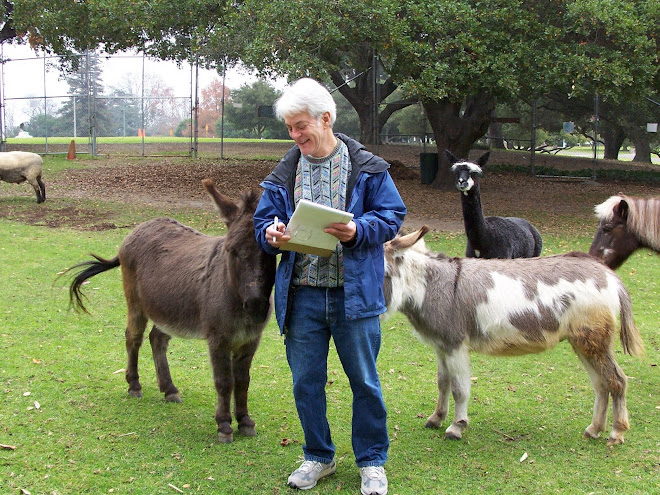
Interviewing the animals at Children's Fairyland in Oakland. L-R: Bobo the sheep, Gideon the miniature donkey, me, Tumbleweed Tommy the miniature donkey, Juan the alpaca, Coco the pony

Sunday, March 4, 2012

JazzGirls


(Above: The Montclair Women's Big Band)

Hey, all you young jazzwomen. (And there are a lot of you out there - more than you know.) Tired of being one of the only females in the band?
Wondering where all the other girls are?
Thinking about joining a jazz group, but feeling shy or discouraged by the lack of other female musicians?
Have I got an event for you!
Come to Berkeley High next Saturday, March 10, for the first ever JazzGirls Day, led by prominent professional women jazz musicians and educators, including trombonist Sarah Cline, director of the Berkeley High Jazz Program; trumpet player Ellen Seeling, director of the Montclair Women's Big Band; tenor saxophonist Jean Fineberg, co-director of the Jazzschool Girls Jazz & Blues Camp; and pianist Susan Muscarella, founder and executive director of the Jazzschool.
"We'll play some tunes, have a jam session, break into groups by instrument, and talk about our experiences as women and girls in the jazz world," says Cline, the first female to head Berkeley High's award-winning jazz program.
This event is for girls only. It's absolutely free. And you don't have to be a student at Berkeley High. It's open to all girls age 10 and older who sing or play an instrument.
"Bring all your friends," says Cline, "even if they don't play jazz yet."
JazzGirls Day will take place from 1 to 5 p.m. Please RSVP to Cline at sarahcline@berkeley.net to let her know you're coming.
Not only is admission free, attendees will also get discounts on tickets to another, related event happening that evening and the next day a few blocks away: the first annual Jazzschool Women's Jazz Festival.
Saturday night features the Young Lionesses, an all-star band of emerging jazz stars in their twenties and early thirties, including pianist Erika Oba and alto saxophonist Kasey Knudsen, already a legend for her bebop solos.
On Sunday afternoon, a dream team of veteran jazzwomen - including Cline, Fineberg, Seeling, bassists Carla Kaufman and Ruth Davies, alto saxist Mad Duran, and drummer Kelly Fasman - will join forces at the Jazzschool for a once-in-a-lifetime concert.
Each of them has a well-established reputation, but this will be the first time they've all played together. Tickets are expected to go fast, so call the Jazzschool at 510-845-5373 to reserve yours now.
It's hard to believe in 2012, but jazz, unfortunately, is still a bastion of male chauvinist piggery. Unless they're singers, jazzwomen have a hard time getting gigs with bands, bookings at jazz festivals, or teaching positions with major university jazz programs.
Things really haven't changed since Cline was a student at Berkeley High herself 30 years ago. At the time, she was one of only two girls in the school's highest-level jazz ensemble.
Despite all her efforts, guess how many girls are in that jazz ensemble today? The same number: two.
That's why she and her fellow musicians are putting on next weekend's events: to tell the next generation of jazzwomen, "Yes, you can."
Have a blast next weekend, girls. And don't listen to anyone who tells you that you can't play jazz as well as boys.
It's about as valid as something similar I used to hear all the time in the 1950s and early '60s, when NBA coaches, players and sportswriters all firmly believed that African Americans can't play basketball as well as whites.

Thursday, March 1, 2012

Books Are Your Friends


I gotta admit: I'm totally stoked because tomorrow is my favorite party of the year: the annual Glenview Elementary School Read-A-Thon in Oakland.
Next Friday, March 2 – Dr. Seuss's birthday, natch – the kids will put away their schoolwork for the day and do nothing but read for pure pleasure.
And they go at it with gusto, especially the littlest ones, who often come to school that day in their pajamas, dragging their teddy bears and sleeping bags behind them.
Using chairs and blankets, they make forts in the middle of the classroom, climb in with their favorite books, and read to their heart's content. It's beyond cute.
It's also very smart. When I was their age, the teachers made us read as punishment when we misbehaved. It taught us a bad lesson: Reading is a drag.
But these kids are getting the opposite message: Reading is fun!
The all-day-party is the kids' reward for the previous two weeks, during which they have been knocking on doors in the neighborhood, asking people to sponsor them in the Read-A-Thon.
The kids pledge to read at least 30 minutes every night, and the sponsors pledge to support them by donating to the Glenview PTA.
Now, I'm not crazy about children having to go door-to-door begging for money for their education – we certainly didn't have to in my day - but it's not Glenview's fault. Blame the shortsighted politicians in Sacramento who keep balancing the state's budget by taking money from education.
Without the Read-A-Thon, Glenview's enrichment programs - chorus, art, drama and physical education – would be at risk, as well as the school aides who help out in classrooms and at lunchtime and recess.
And the school takes every step to protect the kids' safety. They must be accompanied by an adult they know personally, and they can knock only on doors of people they know personally.
At the big party next Friday, awards will be given to the student who logged the most reading hours and the class that raised the most money in pledges.
The luckiest kids of all are the ones in Mr. Miller's 2nd grade class. Once again, as he does every year, he's making them an offer they can't refuse: If they can raise $3,000, he'll let them watch while his hair gets cut off and his head shaved.
There's never a cleanup problem. The kids prize the shorn locks as souvenirs, and they scoop them up as soon as they hit the ground.
Once again, some outsiders – including Oakland cops and firefighters; Cal student athletes; writer Leah Waarvick, author of "I Sit and Stay: A Survival Guide for Kids (And Parents Too!" and her dog, Emma; and me – have been invited to read some of our favorite books to the kids.
If you'd like to contribute to the Read-A-Thon, send a tax-deductible check to Glenview Elementary PTA, 4215 La Cresta Ave., Oakland CA 94602.
Or support any school you like. The kids at Glenview aren't rich – almost half receive free lunches, which is a traditional way of measuring poverty – but they're better off than their counterparts at many other schools, where the parents are too poor to even have a PTA.
They all need our help.

Monday, February 13, 2012

We'll Never Forget What's His Name


Next Monday is Presidents Day, but who cares?
Not me. What kind of holiday is this? Does it mean we should be celebrating losers like James Buchanan and Andrew Johnson?
No, it's just a generic hybrid of Lincoln's birthday and Washington's birthday that falls on a Monday between the two. And for what? So we can have another three-day weekend.
Back when I was a kid, Washington and Lincoln's birthdays were celebrated on their actual anniversaries. And everyone made a big deal about them, too, with public ceremonies, school assemblies and specials on TV.
And they deserved it. Washington was not only a strategic genius who won our independence, he was that rarest character in history: a conqueror who resisted the temptation to seize power. But he gained something more valuable than power: moral authority. When he died in 1799, even his former enemies mourned. Every ship in the British fleet fired a 21-gun salute in his honor.
He was our Obi-Wan Kenobe, not our Darth Vader. And as a result we are the world's oldest ongoing democracy.
And Lincoln was the man who saved that democracy and freed the slaves in the process.
But lumping them together in a generic holiday that could just as easily include Millard Fillmore and William Henry Harrison is tantamount to performing a lobotomy on our national memory. We risk losing our connection to role models who might help us combat today's problems.
But what about our beloved three-day weekends? Isn't it more convenient to move everything to the nearest Monday?
But that's my point: Inconvenience is good. The reason our forebears created national holidays is that some people made such big contributions, it's worth inconveniencing ourselves for a day to stop and say thanks.
Look, I like long weekends as much as the next person. The British create them by periodically declaring what they call "Bank Holidays."
But if you're claiming to honor our past, do it. Let's go back to bells and bonfires and public readings of the Gettysburg Address - and on the actual anniversary, too.
And speaking as one who is old enough to remember those days, I can tell you that the annual ritual had an added advantage: It inspired kids to dream that someday they could grow up to be like another Washington or Lincoln.
That also goes for our other holidays. Martin Luther King's birthday should be a day for all of us to take time to solemnly reflect on racism and how it has been the greatest curse afflicting our country.
Ditto for Labor Day. Who nowadays stops in the middle of a department store sale to think about Eugene V. Debs, Walter Reuther and the other labor pioneers whose sacrifices gave us some basic rights that are under attack once again, like Social Security and the right to organize?
Honoring the heroes of the past is not ancestor worship. It's actually a message of hope for the future. It makes us remember that democracy is an ongoing struggle. And that means we'll get our chance to be heroes, too.
Unfortunately, the trend is running in the opposite direction. Things are getting so generic, it won't be long before Christmas is the last Monday in December and Independence Day is the first Monday in July.

Monday, February 6, 2012


(Above: Karl. Below: The Skipper and King Fuddle)

Children's Fairyland in Oakland suffered two terrible blows last month with the deaths of Karl Osterloh, who died on Jan. 26 at age 79, and Bruce "Skipper" Sedley. who died on Jan. 21 at age 86.
Karl's official title was "volunteer extraordinaire," but that doesn't begin to describe what he meant to Fairyland. If William Penn Mott and Arthur Navlet were the park's fathers, Karl was its fairy godfather.
There's hardly a square inch that doesn't bear his imprint, from the remodeled entrance plaza, where he donated more than 2,500 hours as the project's general contractor, to the new Aesop's Playhouse, which he guided every step of the way from the earliest drawings to its final completion.
"We were too small to attract a company to do the concrete work, so Karl got on the phone and convinced a company he'd previously worked with that the children of Oakland needed them to complete this project," says Fairyland's executive director, C.J. Hirschfield. "They couldn't say no when Karl asked in that way."
Born in Albany, Karl worked his way through Cal (Class of '54) and served two tours of duty in Vietnam, flying HU-1 "Huey" assault helicopters and earning two bronze stars plus a slew of other medals.
Having seen more than enough of war and destruction, he came back to Oakland and spent the rest of his life being kind to little kids.
First he founded a hugely successful construction company that built the executive terminal at Oakland Airport and refurbished the San Pablo Hotel in downtown Oakland and Doe Library at Cal.
Then he put all that expertise to work at Fairyland. He was the best friend the park ever had, but he always deflected praise away from himself.
You'd think a guy like that devoted so much time and energy to other people's children because he had no kids of his own. But not in Karl's case.
To the contrary, he and Rita, his wife of 56 years, presided over an extremely close-knit family of six daughters and sons-in-law and 14 grandchildren, each of whom had a special relationship with their beloved "Papa" and tried their best to make him proud of them. And he was. Very.
Within hours after his died, his grandkids created a Facebook page called "In Loving Memory of Karl Osterloh," featuring videos, photos and fond recollections, especially of his delightfully impish sense of humor.
There will be a funeral Mass at 3 p.m. next Friday, Feb. 17, at Christ the Light Cathedral, followed by a reception at - where else? - Fairyland. In lieu of flowers, his family has asked that donations be sent to Children's Fairyland, 699 Bellevue Ave., Oakland, CA 94610.
* * *
I don't have to explain who Bruce Sedley was to anyone who grew up around here. He and his puppet sidekick, King Fuddle, were stars of local children's television during the 1950s and early '60s, first hosting Popeye cartoons on Channel 4, then hosting Three Stooges flicks on Channel 2.
And he was also the man who invented the Fairyland's most enduring icon: the Talking Storybooks and the Magic Key that activates them.
"I constantly hear from thirty, forty and fiftysomethings, 'I still have my key!'" says Hirschfield. "And I always reply, 'And it still works!'"
In recent years the Skipper lived in retirement in Hong Kong, but he returned to Fairyland in 2008 to celebrate the 50th anniversary of the Magic Key and King Fuddle's 600th birthday. Many of his old fans, now grown and with grandchildren of their own, turned out to greet him.
In his honor, Fairyland is raising money to create Spanish language versions of the Talking Storybook segments for the park's Spanish-speaking visitors. Again, the address is 699 Bellevue Ave., Oakland, CA 94610. Donations are tax-deductible.

Friday, February 3, 2012

Stupor Bowl


It's Super Bowl weekend, and the tension has been building for weeks.
Not about who's going to win, but about what's going to be the dumbest media question.
The reporters will have a tough time matching the standard set in 1981, when someone asked Raiders quarterback Jim Plunkett, whose parents were disabled, "Lemme get this straight, Jim. Is it blind mother, deaf father? Or the other way around?"
Or 1988, when Doug Williams of the Redskins, the first African American quarterback to start (and win) a Super Bowl, was asked, "How long have you been a black quarterback?"
Or that divine moment in 2000 when a reporter asked Titans defensive end Jevon Kearse about the religious symbol dangling from his neck, "What's the significance of the cross?"
The name Super Bowl, of course, is a misnomer. There's nothing super about this year's teams, the Pats and Giants, who were lucky to escape from their respective conference championships by the skin of their teeth.
What makes the game unique is that it's the only time of the year when the whole country comes to a dead stop and watches the same TV show.
Back in the days when there were only three networks, shared experiences like this used to happen all the time. Television was the great national campfire that we all gathered around every night.
We all watched the Beatles make their debut on the Ed Sullivan show. We all watched Tiny Tim marry Miss Vicki on the Johnny Carson show. And we all watched Chuckles the Clown's funeral on "The Mary Tyler Moore Show."
That gave us something in common to talk about around the water cooler the next day. But no longer, thanks to the huge explosion in the number of TV channels. I don't watch what you watch, and vice versa. There are just too many choices.
But we'll all be watching the Super Bowl on Sunday.
Never mind that the game is usually a blowout well before halftime. Never mind that the halftime show features canned performances by geriatric cases - like the Stones, the Who and, this year, Madonna - whose best years were behind them decades ago.
The important thing is that we'll all be doing it together. And unlike the old holidays, like Thanksgiving and Christmas, we'll be doing it with people we like, not with people we're stuck with because we're related to them.
Like it or not, the holidays we grew up with are soooo 20th Century. Nobody takes Labor Day, Memorial Day, Veterans Day or even July 4th seriously any more.
Once upon a time they were celebrated with parades, picnics, ceremonies and solemn remembrances. Today, they're just an excuse for a three-day weekend.
But the biggest change between then and now isn't the game; it's the fans.
Twenty-one years ago, when Buffalo Bills kicker Scott Norwood missed a last-second field goal that would have won Super Bowl XXV, he was showered with condolences from Bills fans.
Today, 49ers kick returner Kyle Williams, who made a couple of flubs in the NFC championship game, is being subjected to a flood of hateful tweets from so-called fans, including "I hope you get cancer," "I hope you get AIDS," and "I hope you, your wife, your kids and your whole family die."
These losers don't care that he had suffered four concussions, or that the Giants knew this and deliberately tried to hit him in the head, or that he didn't use this as an excuse.
He has nothing to be ashamed of. But they do. Are their lives really so empty? I hope the 49ers track them down - it shouldn't be hard to do - and ban them from home games for life.

Monday, January 23, 2012

Do That Crazy Hand Jive!


Berkeley - and the world - lost a giant of rhythm and blues when Johnny Otis died on Jan. 17, just two weeks after his 91st birthday.
It would take 10 columns to list all his accomplishments. But here's a short list of some of the musical legends he discovered: Jackie Wilson, Hank Ballard, Big Mama Thornton, the Robins (who later became famous as the Coasters), Esther Phillips (whom he billed as "Little Esther") and the great Etta James, who, sadly, died three days after he did.
When he was inducted into the Rock'n'Roll Hall of Fame in 1994, Etta called him "my guru."
Johnny produced and played drums on Big Mama Thornton's original (and still the best) version of "Hound Dog," wrote "Every Beat Of My Heart" for Gladys Knight and the Pips, and played several instruments on Charles Brown's classic "Driftin' Blues."
In 1958 he had a Top 10 hit of his own with "Willie And The Hand Jive," the saga of "a cat named Way-Out Willie" who had "a cool little chick named Rockin' Millie," sung to the distinctive "shave-and-a-haircut-two-bits" rhythm pioneered by Bo Diddley.
The son of Greek immigrants, Johnny was born Ioannis Alexandres Veliotes on Dec. 28, 1921, and grew up in the largely African American section of Southwest Berkeley.
It didn't take long for young Ioannis to fall in love with everything about black culture, especially the music. And he made a conscious choice to live his life, both personally and professionally, as an African American.
He shortened his name to Johnny Otis and never looked back.
"Genetically, I'm pure Greek," he told the San Jose Mercury News in 1994. "Psychologically, environmentally, culturally, by choice, I'm a member of the black community."
Keep in mind that when Johnny was growing up, Berkeley was still rigidly segregated. If you were black, you didn't dare venture into certain sections of town after dark. Heck, Berkeley didn't desegregate its schools until 1968!
But though African Americans were geographically relegated to the flatlands, they had the peace of mind that comes with occupying the moral high ground. And Johnny found that very attractive.
Although he never stopped performing - often playing with his children and grandchildren - more and more of his energy was spent on issues of civil rights and social justice.
He served as chief of staff for Mervyn Dymally, California's first black Lieutenant Governor, and ran unsuccessfully for state senate. (He probably would have won if he hadn't insisted on listing his real name on the ballot instead of "Johnny Otis.")
In 1968 he wrote his first book, "Listen to the Lambs," about the Watts riots. In the 1970s he became an ordained minister and, although he joked about being "Reverend Hand Jive," he took his ministry seriously and devoted a lot of time to feeding and sheltering the homeless.
I had the honor of interviewing him once during the 1980s. We had lunch at Mel's Diner - his treat - and he couldn't have been nicer. He was a truly humble guy who took his music seriously, but not himself.
And he was the first to acknowledge that he wasn't even the most famous member of the Veliotes family. That distinction goes to his little brother, Nick - aka Ambassador Nicholas Veliotes, perhaps the most distinguished American diplomat of his generation.
Nick was Jimmy Carter's ambassador to Jordan and Ronald Reagan's ambassador to Egypt. In fact, wherever there was a hot spot, presidents of either party would send Nick there to cool things down. He had a knack for bringing people together.
Come to think of it, so did Johnny.

Monday, January 16, 2012

Happy twenty-twelve!


OK, now that we're in the year 2012, could we please call it by its right name?
Not "two-thousand-twelve," but "twenty-twelve."
I know we're in a brand-new millennium, so I've kept quiet for more than a decade while people persisted in saying, "two-thousand-one," "two-thousand-two," and so on.
But don't you think it's time we got over it? This nomenclature is getting more awkward with each passing year.
Just imagine what a pain it's going to be a hundred years from now. Do we really want our descendants struggling with "two-thousand-one-hundred-twelve" instead of "twenty-one-twelve?"
This problem never cropped up during the last millennium. When our ancestors talked about the year of the Declaration of Independence, they said, "seventeen-seventy-six," not "one-thousand-seven-hundred-seventy-six."
Pearl Harbor was attacked in "nineteen-forty-one," not "one-thousand-nine-hundred-forty-one." And JFK was killed in "nineteen-sixty-three," not "one-thousand-nine-hundred-sixty-three."
The rot started back in 1968 (note: "nineteen-sixty-eight," not "one-thousand-nine-hundred-sixty-eight"), when the classic sci-fi flick, "2001: A Space Odyssey," was released.
To the day he died, Arthur C. Clark, the guy who wrote the screenplay (and the novel on which it was based), kept insisting it should be pronounced "twenty-oh-one," not "two-thousand-one," but nobody listened to him. And a bad habit began.
By the time we got to 2000, we were already conditioned to say "two-thousand." It was short and convenient.
But the name has been getting more awkward with each passing year. Now I wince every night when I turn on "The Daily Show" and hear the announcer intone, "January twentieth, two-thousand-twelve."
I'm probably a lonely voice crying in vain, but mark my words: If we don't wise up soon, we're all going to end up with twisted tongues.
And as long as I'm playing language cop, here's a wag of the finger to Rick Perry, who said in a in a recent GOP presidential debate that Iran would invade Iraq "literally at the speed of light."
Sorry, Rick. According to Newton and Einstein, nothing travels "literally" at the speed of light except light itself. (Of course, he's skeptical about Darwin's theory, so maybe he doubts Newton and Einstein, too.)
The word Gov. Perry was searching for is "figuratively," which the Oxford English Dictionary defines as "not literally."
Another bugaboo of mine is "disinterested," which is incorrectly used to mean "uninterested" - i.e., apathetic.
This really sets my fillings on edge because "disinterested" is such a great word in it own right. It means "fair" or "impartial" - i.e., that you don’t have a personal or financial interest in the outcome.
In other words, a good judge should never be uninterested in the trial, but she should always be disinterested.
But my number one pet peeve is "issue," which people use as a synonym for "problem" - as in "I have an issue with that" or "He has some health issues."
No, no, no! An issue is a topic at the heart of a debate, not a difficulty.
A broken leg is a health problem. The president's medical insurance reform is a health issue. See the difference?
One of the beauties of the English language is that it's always changing to reflect current usage. So all these incorrect words probably will become standard English through sheer repetition, just as "like" has become a synonym for "as."
(Oh for the days when "Winston tastes good like a cigarette should" triggered angry letter writing campaigns! For that matter, oh for the days when people still wrote letters!)
But until that happens, please don't use "issue" when you mean to say "problem." I have an issue with that. :-)