A columnist of heart and mind

A columnist of heart and mind
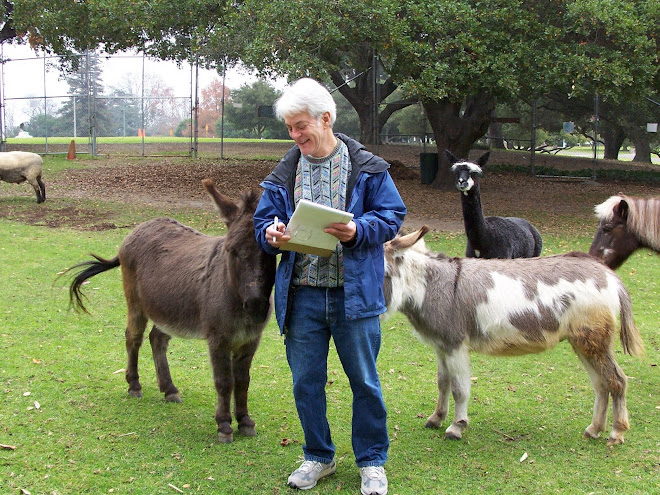
Interviewing the animals at Children's Fairyland in Oakland. L-R: Bobo the sheep, Gideon the miniature donkey, me, Tumbleweed Tommy the miniature donkey, Juan the alpaca, Coco the pony

Sunday, March 20, 2011

Teachers


The first was Mr. Shaver, my 8th Grade history teacher. He was the toughest teacher in the school, which, paradoxically, meant he was also the most popular. He expected only the best from us, and none of us wanted to disappoint him. So we surprised ourselves by doing better than we ever dreamed we could. Mr. Shaver died last year.
The next was Mrs. Helgesson, my high school English teacher. She managed to convince us that learning in general, and English literature in particular, were jolly good fun. It was a priceless lesson we have carried with us our whole lives. She died last year, too, a few months after Mr. Shaver.
I already told you a few weeks ago about Mr. Occhipinti, the history teacher who challenged us to write what he considered an "intelligent" book review of "Huckleberry Finn." I didn't take him up on it then, but how many times do you think I've written and re-written that report in my mind in the years since?
But my favorite was Mr. Rosemond, a history teacher who had just moved to California from Massachusetts. And I was his favorite student - or, at least, I was his favorite on the west coast. His favorite on the east coast was a kid named Randy Alfred whom he had taught in junior high back in Massachusetts.
As luck would have it, Randy and I ended up at the same college. So on the first day of freshman year, I marched up to him and handed him a letter of introduction from Mr. Rosemond. And we've been friends ever since.
Mr. Rosemond died shortly after Randy and I graduated from college. We still talk about him all the time. And we still miss him.
These are the people who made me who I am. They taught me lots of great stuff, but they did more: They nurtured and encouraged me every step of the way. And I'll bet you have a similar list.
A few years ago I worked part time as a substitute teacher in the West Contra Costa School District. I was gratified to find that there are still lot of Mr. Rosemonds and Mrs. Helgessons out there, trying their hardest to educate and nurture the next generation, despite the low pay and lousy working conditions.
And yet it seems to be open season on teachers these days. They're being blamed for everything that's wrong with our education system, when the truth is that they're the only thing that's right.
Yeah, yeah, I've heard the talk: They only work nine months out of the year, and they get off work at 3:15.
But let me tell you: Teaching is the hardest job I've ever done. There are no breaks, even for a second, because you have to pay constant attention to 30 different people. After nine months of this, you need a vacation just to catch your breath again.
And as far as getting off at 3:15, the workday actually goes on well into the night. Somebody has to grade all those exams, term papers and homework assignments, and make lesson plans for the next day.
Our teachers are the most valuable asset we have because without them, there is no next generation. It's time we started treating them as such.

Saturday, March 12, 2011

Human Wave


If you drive past the corner of Oregon Street and Martin Luther King Way in Berkeley on Tuesday, March 22, between 7:30 and 9:30 a.m., you'll see a bunch of people on the northeast corner waving and wishing you a good day. Some will be wearing orange construction workers' gloves. Several of your fellow drivers will be waving back.
They all - wavers and drivers alike - will be celebrating the 101st birthday of Joseph Charles, the late Berkeley Waving Man, who lived in the house on that corner.
For exactly 30 years - from Oct. 6, 1962 to Oct. 6, 1992 - he stood on his corner, rain or shine, and waved cheerfully to the passing cars. Instantly recognizable in his orange gloves, he would call out, "Keep smiling!" and "Have a GOOD day!"
On that first day, a few neighbors thought he was crazy and called the cops. But when the police arrived, they quickly sized up the situation and said, "Go ahead, Mr. Charles. You just keep on waving for as long as you want."
And people kept saying that to him for the rest of his life. Joseph Charles was to Berkeley what Sundar Shadi was to El Cerrito: He was our collective grandfather.
The Bible tells us to love our neighbors as we love ourselves, and that's exactly what he did. It might seem like a small thing, but he meant it literally when he wished us a good day. He loved us, and we loved him right back.
People would drive miles out of their way, just so they could start their day waving to the Waving Man. He brought a big smile to everyone's face.
Mayor after mayor issued proclamations in his honor no fewer than seven times. He was grand marshal of both the Solano Stroll and the How Berkeley Can You Be? parade.
Mr. Charles - that's what everyone called him - had quite an interesting life even before he started waving. He grew up in Louisiana and played ball in the Negro Leagues as a young man.
He faced Satchel Paige once when the great pitcher came through town on a barnstorming tour. He struck out on three straight pitches, but at least he made contact, which was better than anyone else did that day.
In 1942 he joined the great migration of African Americans from the deep South to the Bay Area, where he helped build Liberty ships at the Kaiser shipyards in Richmond.
After the war he worked as a stevedore at the Oakland Naval Supply Center until his retirement in 1962.
That's when he began his true calling, the one for which he will be remembered long after you and I are long forgotten.
He died in 2002, just a few days short of his 92nd birthday, and the whole city went into mourning. He was truly one of a kind.
If you can, I hope you'll drive by his old corner Tuesday morning and wave to the wavers. I'll be one of them.
And if you can't, feel free to stand on your own corner, wherever you are, and wave to your neighbors. Already, people have pledged to wave in Portland, Oregon; Silver Spring, Maryland; and Germany, as well as all over the Bay Area.
Until then, keep smiling. And have a GOOD day.

Monday, March 7, 2011

The Floating White House


Seventy-eight years ago, Franklin D. Roosevelt stood before the American people and told us the only thing we have to fear is fear itself - words we would do well to ponder today.
The pressures on FDR were almost unbearable, and he got away from it all by going fishing on his presidential yacht, the USS Potomac.
That's the official version. But I think he really did it to get away from Mrs. Nesbitt.
Henrietta Nesbitt was the White House cook; and her food was worse than inedible, it was disgusting.
"And the worst part was that the menu was always the same, week after week and year after year," says senior lead docent Bill Hodges, one of the hundreds of volunteers who are keeping the Potomac alive, more than 65 years after FDR's death.
"Monday was boiled tongue, Tuesday was boiled chicken and broccoli - and he really hated broccoli - Wednesday was overcooked roast beef, Thursday was sweetbreads - and he hated sweetbreads, too - and so on.
"But aboard the Potomac the Navy stewards would cook the fish he caught on a little hot plate, supplemented by fresh crabs that local fisherman would sell the president as their boats came alongside. Security was a lot less strict in those days."
No matter how many times he begged Eleanor to fire Mrs. Nesbitt, she never did. Historian Doris Kearns Goodwin says it was because Eleanor's idea of a good dinner was great conversation, not good food. Personally, I think it was payback for Lucy Mercer.
Eleanor rarely came aboard the Potomac - she was prone to seasickness - but FDR's Scottish terrier, Fala, was a frequent visitor.
"Fala was not popular with the crew because he refused to use the sandbox," says Hodges. "He'd relieve himself on the ship's mooring lines, instead."
After FDR's death in 1945 the Potomac was decommissioned and went through a succession of owners. The last one decided to junk her and turn her into scrap.
But at the last moment a rescuer stepped up - none other than Elvis Presley!
He bought the Potomac and donated her to St. Jude's Hospital. The ship's later adventures included being turned into a floating disco and being seized by the DEA for drug running.
She was finally bought at auction in 1981 by the Port of Oakland for only $15,000. Under the leadership of FDR's eldest son, James, the ship was restored as close as possible to the way she was in the days when FDR fished off the fantail.
Today, she's a floating museum docked at Jack London Square. Thousands of schoolchildren have visited her.
Alas, nobody foresaw this recession, and two years ago the Port of Oakland was forced to cancel its financial support. But the ship's operating expenses go on.
One day, the economy is going to bounce back. The only question is whether the Potomac can stay afloat until then. It would be a shame if she can't.
If you want to help, one way is to visit the ship. Go to www.usspotomac.org for a schedule of dockside tours, historical Bay cruises and special events.
Even better, you can become a member of the Friends of the Potomac. Go to the website or call 510-627-1215 for details.
Don't give up the ship.

Monday, February 28, 2011

A Man For All Seasons


On March 10, the Berkeley Symphony will play its final concert of the season at Cal Performances' Zellerbach Hall, featuring works by Stravinsky, Shostakovich and James MacMillan.
For me, the high point will be the world premiere of a solo piano piece called "Vendeval," composed and performed by Latin Grammy winner Gabriela Lena Frank, the Symphony's creative advisor.
The composition is in memory of the late Harry Weininger, who died last Memorial Day. It was commissioned by former KPIX anchor Linda Schacht, who bought the right to do so at last year's Symphony fundraising auction.
She first met him when they served together on the Symphony board.
"But my real appreciation of his role in our community grew through our common relationship to the public library," says Schacht, a board member of the Berkeley Public Library Foundation.
"For several years, Harry worked in a program at the North Branch called 'Lawyers in the Community.' He'd gone to law school at age 54 and, in typical Harry fashion, wanted to use his new skills in a generous way - by counseling anyone who came to the library needing legal advice."
More often than not, they'd arrive feeling angry and frustrated.
"Harry had a way of calming them with courtesy and respect," says librarian Debbie Carton. "He would listen with complete attention and empathy - but not sympathy, because that would have been condescending."
But I haven't even begun to hint at all the good things Harry Weininger did in his 76 years.
A partial list of worthy causes that benefited from his support includes the Berkeley Symphony, Berkeley Public Library Foundation, Berkeley Chamber of Commerce (which he served as president), Planned Parenthood Shasta-Diablo (board of trustees), Berkeley Rotary Club, Berkeley Civic Arts Commission, Berkeley Rep, and the Jewish Community Center and Jewish Family and Children's Services of the East Bay.
He even ran for city council once, with campaign posters designed by longtime friend David Lance Goines. He lost.
But his greatest role was that of peacemaker. For as long as I've lived in Berkeley - more than 40 years - the town has been bitterly divided between the Berkeley Democratic Club, aka "the liberals," and the even more liberal Berkeley Citizens' Action, aka "the progressives."
(In case you're curious: Yes, there are still Republicans in Berkeley, and I know both of them.)
It's hard to overstate the enmity these two groups used to feel for each other. As Harry once said, "While it was possible for Soviet and American officials to have dinner together during the Cold War, I'm not aware that the BDC president and the BCA chair have ever had lunch."
That began to change when he became BDC president in 1983, a role he held off and on (mostly on) until 1996. He was a man who was incapable of having enemies, and he numbered people on both sides of the political divide as his friends.
"He was able to talk to everybody, regardless of their political attitude," says Councilwoman Susan Wengraf. "And that made him an invaluable bridge builder."
He did it with humor, wisdom and, most importantly, by serving as a role model for how a civilized person treats those he disagrees with.
He may be gone, but we still have his example to live up to.

Tuesday, February 22, 2011

Man of the Millenium


This is a column I wrote in 2000. I'm reposting it in honor of Washington's birthday:

Making up "Top 10" lists or "Most Important" lists is fatuous beyond belief, but I'm no better than the next guy. As this millennium draws to a close, I've been thinking about who was the greatest person of the last 1,000 years.
And what an incredible cast of characters to choose from! Joan of Arc, William Shakespeare, Mahatma Gandhi, St. Francis of Assisi, Isaac Newton, Susan B. Anthony, Abraham Lincoln, Leonardo DaVinci, Martin Luther King and Wolfgang Amadeus Mozart, to name just a few.
But for me, the choice is easy. There's one person whom I honor and revere him above all other humans, and I'd give anything if I could be like him: motivated solely by unselfish feelings of love, duty and honor. His name: George Washington.
You might find this a curious choice, because Washington has become a remote figure, somehow more distant from us than even his contemporaries like Franklin and Jefferson. For most people, he's just the guy with the pursed lips, who stares at us from the dollar bill.
But it wasn't so long ago that Washington was a very, very big deal, indeed. The mere mention of his name would bring tears to grown men's eyes (as it still does to mine). And generations of little kids grew up idolizing him, the way today's kids idolize Michael Jordan.
Jefferson and Franklin and the other Founding Fathers idolized him, too. These giants, who were anything but modest about their own abilities, looked up to Washington as the greatest of them all.
Jefferson, who opposed many of Washington's policies, still called him "in every sense of the words, a good, wise and great man." Franklin called him "my friend, and the friend of Mankind." And Light Horse Harry Lee, the father of Robert E. Lee, called him "first in war, first in peace, first in the hearts of his countrymen."
They chose him to lead the army. They chose him to preside over the Constitutional convention. They chose him to be the first president. They called him "Father of the Country," even in his own lifetime. They even named our nation's capital after him.
Why? Well, there were plenty of reasons to look up to him. (Literally. At 6-foot-2, he towered over all of them except Jefferson.)
First was his undeniable natural leadership. Some people have it and some people don't, and Washington had it in spades. How do else you think he kept that bedraggled little army of his together and defeated the greatest superpower in the world?
It was also a question of character. To state it baldly, they knew he was a better person than they were. That story about the cherry tree may be bogus, but its underlying message about Washington's honesty was true enough.
Jefferson and Hamilton were habitual womanizers. (Jefferson even slept with his slaves, which is closer to rape than consensual sex.) Franklin was a vindictive father who went out of his way to make sure that his son, William, who stayed loyal to Britain, rotted in jail for the duration of the war.
Washington, on the other hand, was a loving, faithful husband to Martha and a doting father to her two children, Jackie and Patsy, and (after Jackie and Patsy's untimely deaths) to Martha's grandchildren, Nelly and Washy, whom he brought up as his own.
And while Jefferson and the others were having fun playing armchair general while living in comfort and safety back in Philadelphia, Washington was freezing and bleeding with the troops on the out in the field.
After the war, while others schemed and doublecrossed and generally acted like the politicians they were, he was guided by only two principles: the public good and his private honor.
He was even kind to animals. Cruelty of any sort disgusted him, and he adored his two favorite dogs, whom he named "Truelove" and "Sweetlips." (Try imagining that guy on the dollar bill down on his hands and knees, letting some dog slobber all over his face while he coos, "Is this my little Sweetlips?")
And on the most important moral issue of the day — slavery — Washington still looks good. Yes, he had slaves. (Although he didn't buy them; they came with Martha in her dowry.) Moreover, he — alone among his contemporaries — freed his slaves in his will. He also set up trust funds for them, so they wouldn't be left high and dry after he was gone.
Nowadays, you hear a lot of historians trying to justify some of the Founding Fathers' slaveholding by saying they didn't know any better. But it's not true. The hypocrisy was apparent, even at the time. In London, Samuel Johnson, on being told about the Declaration of Independence, quipped, "Isn't it odd that the loudest yelps for freedom come from the drivers of Negroes?"
Washington knew better, too. And, typically, he put his convictions into practice.
• • •
But the main reason why Franklin, Jefferson and the rest respected him was because were pleasantly flabbergasted when he didn't turn out to be a tyrant. (And they weren't the only ones. Even his old nemesis, George III, when told that Washington had voluntarily given up command of the army, gasped in disbelief, "Why, he must be the greatest man in the world!")
These men, on both sides on the Atlantic, knew from their reading of history how easy it is for someone to start out as a liberator but end up as a despot.
Think of it: Every other conqueror in history — Alexander, Caesar, Cromwell, Napoleon, Mao — started out with good intentions but eventually succumbed to the Dark Side of the Force. (Or, if you're a Tolkien fan, they were seduced by the Ring of Power.)
But not Washington. He alone refused.
The crisis came right after the war. The soldiers had been fighting and dying without pay for six long years, trusting Congress' promise that they'd get their money when it was all over. But in February, 1983, the Congress reneged on that promise.
The same thing had happened about a hundred years before, during the English Civil War. That time, the army responded by marching on London and throwing out the parliament. And England was under the heel of a military dictatorship for the next 20 years.
There were a lot of senior officers in the American army who wanted to do the same thing. They hatched a plan to march on the capital at Philadelphia, arrest the Congress, and install Washington as a military dictator, if he was willing. If he wasn't willing, they were prepared to seize the government anyway — over his dead body, if necessary. And they called a secret meeting to put the final touches of the plot.
But Washington got wind of the meeting, and he surprised them all by crashing it. He walked up to the podium and politely asked for permission to address the meeting, knowing that they couldn't deny their old commander-in-chief this small favor.
He started reading them a letter he'd just received, but he didn't get past more than a word or two before he suddenly stopped. He reached into his pocket and pulled out something they'd never ever seen wear before: a pair of eyeglasses.
"Gentlemen," he said, "please permit me to put on my spectacles, for I have not only grown gray in the service of my country, but also blind."
Then, without another word, he slowly walked out the door. Those hardened war veterans dissolved in tears. The coup d'etat was over before it began. And the United States did not become a banana republic.
• • •
Washington continued giving up power, over and over again, for the rest of his life. After being unanimously elected twice to the presidency (the only man to do so), he turned down a third term that could easily have been his, preferring to set a precedent by arranging a peaceful transition to his successor. Despite all the power that kept gravitating toward him, there was never a man who lusted after power less.
I never understood that until I visited his home, Mount Vernon, which is something I urge you to do, too.
When I was studying American history in school, I'd read about people coming up to him and saying, "George, please head the army" or "George, please run the Constitutional convention" or "George, please be our first president."
And he'd always reply something along the lines of "Gee, fellas, I really hate to leave Mount Vernon, But if you insist, well, OK." And I'd cynically say to myself, "Who does this guy think he's kidding?"
But the instant I laid eyes on Mount Vernon, I knew he wasn't kidding at all. Mount Vernon is the most gorgeous place on Earth. Every time I visit (and I visit as often as I can), I'm filled with a glorious combination of exhilaration and serenity. If I lived there, wild horses couldn't to drag me away.
And the beauty is that it reflects Washington's personality so perfectly, right down to the key to the Bastille that hangs in the hallway — a gift from the Marquis de Lafayette.
Mount Vernon is refined, but it's not fancy. Unlike Monticello, which looks like the aristocrat's house that it is, Mount Vernon is a simple farmer's house, albeit a very elegant one.
But as much as he loved Mount Vernon, Washington loved his country more. During the war, a British frigate sailed up the Potomac, threatening every home along the river with its big guns. At Monticello, Jefferson, who was governor of Virginia at the time, hastily sent the ship's captain a sizable bribe to spare Monticello.
Washington was up North at the time, but his caretaker sent a couple of barrels of whiskey to the ship's captain to induce him to spare Mount Vernon, too. When Washington heard about it, he was furious. "Better it should have been burned to the ground," he wrote, "than that any tribute should be paid to the tyrant!"
Washington died on Dec. 14, 1799, exactly 200 years ago this coming Tuesday. He'd caught a bad cold the day before, and he woke up in the middle of the night with difficulty breathing. Typically, he wouldn't let Martha get up and fetch the doctor, because he didn't want her to risk a chill getting out of bed.
The next day the doctor arrived and made matters worse. In those days, the main remedies were bleeding and enemas, both of which only served to further weaken the patient. He was slowly suffocating to death, and the doctors informed him that the end of near.
"'Tis well," said Washington. "I die hard, but I am not afraid to go." In a few minutes he was gone.
After his death, Mount Vernon gradually deteriorated over the next 70 or 80 years until it was reduced to a truly dilapidated state. But it was saved from ruin in the nick of time by women — namely, the Mount Vernon Ladies Association, which was founded shortly before the Civil War by a patriot named Anne Pamela Cunningham.
They bought Mount Vernon from Washington's heirs and set about restoring it. Today, it looks just the way it was when Washington lived there, including his granddaughter Nelly's harpsichord, which is in the same spot in the parlor where it was when she played for her doting "Grandpapa" every night after dinner. It's all subsidized by contributions from the public; not a penny of taxes goes into its upkeep.
Next week, Mount Vernon will observe the anniversary of the great man's death by recreating all the important events, including a full restaging of his funeral procession, complete with rituals of Washington's Masonic lodge. It may sound macabre, but how I wish I could be there!
• • •
We have much to be grateful to Washington for. But perhaps the most important is the example he set for the rest of us to live up to.
And we can do it, too. Washington was a human being, no different from you and me. He was no superhero or saint. What he did, we can do. All it takes is the will power.
Don't believe me? Here's exhibit A: another man, still living, who in all the important details could be Washington reincarnate.
He has the same dignified manner — the same, for want of a better word, leadership quality — as Washington.
He has the same dedication to freedom, the same lack of rancor toward former enemies, and the same ability to get his countrymen to forgo their petty concerns and focus on the greater good.
Like Washington, he is being called "Father of His Country" in his own lifetime. And like Washington, he is beloved not just in his own country, but all over the world.
Can you guess whom I'm talking about? Nelson Mandela, of course. Enjoy him while we're still lucky enough to have him among us.
And let's try to be like him, too.
Sunday, February 20, 2011

Reading For Fun


Once again, as they have every year for the past 13 years, students from Glenview Elementary School in Oakland are knocking on doors in the neighborhood, asking people to sponsor them in the annual Glenview Read-a-thon.
The kids pledge to read for at least 30 minutes every night, and the sponsors pledge to support them by donating to the Glenview PTA.
This year, the kids are trying to raise $30,000 to fill the gaps in the school's budget created by the latest round of cuts from Sacramento.
At risk are the school's enrichment programs - chorus, art, drama and physical education - as well as the school aides who help out in classrooms and at recess and lunchtime.
For the children's protection, there are two hard-and-fast rules: They must be accompanied by an adult they know personally, and they can knock only on doors of people they know personally.
As a reward for their efforts, the kids will be treated to a unique all-day party next Wednesday, March 2, which - by no coincidence at all - is Dr. Seuss's birthday. (He would have been 107.)
For that one day, they will be allowed to put aside their schoolwork and do nothing but read, read, read all day for sheer pleasure.
Smart, huh? By making reading a reward, the kids learn a lesson they will carry with them for the rest of their lives: Reading is fun!
And the kids take to it with a passion. Some of the younger ones come to school in their PJs, dragging their sleeping bags and teddy bears behind them.
Using chairs and blankets, they make forts in the middle of the classroom, climb in with their favorite books, and read to their heart's content. It's beyond cute.
Once again, teacher John Miller is offering his 2nd graders an added incentive: If they can raise $2,500 in pledges, he'll let them watch while his hair gets cut off.
There's never a cleanup problem afterward. The kids prize the shorn locks as souvenirs, and they scoop the hair up as soon as it hits the ground.
And once again, grownup celebrities - including KPIX anchor Wendy Tokuda, Oakland City Council President Ignacio de la Fuente, and local police and firefighters - will be on hand to read to the kids.
If you'd like to contribute to this very worthy cause, send a tax-deductible check to Glenview Elementary PTA, 4215 La Cresta Ave., Oakland CA 94602.
P.S. I'll be at the Read-a-thon, too, reading from one of my Freddy the Pig books, which I consider to be on a par with "Charlotte's Web" and "Stuart Little." And there's no higher recommendation than that.
Overlook Press has just issued paperback versions of three of my favorite Freddy books - "Freddy the Detective," "Freddy the Politician" and "Freddy and the Bean Home News," with the other 23 in this classic children's series soon to follow.
The Freddy books were written between 1927 and 1958 by Walter R. Brooks, whose other claim to fame is that he's the guy who invented Mr. Ed, the talking horse. If you know any kids in the 3rd, 4th or 5th grade, you couldn't ask for a better present to give them.

Monday, February 14, 2011

Sisters


September 1942 was an exciting time for Carol Hogerheide and Barbara Stuhr. They were starting first grade at Thousand Oaks Elementary School in Berkeley, and it didn't take long for them to become fast friends. (Mary Barnes joined them two years later.)
At the same time, Pam Maloy, Marilee Goodwin, Margie Snyder, Nancy Seavey and Eleanor Price were forming similar friendships at Oxford Elementary School, as were Gail Evans, Jane Simmons, Cathy Zitzer and Toni Sweet at Hillside Elementary School.
All three schools fed into Garfield Junior High, where the three groups of friends made friends with each other, along with girls from other elementary schools, including Ingrid Lund, Betsy Morphet, Carol Walker, Sheilah MacLeod, Joan McMurray, Jean Kwasnicki, Sara Boke, Zeva Shalmy and Marilyn Porter.
In 1951 they moved on to Berkeley High, where they were joined by Nancy Cupit, Jane Lonergan, Ann Bradshaw and Jane Mills, who had gone to Willard Junior High.
By the time they all graduated from Berkeley High they were as thick as thieves.
In elementary school there was a season for every game: a season for jacks, a season for jump rope, a season for hopscotch, and so on.
In junior high they ice-skated, roller-skated, rode their Flexi Flyers, took in the Saturday matinees at the Oaks Theater (ticket price: 25 cents), held slumber parties, and got into mischief such as sneaking into the Claremont Hotel and sliding down the spiral fire escape in back.
High school was a different story.
"The turning point was when we turned 16 and everyone got their drivers' licenses," said Toni. "That meant we could go up to the hills and smooch with our boyfriends."
There is considerable debate, even to this day, over what was the best parking spot. Some liked Cragmont Rock. Others preferred Inspiration Point. Still others swore by "The Flats" on Grizzly Peak Boulevard.
"It had to happen in cars in those days," said Gail. " And nothing much happened!"
They graduated from Berkeley High in 1954. Then life happened. There were marriages and divorces, births and deaths - including several of their own number. But they never completely lost contact.
"We used to stay in touch by word of mouth, but email has just made everything blossom," said Mary.
In 1996 they held a big reunion to celebrate their collective 60th birthday. And they've been holding reunions at irregular intervals ever since.
Last Saturday they gathered again in Berkeley. They call themselves BHS - short for Berkeley High School, but also "Big Hearted Sisters" - and sisters is exactly what they are.
"We're no longer little girls thinking about boys," said Marilyn. "Been there, done that. Some of us have buried our husbands. The real strength of this groups is the emotional connection, and the love and support we share."
They graciously invited me to join the party, and they treated me like their kid brother. More than one told me I was "adorable."
Then they kicked me out. The final item on the agenda was strictly private. At the end of each reunion they arrange their chairs in a circle and, as Amy March said in Little Women, "We bare our souls and tell the most appalling secrets."
It was fun being Laurie, if only for a day.