A columnist of heart and mind

A columnist of heart and mind
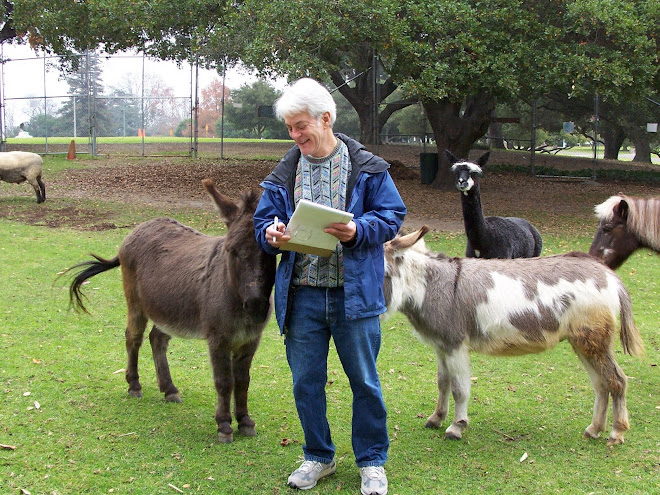
Interviewing the animals at Children's Fairyland in Oakland. L-R: Bobo the sheep, Gideon the miniature donkey, me, Tumbleweed Tommy the miniature donkey, Juan the alpaca, Coco the pony

Saturday, October 16, 2010

How To Get A Butterfly Drunk


It seemed as if everyone in Berkeley was celebrating last weekend's annual Homecoming at Cal - even the homeless people. On Saturday morning, I spotted a homeless man sitting on the curb at Bancroft and Telegraph, holding a hand-lettered cardboard sign that read, "Go Bears!"
Meanwhile, Sal Levinson, the UC Botanical Garden's "Caterpillar Lady," was leading a group of insect enthusiasts searching for drunken butterflies.
"Butterflies don't drink only nectar; they drink all kinds of stuff, including fruit that falls to the ground and starts fermenting," she explains. "And when that happens, they get tipsy and have problems flying."
You can see it for yourself in your own backyard.
"Just buy 10 pounds of grapes, take them home and stomp them," says Levinson, who calls caterpillars "the perfect pet."
"They're so cheap and so fascinating and so much fun. But the best part is that you never have to watch them die. You raise them, see the butterflies emerge, watch them fly away, and that's it. There are never any tears."
The Caterpillar Lady will lead her last butterfly walk of the season at the UC Botanical Garden on Oct. 26. For more information, visit berkeleybutterflyblog@blogspot.com/
Finally, I don't know what you're going to be doing on New Year's Day, but I know where Amit Pande of Dublin will be: He'll be riding an auto-rickshaw (basically, a rickshaw with a lawn mower motor) on a 3,000-mile trip across India to raise money and awareness to help solve the lack of access to clean water for millions of people in developing nations.
"More people in India have access to cell phones than have access to toilets," says Amit, who graduated from Cal last June.
Amit plans to stay off the beaten path and avoid the usual tourist destinations, camping out along the way or asking locals to put them up for the night.
"What would you rather tell your children? 'I took a tour bus to the Taj Mahal?' Or 'I remember the time my rickshaw broke down in the Thar Desert on our way to Mt. Abu, and we had to ride into the nearest town on our camel to get the parts to fix our vehicle?'"
The Rickshaw Run is hosted by a British adventure travel company called the Adventurists, whose philosophy is "fighting to make the world less boring." The goal is to raise money through online pledges for Frank Water, a charity that funds sustainable clean water projects in developing countries. Amit says more than 4,000 children die every day from water-borne diseases.
Each team is trying to raise $1,000 British pounds in pledges. If you'd like to contribute to Amit's team, visit www.bit.ly/dreamteamsupreme/
For Amit, whose parents grew up in India, this also will be a voyage of self-discovery.
"When I was a kid we used to go to India every two years, and I hated it - spending summer away from your friends, relatives pinching your cheeks, being covered with bug bites. having to eat Indian food.
"But now, as I continue to study and grow as a person, I feel an increasing pull to my roots. I want to see how my parents grew up and, more generally, I want to see how India is transforming into a global power and what this looks like for the rural population."

Monday, October 4, 2010

A Reporter Who Did His Job


(Above: Andrew Meacham)

I'm not in the habit of praising other newspapers; but something remarkable happened at the St. Petersburg (FL) Times last week, and I want to tell you about it.
On Sept. 12 a 48-year-old Tampa man named Neil Alan Smith was struck by a hit-and-run driver as he was bicycling home from his work as a dishwasher at an eatery called the Crab Shack. His head struck a metal light pole, and he never regained consciousness, dying six days later.
The Times ran a brief story about the accident, and that was that - or so they thought.
But then a reader posted a comment - anonymous, of course - on the paper's website that said, "A man who is working as a dishwasher at the Crab Shack at the age of 48 is surely better off dead."
That impelled a Times reporter named Andrew Meacham to go back and revisit the story to find out what kind of man was Neil Alan Smith, whose life and death had been dismissed so cavalierly.
The first thing Meacham found out is that a lot of people miss him, including his landlady, who told Meacham that once, when she was worried that the power company would shut off her electricity because she hadn't been able to pay the bill, he gave her more money than she had asked to borrow and insisted she take it. "I'll never forget that," she said.
His co-workers called him steady and dependable, a man who showed up every day, rain or shine, biking four miles each way from his trailer park to the Crab Shack. He worked there for ten years - a virtual lifetime in a business known for heavy turnover - for the $7.25 per hour minimum wage.
"I'll probably go through another 10 people to find somebody like him," his boss said.
A native New Englander, he was a huge fan of the Celtics, Patriots and, of course, the Red Sox.
Aside from one open container violation in 2007, he was never in any trouble with the law. When he was hit by the car he was following all the rules, including wearing a safety helmet, light-colored clothing and reflectors, and staying in the bike lane.
His landlady plans to take his ashes to Boston and scatter a few at Fenway Park. Then she'll go to New Hampshire and lay the rest on his parents' graves - if she can find them.
In short, Neil Smith was a human being. He loved and was loved by others. He had both joy and pain in his life, just like you and me.
I called Meacham and thanked him for writing that story. He said he's gotten a lot of calls like that from reporters and editors around the country.
I think it's because he struck a nerve with the rest of us. In an era when newspapers are becoming an endangered species, he reminded us how important they really are.
I've heard people say that if newspapers go away, there will be nobody to keep an eye on the politicians, corporations and special interests that run our lives. And it's true: We need more Woodwards and Bernsteins, not fewer.
But we also need more Andrew Meachams, to remind us of our common humanity. He has brought honor to my profession. I hope he wins the Pulitzer Prize.

Monday, September 27, 2010

Life Line


Congratulations to Terry Englehart, executive director of Senior Center Without Walls in Oakland, who was awarded a Jefferson Award for Public Service earlier this week.
I can't think of anyone more deserving. SCWW does more good for more people than any other organization I know.
As many aging Baby Boomers are discovering, getting old means aches and pains that often make it more and more difficult to leave your home. Your world shrinks down to your bedroom, and you get cut off from all the things you used to know and love.
That's where SCWW comes in. Even people who are homebound can still use the telephone. And that can be their gateway back to the wider world again.
Every week, SCWW offers dozens of different discussion groups, support groups and other telephone group activities, ranging from the silly to the serious. There are enough things going on to keep you busy from the moment you wake up in the morning to the moment you go to bed at night.
All you have to do is call in at the designated time and join the conversation. And get this: It's completely free!
So what's the catch? There isn't any. SCWW is sponsored by Episcopal Senior Communities as part of their non-denominational community outreach program, but you don't have to be Episcopalian to take part.
You don't have to live in Oakland, either. SCWW has active participants all over the Bay Area.
There isn't room here to list even a fraction of the many different discussion groups. But it's safe to say that whatever your interest, they probably have a group for it. Call toll-free 877-797-7299, and SCWW will mail you a complete schedule. Then sign up for the groups that interest you most, and you're off to the races.
As I said, there's no charge. But Englehart and her tiny, two-two person staff still have to pay for the conference calls. If you'd like to help, please mail a tax-deductible check to Senior Center Without Walls, 114 Montecito Street, Oakland CA 94610.
A few months ago, I had the honor of being the focus of one of the groups. I asked the participants, "What was the most memorable event of your life?"
"The feminist movement of the 1970s," said a woman named Lynn. "I had spent all my adult years fighting racial prejudice, and it finally dawned on me: When are women going to have our turn? I spent the next decade learning how to be a human being. Before that, I just learned to be a woman."
"It was 73 years ago, but I remember it as if it were yesterday," said Beatrice. "One of my neighbors was someone I called 'Uncle Larry,' and he was very good to me. He would take me to the candy store and buy me everything. One day I opened the newspaper, and a big headline said a member of Murder Incorporated had been gunned down. And there was a picture of Uncle Larry. I was only seven years old, and I was deeply touched."
But my favorite was Rosalee, who said, "It hasn't happened yet. I'm always looking forward to the next most wonderful thing. I've been in a wheelchair for 30 years, and I love this telephone community. I'm in love with you all."
And that's why we need Senior Center Without Walls.

Monday, September 20, 2010

Fighting The Good Fight


Oakland and the music community lost a giant when Irwin Silber died Sept. 8 from Alzheimer's. He was 84.
Perhaps more than any other person, Silber launched the folk music boom of the 1950s and early '60s. He was the editor of "Sing Out!" a folk singing magazine he founded with Pete Seeger and folklorist Alan Lomax. (Their office secretary was the future playwright Lorraine Hansberry, who wrote "A Raisin in the Sun.")
Under his guidance, "Sing Out!" became a lonely voice of opposition to the McCarthy witch hunts, which caused Silber to be hauled in front of the House Un-American Activities Committee and asked the ominous question, "Are you now or have you ever been a member of the Communist Party?"
In Silber's case, the answer was yes. He had joined the party in 1942, when the Soviet Union was known as "our gallant Russian ally" and everybody, including conservatives like Winston Churchill, called Stalin "Uncle Joe." He quit in the mid-50s, after Khruschev's "secret speech" in 1956 revealed that Uncle Joe was actually a cold-blooded mass murderer.
He didn't want to answer the question because it was none of the committee's business. Besides, he knew the next question would be a demand to sell out his friends.
But he didn't want to invoke the Fifth Amendment - his right against self-incrimination - because he didn't think he had done anything wrong. What was so bad about that fighting for civil rights, social justice and peace? So he refused under his First Amendment right to free speech, instead.
Undaunted, the committee chairman tried to get the answer another way: "Did you ever teach at the Jefferson School?" (a Marxist academy in Manhattan)
"Yes."
"Aha!" said the chairman, zeroing in for the kill. "And what did you teach?"
"Square dancing," Silber replied.
The room exploded in laughter, and that was the end of that.
That's just one chapter in the life of this remarkable man, who produced the first hootenannys at Town Hall and Carnegie Hall, featuring blacklisted artists like Josh White, Sonny Terry, Brownie McGhee and Leadbelly.
"Leadbelly always dressed impeccably, onstage and off, wearing the spiffiest suits and carrying himself with great dignity," he told me. "It was his reaction against Alan Lomax's trying to dress him in overalls or prison stripes when he performed."
Every summer, Silber played softball with Paul Robeson at a Marxist summer camp in New Jersey called Camp Wochica (short for Workers' Children's Camp).
Robeson wrote the forword to Silber's first book, "Lift Every Voice." John Steinbeck wrote the forword to a later book, "Hard-Hitting Songs for Hard-Hit People." The title was suggested by Woody Guthrie.
He wrote 10 other books, including "Socialism: What Went Wrong?" "A Patient's Guide to Knee and Hip Replacement" and "Press Box Red," the story of Lester Rodney, a Daily Worker sports reporter who pioneered the campaign to integrate the major leagues.
For the last 30 years he lived in Oakland with his wife, jazz singer Barbara Dane. Appropriately, they fell in love on a May Day.
And he had no regrets - except one. In his later years, he regretted writing a scathing editorial in 1965 that ripped Bob Dylan for going electric.
Dylan responded by writing "Positively Fourth Street," which begins with the words "You've got a lot of nerve."

Monday, September 13, 2010

Back To School


(Above: Sather Gate at noontime)

I was walking across the Cal Campus last Friday past the informational tables on Sproul Plaza representing everything from Young Socialist Alliance to Campus Crusade for Christ.
Right next to Sather Gate, an undergraduate a capella singing group was belting out sweet-sounding four-part harmonies.
And I couldn't help thinking, "How thrilling all this must be for the new freshmen!'"
The next day I was on campus again, just as the crowd was filtering out of Memorial Stadium after the football game against Colorado. (Cal won in a laugher, 52-7.) I ran into a group of Colorado students who were freaking out at the names of the campus buildings.
"Look at that!" one guy exclaimed in disbelief. "Cesar Chavez Student Center! Martin Luther King Jr. Student Union! How long has this been going on?"
"A long time," I said.
"But why?" they asked.
"This is Berkeley," I explained.
I didn't have the heart to point out the Free Speech Movement Café; I figured their minds had been blown enough for one day. But it reminded me once again what a special place Cal is - unlike any other in the world.
Speaking of special schools, many happy returns to the College Preparatory School in Oakland, which will celebrate its 50th birthday with an all-day party on Sept. 25.
College Prep lives up to its name: 100 percent of its graduates go on to four-year colleges. But more impressive than the numbers is the way they do it.
"I think the seriousness with which I was taken as a human being at College Prep made me expect to be treated seriously in college," says one recent grad. "I dealt with my professors as fellow adults, and it worked out really well."
College Prep was founded in 1960 by Mary Harley Jenks and her partner, Ruth Willis.
Jenks had been a philosophy major at Cal, but she was told that "no respectable university would hire a woman in philosophy." So she became an educator, instead.
The school was founded on the principle of "egalitarian modesty," meaning that they wanted the kids to be highly motivated but not elitist.
They started with five teachers and 35 students, plus a housekeeper named Rosie who made tuna fish sandwiches (heavy on the mayo, as everyone recalls) for the entire staff - starting an enduring tradition.
"To this day, we do not have a food program for the kids, but we feed the faculty every day," says Murray Cohen, the Head of School. "But not tuna fish sandwiches, though."
Today, College Prep has 52 teachers 350 students. The average class has only 13.5 students.
Perhaps the most important event in the school's history was something that didn't happen: In the mid-'70s College Prep was offered some prime property in affluent Lafayette. But in the end, they decided to stay in Oakland.
"It would have changed the nature of the school and made our principle of egalitarian modesty very difficult to sustain," Cohen explains.
Jenks chose the name "College Preparatory School" because she wanted to be clear about the school's mission, but Cohen admits that he and his colleagues have mixed feelings about it.
"It sounds like we're a preparation for something else, rather than an appreciation for what we have," he says. "We think of ourselves as a participatory school, not preparatory."

Saturday, September 11, 2010

Bullish on the Bears


(Above: Roy Riegels on his infamous wrong-way run that lost the 1929 Rose Bowl)

Berkeley has a long tradition of town-gown conflict, but next weekend the university and the city will get together to celebrate something everyone can agree on: the glorious history of Cal sports.
It's a new exhibit at the Berkeley Historical Society called "Golden Bear Pioneers: UC Sports & Athletic Traditions from Their Beginnings to 1945," and what treasures they have! Among them:
* A patch from the jersey worn by Cal running back Loren Hunt in the first Big Game in 1892. (Herbert Hoover was the Stanford team manager.)
* A football-shaped program from the fourth Big Game, featuring long (and, apparently, necessary) articles explaining how the game is played. They also have the program from the 1929 Rose Bowl, which Cal lost 8-7 because of Roy Riegels' wrong-way run.
* Lapel buttons reading, "I'm a stadium builder," which were given to contributors to the Memorial Stadium building fund in 1923. For a $100 donation, you got free Big Game tickets for five years, plus an option to buy tickets for the next five years.
* Action photos of tennis greats Helen Wills Moody and Helen Jacobs, football All-American and track star Brick Muller and the Olympic gold medal-winning 1932 Cal crew, shown at their moment of triumph as they edged out the boat from Italy at the finish line.
But my favorite photo is of Bill Rockwell, the original Oski, shown walking along the crossbar of the goal post (no kidding!) at Memorial Stadium on Sept. 26, 1941, when he appeared for the first time in the now-familiar letter sweater, baggy pants and oversized shoes.
Alas, he had so much fun being Oski, his grades quickly went south. At the end of the semester the Japanese attacked Pearl Harbor; so he dropped out of school, joined the Navy and won many medals as a fighter pilot. After the war he went back to Cal and got his degree in 1948.
The word "fan" comes from "fanatic," and that's what the curators of this exhibit, Keith Tower and Bart White, are. Tower, who attended Cal in the mid-70s, has been lovingly collecting Golden Bear memorabilia since he was a kid.
White, who graduated in 1995, didn't get the bug until he was an undergrad, but he's been making up for lost time. Taken together, their collections constitute the second-largest compilation of Cal sports stuff in the world, second only to the Bancroft Library.
"It's a very expensive hobby," White sighed. "And it's getting more expensive all the time, thanks to eBay."
I visited him while he was sorting through his treasures. The boxes and piles spilled out of his living room into the kitchen and hallway.
"We have an agreement that the stuff stays down in the basement and we get to live up here," said his wife, Michelle. "But, as you can see, this is not always true."
But she's a good sport about it, perhaps because she was a history major at Cal, so she understands the attraction of historical artifacts.
The exhibit will open Sept. 18 and run through March 26. It's on the first floor of the historic Veteran's Memorial Building, 1931 Center Street, and is open Thursdays, Fridays and Saturdays from 1 to 4 p.m. Call 510-848-0181 for more information.
Go Bears!

Thursday, September 2, 2010

Garden of Earthly Delights


(Above: Amprphophallus Titanum, aka the Giant Stinky Plant)

Is the cool weather we've been having this summer getting you down? That's nothing compared to how it's affecting the plants at the UC Berkeley Botanical Garden.
"It's delayed all kinds of plant activity - when they sprout, when they start producing leaves and flowers, when they bloom and when they set fruit," says Director Paul Licht.
"We have two Palo Verde trees at our entrance. Usually, they're covered with beautiful yellow flowers; but this year they've barely set buds. I don't think they'll bloom this season at all."
The geophytes - including tulips and gladiolas - are also suffering.
"We're afraid they're going to lose their bulbs. Every year, they have to grow their green foliage, which supplies food to make the bulb grow large. If it isn't hot enough, they miss a season of growth and use up a lot of energy from the bulb that hasn't been replenished. They feel miserable."
But there's an upside, too, especially for visitors: A lot of plants that usually are dormant in the summer are staying in bloom much longer than they normally would. So it you were ever going to visit the Botanical Garden, now's the time.
Licht gave me a tour last week, and I have to tell you: I was absolutely fascinated. The place is like Disneyland for plant lovers. And it doesn't take you long to become one.
I know nothing about plants. In fact, neither did Licht before he took this job. He had just retired from a distinguished career as a zoologist when the university called and asked him to come out of retirement and take over the Botanical Garden. And, like me, he got hooked.
The garden has more than 10,000 different species of plants, and 1,300 of them have been officially declared endangered species.
"The number is probably twice that amount because they're so rare, we don't even know if they're endangered or not," says Licht. "Some are so poorly known that we may have some species that haven't been described yet."
One new acquisition is a previously unknown orchid that was collected in the Dominican Republic by a local researcher named Donald D. Dodd, who left it to the Botanical Garden when he died.
They've named it after him: Orthinidium Donalddeedoddii.
The plants come from all over the world, including Amprphophallus Titanium - aka the Giant Stinky Plant - which comes from Sumatra. But some of the garden's rarest acquisitions come from a lot closer to home, such as the Mount Diablo buckwheat, which was thought to have gone extinct in 1936.
Just like a work of art, each plant has its own provenance. And a plant that has grown in the wild is much more valuable than a plant that has been hybridized or cultivated in a nursery.
The Botanical Garden only collects plants that were grown in the wild, which makes it an invaluable resource not only for other botanical gardens but also for us, the public.
Twice a year, the Botanical Garden has a public sale, where you can buy seedlings of some of its rarest plants, including the Giant Stinky Plant.
The next sale will be Sept. 26. But I wouldn't wait until then to check out this amazing garden, which boasts plants from every continent except Antarctica.
"And as soon as it melts, we'll probably get some from there, too," says Licht.