A columnist of heart and mind

A columnist of heart and mind
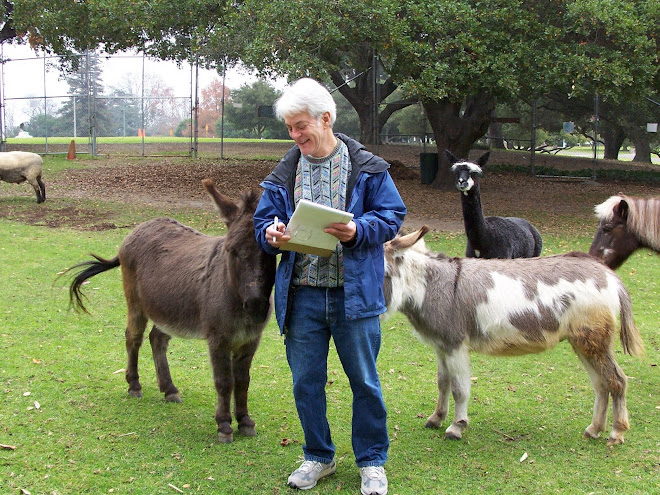
Interviewing the animals at Children's Fairyland in Oakland. L-R: Bobo the sheep, Gideon the miniature donkey, me, Tumbleweed Tommy the miniature donkey, Juan the alpaca, Coco the pony

Saturday, September 11, 2010

Bullish on the Bears


(Above: Roy Riegels on his infamous wrong-way run that lost the 1929 Rose Bowl)

Berkeley has a long tradition of town-gown conflict, but next weekend the university and the city will get together to celebrate something everyone can agree on: the glorious history of Cal sports.
It's a new exhibit at the Berkeley Historical Society called "Golden Bear Pioneers: UC Sports & Athletic Traditions from Their Beginnings to 1945," and what treasures they have! Among them:
* A patch from the jersey worn by Cal running back Loren Hunt in the first Big Game in 1892. (Herbert Hoover was the Stanford team manager.)
* A football-shaped program from the fourth Big Game, featuring long (and, apparently, necessary) articles explaining how the game is played. They also have the program from the 1929 Rose Bowl, which Cal lost 8-7 because of Roy Riegels' wrong-way run.
* Lapel buttons reading, "I'm a stadium builder," which were given to contributors to the Memorial Stadium building fund in 1923. For a $100 donation, you got free Big Game tickets for five years, plus an option to buy tickets for the next five years.
* Action photos of tennis greats Helen Wills Moody and Helen Jacobs, football All-American and track star Brick Muller and the Olympic gold medal-winning 1932 Cal crew, shown at their moment of triumph as they edged out the boat from Italy at the finish line.
But my favorite photo is of Bill Rockwell, the original Oski, shown walking along the crossbar of the goal post (no kidding!) at Memorial Stadium on Sept. 26, 1941, when he appeared for the first time in the now-familiar letter sweater, baggy pants and oversized shoes.
Alas, he had so much fun being Oski, his grades quickly went south. At the end of the semester the Japanese attacked Pearl Harbor; so he dropped out of school, joined the Navy and won many medals as a fighter pilot. After the war he went back to Cal and got his degree in 1948.
The word "fan" comes from "fanatic," and that's what the curators of this exhibit, Keith Tower and Bart White, are. Tower, who attended Cal in the mid-70s, has been lovingly collecting Golden Bear memorabilia since he was a kid.
White, who graduated in 1995, didn't get the bug until he was an undergrad, but he's been making up for lost time. Taken together, their collections constitute the second-largest compilation of Cal sports stuff in the world, second only to the Bancroft Library.
"It's a very expensive hobby," White sighed. "And it's getting more expensive all the time, thanks to eBay."
I visited him while he was sorting through his treasures. The boxes and piles spilled out of his living room into the kitchen and hallway.
"We have an agreement that the stuff stays down in the basement and we get to live up here," said his wife, Michelle. "But, as you can see, this is not always true."
But she's a good sport about it, perhaps because she was a history major at Cal, so she understands the attraction of historical artifacts.
The exhibit will open Sept. 18 and run through March 26. It's on the first floor of the historic Veteran's Memorial Building, 1931 Center Street, and is open Thursdays, Fridays and Saturdays from 1 to 4 p.m. Call 510-848-0181 for more information.
Go Bears!

Thursday, September 2, 2010

Garden of Earthly Delights


(Above: Amprphophallus Titanum, aka the Giant Stinky Plant)

Is the cool weather we've been having this summer getting you down? That's nothing compared to how it's affecting the plants at the UC Berkeley Botanical Garden.
"It's delayed all kinds of plant activity - when they sprout, when they start producing leaves and flowers, when they bloom and when they set fruit," says Director Paul Licht.
"We have two Palo Verde trees at our entrance. Usually, they're covered with beautiful yellow flowers; but this year they've barely set buds. I don't think they'll bloom this season at all."
The geophytes - including tulips and gladiolas - are also suffering.
"We're afraid they're going to lose their bulbs. Every year, they have to grow their green foliage, which supplies food to make the bulb grow large. If it isn't hot enough, they miss a season of growth and use up a lot of energy from the bulb that hasn't been replenished. They feel miserable."
But there's an upside, too, especially for visitors: A lot of plants that usually are dormant in the summer are staying in bloom much longer than they normally would. So it you were ever going to visit the Botanical Garden, now's the time.
Licht gave me a tour last week, and I have to tell you: I was absolutely fascinated. The place is like Disneyland for plant lovers. And it doesn't take you long to become one.
I know nothing about plants. In fact, neither did Licht before he took this job. He had just retired from a distinguished career as a zoologist when the university called and asked him to come out of retirement and take over the Botanical Garden. And, like me, he got hooked.
The garden has more than 10,000 different species of plants, and 1,300 of them have been officially declared endangered species.
"The number is probably twice that amount because they're so rare, we don't even know if they're endangered or not," says Licht. "Some are so poorly known that we may have some species that haven't been described yet."
One new acquisition is a previously unknown orchid that was collected in the Dominican Republic by a local researcher named Donald D. Dodd, who left it to the Botanical Garden when he died.
They've named it after him: Orthinidium Donalddeedoddii.
The plants come from all over the world, including Amprphophallus Titanium - aka the Giant Stinky Plant - which comes from Sumatra. But some of the garden's rarest acquisitions come from a lot closer to home, such as the Mount Diablo buckwheat, which was thought to have gone extinct in 1936.
Just like a work of art, each plant has its own provenance. And a plant that has grown in the wild is much more valuable than a plant that has been hybridized or cultivated in a nursery.
The Botanical Garden only collects plants that were grown in the wild, which makes it an invaluable resource not only for other botanical gardens but also for us, the public.
Twice a year, the Botanical Garden has a public sale, where you can buy seedlings of some of its rarest plants, including the Giant Stinky Plant.
The next sale will be Sept. 26. But I wouldn't wait until then to check out this amazing garden, which boasts plants from every continent except Antarctica.
"And as soon as it melts, we'll probably get some from there, too," says Licht.

Monday, August 23, 2010

Two Good Guys


(Above: Mac. Below: Cliff)

First, a pair of sad farewells to two old friends and colleagues - Cliff Pletschet, who died August 8 at age 80, and Dave McElhatton, who died on Monday at age 81.
Cliff, who was born in Saskatchewan, was the longtime business editor and financial columnist for the Oakland Tribune, and a finer gentleman never lived. He was very, very good at what he did, and he never had an unkind word for anyone.
Mac, who was born and raised in Oakland, was the morning drive anchor at KCBC, in tandem with his good friend, Al Hart. Together, they made the show the most popular one in the Bay Area for 25 years.
Then he moved to KPIX, where he worked with Wendy Tokuda and Kate Kelly. And together, they made that show the most popular one in the Bay Area for the next 25 years.
The secret of Mac's success was that he was a great storyteller. It was like listening to the guy sitting next to you at a bar telling you what went down that day.
And the secret of Cliff's success was that he didn't tell his readers how to invest their money; he educated them so they could make wise investment decisions on their own.
They were successful both as journalists and as human beings, and I miss them both already.
On a happier note, here's wishing a happy retirement to Monica Clark, who will step down at the end of the year as editor of the Catholic Voice, the official publication of the Diocese of Oakland (which includes both Alameda and Contra Costa counties).
Under her guidance, the paper has been catholic as well as Catholic, which is no easy task in a diocese that ranges from ultra-liberals in Berkeley and Oakland to ultra-conservatives in Concord and Danville.
No matter how contentious the issue - whether it's abortion or priestly sexual abuse - she always manages to include all sides. As a result, the Catholic Voice, especially its letters-to-the-editor page, has been one of the liveliest reads around.
Anyway, good luck, Monica. You have fought the good fight, you have finished the race, you have kept the faith.
Meanwhile, Poulet, the upscale Berkeley deli specializing in (what else?) chickens, is coping with the recession by luring customers with a new gimmick: membership in the "Frequent Fryers Club." The deal: Buy 10 chickens, get one free. And the first winner is Poulet's most loyal customer, Ivan Skolnikoff., who always orders lemon-garlic.
Finally, my apologies to Berkeley Animal Services (aka the city shelter) especially its director, Kate O'Connor.
When I wrote about the disastrous fire that gutted the Berkeley Humane Society's shelter last spring, I said the city shelter doesn't have the time to be a full-time adoption agency. But I didn't mean to imply that O'Connor and her staff don't try their best to find new homes for their animals.
But with all their other responsibilities - including rounding up strays, busting dog-fighting rings, etc. - they need help.
That's where the Humane Society comes in. The two agencies - one private, one public - work hand-in-hand.
And the partnership works both ways. After the fire, the city shelter offered its time and space to house the Humane Society's animals who were evicted by the fire.
Hope I cleared that up.

Monday, August 16, 2010

Remembering the "Good War"


(Above: the USS Hornet, now docked at Alameda, California)

This weekend is the 65th anniversary of V-J Day, the end of World War II.
It's called "The Good War," which is a bitter irony because it was the most horrible war in history. Deaths were estimated at anywhere from 60 million to 100 million. And the overwhelming majority were civilians.So why do we call it The Good War? Because it's one of the few wars in history that, even in hindsight, absolutely had to be fought.
It has been perceived as a case of good vs. evil but even the "good guys" had some skeletons in their closets. The Soviet Union was a brutal dictatorship, Britain had a colonial empire and, after the attack on Pearl Harbor, we imprisoned more than 100,000 of our fellow citizens behind barbed wire because of their ancestry.
But that just shows how truly evil Hitler really was -- he made a monster like Stalin look good by comparison.
As Churchill said when he heard Hitler had invaded Russia: "If Hitler were to invade hell, I would find something favorable to say about the devil the next day in the House of Commons."
The real good guys of World War II, of course, were the men and women who won it, both over there and here at home.
To call them "The Greatest Generation" doesn't even begin to describe the debt we owe them. Hitler predicted his Reich would last a thousand years, and were it not for the heroes who defeated him, it very easily could have happened.
But oh, how they suffered to give us this priceless gift of freedom.
Try to imagine yourself on a B-17 bombing raid over Germany without any fighter planes to protect you from the German fighters, who would attack you all the way to the target and all the way back home.
Or in a foxhole in the Voges mountains of Alsace as German 88 shells shattered the treetops overhead, sending millions of jagged splinters raining down on you.
Or on a Liberty ship in the North Atlantic, a helpless sitting duck for the U-boat wolf packs roaming at will through your convoy. Imagine knowing that if your ship was sunk, the convoy was under strict orders not to stop and pick up survivors.
Imagine yourself on a flattop in the South Pacific, fighting off attacks from kamikazes.
Or as a Marine on Okinawa, waiting for the next Banzai charge from an enemy so tenacious that even even the civilians were killing themselves rather than surrender.
"You assumed you weren't going to make it," says Dr. Gordon Binder of San Francisco, an army field surgeon operating just a few hundred yards behind the front line. "You knew you were going to get killed. It was just a question of when."
Finally, imagine yourself as a Rosie the Riveter at the Kaiser shipyards in Richmond, exhausted after another hard day's work but a little reluctant to go home because a telegram might be waiting for you from the War Department beginning with the words "We regret to inform you "..."
They don't think of themselves as heroes because in their eyes, the real heroes are the guys -- and gals, too -- who never came back.
And they're right, of course. But while we still have some of them with us, let's tell them that in our eyes, they are heroes, too.
Bless them all.

Thumbs Up For A Gentle Man


It was with mixed emotions that I watched the final program of "At The Movies," which ended its television run on Sunday after 45 years.
I couldn't help thinking, "I wish Gene Siskel were still here."
Gene was one of the guys who founded the show, and he was my friend. (We were in the same class in college.)
In 1975 he was the film critic for the Chicago Tribune, and a producer at the local PBS station named Thea Flaum got the brilliant idea of pairing him with his rival critic from the Chicago Sun-Times, Roger Ebert. For a half hour each week, they'd argue about the movies and give each film a thumbs up or thumbs down.
The show was an instant hit, and no wonder: Gene and Roger were the original odd couple.
I'm hopelessly biased, but I think Gene usually got the better of the argument. He championed films that appealed to the mind and heart, and occasionally other parts of the body.
The most honest review I've ever heard anyone give is the thumb's up he gave to the soft-core French film, "Emmanuelle."
Instead of tiptoeing around the truth by talking about the cinematography or lighting, he looked into the camera, shrugged his shoulders and said sheepishly, "What can I say? It turned me on."
For me, the most memorable review is the one he gave to another French film, "Rififi," which depicts a jewel robbery, moment by moment. He said the reason it's so exciting is that we love to see the behind-the-scenes details of how people in exotic professions do their jobs. And what profession could be more exotic than jewel robber?
It's a lesson I've applied to everything I write. Whenever I interview someone, I always ask them to describe the details of how they do what they do. Thank you, Gene.
I'd run into him whenever he and Roger came into town on a promotional tour, and what most impressed me is that he never thought of himself as The Famous Gene Siskel.
He treated everyone, down to the go-fer who brought him a cup of coffee, with complete respect. He was a true gentleman, and you don't find that very often, especially among celebrities.
Gene died from a brain tumor in 1999, and Roger carried on with a succession of co-hosts until he, too, got sick and had to retire in 2008. For the last few years the show has been hosted by a series of critics who are very good, but not in Gene's league.
At our 25th college reunion, Gene passed on some precious wisdom he received from the master of his residential college, novelist John Hersey, and I'm passing it on to you:
"1. Don't do anything for money. In America if you do anything well, money will follow - if you want it."
"2. Have more than one career. Don't be trapped into working for one company or in one profession for your entire life."
"3. Don't view life as a test on which you can get a perfect score. Life is problems. Therefore, don't be unhappy when you're unhappy. Strive for and appreciate moments of serenity, a much more reasonable goal."
P.S. The last movie Gene reviewed was a romantic comedy called "Simply Irresistible." He gave it a thumbs down.

Monday, August 2, 2010

25 Years of Yum!


From the moment Lalime's opened 25 years ago, it shot to the top tier of Berkeley restaurants, which is really saying something considering that Berkeley is a town where people take their food as seriously as they take their politics.
Its loyal patrons come from all over the Bay Area, and its popularity has spread even farther as Cal professors on sabbatical at other colleges spread the word.
(There's a sign on the bulletin board in the faculty dining room at MIT saying, "When you're in Berkeley, be sure to eat at Lalime's." Ditto for the Los Alamos National Laboratory in New Mexico.)
I hadn't been there in a while, so when Lalime's held a 25th birthday party a couple of weeks ago I went to see if it was as good as I remembered.
Answer: No, it wasn't. It was better.
But don't take my word for it. Ask KCBS food maven Narsai David, who regularly dines there with his wife, Venus.
"We love Lalime's because of the wonderfully mellow environment and the friendly attitude of the staff," he told me. "But, of course, the most important thing is the creative presentation of the best contemporary cuisine."
But Lalime's has always had another role: as a local hangout for the folks who live in Berkeley's Westbrae neighborhood.
"There's this great big picture window, and as you walk by you can see the people dining there," said Marshall Platt, who lives down the street. "And when I dine there, I can see the people walking by. It's part of the fabric of Northwest Berkeley. Plus, it's very affordable, especially for what it is."
So how do owners Haig and Cindy Krikorian - Lalime is Cindy's maiden name - manage to juggle these dual roles?
"The answer is that we don't feel like a Top 10 restaurant, and we never have," said Cindy. "We just want to serve good food to our friends."
It all starts with local food, seasonally produced. That's a staple of California cuisine, but Haig learned this long before it became fashionable, when he was growing up in Lebanon.
"The Bay Area gives you so many food choices, it would be incredibly stupid not to take advantage of that," he said. "If the tomatoes aren't good that day, you don't serve a dish that requires tomatoes."
But the person who really set the standard was Haig's mother, Nevart. Almost up until the day she died last year at 87, she was the restaurant's official napkin folder - she didn't trust anyone else do it precisely enough - garlic peeler and produce buyer.
"She was totally in charge," said general manager Michael Hutchings as his baby daughter, Eloise, played underfoot. "She was like a second mother to me. I called her Nene, which is Armenian for 'grandmother.'"
Eloise is the latest in a long line of employees' children who have grown up at Lalime's, as have Haig and Cindy's own kids.
The extended family also includes patrons such as Chester Zinn, whose regular table, Table 18, has a silver plaque to commemorate his 100th birthday, Raider great Raymond Chester, and the physics department at Cal, who named a new scientific theory "Lalime's Theory."
"Haig has finally found a way to entertain all his friends," said Richard Mazzera, owner of Cesar's restaurant. "And he doesn't have to do the dishes!"

Monday, July 26, 2010

Pillar of the community


(l-r: George Jr., Kristina, George Sr., Sonja)

I was walking down Webster Street in downtown Oakland a few months ago with George Vukasin, the president of Peerless Coffee. He's a second-generation American; his parents came here from Yugoslavia.
He pointed to the Chinese, Vietnamese and Cambodian restaurants on the street and said, "When I was a kid they all used to be Yugoslavian restaurants. Same people, different faces."
That tells you pretty much everything you need to know about him. He's never forgotten where he came from, and he doesn't think he's better than the people who came after him.
Vukasin, who is known to everyone at Peerless as "George Sr.," took over the business in 1975 from his father, John Vukasin (aka "Mr. V."), who founded the business in 1924.
Last week he announced that he and his wife, Sonja, are turning over the reins to their children, George Jr. and Kristina.
George Jr. will supervise the coffee end of the business, and Kristina, a former Alameda County deputy district attorney, will handle the finances and legal stuff.
It's an old family tradition: Mr. V did the coffee roasting and his wife, Natalie (aka "Mrs. V"), kept the books. Then George Sr. ran the coffee side and Sonja ran the business side.
"We didn't plan it," Kristina laughs. "It's just worked out that way."
Full disclosure: There are very few people in this world whom I admire as much as George Sr. If he had done nothing else but give good value to his customers and treat his employees like human beings, that would have been enough. But he did so much more.
As longtime president of the Pacific Coast Coffee Association and chairman of the National Coffee Association, he worked tirelessly with farmers in Colombia to make it economically profitable for them to grow coffee instead of coca, which is the basic ingredient of cocaine.
For this he received the prestigious Manuel Mejia Award - named after the father of the Colombian coffee industry - from the Colombian government and death threats from the drug lords.
He also convinced the growers to treat their own workers more decently, such as supplying free meals during working hours and free childcare for their children.
His method is as simple as it is effective: The better they treat their workers, the more he pays them for their coffee beans.
He also was president of the Oakland-Alameda County Coliseum Commission back in the good old days, when the Coliseum was one of the most charming of the '60s "cookie cutter" stadiums instead of the dump it has become today.
It was only last week that I was quoting some longtime Raider fans who said the team's return in 1995 turned out to be an anti-climax. They complained that the Coliseum had been taken over by what they called "the thug element."
It was a different crowd in the Vukasin era, believe me. And we have that to thank him for, too.
He and Sonja are leaving some mighty big shoes for George Jr. and Kristina to fill, but I have no doubt they're more than up to it.
"What we learned most from our parents wasn't so much how to run a business," says Kristina. "It was about character and treating people the right way."
See what I mean?