A columnist of heart and mind

A columnist of heart and mind
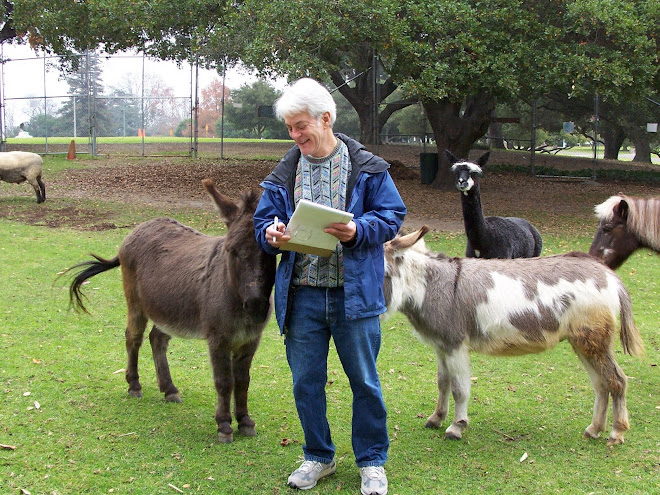
Interviewing the animals at Children's Fairyland in Oakland. L-R: Bobo the sheep, Gideon the miniature donkey, me, Tumbleweed Tommy the miniature donkey, Juan the alpaca, Coco the pony

Tuesday, July 6, 2010

Musical Miracle


Every year at this time I tell you about the Midsummer Mozart Festival, for two reasons:
First, there's nothing like Mozart. His music is so beautiful, it warms your heart and soul.
And second, if you want to hear Mozart you can't do better than the Midsummer Mozart Festival. The musicians are some of the finest in the world, let alone the Bay Area.
But this year there's an added reason: The festival will showcase 14-year-old piano sensation Audrey Vardanega, a student at College Prep in Oakland.
I saw Audrey perform last year, playing the same piece she'll play at the festival - Mozart's exhilarating Piano Concerto No. 21 in C.
It reminded me of Ken Burns' "Jazz" series on PBS, when trumpeter Wynton Marsalis said about Count Basie, "When Basie sat down to play, he'd be swinging before he played the first note."
That's Audrey, too. Her solo didn't come until about seven or eight minutes into the concerto; but instead of sitting around waiting for her turn, she was totally into the music.
She and the music were one. It went way beyond her flawless technique. She was feeling the music down to the bottom of her soul, and it all came pouring out through her fingertips. It was one of the most exhilarating musical experiences I have ever had.
And I'm not the only one who feels this way.
"Her age has nothing to do with it," says Maestro George Cleve, the festival's founder and artistic director. "You're lucky to find that kind of ability at any age. She has an endless capacity to move me musically. It's a privilege to work with her."
And get this: She's a brilliant violinist and composer, too! She has composed ballets, string trios, sonatas, pop songs and a musical version of Hans Christian Anderson's "The Emperor's New Clothes."
And as if that weren't enough, she's also a gifted actress who, despite her tender age, has already received raves from the critics for her appearances with ACT in San Francisco.
But the best part is that none of this has gone to her head.
"She is totally sweet and full of fun, with no pretension," says ACT's Craig Slaight, who directed her in a Noel Coward play last year. "Everybody in the company loves her."
Murray Cohen, the Head of School at College Prep, concurs.
"Her teachers and fellow students love her. She is a wonderful, delightful, very deep person with a remarkable degree of thoughtfulness on any subject."
With so many different talents, Audrey is being pulled in all directions. Professional musicians want her to concentrate on music, and theater people want her to concentrate on acting. But she's resisting the pressures.
In fact, most of her friends don't even know about her artistic life, and that's just the way she likes it.
"It's great to be judged by your personality, not how people think you play the piano," she explains.
Audrey will appear with the Midsummer Mozart Festival July 15 in Santa Clara, July 16 in San Francisco, July 17 in Sonoma and July 18 in Berkeley.
There will be a second series of concerts the following week in San Jose, San Francisco, Sonoma and Berkeley, featuring a pianist whom Audrey reveres, the beloved Seymour Lipkin, playing two highly contrasting piano concerti.
Call 1-800-838-3006 or visit midsummermozart.org for tickets and details.

Sunday, July 4, 2010

Bless 'Em All


(Above: The American cemetery at Colleville-Sur-Mer, above Omaha Beach. A shorter version of this story appears in the current issue of the California alumni magazine.)

Rosamond Castle '43 remembers Dec. 7, 1941, like it was yesterday.
"I was walking through Sather Gate toward Wheeler Hall, and I saw people huddling around, staring at newspapers. By the time I got to Doe Library I heard something about Pearl Harbor. Then inside the library everyone was talking about what had happened."
The news was so incredible, Catherine "Cappy" Vail Bridge '42 didn't believe it at first.
"I thought it was a hoax, like Orson Welles' 'War of the Worlds' broadcast a few months before."
So began America's entry into World War II, which ended 65 years ago this summer. To celebrate the end of that terrible war, we talked with some of the Golden Bears who lived through it.
The days after Pearl Harbor were a mix of uncertainty and fear.
"It was the middle of finals," says Jean Heying Rusmore '42. "We didn't have blackout curtains yet, so we couldn't study in our rooms because you couldn't have any light showing outside. So we sat on the floor in the hallways and studied there, instead."
"The great fear was for the young men of our class," adds Rosamond. "The young man I was dating invited me to the Class of '42 graduation ball at the Palace Hotel, even though we were both Class of '43, because he knew he probably wouldn't make it to our real graduation in 1943. And he was not alone."
It didn't take long for tragedy to strike home. In April 1942, Ed Tackle '41, who had been editor of the Daily Cal, was killed on the infamous Bataan Death March.
Four months later, Rosamond's beloved older brother, Gordon Craig, was killed off Guadalcanal when an enemy bomb blew apart the bridge of his ship, right were he was stationed.
"My last image of him was the day he went away, when he turned and saluted me and my mother at the door," she says. "I still miss him every day."
Jean Marchant '45 adds, "Our class had a flag made, and we hung it from the Campanile. Every time we got word that someone from Cal had been killed, we added another star."
A few weeks after Pearl Harbor, tragedy struck the campus in a different way.
"One day, my best friend, Grace Imamoto, who was also Class of '42, asked me if I would keep her tennis racket for her," says Jean Heying Rusmore '42. "I didn't know what she was talking about. I said, 'Grace, don't you like to play tennis anymore?' And she said, 'Jean, I have to go away.'"
Grace and all the other Japanese-American students were sent to detention camps for the duration of the war.
"We wanted to help them," says Clavel Fender '43. "The day before they were taken away, we held a tea party for them, with everyone dressed in pastel evening gowns. How innocent we were!"
As the men went off to war, the women threw themselves into supporting the home front.
"We would pick tomatoes or wrap bandages or make Bundles for Britain," says Jean Marchant '42. "Whatever we could do to help."
"There was such a shortage of men on campus, many of us sorority girls used to go to the USO in downtown Berkeley," adds Gwyneth Caster Page '45. "I asked a Marine captain to escort me to the senior ball. I went out and bought a beautiful black taffeta-and-lace formal and little pearl earrings. I thought I looked very chic. The doorbell rang, and there was my date in full dress Marine uniform. He was prettier than I was!"
Many of the younger faculty also went off to war, which meant the remaining undergrads had the cream of the crop as their professors.
"We had all the big guns," says Margaret Cooney Walton '47. "Glenn Seaborg was my section leader in chem!"
Army Capt. Charlie Fender '41 and his wife, Clavel '43, wrote each other every single day of the war, without fail. Whenever his outfit liberated a new city, Charlie would buy a little charm and send it to Clavel, who put them all on a bracelet that remains her most treasured possession.
Charlie was the military governor of the devastated town of Cerignola, Italy, where he rebuilt the social infrastructure from the ground up, establishing a new judicial system, schools, food supplies, and fire and police protection.
"Every day was a lot of fun because I was being useful," he says. And the locals really appreciated it.
"Twenty-seven years later he took me back," says Clavel. "When we checked into the hotel, the man behind the desk took one look at Charlie and said, "I remember you!" He whisked us to the city hall and shouted to the chief of police, 'Get out of that chair! The governor's here!' You can imagine how that impressed me."
Gordon Binder '40 was an Army field surgeon in Europe, operating under enemy fire only a few hundred yards behind the front lines.
"We didn't have an operating room, not even a tent. Just a field somewhere where we'd put up a sign saying, 'Battalion Aid Station.' We'd just park there and receive the casualties."
Many of the casualties were beyond saving. The best he could do was shoot them full of morphine to ease their agony.
"Nobody can imagine how awful it was. It was just horrible. You assumed you weren't going to make it. You knew you were going to get killed. It was just a question of when."
Bob Breuer '43 served on the U.S.S. Wichita, a heavy cruiser in the Pacific. At 22, he was the old man of the group of 18 and 19 year olds whom he supervised.
"We were like family, and I was their uncle. One day, two of them were killed and several others badly wounded by friendly fire from one of our own ships. I just sat down and cried like a baby."
Chuck Auerbach '42 fought with Patton's Third Army in the Battle of the Bulge.
"Some of the things George C. Scott said in the movie I heard Patton say in real life. Unlike Scott, his voice was high and squeaky, but the pearl-handled revolvers were real. He'd race around in a jeep with a machine gun mounted on it, and he really tore down the road. I said to one of my buddies, 'That man's going to die in an automobile accident,' which is exactly what happened."
Not all the heroes were men. Catherine "Cappy" Bridge '42 was a member of the Women Air Service Pilots, or WASPs. Their job was to ferry fighters and bombers from the factory to the airfields, freeing up male pilots for the actual fighting.
"Gosh, it was fun! We just loved it. But it was still dangerous. Thirty-eight of our girls were killed on the job - mostly accidents, not pilot error. One of us would take the body home to her parents, and we would pass the hat among ourselves to cover the expenses."
There weren't many happy days in the war, but one of them was Aug. 25, 1944, the day Paris was liberated.
We've all seen the pictures of ecstatic Parisians swarming over the American tanks, showering the G.I.s with flowers and kisses.
One of the people in that crowd was Tito Moruza '43, who had already been in Paris for three weeks, waiting for the troops to arrive. Tito was an American special agent on a secret mission: As soon as the city was liberated, he was to make his way to Gestapo headquarters and seize all the documents so they could be used in war crimes trials after the war. Which he did.
Tito had landed in France on the morning of D-Day with the 82nd Airborne. Their canvas-and-plywood glider was ripped open by one of "Rommel's Asparagus" - wooden logs driven into fields along the Normandy coast. The three soldiers sitting next to Tito were mortally wounded.
"The youngest, who was only 18, cried for his mama. The second called for the medics, and the third cussed. That was when I lost my religion. I still haven't gotten it back."
While the others were fighting, Tito's job was to contact the French Resistance so they could smuggle him into Paris. He narrowly escaped capture several times, thanks to a heroic couple named Paul and Marcelle Dufour, who operated a safe house for Resistance fighters and escaping American prisoners of war. After the war, he named his first two children after them.
To this day, Tito refuses to watch a war movie. But he does have one happy memory of the war.
"My greatest blessing was that I never had to kill anybody. I'm not belittling those who did; that was their job. I was just lucky."
The war finally ended on Aug. 14, 1945. Jay Jacobus '43 heard the news as his ship was headed from San Francisco to the Pacific for the expected invasion of Japan.
"We all shouted, 'Turn the ship around!' So the ship made a left turn and headed for the Philippines, instead."
Gwyneth Page Caster '45 heard the news when she was in Cowell Hospital with a raging case of mono.
"Somebody sneaked me a bottle of something alcoholic to celebrate," she says. "It made me sick as a dog."
They have been called The Greatest Generation, a term that makes them distinctly uncomfortable.
"It bothers me a lot," says Dave Stewart '43. "I'm no hero. I just did my duty, like thousands of others. The real heroes are the guys who didn't come back."
Dave is being modest. He was awarded the Bronze Star, two combat medals and two Purple Hearts, the second for wounds suffered when he was hit by a German Panzerfaust anti-tank grenade.
"But I still have all my body parts," he says. "So I got out of it lucky."
But the last word belongs to Tom Mulcahy '43, who served on a Navy tanker in the Pacific.
"My two best friends were killed in the war," he says. "One was my best friend from high school, Danny Hurst. The other was Norm Hennessey, whom I rowed with on the Cal crew. I had a chance to get married to the greatest girl in the world, have kids and grandkids, and have a full life. They didn't."

Saturday, June 26, 2010

Happy birthday, Nancy


Happy birthday to Nancy Reagan, who will turn 89 on July 13.
Now, you know me: I've been a liberal Democrat since I was a kid, when my mother warned me that a boogeyman named Joe McCarthy would get me if I didn't eat all my lima beans.
But, at the risk of shocking my friends in Berkeley, I think Nancy was a good First Lady.
Yes, I know she got off to a rocky start. Her critics painted her as a latter-day Marie Antoinette who wore designer gowns and munched lobster salad at Le Cirque with her pals Babe Paley, Betsy Bloomingdale and Jerry "The Social Moth" Zipkin.
Even her anti-drug "Just say no" campaign was an embarrassment, especially when she said, "Drugs are such a downer" - apparently not realizing that "downer" was a word from the drug culture, meaning sedative.
In short, she wasn't Eleanor Roosevelt. And she never should have tried to be. Dandling third world babies on her knee just wasn't her style.
What she did well - and she did it really well - was being her husband's loyal partner. And during the second Reagan term, that partnership helped change the world.
Ronald and Nancy Reagan were what Kurt Vonnegut termed a "duprass" - a union between two people that is so strong, it can't be penetrated even by children born of that union (as their children, Patti and Ron Jr., were to discover to their sorrow).
Her devotion to him trumped everything, even ideology. She had been a lifelong conservative; in fact, it was she and her stepfather, Dr. Loyal Davis, who converted Ronnie from a New Deal Democrat to a Goldwater Republican.
But her devotion to conservatism paled in comparison to the only thing she ever really cared about: What was good for Ronnie?
And in the mid-1980s, when Mikhail Gorbachev's rise to power in the Soviet Union seemed to present an opportunity to make a serious deal, she decided that what would be good for Ronnie would be to go down in history as a peacemaker.
So, operating hand-in-hand with her ally, Deputy Chief of Staff Mike Deaver, she engineered the ouster of Deaver's nominal boss, belligerent Chief of Staff Donald Regan, and his replacement by the more pragmatic Howard Baker.
Then she urged Ronnie to hold summit conferences with Gorbachev and establish a personal friendship beforehand.
To do this, she had to overcome not only her own anti-Communist instincts, but also her intense dislike of Gorbachev's wife, Raisa, whom she found absolutely insufferable.
And Ronnie listened to her because he knew she was the only person in the world who had no agenda but his best interests.
The Reagan-Gorbachev friendship resulted in the 1987 INF Treaty, the first step in the process that led to the peaceful end of the Cold War - and on our terms, too.
She has also been a good ex-First Lady, taking loving care of her husband during his long battle with Alzheimer's and defying Republican orthodoxy by championing stem cell research.
That was because of Ronnie, too. If stem cells could help him or others suffering from that terrible disease, then ideology be damned.
I don't think she set out to change the world. What she did, she did for love. But she changed the world all the same.

Sunday, June 20, 2010

Smell test


(Above: TamTam and one of her kittens)

The UC Berkeley Botanical Garden is eagerly anticipating the flowering of its Titan Arum, better known (for good reason) as the Corpse Plant.
The plant is expected to bloom on July 1, when it will emit a revolting rotting-flesh-like stench for 24 hours. Director Paul Licht says Titan Arum seeds will be sold to the public to grow their own at home.
"The Titans make nice house plants," he says, adding in a masterpiece of understatement, "except perhaps during the one night when they bloom."
Meanwhile, did you read about the 62-foot-tall statue of Jesus in Monroe, Ohio, that burned to the ground after being struck by lightning last week, while the porn shop next door was untouched?
Talk about déjà vu! The same thing happened after the 1906 San Francisco earthquake and fire. The bluenoses called it divine punishment for the wickedness of the Barbary Coast. But popular sentiment disagreed, as expressed by this doggerel:
"If, as they say, God spanked this town/For being over-frisky/Why did He burn the churches down/And save Hotaling's Whiskey?"
Next, a sad goodbye to former Warrior Manute Bol, who died much too early last weekend at age 47.
The press dubbed him the "Dinka Dunker," a tribute to his 7'7" height, which made him the tallest player in the NBA. But Warriors fans remember him most fondly for his 3-pointers, which he connected more often than any big man has any right to expect.
He will be most remembered for his humanitarian efforts in his native Sudan, of course. But he'll also go down in history as the player who coined the phrase "my bad."
In baseball news, next Tuesday will be the third anniversary of the one-sided trade when the A's essentially gave away talented but troubled outfielder Milton Bradley to the San Diego Padres in exchange for a minor-league pitcher who never amounted to much. The A's even had to throw in some cash to sweeten the deal.
The reason they unloaded him was his volatile temper. He fought with everybody - teammates, managers, umpires, fans, even the guy in the announcer's booth.
But Bradley has always maintained that his bad guy rep is a bum rap.
"I want people to say Milton Bradley was a pretty good ballplayer and a pretty good person," he said. "Anybody who is going to stand between me getting there, then they need to be eliminated."
Finally, farewell to Tamerack the Siberian husky, the kindest dog I ever met.
TamTam, as she was known to her many friends, belonged to Sarah Kidder of Oakland. She exuded sweetness and gentleness, and her kindness extended to anything smaller and weaker than she was - especially homeless kittens.
One day last year, she and Sarah were walking around Lake Merritt when they spotted a pair of kittens who had been dumped on the street.
Sarah scooped them up and took them home, but then TamTam unexpectedly took over.
"She would follow them around and lick their heads and make sure they were OK," says Sarah. "After 24 hours, they started following her around. Whenever she sat down, they sat down, too. Even when she was gnawing on a bone, she'd let them munch on it, too!"
But a few months ago, TamTam developed a malignant tumor on her muzzle that was inoperable. Knowing that she had only had a short time left, Sarah crammed as many doggy pleasures as she could into TamTam's remaining days.
Shortly before she died, Sarah threw her a 13½ birthday party (that's 95 in dog years). All of her friends came to say goodbye, each bearing her favorite doggy treats.
She was the center of attention, and she loved every minute of it.
But a few days later it was clear that she was suffering too much, and Sarah reluctantly had her put down. She was with TamTam when she died.
Go to sleep now, TamTam. Good dog.

Tuesday, June 15, 2010

Reading for fun


Every year, one of my most popular columns has been the annual Mrs. Dittmer's Summer Reading List, compiled by Helen Dittmer, the beloved librarian at Redwood Day School in Oakland.
But Mrs. Dittmer retired last summer, and since then many of my readers have been wondering which books they should give their kids this year.
Not to worry. Nobody can possibly replace Mrs. Dittmer, of course, but Redwood Day School has found a worthy successor - former fourth grade teacher Jen Ammenti.
Like Mrs. Dittmer, she's on a mission to turn kids on to the joy of reading. And she's keeping many of Mrs. Dittmer's traditions, including the annual summer reading list.
"I feel really lucky to be able to continue Helen's legacy," she says. "And I really miss her."
Ms. Ammenti and I met in the newly-named Helen Dittmer Library, where she revealed a secret weapon that even Mrs. Dittmer might not have thought of: comic books!
"I've seen 'Calvin and Hobbes' turn around so many kids from being struggling and reluctant readers to being willing to pick up anything, any time," she says.
She has fond memories of her own childhood summers, spent devouring "The Baby Sitters Club," the Cam Jensen mysteries and "The Secret Garden," which she read and reread more times than she can count.
"It was wonderful! Nobody telling me what to read, no book reports to write, no forced research to complete, just simply reading for the joy of reading."
In that spirit, here is Ms. Ammenti's Summer Reading List. Each section is listed with increasing difficulty. Simpler texts come first and become more challenging as you move across the list:

Great Series for Early Readers (Grades K-2): "Fly Guy" by Tedd Arnold, "Good Dog Aggie" and other Aggie stories by Lori Ries, "Roscoe Riley Rules" series by Katherine Applegate, "Sugar Plum Ballerinas" by Whoopi Goldberg and the "Franny K. Stein, Mad Scientist" series by Jim Benton.

Favorite Chapter Books (Grades 3-6): "The Monster's Ring" by Bruce Coville, "The Gold-Threaded Dress" by Carolyn Marsden, "Riding Freedom" by Pam Munoz Ryan, "Maniac Magee" by Jerry Spinelli and "The Red Pyramid by Rick Riordan."

Young Adult Top Picks (Grades 7 and up): "Leviathan" by Scott Westerfeld, "Graceling" by Kristin Cashore, "The Vinyl Princess" by Yvonne Prinz, "The Surrender Tree: Poems of Cuba's Struggle for Freedom" by Margarita Engle and "Hold Still" by Nina LaCour. (Please note: These books contain mature subject matter that might not be appropriate for every teen.)

And no matter what your child's age, Ms. Ammenti recommends anything by Amy Krouse Rosenthal.
"She is by far my favorite new discovery. Amy tackles topics, such as bedtimes, healthy eating and what it's like to be the middle child, in fun and refreshing ways. You can't help but fall in love with the sweet illustrations, and they are a delight to read aloud. Be sure to check out her website, www.whoisamy.com, and enjoy her books for grown-ups as well."
She also recommends joining your local library's "Making Waves" summer reading program or setting some time aside each week when the entire family can read interrupted.
"Let your child pick whatever they like, whether it's a comic book, magazine or lengthy novel," she says. ""Remember that the love of reading is nurtured when we have the space to find the stories that speak to us."
Enjoy!

Monday, June 7, 2010

Farewell, Coach


Who says lightning never strikes twice? As Doug Oakley reports elsewhere in this paper, the Berkeley school board scheduled interviews for possible successors to Berkeley High principal Jim Slemp, who is retiring after seven years. But only half of the candidates showed up.
I'm getting an eerie sense of déjà vu, because something similar happened back when Slemp was hired. The board had offered the job to another candidate named Patricia Christa, and she accepted. But a few days before she was due to begin, she got cold feet and backed out. So they turned to Slemp, instead.
And get this: When he was hired, he became Berkeley High's sixth principal in four years! This job is obviously a hot seat that nobody wants.
Part of the problem is Berkeley's tradition of internecine warfare between those who are liberal and those who are really, really liberal. They make up for their lack of substantive political disagreement with paranoia and personal attacks. You can't blame someone for not wanting to step into that hornet's nest.
One of the happy exceptions was the late Harry Weininger, who died May 31 at age 76. Among many other things, Harry was the longtime president of the Berkeley Democratic Club (the "moderates," in Berkeley terms). But that didn't stop him from being friends with people on the other side.
"He was a real peacemaker," says Councilwoman Susan Wengraf. "He was able to talk to everybody, regardless of their political attitude. And that made him an invaluable bridge builder."
In other Berkeley political news, happy birthday to Councilman Kriss Worthington, who turned 56 on Thursday. His friends will fete him on Monday with a big party that celebrates him as "The Most Dangerous Man in Berkeley."
Hearing this, former Worthington aide Jesse Arreguin, who now holds a council seat of his own, quipped, "That must make me the second most dangerous man in Berkeley!"
Finally, a sad farewell to John Wooden, the great UCLA basketball coach, who died last week at 99. He reminded me of the late, great Cal football coach Pappy Waldorf, who also won a ton of games and - like Wooden - did it the right way.
Both men were throwbacks to a golden age that probably never existed, when coaches saw their primary job as molding character, with winning coming in a distant second.
Unlike martinets like Bobby Knight or Mike Leach, who regularly unleashed streams of profanity and abuse at their players, neither Wooden nor Waldorf ever uttered a curse word. The strongest thing Wooden ever said when he was upset was "Goodness gracious sakes alive!"
He was the Good Father - stern but fair, and completely loving. He famously started the first practice of every season by announcing, "Gentlemen, today we're going to learn the proper way to put on our socks and shoes."
Ostensibly, it was to avoid blisters. But there was a deeper purpose, one that the players would come to realize only decades later: It was a Zen lesson on how to live your life.
His point was that everything - even something as trivial as tying your shoelaces - should be done with total focus and dedication. It's called living in the moment. He was like Mr. Miyagi in "The Karate Kid," teaching Daniel-san "Wax on, wax off."
And now he's gone. Goodness gracious sakes alive.

Sunday, June 6, 2010

D-Day: June 6, 1944


"In this column I want to tell you what the opening of the second front entailed, so that you can know and appreciate and forever be humbly grateful to those both dead and alive who did it for you." - Ernie Pyle