A columnist of heart and mind

A columnist of heart and mind
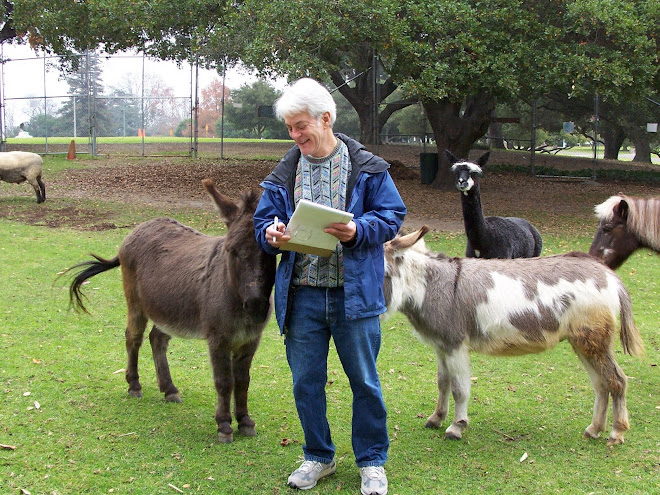
Interviewing the animals at Children's Fairyland in Oakland. L-R: Bobo the sheep, Gideon the miniature donkey, me, Tumbleweed Tommy the miniature donkey, Juan the alpaca, Coco the pony

Tuesday, October 27, 2009

'Round Midnight


(Above: Terry Riley)

Composer Terry Riley, the father of the minimalist movement in classical music, will hark back to the famous all-night concerts he used to give in the 1960s and 1970s when he performs Nov. 6 at the Berkeley Art Museum.
Back in the day, the concerts would last until sunrise, with the audience bringing their own sleeping bags and hammocks to doze in while Riley played mostly improvised music all night long.
"He's in his 70's now, and he doesn't play all night as much as he used to," says pianist Sarah Cahill, who has performed many of Riley's works and is curating the event. "So he'll play a late night concert from 9 p.m. to at least midnight, and maybe beyond."
The last time Riley played at the Berkeley Art Museum was in 1975, when a local carpet company loaned Oriental carpets for the audience to lie on during the concert.
This time, audience members are asked to bring sleeping bags, camping pads, blankets, pillows or whatever will make them comfortable on the museum floor. A limited number of chairs will be available, and the music can also be enjoyed from the galleries above.
Riley, who has been cited as a major influence by composers and performers ranging from John Adams to The Who, will sing and play a selection of his works on a rare, $129,000 Fazioli piano loaned by the Piedmont Piano Company.
The Berkeley Art Museum is located at 2626 Bancroft Way. Admission is $5, and people are urged to arrive early to get a good spot on the floor.

Sunday, October 25, 2009

All Creatures Great and Small


(Above: Hey, who's that guy with Gideon and Tumbleweed Tommy?)

Everyone at Children's Fairyland in Oakland - both two-footed and four - is in mourning because their beloved friend, Marguerite Clemens of Concord, has passed away.
Her special relationship with Fairyland began in 2003, when Lampwick, one of miniature donkeys in the petting zoo, suddenly died.
Gideon, Fairyland's other miniature donkey, was devastated. He wouldn't eat, and he spent hours calling out for his friend.
Yvonne Backman, Fairyland's chief animal caregiver, and her staff spent hours trying to comfort him, but nothing worked. He was literally pining away.
The only thing that might help was a new friend. After much searching, Backman located a breeder about 200 miles away who had a tiny little spotted donkey named Tumbleweed Tommy for sale.
Trouble was, it would cost $550 - $500 to buy Tommy and $50 to transport him to Oakland. And Fairyland, which always operates on a tight budget, just couldn't afford it.
So I wrote a column about the situation, and you readers responded by donating all the money needed within 24 hours.
Tommy was duly purchased; and when he and Gideon finally met each other, it was love at first sight. And they've been inseparable ever since.
One of the contributors was Marguerite Clemons. A retired schoolteacher on a very limited income, she sent a check for $20. Then she sent another. And another. And another.
The checks kept on coming long after Tommy arrived. Sometimes she'd enclose a card to say hi. Sometimes the check would be for $10; and she'd apologize, explaining that money was tight that week. Other times she'd send a card and no check, and she'd apologize again.
She continued to send what she could for several years. But, believe it or not, she had never been to Fairyland in her life! She was 89 at the time, and her mobility was further hampered by a long-ago bout with Polio.
So she and Yvonne became pen pals. Yvonne would write back with photos and the latest gossip, such as Gideon and Tommy stealing the ducks' food. (But the ducks didn't mind because they were busy sneaking into the funhouse, where they would spend hours gazing at their reflections in the funny mirrors.)
But in 2005 she was finally able to visit Fairyland. I was there, and you should have seen the look on her face when she finally met Gideon and Tommy and all her other animal friends.
The folks at Fairyland gave her the VIP treatment, which seemed to surprise her. I don't think she realized how rare it is to find that much sincerity and goodness in a grownup. In little kids, sure, all the time. But not in big people. Marguerite was one of a kind.
She made a return visit in 2007. But last year she stopped writing, apologizing over and over again because she could no longer hold a pen to write. So she and Yvonne kept in contact over the phone.
But she kept declining over the last six months, and on October 4 she gently passed away. She would have been 93 on Nov. 20.
"Marguerite was a kind, gentle, soft spoken lady with a great love for books and animals and Fairyland and donkeys," says Yvonne. "And I will miss her very, very much."
You aren't the only one, Yvonne.

Tuesday, October 20, 2009

Bouncing Back


(Right: Louie, Leslie and Chocolate Bunny. Below: Oliver 12 days after rescue.)


Oliver the kitten was only three weeks old when he was rescued from LaPreda Thomas' house. Both his front legs were broken, and he was suffering from pneumonia and severe malnutrition.
"He was near death," said Merry Bates, president of Island Cat Resources and Adoption. "His life was touch and go for a number of weeks after we rescued him. X-rays found kitty litter in his stomach, which meant he had been eating the litter to fend off starvation."
Oliver, a tiny orange tabby, was one of seven felines rescued from Thomas' home in Oakland over the last four months. Their injuries ranged from multiple broken limbs to huge puncture wounds, police said. Many of the cats also had their claws crudely cut off, sometimes with portions of their toes removed.
On Oct. 9 Thomas was charged with felony animal abuse, accused of severely injuring more than 15 cats and kittens in incidents dating back to 2006.
Choco, a black kitten about the same age as Oliver, suffered a gouged-out right eye. Dr. Devin Johnsen, a veterinarian at VCA Bay Area Animal Hospital in Oakland, was shocked when she first saw him.
"That kind of injury is very unusual because of the shape of a cat's head," she said. "You usually see it only when there's been a lot of trauma, such as a cat getting hit by a car."
The damage to Choco's spirit was considerable, too.
"His gaze was an empty stare," said Bates. "When held close in your arms, he was still, almost as though he was trying to be 'good' and hoping for the best."
After they got out of the hospital, the kittens were placed in the care of ICRA volunteers - Oliver to Peggy Harding of Oakland and Choco to Leslie and Louie Hernandez of San Leandro.
So how are they doing now?
"Oliver's legs were so weak after they took the casts off. He wanted so desperately to walk. It was hard for him, and hard to watch," said Harding. "But now it's like night and day. He's just a little bundle of energy and playfulness and curiosity and love."
Oliver lives with two other foster kittens - not abuse cases - named Dudley and Duncan, and he's decided they're his foster brothers.
"He loves his little brothers. They chase each other up and down the cat trees and race all around the house. He loves them, and they love him."
Surprisingly, given the abuse he suffered, Oliver also loves people.
"He loves to lie on his back and purr while I hold him in my arms," said Harding. "And he loves to curl up with me when I'm lying in bed reading."
Choco, has bounced back amazingly, too, although his name isn't Choco anymore.
"We call him Chocolate Bunny," said Leslie Hernandez. "It seems to fit his personality better. He has an amazing spirit of playfulness, he's always purring, and he never has a negative reaction to a loving touch.
"But I keep wondering: Did he do that for her, too? Did he purr and act like his wonderful little self? I have no reason to think he didn't. And that breaks your heart even more."
Not all the rescued kitties are recovering as quickly as Oliver and Chocolate Bunny, but all are showing remarkable improvement. They can be viewed on ICRA's website, www.icraeastbay.org. Several are available for adoption now, and the rest will be available soon.
All except Chocolate Bunny, that is.
"He's so sweet, we've decided to keep him," Hernandez said.
This story has many heroes, including Megan Webb, director of Oakland Animal Services; the veterinarians and staff at VCA; Bates and her fellow volunteers at ICRA; and Dr. Gary Richter of Montclair Veterinary Hospital, who X-rayed the cats free of charge.
The money for the X-rays came from the Montclair Veterinary Hospital Pet & Wildlife Fund, which is funded by private donations. To contribute, send a tax-deductible check to 1961 Mountain Blvd., Oakland CA 94611.
The money for all the other medical expenses was furnished by ICRA. Oliver's medical bills came to $2,876, and Coco's medical bills cost $1,287. To contribute, send a tax-deductible check to ICRA, P.O. Box 1093, Alameda CA 94501.
Thomas, who is being held without bail, will appear in court on Thursday to enter a plea.

(Picture of Oliver courtesy of ICRA. Photo of Chocolate Bunny courtesy of Bay Area News Group)
Monday, October 19, 2009

To Life!


(Above: a Coach purse)

When 2-year-old Paula Baker drowned in a freak swimming pool accident in 2001, it devastated her whole family - her two brothers, her father and, especially, her mother, Marian Baker.
"Marian was non-functional, in a fog," says her husband, Michael, a trauma surgeon at John Muir Hospital in Walnut Creek. "A lot of days, she didn't come out of her bedroom. She couldn't deal with the overwhelming pain."
But somehow, Marian found the strength to call the Contra Costa Crisis Center. They hooked her up with other parents who had lost children. And that made all the difference.
"It saved our marriage, for one thing," says Michael. "I never understood before that men and women have different ways of grieving."
Grateful for the help, Marian threw herself into raising funds for the Crisis Center. She wanted to make sure it could help other people the way it helped her family.
Things got so much better, four years ago Marian and Michael adopted a little girl and named her Joy.
But a few weeks later, Marian was diagnosed with ovarian cancer. But even while she was undergoing chemotherapy, she always more worried about others - especially the little kids who were also getting chemo at the oncology center - than about herself.
She would bake cookies to bring to the kids, and that was just the beginning.
"One child wanted a Sony Xbox, but they weren't available on the market yet," Michael recalls. "So she personally tracked down a Sony vice-president in New York and arranged to pay for one and have it delivered to the kid. She used to say, 'If chemo sucks for me, it's ten times worse for a 14-year-old.'"
Her passion was expensive purses, especially Coach purses, which she would buy on the Internet and donate to the Crisis Center for its fundraising auctions.
But her own battle with cancer came to an end on June 14. Heartbroken, Michael buried her with a Coach purse by her side.
But her good works live on. On Nov. 7 the Crisis Center will hold its annual fundraising gala at the Diablo Country Club, and it's being held to honor Marian's memory. Among the raffle prizes: a 2010 VW Beetle, a laptop computer and - what else? - a Coach purse.
You don't have to be present to participate in the raffle. For raffle tickets or to RSVP for the gala, e-mail rociop@crisis-center.org or phone 925-939-1916 x100.
And if you can't attend but would like to contribute anyway, send a tax-deductible check to P.O. Box 3364, Walnut Creek, CA 94588.
But I'm not really writing this column to plug the gala. My real reason is to let you know that this lifesaving service is available to you, too, if you need it. And in these hard times, a lot of people do. Just make the call:
Suicide: 1-800-SUICIDE
Grief: 1-800-837-1818
Crisis: 1-800-833-2900
Homeless: 1-800-808-6444
Youth: 1-800-863-7600
If you live in Alameda County, the comparable organization is Crisis Support Services of Alameda County. Its phone numbers:
Suicide/Crisis: 1-800-309-2131
Grief/Job Loss: 1-800-260-0094
And if you'd like to contribute, send a check to P.O. Box 3120, Oakland, CA 94609.
But the most important thing is to make that call. I promise: The person on the other end of the line will understand what you're going through because they've been there themselves.

Sunday, October 11, 2009


(Above: The Paine family dog of early Spruce Street gets his training in steering an early model of a horseless carriage. Note how this vehicle is a one-seater. Courtesy of Penny Hern Adams.)

Some of the best histories have been written by amateurs, including Thucydides, Edward Gibbon and, in our own time, Barbara Tuchman, Shelby Foote and David McCullough.
Richard Schwartz is another one. He isn't a history professor; he's a building contractor. But one day in 1996 he happened to be visiting the Berkeley Historical Society when he spotted a two-foot stack of old Berkeley Daily Gazette newspapers from 1900 to 1909 that somebody had donated.
The Historical Society was about to throw them out because they were moldy, and nobody wanted to run the risk of the mold spreading to other collections.
"Hey, I'll take them," he said. And the rest - if you'll pardon the expression - is history.
These newspapers became the genesis of his first book, "Berkeley 1900: Daily Life at the Turn of the Century," published in 2000. Befitting his daytime job as a contractor, he sold it not only in local bookstores, but also in hardware stores.
It was an immediate hit, and no wonder. Who could resist crime stories like this one?
"Too much indulgence in whiskey last night proved to be the undoing of one of the must successful juvenile robber bands that has infested Berkeley for some time. As a result, the gang is broken up and five small boys - Willie Small, aged 8, James Small, aged 9; Fred McNamara, aged 10; John McNamara; aged 13; and Gustav Palache, aged 13; have been made to feel the stern rebuke of the law."
Or this one?
"Perhaps because she feared to undergo the dreaded tuberculin test, or perhaps because her bovine lover no longer smiled at her, a cow of this city committed suicide a few days ago by eating a can of green paint."
Within three weeks, the entire first printing of 2,000 copies sold out. So he printed 8,000 more. And they quickly sold out, too.
People kept bugging him to print more, but he couldn't because there was no room for them in his garage, where he was also storing copies of his second and third books, "Earthquake Exodus 1906: Berkeley Responds to the San Francisco Refugees" (2005) and "Eccentrics, Heroes and Cutthroats of Old Berkeley" (2007).
But in the 10 years since "Berkeley 1900" was published, people have been coming out of the woodwork with their old family photos, diaries, letters and other artifacts. Schwartz has incorporated them into an expanded 10th anniversary edition, with hundreds of new pictures and stories.
Not all the stories are warm-and-fuzzy nostalgia. In many ways it was a terrible time, with rampant racism ("The fact that two Chinese restaurants are to be opened here is arousing much public indignation") and the constant presence of death. Consider the sad story of the Mushet family:
"Mr. and Mrs. W.T. Mushet of 1831 Derby Street left Berkeley two weeks ago with their four children for a trip to Santa Cruz. On the way down on the train there was a child suffering from diphtheria and, by the time the family arrived in Santa Cruz, the four children had taken ill. Two of them have recovered, but two have passed away. Muriel was six years old and Douglas five."
This isn't stuff you'll find in history textbooks, but it's history just the same - and a lot more fun. "Berkeley 1900" is available in a bookstore - or hardware store - near you.

Saturday, October 3, 2009

The woman who tore down walls


(Above: Sue Olive with her granddaughter, Shama)

When Sir Christopher Wren, the architect of St. Paul's Cathedral in London, died, he was buried in the cathedral under a headstone reading, "If you seek his monument, look around you."
The same could be said of environmental leader Sue Olive of Berkeley, who died at age 66 on Aug. 30 after a 4 ½-year battle with uterine cancer.
Her monument is the San Francisco Municipal Railway's Third Street Light Rail Project, which, as Project Manager, she spearheaded from start to finish. It brought the previously isolated minority neighborhoods of the Bay View, Hunter's Point and Visitacion Valley in contact with the rest of San Francisco.
But another important legacy is something that wasn't built. It seems incredible now; but after the 1989 Loma Prieta earthquake, CalTrans actually wanted to rebuild the collapsed Cypress Structure, which cut West Oakland off from the rest of the city.
But Olive and her husband, Michael Fried, teamed with the late grassroots organizer Chappell Hayes to mobilize the community to put the kibosh on that dumb idea.
Olive was the first female president of Urban Ecology, a band of merry pranksters with a serious purpose, which was founded in 1975.
Operating out of the Urban Ecology House at 1939 Cedar Street, they would sally forth on roller skates to distribute "Gasaholics Anonymous" parking tickets, inviting car owners to think about their dependence on automobiles.
The Urban Ecology House was instantly recognizable by the warm glow emanating from within - it seemed as if there was always a dinner party going on - and the "Veggie Car," a 1968 Pontiac GTO with a vegetable patch growing inside, parked in front.
Urban Ecology also was known for its very attractive women members, known as the Eco-Babes, of whom Olive definitely was one.
"Needless to say, they attracted a lot of men to their meetings, and I was one," says San Francisco architect Paul Okamoto, Urban Ecology's current president, who met his wife, Ariel, at the Urban Ecology House.
One of Urban Ecology's first projects was the successful campaign to redesign Milvia Street to slow cars and create safer spaces for pedestrians and bicyclists. It was considered radical then, but today every neighborhood in Berkeley is clamoring for its own bike lanes, speed bumps and roundabouts.
But just as important as what she did was the way she did it. Drawing on her Midwestern roots, she always treated people - even those with whom she disagreed - with respect and consideration. Her generosity could defuse almost any conflict.
"When you have a $600 million project like the Third Street Light Rail Project, which goes through three different communities, you have to bring all these people together, and Sue did that better than anyone," says San Francisco Supervisor Sophie Maxwell, who remembers one meeting when everyone was in a panic because of rumors of a proposed change to the project.
"Sue just kept saying very quietly, 'Just a moment, let me explain it to you.' And everyone calmed down! They were fuming just a moment before, but because they believed in her, they listened. And it turned out not to be as bad as they thought."
By the way, this "Eco-Babe" was also a proud feminist.
"When I proposed to her, she accepted," says Fried. "Then she proposed to me."

Sunday, September 27, 2009

Eat at Bill's, part 2


(Above: Bill Fujimoto and his wife, Judy)

Last June, after I wrote about Bill Fujimoto (the man who made the Monterey Market in Berkeley the mother church of the seasonal food movement) getting the heave-ho after 31 years, I got a ton of phone calls and emails from his loyal customers, all saying the same thing: "Please let me know where he ends up so I can shop there."
Well, Berkeley's loss is Lamorinda's gain. He's signed on as a consultant with Diablo Foods in Lafayette, where he's happily turning the produce section into a mini-version of the Monterey Market.
"The management is treating me wonderfully," he says. "They're allowing me the freedom to do what I do. And the customers are great. I thought appreciation of seasonal foods was just a Berkeley thing, but these people are real food people. I had no idea it was so pervasive."
He's also impressed with the staff, many of them veterans with as much as 20 years' experience.
"They only thing they didn't have was a buyer," he says. "That's my role."
Which means that instead of buying produce from a catalog to fill a designated space on the shelf, whether or not the item is in season, he inspects everything personally and buys only whatever is top condition that day.
"Strawberries are always better when you see them before you buy them," he says. "Some days, the tomatoes might not be at their best, but the greens are. So I'll pass on tomatoes that day and load up on greens, instead."
Just like old times, his day starts around midnight, when he wakes up without an alarm clock and starts phoning growers to find out what's hot and what's not that day.
Then he goes back to sleep for a couple of hours. But he's up again in time to be at the Oakland produce district at 4 a.m.
He selects only the best of the best, loading the produce in the back of his pickup truck and driving to Diablo Foods, where he's setting up the produce by 6 a.m.
All the while, he's indirectly instructing the staff in the fine points of seasonal produce buying.
"I teach the only way I know how," he says. "By example."
He's also introducing them to his favorite growers - contacts that will stand them in good stead long after he's moved on to his next project.
"I'm only a consultant," he says. "My goal is to eventually make myself unnecessary."
Then, just like the old days, he's back home in Berkeley by noon for his daily midday nap.
But unlike the old days, that's the end of his workday.
"I used to wake up again at 2 and go back to the Monterey Market for the afternoon shift," he says. "Now I actually have a life. I can actually have dinner with my wife. I'm working hard and enjoying myself, and I've lost 18 pounds!"
After he was so unceremoniously dumped by the Monterey Market last spring, there were dark mutterings of a boycott by both customers and growers. But Bill is having none of it.
"I'm a Buddhist," he says. "Everything always works itself out. Besides, the employees are like my family. How can I wish them anything but the best?"