A columnist of heart and mind

A columnist of heart and mind
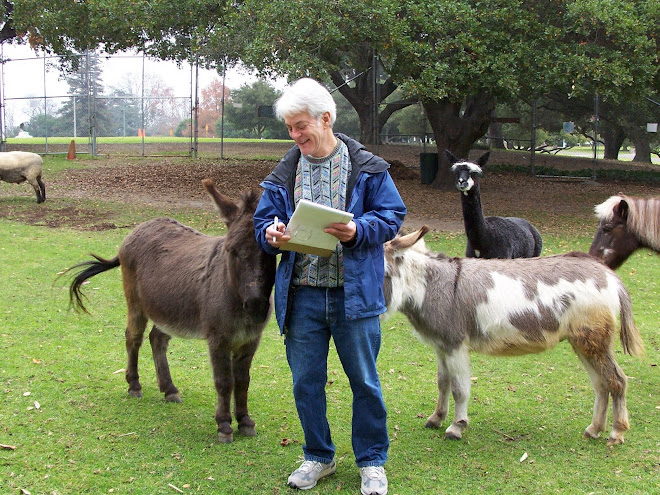
Interviewing the animals at Children's Fairyland in Oakland. L-R: Bobo the sheep, Gideon the miniature donkey, me, Tumbleweed Tommy the miniature donkey, Juan the alpaca, Coco the pony

Saturday, October 3, 2009

The woman who tore down walls


(Above: Sue Olive with her granddaughter, Shama)

When Sir Christopher Wren, the architect of St. Paul's Cathedral in London, died, he was buried in the cathedral under a headstone reading, "If you seek his monument, look around you."
The same could be said of environmental leader Sue Olive of Berkeley, who died at age 66 on Aug. 30 after a 4 ½-year battle with uterine cancer.
Her monument is the San Francisco Municipal Railway's Third Street Light Rail Project, which, as Project Manager, she spearheaded from start to finish. It brought the previously isolated minority neighborhoods of the Bay View, Hunter's Point and Visitacion Valley in contact with the rest of San Francisco.
But another important legacy is something that wasn't built. It seems incredible now; but after the 1989 Loma Prieta earthquake, CalTrans actually wanted to rebuild the collapsed Cypress Structure, which cut West Oakland off from the rest of the city.
But Olive and her husband, Michael Fried, teamed with the late grassroots organizer Chappell Hayes to mobilize the community to put the kibosh on that dumb idea.
Olive was the first female president of Urban Ecology, a band of merry pranksters with a serious purpose, which was founded in 1975.
Operating out of the Urban Ecology House at 1939 Cedar Street, they would sally forth on roller skates to distribute "Gasaholics Anonymous" parking tickets, inviting car owners to think about their dependence on automobiles.
The Urban Ecology House was instantly recognizable by the warm glow emanating from within - it seemed as if there was always a dinner party going on - and the "Veggie Car," a 1968 Pontiac GTO with a vegetable patch growing inside, parked in front.
Urban Ecology also was known for its very attractive women members, known as the Eco-Babes, of whom Olive definitely was one.
"Needless to say, they attracted a lot of men to their meetings, and I was one," says San Francisco architect Paul Okamoto, Urban Ecology's current president, who met his wife, Ariel, at the Urban Ecology House.
One of Urban Ecology's first projects was the successful campaign to redesign Milvia Street to slow cars and create safer spaces for pedestrians and bicyclists. It was considered radical then, but today every neighborhood in Berkeley is clamoring for its own bike lanes, speed bumps and roundabouts.
But just as important as what she did was the way she did it. Drawing on her Midwestern roots, she always treated people - even those with whom she disagreed - with respect and consideration. Her generosity could defuse almost any conflict.
"When you have a $600 million project like the Third Street Light Rail Project, which goes through three different communities, you have to bring all these people together, and Sue did that better than anyone," says San Francisco Supervisor Sophie Maxwell, who remembers one meeting when everyone was in a panic because of rumors of a proposed change to the project.
"Sue just kept saying very quietly, 'Just a moment, let me explain it to you.' And everyone calmed down! They were fuming just a moment before, but because they believed in her, they listened. And it turned out not to be as bad as they thought."
By the way, this "Eco-Babe" was also a proud feminist.
"When I proposed to her, she accepted," says Fried. "Then she proposed to me."

Sunday, September 27, 2009

Eat at Bill's, part 2


(Above: Bill Fujimoto and his wife, Judy)

Last June, after I wrote about Bill Fujimoto (the man who made the Monterey Market in Berkeley the mother church of the seasonal food movement) getting the heave-ho after 31 years, I got a ton of phone calls and emails from his loyal customers, all saying the same thing: "Please let me know where he ends up so I can shop there."
Well, Berkeley's loss is Lamorinda's gain. He's signed on as a consultant with Diablo Foods in Lafayette, where he's happily turning the produce section into a mini-version of the Monterey Market.
"The management is treating me wonderfully," he says. "They're allowing me the freedom to do what I do. And the customers are great. I thought appreciation of seasonal foods was just a Berkeley thing, but these people are real food people. I had no idea it was so pervasive."
He's also impressed with the staff, many of them veterans with as much as 20 years' experience.
"They only thing they didn't have was a buyer," he says. "That's my role."
Which means that instead of buying produce from a catalog to fill a designated space on the shelf, whether or not the item is in season, he inspects everything personally and buys only whatever is top condition that day.
"Strawberries are always better when you see them before you buy them," he says. "Some days, the tomatoes might not be at their best, but the greens are. So I'll pass on tomatoes that day and load up on greens, instead."
Just like old times, his day starts around midnight, when he wakes up without an alarm clock and starts phoning growers to find out what's hot and what's not that day.
Then he goes back to sleep for a couple of hours. But he's up again in time to be at the Oakland produce district at 4 a.m.
He selects only the best of the best, loading the produce in the back of his pickup truck and driving to Diablo Foods, where he's setting up the produce by 6 a.m.
All the while, he's indirectly instructing the staff in the fine points of seasonal produce buying.
"I teach the only way I know how," he says. "By example."
He's also introducing them to his favorite growers - contacts that will stand them in good stead long after he's moved on to his next project.
"I'm only a consultant," he says. "My goal is to eventually make myself unnecessary."
Then, just like the old days, he's back home in Berkeley by noon for his daily midday nap.
But unlike the old days, that's the end of his workday.
"I used to wake up again at 2 and go back to the Monterey Market for the afternoon shift," he says. "Now I actually have a life. I can actually have dinner with my wife. I'm working hard and enjoying myself, and I've lost 18 pounds!"
After he was so unceremoniously dumped by the Monterey Market last spring, there were dark mutterings of a boycott by both customers and growers. But Bill is having none of it.
"I'm a Buddhist," he says. "Everything always works itself out. Besides, the employees are like my family. How can I wish them anything but the best?"

Monday, September 21, 2009

Bird is the word


(Above, the cover of "The Ugly Pugling" by Wilson the Pug, which is set at the Albatross)

Happy birthday to the Albatross pub in Berkeley, which will celebrate its 45th anniversary Oct. 7.
The Albatross - or, as the regulars call it, "The Bird" - was founded in 1964, the same year as the Free Speech Movement. It's located on San Pablo Avenue, exactly one mile from the Cal campus.
(Back in the day, alcohol sales were banned within a one-mile radius of campus, so if you travel a mile in any direction from Cal, you'll find a cluster of bars.)
But The Albatross isn't a conventional bar. It isn't a place to get drunk or pick up someone for a one-night stand.
Instead, it's the closest thing you'll find in this country to a real, old-fashioned British pub, short for public house.
Which isn't to say it doesn't have an extensive collection of local and international beers, wines and whiskies; it does. But the alcohol is incidental to its real purpose, which is a place for the whole community to hang out.
"Have you ever had the feeling when you walk into a public place that everyone is checking you out?" says marketing consultant Marshall Platt, who uses "The Bird" as a place to meet with clients.
"The Albatross is the exact opposite of that. You feel appreciated as soon as you walk in. Everything there says, 'Relax.' People are throwing darts, people are munching on crackers, and there are dozens of board games to play."
Local jazz or bluegrass musicians play live four times a month. Sunday night is Trivia Pub Quiz Night, when competitors vie for free t-shirts or drink coupons. Tuesday is Dart Tournament Night in the dart room, which features six professional lanes.
"We sell used dartboards because the players are so good here, they wear out the bull's-eye before the rest of the board," says co-owner Wendy Halambeck. "So they're good for learning on."
Halambeck and her partner, Linda Zsilavetz, bought The Albatross in 1997 from its original owners, brothers Bob and Val Johnson. They replaced the Formica tables with wood, cleaned 33 years of tobacco residue from every surface and crevice, and added a pool table.
But they kept all the old traditions. Small brass plaques honor deceased longtime patrons at their usual spot at the bar, including Howard Albert (Jan. 24, 1911 - Feb. 28, 2004), Horst Duhnke (May 22, 1922 - Feb. 3, 2005) and Jules Spillman (March 31, 1941 - June 11, 2007).
"Jules' wake was held here," says Halambeck. "And so was the reception after the funeral."
The Albatross also has its share of famous patrons, including George Cleve, musical director of the Midsummer Mozart Festival; two-time Oscar winner Sean Penn; and Wilson the Pug, who (with a little help from his owner, Nancy Levine) has authored four published books, including "The Tao of Pug" and "The Ugly Pugling," which features the Albatross as its setting.
Wilson is a frequent patron because the Albatross is dog-friendly until 8 p.m.
"For him, it's a big treat," says Levine. "You can buy unlimited popcorn for a quarter, and Wilson is a big fan of popcorn. He gets lots of attention, music and popcorn - all things that he loves."
The celebration runs from 7:30 to 10:30 p.m. For more information, visit www.albatrosspub.com or call 510-THE-BIRD.

Saturday, September 19, 2009

Kindness to Kittens


(Above: Tamerack and Roxana, one of her kittens)

When Sarah Kidder adopted a 12-year-old female Siberian husky named Tamerack last year, she knew she was getting a loving, friendly, playful dog. But she never suspected that Tamerack had a hidden talent: as a foster kitten raiser.
It all started three weeks ago, when Kidder, who lives in the Grand Lake area, was taking Tamerack for a walk.
"About a block away, I saw this beautiful, blue-eyed, chocolate point Siamese adult and two little black kittens playing in a driveway," she says. "I was like, 'Why would those little kittens be there?'"
After talking with the neighbors, Kidder found out that that the family who lived there had moved away and abandoned the Siamese - who she assumed was the mom - and the two kittens. So she decided to take them home with her.
"It wasn't safe for them to be out there. And we don't need any more feral cats in the neighborhood because they would keep on breeding. Plus, they were just ridiculously cute."
That's when Tamerack unveiled her hidden talent.
"She was like, 'Oooh! Kittens!' I was a little concerned at first because she was so excited, but then I realized she was excited because she wanted to mother them. She would follow them around and lick their heads and make sure they were OK. After 24 hours, they started following her around. Whenever she sat down, they sat down, too."
By the next day, Tamerack was sharing her food with her little feline friends.
"Even when she was gnawing on a bone, she'd let them munch on it, too! I just sat there, slack-jawed, for a week."
Now Tamerack and her kittens are inseparable. They sleep together, eat together and play together.
"She understands that she's a lot bigger than they are, so she's very gentle with them. If they're gone too long, she searches for them and hangs out wherever they are. If I'm looking for them, I just look for her because I know she'll be where they are."
She named the mommy cat Choco Kitty and the kittens Roxana and Stetaria, after Alexander the Great's wives. (Kidder is the product of a classical education.)
The next order of business was to get Choco Kitty and the kittens fixed, so Kidder called Island Cat Resources and Adoption, who arranged and paid for the surgeries.
That's when Kidder got another surprise: Choco Kitty isn't the kittens' mother. He's their father!
"It's not unusual for adult male cats to be a great guardian for kittens," says ICRA's Gail Churchill. "When his owners moved away, he must have realized the kittens were helpless and took it upon himself to be their guardian."
It's also not unusual for large dogs like Tamerack to be kind to kittens, as Churchill can attest. Her golden retriever, Rosie, was in the news last June for fostering homeless kittens, too.
"Gentle, sweet dogs will take to anyone," says Churchill, "especially young ones."
Now that they've been spayed or neutered, all three cats are available for adoption.
"They're all incredibly sweet and friendly, says Kidder. "I'd love to adopt them myself, but I can't. It wouldn't be fair to my cat, Enkidu."
But what will Tamerack do when her kittens are finally adopted?
"I'm going to take her up to the snow as a reward," says Kidder. "If she's still missing them after that, I'll guess I'll have to start fostering more kittens."
To adopt these cats, either singly or in combination, call ICRA at 510-869-2584 or visit www.icraeastbay.org.

Sunday, September 13, 2009

Glamour girl


(Above: Lily on the Capitol steps. Photo by Tina Raheem/Orphan Foundation of America)

Good news for Lily Dorman-Colby fans, and that includes Berkeley school board President Nancy Riddle, state Senator Loni Hancock, everyone who went to Berkeley High from 2000 to 2004, and me.
Lily, who is now a senior at Yale, has just been named one of the top 10 college women of 2009 by Glamour magazine.
It's a very big honor. Martha Stewart was one of the winners back in 1961.
I first met Lily during her senior year at Berkeley High, when her fellow students elected her to be their representative on the Berkeley school board.
It's usually a nominal position, sort of a glorified civics lesson. But Lily turned it into something substantive, successfully lobbying the board on a wide range of issues affecting students.
"State law forbids us from counting her vote," Riddle told me. "But we have such respect for Lily's judgment, we always pay very careful attention to everything she says."
Lily was also getting great grades, despite suffering from dyslexia, and starring on the wrestling team. But she was so down-to-earth and unpretentious, her fellow students weren't jealous. They rooted for her, instead.
Even more impressively, she accomplished all these things despite a truly horrific childhood. She was in the foster car system since she was 12 because her parents were unable to care for her due to drug use and mental illness.
She bounced from one foster home after another. Some were good, but others were right out of Dickens. But she never felt sorry for herself. Instead, she latched onto education as her ticket out.
But she never forgot where she came from. As one of the lucky survivors of the foster care system - only 2 percent of foster children graduate from college - Lily has made it her life's mission to reform foster care so other kids won't have to go through what she did.
Between high school and college she interned in Hancock's office, where her suggestions helped Hancock draft a law that made it easier for kids to find foster homes.
"While the official title was 'Child Welfare Services: Resource Family Pilot Program,' I always referred to this bill as 'Lily's Bill,'" Hancock says.
Every time I run into Hancock, her first words to me are always "Have you heard from Lily? How's she doing?"
Answer: Very nicely, thanks. She spent last summer interning in Washington D.C. with the American Bar Association, doing legal research on laws affecting foster children.
She was back in Washington again this summer, interning with both the Child Welfare League of America and Sen. Chris Dodd of Connecticut. Her next step: law school.
She has also written a how-to guidebook, based on her own experiences, to teach foster kids how to get into college.
For Lily, the best part of the Glamour award was hanging out with the other winners, including a chanteuse from USC, Stanford basketball star Jayne Appel, the inventor of a folding wheelchair from MIT, and a future doctor who is first in her class at West Point.
"They’re awesome!" she says. "We're hoping to stay in touch with each other and work with each other on projects."
The issue is on the stands now; Gwen Stefani is on the cover. The article about Lily is on page 240.

Saturday, September 12, 2009

Black cats make the best pets


Above: Midnight the Cat and Andy Devine, two of the stars (along with Froggy the Gremlin) of "Andy's Gang." Do you remember what Midnight said when she meowed? Answer at the bottom of the column.

The English are different from us. They drive on the left, and their steering wheels are on the right. And in England, a black cat is a sign of good luck, not bad - which is why black cats have no problem getting adopted over there.
But it's a different story over here. Black cats usually have to wait two or three times as long for a new home as other felines.
It's a stupid superstition. As Groucho Marx observed, "A black cat crossing your path signifies that the animal is going somewhere." But people still believe it.
That's why Island Cat Resources and Adoption is holding a special Black Cat Adoption Day on Saturday, Sept. 26, at Petco, 2310 South Shore Center in Alameda, from Noon until 4 p.m.
Many of the cats will be kittens - specifically, former ferals that ICRA rescued when they were so young, they were able to be socialized.
Older ferals usually can't be socialized because they are too set in their ways. So they are humanely trapped, spayed and neutered, and returned to their cat colonies, where they don't produce any more kittens.
But feral kittens, on the other hand, make terrific pets. And I ought to know because my own cat, Phoebe, was a feral kitten.
She was scared of me for the first few days; but once she figured out that I wasn't going to eat her, she did a complete flip-flop. Now I couldn't ask for a sweeter, more attentive, more affectionate kitty.
ICRA will have 30 black cats and kittens ready for adoption on the 26th, including Daryle and Kenda, a pair of little cuties who were born across from the Raiders' practice facility, and Choco, who is remarkably loving and trusting despite the fact that one of his eyes was gouged out by an abusive so-called human being.
And if you can't make it to Petco, you can view the kittens at ICRA's web site, www.icraeastbay.org. You can also use the site to donate money or volunteer your services.
ICRA cares for homeless cats in Alameda and Oakland. Its counterpart in Berkeley, Albany, Emeryville, Piedmont, El Cerrito and Richmond is another group called Fix Our Ferals.
FOF is kicking off its fifth annual Winter Campaign for Cats this weekend, and it's seeking volunteers to help trap and spay or neuter homeless neighborhood cats in all these cities, as well as provide foster homes to socialize them.
There will be a volunteer orientation this weekend, on Saturday, Sept. 12, at the Berkeley-East Bay Humane Society, 2700 9th Street in Berkeley, from 10 a.m. to noon. If you can't make the meeting, you can still volunteer. Just call 510-908-8515 or e-mail rebeccamarshallfof@yahoo.com. For more information about volunteering or donating, visit www.fixourferals.org.
I've been writing about ICRA and FOF for years, and I'm constantly amazed by how much they accomplish with so little. There is no paid staff; everyone is a volunteer.
There's also no shelter - which, paradoxically is an advantage. Instead of living in cages, the cats are fostered in private homes, many with dogs or kids, so they're well accustomed to life in the real world.
If you're thinking of adopting a new cat or kitten - or, better yet, a pair of cats or kittens - this is the first place I'd look.

(Answer: Midnight said, "Nice!")

Sunday, August 30, 2009

How to really honor the victims of 9/11


(Left: Cat Right: Mark and his mom)


As the eighth anniversary of the September 11, 2001 terrorist attacks approaches, my thoughts keep turning back to those who died.
I didn't know any of them, but I have two close friends who did.
The first is George Lazarus, a pediatrician in Manhattan. On that day he lost his favorite patient, Catherine "Cat" MacRae. She was only 23.
Her father called her "bright and beautiful, gentle and kind, the epitome of all that is good in the world," and that's a pretty fair description.
She would surprise her friends with unexpected gifts and notes to remind them that she loved them. And whenever she was invited to a party, she made sure all her friends got invitations, too.
Cat was sitting at her desk on the 93rd floor of the North Tower, in the direct path of the first hijacked plane. She never had a chance.
My other friend is Alice Hoglan of Los Gatos. She lost her only child that day - her son, Mark Bingham. He was only 31.
Mark was one of the passengers on United Flight 93 who attacked the hijackers and prevented them from crashing the plane into the Capitol – at the cost of their own lives.
That came as no surprise to anyone who knew him. A strapping 220-lb., 6'5" rugby star who led Cal to national titles in 1991 and 1993, he was always quick to jump in and protect the weak from bullies.
Once, when he and some friends were accosted by an armed robber in San Francisco, Mark tackled the guy, took his gun away and held him until the police arrived.
Alice had a chance to say goodbye before he died. He called her from the plane and said, "I want you to know that I love you."
They talked for a while. Then she heard Todd Beamer, who was sitting next to Mark, say, "OK, let's roll." Then the line went dead.
Cat and Mark were our best and brightest. Who knows what wonderful things they would have gone on to accomplish if they hadn't been cheated so brutally out of their future?
In the days following 9/11 it seemed that we might be able to salvage some good out of this evil by transforming our country into one that was worthy of their sacrifice.
And yet, if I could talk to them today, I would have to confess that we have failed.
The "Spirit of 9/11" lasted about five minutes. Then it was back to business as usual - tearing the country apart for partisan advantage.
We are turning into two Americas. One watches Fox News and thinks Obama is an enemy alien who wants to kill our grandparents. The other watches MSNBC and thinks the Republicans are cynically exploiting the darker aspects of human nature.
Neither side remembers the advice Ted Kennedy gave his son: "Teddy, Republicans love this country just as much as I do."
This is a very dangerous road we're going down. Sometimes, in my gloomier moments, I fear we've already passed the point of no return.
But, as with global warming, we have no choice but to act as if there's still time to step back from the abyss. But we'd better get going before it really is too late.
Otherwise, Cat and Mark will have died in vain.