A columnist of heart and mind

A columnist of heart and mind
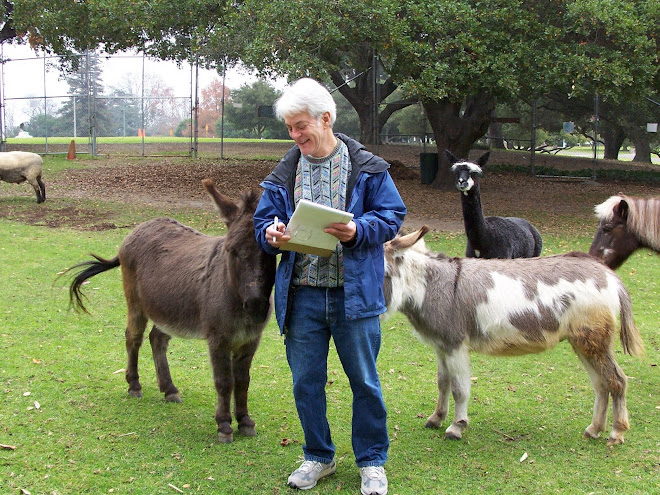
Interviewing the animals at Children's Fairyland in Oakland. L-R: Bobo the sheep, Gideon the miniature donkey, me, Tumbleweed Tommy the miniature donkey, Juan the alpaca, Coco the pony

Monday, April 13, 2009

Kitties And Fiddlers


Three weeks ago, a woman heard some faint crying coming from a dumpster on the Embarcadero in Oakland.
She looked inside and found tiny four kittens in a plastic bag that was sealed with duct tape. If she hadn't come along when she did, they would have suffocated.
The kittens were so young - only three or four days old - their umbilical cords were still attached.
One was already dead, and another died soon after. She took the two survivors home, but she soon realized they required more care than she knew how to provide. So she called Island Cat Resources and Adoption (formerly known as Island Cat Rescue) in Alameda.
ICRA volunteers bottle-fed the little kittens every two hours around the clock, and they thrived. In a few weeks they'll be old enough to be placed in new homes. And you couldn't ask for nicer, sweeter, more affectionate kitties because all that bottle-feeding has made them extremely people-oriented.
And ICRA has more than 350 success stories like that every year. Its mission is to reduce the feral cat population of Alameda, Oakland and Emeryville by humanely trapping them and taking them to local veterinarians for spay/neuter surgery and whatever other medical attention is needed.
Those that are tame enough to be adopted are put in temporary foster homes, where they learn to trust humans, then placed in permanent homes.
Those that are too wild to be adopted are returned to their feral cat colonies, where they live out their lives under the watchful eyes of ICRA volunteers, who feed them and monitor their wellbeing. And, most importantly, they don't produce any more kittens.
ICRA is celebrating its 15th anniversary this year, and it's celebrating with a gala fund-raiser April 25 at the Elks Lodge in Alameda. Gift certificates, art, fine jewelry, overnight trips, pet goodies, sports memorabilia and more will be auctioned; and all proceeds will go to the kitties.
For more information about ICRA and the auction, call 510-869-2584 or visit www.icraeastbay.org.
Meanwhile, do you know the difference between a violin and a fiddle?
"Violin music is for listening; fiddle music is for dancing," says Pate Thomson of Berkeley. And he ought to know because he plays some of the most danceable music there is: Scottish fiddle tunes, with titles like "Miss Grace Hay's Delight" and "Miss Oswald of Auchincruive's Favorite Reel."
By day, Thomson is a cardiologist. But at night he puts down his stethoscope and picks up his fiddle, and he and his wife Judy make music with other members of the San Francisco Scottish Fiddlers. In large groups and small, they get together and fiddle to their hearts' delight until the wee small hours.
Once a year, the Scottish Fiddlers don their formal kilts and present a series of boisterous public concerts when, as the group's leader, Alisdair Fraser, puts it, "spontaneous things break out and anything's likely to happen."
This year they will appear locally on April 24 at the Valley Center for the Performing Arts at Holy Names University in Oakland. For more information or tickets, call 800-838-3006 or visit www.brownpapertickets.com.
Dancing in the aisles is not only permitted, it's practically mandatory. Periodically, Fraser will turn to the audience and proclaim in a thick Scottish burr, "Get up and fling yourselves about in an ethnic manner!"
I can't think of anything that's more fun. Enjoy!

Tuesday, April 7, 2009

The Sweteest Sounds


How tough is it to get into the Juilliard School of Music in New York? The world-famous conservatory accepted only one pianist for next fall's freshman class.
That person is Samora Pinderhughes, a senior at Berkeley High, who plays first piano with the award-winning Berkeley High Jazz Ensemble.
Samora has been wowing 'em since before he could walk. He began studying Venezuelan and Cuban percussion at age two and Latin piano at age seven. He fell in love with jazz at age 11 when he entered the Young Musicians Program at UC Berkeley.
A gifted composer and arranger as well as a virtuoso performer, he has won so many prizes, including the prestigious Downbeat Award for "best original composition/best song," it would take 10 columns to list them all. He has played everywhere from Yoshi's to Carnegie Hall.
Music critics and professional musicians agree: His potential is unlimited.
"Samora is one of the most naturally gifted musicians I've ever had the privilege of teaching," says pianist Susan Muscarella, director of The JazzSchool. "He has everything he needs: great voice leading and exciting melodic lines. But most importantly, he swings hard. It would be no surprise to me to see him among the next generation of jazz masters."
But according to Samora, he isn't even the best musician in the family.
That distinction belongs to his little sister, Elena, 14, who plays flute and sings.
"Her ear, the way she listens and reacts, she's such a natural player," he says. "She's just learning about chord changes and stuff, but if I play something she's never heard before she picks it up in seconds, way faster than everyone else."
She, too, has won a Downbeat Award and played at Yoshi's and Carnegie Hall. Two years ago she was the featured soloist with the Montclair Women's Big Band at the Gualala Whale and Jazz Festival, the first time the festival featured a child on the main stage.
"She just blew everybody away," says trumpeter Ellen Seeling, the Big Band's director. "She's a very mature bebop player, and she gets a sound on the flute that you almost never hear, even in professional musicians. She's frighteningly talented and a consummate pro, even though she's only in 8th grade. She's going to be a big deal some day."
Elena gives Samora a lot of the credit.
"He has always pushed me, but in an encouraging way. He doesn't let me not rise to my potential. And I know he's always going to have my back. If I mess up in a concert, I know he's going to cover for me or follow me in an unexpected direction."
Elena and Samora have been performing together since he was 11 and she was 7. Their first gigs were at the Saturday morning Berkeley Farmer's Market, where the tips paid for their music lessons.
Their current combo, a jazz quartet, will appear April 19 at La Pena.
The concert has two purposes: first, it's one of Samora's last chances to play with his friends before he goes off to Juilliard; and second, to raise money so Elena and Samora can go with the Berkeley High Jazz Ensemble on its European trip this summer.
Don't miss this chance to catch a pair of rising stars.

Friday, April 3, 2009

Not In Our Town


(Above: Local kids make their feelings known)

Everywhere I go, I keep hearing the same refrain: "This is the worst thing to happen to Oakland since the firestorm."
I'm talking about the murder of four police officers - Mark Dunakin, John Hege, Ervin Romans and Daniel Sakai - who were gunned down by an ex-con named Lovelle Mixon after an apparently routine traffic stop turned into a deadly shootout.
Barbara Littleford lives not far from where the killings happened, and she was one of many people who felt they just had to do something - anything - to say, "Not in our town."
"My daughter and I were sitting and watching TV, and we were both in tears," she said. "I thought, 'Well, I don't have a lot of money, but I do know a lot of people.'"
She called her friend, Deanna Davis, who works with the Children's Quilt Project of the East Bay, and said, "I just want to take care of the children of the officers who were killed."
Davis replied, "I was Officer Hege's next door neighbor when I was 10."
The quilt project donated 10 quilts, one for each child. Kathleen Caldwell, owner of A Great Good Place For Books, donated $200 worth of children's books.
"I felt strongly about doing this," she said. "My grandpa, my uncle and my cousins were all cops. It could have been my family."
Laurel Bookstore contributed more books. The Toy House donated Beanie Babies. Massage therapist Hana Levin gave free massages to the families and co-workers of the slain officers. The manager of the Safeway on Redwood Road donated a large gift certificate. The local Long's Drugs contributed gift baskets and stuffed animals. And so on and so on.
But not everyone is cheering. Littleford is getting hate mail, too.
Reason: She's including Mixon's niece - who was severely traumatized when he barricaded himself in her bedroom and staged the final shootout right in front of her - in the list of recipients.
One guy told her she should "rot in hell," adding, "Perhaps next you'll be taking up a collection for Charlie Manson's 'family.'"
Well, I though I'd check this out with the Oakland Police Department's chaplain, Father Jayson Landeza, who has been working night and day to comfort the grieving families and fellow officers.
"There's not a person in the department who isn't furious at Mixon," he said. "But there isn't one officer who doesn't see her as a victim in all this. My God, what kind of image is that poor girl going to have to live with for the rest of her life?"
The slain officers left behind nine children - a 3-year-old girl, 4-year-old girl, 8-year-old boy, 10-year-old boy, 13-year-old girl, 15-year-old boy, 17-year-old boy, 20-year-old girl and a 23-year-old girl. Add Mixon's little niece, and you have 10 kids whose lives have been shattered.
If you'd like to be part of this effort, contact Littleford at comfort.survivors@gmail.com or call 510-273-9393.
"There's this big weight over Oakland, and has been for some time," said Luan Stauss, owner of Laurel Bookstore. "I can't lift it by myself, neither can Dellums, and neither can the police. We have to do it together."

Monday, March 23, 2009

Handling the stress of unemployment


(Above: Bob)

Have you been laid off? Or are you scared that you're about to be? My friend, Dr. Robert Leahy, author of "The Worry Cure" and president of the Association for Behavioral and Cognitive Therapies, sent me a few tips on how to handle the stress:

1. Validate that it's difficult. One of the most important things to do is to treat yourself with kindness and warmth during this time. Tell yourself that you have every right to feel sad, anxious, angry and even confused. You are human, and these are natural feelings during this time. Having said that, it's also important to think of moving to the next step - as soon as it seems feasible for you. You are not going to be better off feeling terrible for too long.

2. Accept the reality as it is. There are a lot of things that we have learned to accept in life - traffic, unfairness, getting older, disappointments, and losses. Accepting reality simply means that you recognize that it is what it is - without protesting or ruminating about it. It's hard to accept, but there really isn't any better alternative. At least accepting it gives you a starting point: "Where do I go from here?"

3. Normalize the problem. When you watch the news you recognize that you are not alone. Millions of people are in the same boat. That doesn't mean the boat is sinking, it only means that market economies like ours go through ups and downs. Usually a recession is followed by eight years of growth. If you are out of work, join the crowd. But also recognize that you will probably be back at work sooner than later.

4. Develop a daily plan of action. Just because your prior job ended doesn't mean you don't have a current job. Your current job is looking for a job. Dedicate a couple of hours each day to your job search. This can include looking at ads, contacting people who are potential leads in a network of people in your field, and asking for more leads to contact. There will be lots of dead-ends, but - like sales - looking for a job takes persistence. You never know when a job opens up and you happen to be the person they are looking for.

5. Schedule some fun for yourself. Although you are unemployed, you don't have to be morose. Keep yourself busy by scheduling daily activities that are interesting, fun or even challenging. Get out your old hobbies or start a new one. Get more exercise rather than lie around brooding. Have lunch with friends, take a course, read a book or travel. Think of this a sabbatical from your prior job. You may as well make use of the time now, because when you are back to work you will kick yourself for not having had some fun when you had the time.

6. Don't put yourself down. Self-criticism is a major burden during this time for you. Losing a job doesn't make you a loser; it means that you are part of the work force that is always changing. Write down these negative put-down thoughts and challenge them with reality. For example, "I'm a loser" can be challenged with the fact that you got an education, you worked, you probably got good feedback on some things, you have friends who value you, and you are trying to help yourself. In fact, think about how you would be kind to a stranger going through this rough time. Then be kind to yourself.

7. Don't ruminate. If you are like a lot of unemployed people you are spending too much time brooding and chewing over negative thoughts like, "Why me?" "Will I ever find a job" and "I can't believe this has happened." Unemployment is a natural condition of free market economies and it's important to recognize that you didn't make the economy work the way it is not working now. When you start ruminating, ask yourself, "Is there any productive action that this will lead to?" If not, then plan some productive action aimed toward another goal - for example, having fun, acquiring new skills, socializing, exercising, etc.

8. Join a community. Don't isolate yourself during this time. Get involved in communities, such as your church or synagogue or alumni association. There are on-line communities, including Linkedin.com or Facebook.com. Getting involved in professional organizations, political interest groups, environmental groups and other organized activities can give you a sense of connectedness and a feeling that you are valued. Communities help sustain us during the difficult times and give us a larger meaning of life at all times. We weren't meant to exist in isolation.

9. Help someone else. One of the best ways to put things in perspective is to find someone else who needs you. There are endless opportunities to feel like you matter. One man told me that one of the most meaningful things that he ever did was to volunteer at a homeless shelter. Other people have found that reading to the blind, volunteering at an animal shelter, visiting people in the hospital, or helping others was the best way that they could help themselves. This helps you feel great about yourself because, in fact, you do matter. Someone needs you.

10. Stretch time. It’s natural for you to feel a sense of urgency in finding a job, but if you can keep yourself within a tight financial budget and weather the storm, there really may be no urgency. One man felt discouraged after several months of unemployment, but when I suggested the possibility of stretching time to give himself more of an opportunity, he felt immensely relieved. He eventually did get a job and he looks back at that prior time as one that was difficult but also one that helped him know who his real friends are.

Note: A more complete version of these tips can be found on Bob's blog: http://blogs.psychologytoday.com/blog/anxiety-files/200902/facing-unemployment-ten-steps-handling-your-unemployment-anxiety

Monday, March 16, 2009

Give me your tired, your poor?


This economic crisis is not only a calamity, it's also having a nasty ripple effect: pushing other important problems onto the back burner.
One of them is immigration reform. There are between 13 and 14 million undocumented people in this country, and politicians traditionally vie with each other to see who can be cruelest to them - despite the fact that our economy would come to a crashing halt without them.
The ACLU of Northern California's Berkeley/North East Bay chapter is co-sponsoring a forum with the Richmond Public Library on March 26 to try to bring a little common sense to the discussion. Among the participants: Richmond Mayor Gayle McLaughlin and San Pablo Mayor Leonard McNeil.
"How could I and my colleagues on the City Council possibly be fulfilling our responsibilities to the people of Richmond if we ignore this suffering of the immigrant people of Richmond, who constitute one in four of our residents?" McLaughlin told a congressional committee.
She told me she's heard countless horror stories from her constituents about ICE (short for Immigration and Customs Enforcement) raids that are tearing families apart. When the parents are deported, the children - many of whom were born in the U.S. and are legally American citizens - confront a horrible choice: either go with them or stay here and try to survive on their own.
I can verify what she's heard. I used to teach first, second and third-graders in the West Contra Costa Unified School District, and a number of my students were in this situation.
They were among my most eager and brightest kids, but they were scared to come to school each day. They were afraid that when they got home they'd find an empty house because Mom and Dad had been rounded up while they were at school.
This is way more stress than any little kid should have to handle. And the price they pay doesn't stop there.
"When people are ill they're afraid to go to a doctor; when they're victims of crime they're afraid to call the police," says McNeil. "And they're extremely vulnerable to exploitation by employers because they can't speak up for fear of being reported to the authorities."
Clearly, something has to be done; but what? Opponents of immigration reform call it amnesty for lawbreakers, and they say it's unfair to people who played by the rules.
But I can think of two people who disagree: John McCain and George W. Bush, who both took considerable political risks by lobbying for a liberalized immigration policy.
"Call it a banana if you want to," said McCain. "To call it amnesty frankly distorts the debate, and it’s an unfair interpretation."
There must be a middle way between deporting 13-14 million people (which is impossible, anyway) and giving everyone a free pass. That's what the forum is going to discuss.
In addition to McLaughlin and McNeil, the event will include an immigration attorney and a representative from Congressman George Miller's office, who will update everyone on the latest developments in Washington. It will take place from 7 to 9 p.m. at the Richmond Public Library, 325 Civic Center Plaza. For more information, call 510-620-6561.

Friday, March 6, 2009

What They Should Have Done


(Above: Didius Julianus)

Welcome to Snapp's School For Stupid Politicians, where we advise our elected officials how to remove the feet they keep stuffing in their mouths.
Let's start with Bobby Jindal, who is still in hiding two weeks after his wince-inducing response to Obama's non-State of the Union speech.
But laying low is the worst thing he could do. Instead, he should be on David Letterman, letting Dave make fun of him.
That's what another young southern governor did in 1988, after giving what is generally considered the most boring convention keynote speech ever.
The only applause occurred near the end, when he said, "In conclusion…" And the weary crowd erupted in cheers.
His future seemed over before it began. But a few days later he popped up the Johnny Carson show, inviting Johnny to take his best shots and even making a few self-deprecating jokes of his own.
He completely changed his image from the guy who gave a lousy speech to the guy who knows how to laugh at himself.
Four years later that young governor, Bill Clinton, was elected President of the United States.
"Those 20 minutes on 'The Tonight Show' did more for my career than speaking for two days at the Democratic National Convention," he said later.
Next, we turn to Roland Burris, who appears to have lied under oath when he told an Illinois state senate investigating committee he hadn't raised any money for Rod Blogojovich as a quid pro quo for appointing him to Barack Obama's old Senate seat.
I don't know whether he'll get indicted for perjury and tossed out immediately, or if he'll manage to hang on until he gets crushed in the primary election next year. But either way, he's a political dead man walking.
If he'd only asked me, I could have told him what to do. As soon as Blago announced the appointment, he should have held a press conference to declare that he was refusing to accept the seat from Governor F-bomb but would be happy to accept it from the voters, and that he was calling for a special election and declaring his candidacy.
He would have come across as Mr. Clean and been a prohibitive favorite in the election. Instead, he's going to wind up as an obscure footnote in the history books.
But maybe that's all he wants. Richard Nixon said, "Some men want to be president, and some men want to do president." Burris doesn't appear to want to do anything; he just likes the sound of "Senator Burris." What else would you expect from a man who has already built his own mausoleum?
Burris reminds me of the Roman Emperor Didius Julianus, who got the job by being the highest bidder after the Praetorian Guard murdered the previous emperor and put the office up for auction. Here's how Edward Gibbon described his first night on the job in "The Decline and Fall of the Roman Empire":
"Yet it was observed that after the crowd of flatterers dispersed and left him to darkness, solitude and terrible reflection, he passed a sleepless night; revolving most probably in his mind his own rash folly, the fate of his virtuous predecessor, and the doubtful and dangerous tenure of an empire which had not been acquired by merit, but by the purchase of money."

Monday, March 2, 2009

Reading the future


Every year, I look forward to the annual Glenview Elementary School Read-a-thon in Oakland with a mixture of pleasure and sadness.
On the upside, it's a delightful one-day treat for the kids, when they put aside their regular schoolwork and do nothing but read for sheer pleasure.
Some of the little ones come to school in their pajamas, toting sleeping bags and their favorite stuffed animals.
Using blankets and chairs, they make "forts" in the middle of the classroom, drag their sleeping bags inside, and read to their heart's content. It's beyond cute.
And as an extra treat, local celebrities, including Oakland firefighters and Cal basketball players, are on hand to read aloud to them.
The Read-a-thon is preceded by a two-week fundraising drive conducted by the Glenview PTA. The kids fan out through the neighborhood, raising money to pay for essentials that have been cut from the school's budget.
These include such basics as pencils and paper, which the teachers otherwise would have to pay for out of their own pockets, as well as library books, an onsite school counselor and a playground supervisor.
Every effort is expended to make the drive fun and safe for the kids, but what makes me sad is that the drive is necessary. These children have to go begging door-to-door for things that were taken for granted when I was their age.
When we're talking about infrastructure, what could be more crucial to our future than the next generation? They're even more important than bridges, roads and electrical grids. Without them, we have nothing.
And they can't wait until next year, or even next month, for our political leaders to get their act together. Every day they spend not being challenged to do their very best is a day lost forever. And those days add up awfully quickly.
The need is greater than ever this year because of the economic crunch. Last fall, the PTA wisely set aside a $10,000 contingency fund in case an emergency cropped up; and sure enough, it happened.
Halfway through the school year, the money ran out for the school's performing arts programs. Without the contingency fund, there would have been no more dance, chorus or drama programs for the rest of the year.
Glenview is far from the poorest school in Oakland. It isn't as rich as some of the schools higher up the hill, which can raise more in one night at an auction than Glenview can raise all year. But at least it has good neighbors.
Like Richard Wee, owner of Ultimate Grounds Cafe, who is giving away free coffee on Saturday to everyone who donates a book to the school library. And Debbie Long, owner of Glenview Lock & Key, and Omar Korin, owner of Savemore Market, neither of whom have kids at Glenview but donate anyway because they know how important the school is.
"The schools I really worry about are the ones in the flatlands, where they don't even have the resources that we have," says PTA mom Pamela Fong.
The fundraising drive started on Wednesday and will culminate with the Read-a-thon on March 19. If you live in the Glenview district, be on the lookout for some adorable moppets who will be knocking on your door soon.
And if you don't live nearby, your own local school probably needs help just as badly. Give them a call and ask how you can help.