A columnist of heart and mind

A columnist of heart and mind
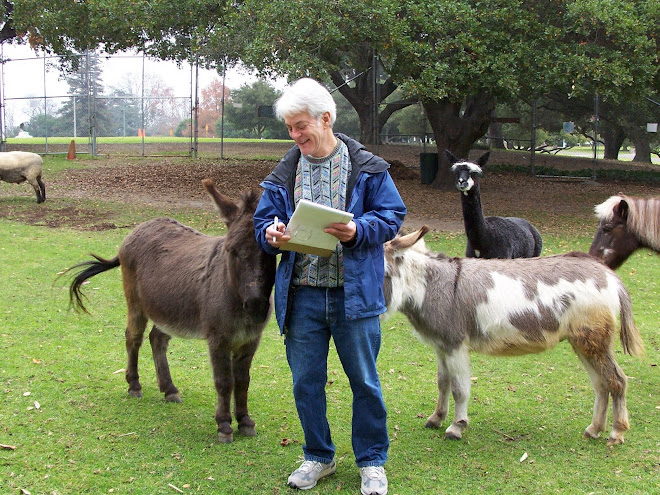
Interviewing the animals at Children's Fairyland in Oakland. L-R: Bobo the sheep, Gideon the miniature donkey, me, Tumbleweed Tommy the miniature donkey, Juan the alpaca, Coco the pony

Saturday, January 24, 2009

How Dr. Moyce Spent Inauguration Day


What did you do on Inauguration Day? Dr. Andrew Moyce of Oakland spent the day doing his civic duty: showing up for jury service at the Alameda County Courthouse.
He was ordered to be there by 8:30, with stern warnings about possible fines if he was late.
"The parking lot was full by the time I arrived at 8:15, and I had to find another lot across the street," he says. "That lot required a prepay ticket from a very slow machine, so I joined the line of a dozen or so fellow jurors waiting to pay.
"After that, a hurried walk all the way around the courthouse to find the only open entrance, followed by the security check. I got to the jury room, breathless, at about 8:45 and handed my papers to the admitting clerk."
The potential jurors - about 200 people, ranging in age from 18 to senior citizens - were ushered into the waiting room. Television sets were mounted on the pillars around the room, all tuned to the inauguration.
"The first thing that struck me was the respectful silence of the people in the room. The clerk could be heard checking people in at the door, and an occasional person talked quietly on a cell phone while people in the vicinity frowned disapproval, but overall there was an ecclesiastic silence.
"On television, Diane Feinstein had just started the ceremonies, and she held the rapt attention of everyone in the room. All eyes were on the nearest TV, and the seats with backs to the TV were empty, while several of us stood around the edges. Even during the two musical performances, no one spoke."
When the time for the oath of office arrived, Feinstein asked everyone at the ceremony to stand.
"From across the jury room a middle-aged African American lady - I think she was a clerk - called out, 'C’mon people, this is history! Stand up!'
"As she moved into the crowd, gesturing with her arms, it was plain that she was not to be denied. Within seconds, all of us were on our feet. After the oath was administered, complete with flubs, our room filled with applause, punctuated with loud whoops, and several people were in tears.
"An older white man softly applauded as the new president thanked the outgoing president for his service to the country. During his comments on upholding the Constitution, as the camera focused in on an uncomfortable-looking Mr. Bush, there were scattered outbreaks of derisive laughter. When Mr. Obama acknowledged that we are a nation of various religions - and non-believers, too - a very Berkeley-looking lady in jeans and a flannel shirt clapped alone.
"When the speech was over there was more applause from our group, and not a few handshakes and hugs were shared. All stood in formal attention as the choir sang the National Anthem, and several of us joined in.
"The mood was broken only when the clerk interrupted the broadcast to remind us that we were here for a purpose, and he started the first roll call.
"It finally occurred to me that no court business would take place during the ceremony, as the judges were probably sequestered in chambers with their own TV sets. Time at the courthouse seemed at a standstill until the business of federal government was accomplished.
"After the second roll call my name still had not been called, and those who remained in the room - about a third of the original crowd - were thanked for our service and dismissed.
"I left feeling that I had literally been swept into participation in history. Jury calls have a way of taking us out of our comfortable routines, and, after a frantic start, the day turned out in a way I hadn’t planned. But somehow when it was over, it seemed just right."

Tuesday, January 20, 2009

Hail to the chief!


The 19th Century German Chancellor Otto Von Bismarck once said, "God looks after drunks, little children and the United States of America."
If you ever needed proof of that, look at what happened today. With our whole world unraveling everywhere we look, along comes the perfect guy to deal with it.
Coincidence? I don't think so.
Shortly after Franklin D. Roosevelt was inaugurated in 1933, Justice Oliver Wendell Holmes went to the White House to check out the new president.
He came away much relieved. FDR, he said, had "a second-rate intellect." But, he added, it didn't matter because FDR had a first-rate temperament.
But we're even luckier. Our new president has both a first-rate intellect and a first-rate temperament. The last one we had with that combination was Lincoln. Like Lincoln, he has that rarest of gifts: the ability to step outside himself and look at himself objectively.
He's like a chess master, always thinking two or three moves ahead. Even during the hottest moments of the campaign, he was keeping one eye on how he would govern.
That's why he's able to brush off past slights and surround himself with people who have said really awful things about him. He's not threatened by their intellects, and he's not threatened by their ambitions. All he cares about is whether they can help him save our country.
And that's why the young people love him so much. They think of him as their best hope to move America past the issues of the 20th Century and start dealing with the issues of the 21st.
I don't think they fully appreciate the significance of having our first African American president because they're looking forward, not back. Heck, they don't even see him as black; they see him as multi-racial, which reflects the world they live in.
And they're right. Black father, white mother, growing up in Indonesia and Hawaii - he's our first global president. Everyone in the world can identify with him, and he can identify with them.
For the first time since 1963, the coolest guy on the planet, bigger than any rock star, the idol of every teenager from Beijing to Baghdad, is the President of the United States. How cool is that?
But I can't help one last glance backward to when I was a kid, when separate - but definitely not equal - was the law of the land.
It was worst in the South, where it was open season on blacks. A white could bully, cheat, rape, even kill blacks; and nobody would lift a finger.
But the shame wasn't confined to the South. Even in liberal Berkeley - Berkeley! - the schools weren't fully desegregated until September 1968, five months after Martin Luther King was killed.
That history was implicit in everything that happened Tuesday, especially in Rev. Joseph Lowery's benediction. He was with King from the very start, succeeding him as head of the Southern Christian Leadership Conference.
He began the prayer with a quote from a 109-year-old song that I'll bet every African American in the country recognized immediately: "Lift Ev'ry Voice And Sing," aka "The Negro National Anthem":
"God of our weary years/God of our silent tears/Thou who has brought us thus far on the way/Thou who has by Thy might/Led us into the light/Keep us forever in the path, we pray."
As I heard those words, the images of Emmett Till, Medgar Evers, those four little girls in Birmingham and so many others came flooding through my mind.
Not that racism is dead. As usual, the black guy had to be twice as good to get the job. But something wonderful is happening in this country.
President Obama, as usual, said it best: "What the cynics have failed to understand is that the ground has shifted beneath them."
Our president has given us our marching orders. Be the change.

Thursday, January 15, 2009

None So Great


More than 320 members of the Class of 1958 (class motto: "None so great as '58") attended their 50th reunion Oct. 3-5, the largest 50th reunion in Cal history.
They cheered when basketball captain Earl Robinson led them in the Cal spell-out, cried when they sang "Hail To California" and reminisced about what Cal was like back in the day.
"One difference is that Telegraph Avenue went all the way to Sather Gate," said reunion chairman Roger Samuelsen. "There were restaurants across the street from the Administration Building (now known as Sproul Hall), where the student union is today."
The most popular was Jules' Coffee Shop, where everyone met for a mass kaffe klatch every day at 10 a.m.
"You arranged to not have a 10 o'clock class; and if you couldn't avoid one, you'd take one for which Fybate notes were available," said Gail Follett Hughes. "I don't know why, because the coffee was terrible. It tasted like metal."
At Sather Gate the students bought ice cream from the Crunchy Munchy Man ("Cruncy Munchy/Great after lunchy," the jingle ran). And before football games at Memorial Stadium they bought frozen fruit ices called Gremlins, which the guys in the men's rooting section laced with vodka.
(Yes, there were separate rooting sections for men and women.)
Social life revolved around fraternities and sororities, with elaborate ceremonies and rigid rules.
"You couldn't wear blue jeans or Bermuda shorts in public, or you'd be 'campused' the next weekend," recalled Sharon Foster Strong. "And if you weren't inside your sorority house by curfew, you'd be locked out.
"If you were 15 minutes late, the house president would be wakened. Fifteen minutes later, the housemother would be wakened. And if you still weren't there 15 minutes after that, they'd call the dean of women, and she'd send the police out looking for you."
One of the most elaborate rituals was the pinning ceremony.
"They always took place on Monday nights, which was dress-up night at the sororities, with everyone wearing high heels and hose," said Lynn Springer Pettit. "We would sit around the dining table, trying to guess who was getting pinned.
"A lighted candle, in the color of the boy's fraternity, would be passed from girl to girl until it came to the one who was being pinned. She'd blow it out, and the rest of us would start screaming and congratulating her, and her sorority big sister would pin the pin on her sweater."
Libby Sutton Middleton added, "Then, if she were lucky and her boyfriend belonged to a local fraternity, the boys from his house would gather on our front porch and serenade us."
Strong interjected, "Another difference between then and now: Notice the correct use of the subjunctive."
Meanwhile, Jack Saroyan and Don Kosovac fondly recalled tearing down the goal post after the 1953 Big Game (a 21-21 tie that knocked Stanford out of the Rose Bowl), rushing the crossbar out of Stanford Stadium just ahead of a mob of angry Stanford fans, and driving it back to their fraternity house, Pi Kappa Alpha, in Berkeley.
"And that crossbar is still hanging from the ceiling of the dining room!" Kosovac said proudly.
But it wasn't all hijinks. Then, as now, Cal was blessed with some of the finest professors in the world, including Armand Rappaport teaching American diplomatic history, Raymond Sontag teaching European cultural history, Josephine Miles and Charles Muscatine teaching English, and Richard Aiken teaching embryology.
"Aiken was a consummate artist," said Pate Thompson. "He would create these gorgeous drawings on the backboard that I admired so much, I would come an hour before class and watch him do it."
Patricia Pereira Nielson added, "Rappaport once gave me back a paper and said, 'You didn't tell me anything I didn't already know.' It was the first time I realized that learning is more than regurgitation."
So what does Cal 1958 think of Cal 2008?
"Well, Telegraph Avenue looks dreadful, but the essence of the university is still in great shape," said Strong. "We might not agree with everything that's happened since we graduated, but remember what Clark Kerr said: 'The university isn't here to make ideas safe for the students; it's here to make the students safe for ideas.'"

(This story originally appeared in the Jan/Feb 2009 issue of California Magazine.)

Tuesday, January 6, 2009

The Man Who Put The Water In Watergate


(Above: Reds when he was serving in the Navy during World War II)

And now, in honor of the presidential inauguration, an interview with an honest-to-goodness White House plumber.
No, not one of Richard Nixon's burglars. I mean the man who actually fixed the White House plumbing.
His name was Howard "Reds" Arrington, and I met him in 1993, when I was in Washington covering the first Clinton inauguration.
Reds died last spring, but before he retired in 1979 he served every president from Harry Truman to Jimmy Carter.
He's the guy who fished John-John's diapers out of the john after Jackie's nanny inadvertently flushed them.
He's the guy who retrieved Julie Nixon's contact lens from a sink trap when she lost it right before a big party.
He's the guy who rescued Bess Truman's mother's false teeth from the toilet. (Don't even ask how they got there.)
But the president he remembered most vividly was Lyndon Johnson.
"The first day President Johnson moved in he called me and said he wanted a few changes made to his shower. He wanted six nozzles installed: two overhead - one for the front and one for the back - three at waist level, and one about two feet off the ground pointing upward, so it would send water up his backside.
"But the most unusual thing about that shower was the pressure. I put in a special pump, but he wanted it stronger. I added a second pump, but he still wasn't satisfied. I added a third pump, but that still wasn't strong enough for him.
"By the time I finished, I had four pumps going at the same time, putting out more than 100 lbs. of nozzle pressure. To give you an idea how strong that is, the average shower puts out only 10 to 15 lbs.
"But before the Secret Service let the president use it, they insisted on giving it a trial run. An agent put on a bathing suit and stepped inside. It pinned him to the wall."
Five years later, when Richard Nixon moved in, the first thing he said to Reds was, "Take that thing out of here!"
President Kennedy, on the other hand, never took showers.
"He took baths," said Reds. "I think they helped his bad back. He had his valet run the water the night before so in the morning, all he had to do was run a little hot water to heat it up. He hated waiting for anything.
"He also liked to shave sitting in the tub. I made a little tray that fit over the sides of the tub for him, to hold his razor and things. And we put mirrors on all the walls around the tub so he could see what he was doing."
President Eisenhower put Reds to some unorthodox uses, too.
"We built a full-sized putting green for him in the Oval Office. And he liked to go out on the porch and hit golf balls into the south fountain, and it was my job to fish them out for him. So he bought me a pair of waders to wear. They came up to right under my armpits."
But they aren't all pleasant memories. On Nov. 22, 1963, Reds was working in the Oval Office, helping the carpenters lay a new carpet that Jackie Kennedy had ordered as a surprise for her husband.
"All of a sudden, all hell broke out, and we were ordered to stop what we were doing and haul out all the furniture right away so the new president, President Johnson, could move in. I was OK until the time came to haul out President Kennedy's rocking chair. That's when I really lost it."
Jackie didn't forget him, either. She invited him to the funeral. You can see him in the photographs, sitting right behind Charles De Gaulle.

Thursday, January 1, 2009

The Barber Of Civility


Memo to President-elect Obama: Don't change your hair style.
Sez who? The late Milt Pitts, barber to the presidents. He cut every chief executive's hair from Richard Nixon to the first Bush, and he knew Carter was a goner in 1980 the moment Carter changed his part from right to left.
"You never change your style so dramatically overnight," Milt told me shortly before his death in 1995. "It unsettles people. It indicates a vacillating nature."
Milt was the barber at the old Sheraton-Carton Hotel (now called the St. Regis) in Washington. Twice a month, the Secret Service would chauffeur him to the White House, where there was a tiny, one-chair barbershop in the basement, right underneath the Oval Office.
When I first met Milt in 1985, he showed me a cigar box containing a lock of Ronald Reagan's hair.
"Look!" he said proudly. "Completely natural! You can tell it hasn't been dyed!"
Though he claimed to have liked all the presidents, it was obvious that Reagan was his favorite.
"The first thing I did was get rid of that pompadour. I gave him a layered cut, about 2 inches long, pretty even all around. Nancy walked in and said, 'Ronnie, don't you look good!' I knew right then and there, if Nancy liked it, I was a winner."
So what did he do with Nixon's hair?
"When Nixon first came to see me, his hair was much too long, about 8 inches, and it was dripping with Brylcreem. I took out all the grease and cut it back to 3 inches, longer in the back and fuller on the sides. It looked a lot better."
Mostly, Milt and his celebrated clients indulged in small talk. (Reagan, for instance, loved to reminisce about his old movies.) But there was one time when a president shared his inner feelings: It was Nixon, the night before he resigned.
"When I brushed him off and helped him on with his coat, he said, 'We did a lot of things right, but we've made some mistakes, too. No question of that. I'll see you sometime, perhaps at the Carlton.' Needless to say, there were tears in both our eyes."
And what was Ford like?
"The first Sunday after Ford took office, I was in the back yard mowing the lawn. My wife came out the back door and said, 'The Secret Service is calling you!' They said the president wanted his hair cut right away, and they were sending a car out to get me.
"When I got to the White House, in came Ford in his shirt sleeves, accompanied by a bunch of aides. He looked at me and said, 'Milton, I need a little haircut. Let me explain a few things to you. My hair is thinning and light, and if you cut the sideburns too short, it'll look like I have no sideburns at all. And I use Vitalis.' I said, 'Mr. President, everything you're doing is wrong.'
"All the aides started laughing, so I said, 'Excuse me, Mr. President, it's your hair I'm referring to.' And he said, 'I'm sure glad to hear that!' I gave him a shampoo, a razor cut, blow dry and a little hair spray. That way, it made his hair look thicker and fuller."
And the elder Bush?
"I've been cutting his hair for 18 years and it's never changed: shampoo, a layered cut while wet, sides short, blowdry, and a little spray. Just the way he likes it."
Milt had a shot at cutting Clinton's hair, too. He was recommended by another one of his customers, George McGovern, but he blew it a few weeks before the inauguration.
"A newspaper reporter interviewed me, and I said that Clinton looks like he has the same barber as Don King. After that, my chances went out the window."
So which president was the biggest tipper?
"To tell the truth" said Milt, "none of them has ever given me a tip."

A Guy With A Heart


This is a bittersweet day for Al Hart fans.
On the upside, it's his 81st birthday.
On the downside, he's decided to call it a career after more than four decades as the voice of KCBS. Your last chance to hear him will be next Wednesday morning, when he and John Madden do their final shmooze-fest.
His biggest fans are his peers at other radio and TV stations, who understand how hard it is to do what he makes look so easy.
"He's the gold standard in our profession," says Tom Newton, assignment manager at KRON. "All our star reporters are huge Al Hart fans. And it's not just here; people feel this way about him in newsrooms all over town. He's the guy we all want to be."
It's so rare to find someone who is not only the very best at what he does but also one of the kindest, sweetest, most decent people you'll ever meet.
People ask me if anyone can possibly be as nice as Al comes across on the radio. And the answer is no.
In real life, he's even nicer.
We've all had the unhappy experience of working with people who could be described as "kiss-up, kick-down guys." Al is the exact opposite. Longtime KCBS engineer Andy Ellis calls him "the anti-prima dona."
Kitty Rea, who was one of KCBS's first female engineers back in the 1970s, remembers most men at the station treating her like a second-class citizen, assuming she'd gotten the job only because she was a woman. But not Al.
"He never acted that way towards me or any of the other women," she says. "Here was this broadcasting legend treating me not as a lowly little girl tech who was supposed to make him look good, but as an equal. And this was way before it was fashionable or required to treat women like that in the workplace."
The women who have worked at KCBS over the years invariable call him "an old-fashioned gentleman," and it's a perfect description. He treats women with respect because he treats with respect.
Al was born in Minneapolis, Minnesota, where he learned the values of decency and tolerance common to that area. His early career included stints in Rhinelander, Wisconsin ("WOBT, home of the Ho-Dads") and Shreveport, Louisiana ("KTBS, in the heart of the Ark-La-Tex"), where he was billed as "Your pal, Al, the guy with a heart."
In Shreveport he launched a second career as a pop singer for Mercury Records. His biggest hit was "Tears Are Only Rain To Make Love Grow."
In 1966 he moved to San Francisco and went to work at KCBS as producer of Dave McElhatton's morning drive show.
It was an inspired pairing. Al invented a host of colorful characters - including Charlie the Checker and Larry Fatooker, coach of the Milpitas Mud Hens - and pretended to call in, and McElhatton pretended to interview them. The audience loved being in on the joke and ate it up.
When McElhatton moved over to Channel 5 to anchor its nightly news, Al gracefully - that's the only way he knows how to do anything - moved into his slot. And he became a Bay Area institution.
In 2000 he retired from his daily morning show to take care of his wife, Sally, who was dying from Lou Gehrig's Disease. After Sally's death KCBS coaxed him back to shoot the breeze with Madden (another big fan of his) on Wednesday mornings.
He's won every award in the book, including being in the first group to be inducted into the Bay Area Broadcasting Hall Of Fame. But more important than any award is his place in the hearts of everyone who has ever known him.
I've known him for more than 30 years. And one of the biggest honors of my life is that this great and good man thinks of me as his friend.

Sunday, December 28, 2008

Sweeter Sounds


Is the piano mightier than the sword? That's what pianist Sarah Cahill aims to find out when she premieres her new musical project, "A Sweeter Music," Jan. 25 at Cal Performances' Hertz Hall.
Cahill asked 18 eminent new music composers - including Terry Riley, Yoko Ono, Frederic Rzewski, Larry Polansky, Jerome Kitzke, Pauline Oliveros and The Residents - to compose works about peace, and they all rushed to accept.
"Any time Sarah asks me to write a piece, I say yes," said Polansky. "I don't care what it's about, I'm just flattered and honored that she asked me."
"She's just fearless and will try anything," added Kitzke, whose score calls for Cahill to speak, sing and rap the keyboard lid with her knuckles. "She's a great musician."
"This is the third or fourth piece I've written for Sarah, and she's always able to handle anything I throw at her, which is quite a variety, " said Oliveros. "This time, I've written a 12-bar blues with the audience joining in, singing, 'We want peace on Earth.' I think it's going to really rock."
"A Sweeter Music" will get its world premiere Jan. 25 at Cal Performances' Hertz Hall, augmented by a three-screen video projection by Cahill's husband, award-winning video artist/director John Sanborn.
The concert will be preceded by a panel discussion featuring Cahill and some of the composers on Jan. 23 at Wheeler Auditorium. Then Cahill will take "A Sweeter Music" on tour - first across the country and then to Europe and Asia.
The title is a quote from Martin Luther King's Nobel Prize lecture: "We must see that peace represents a sweeter music, a cosmic melody, that is far superior to the discords of war."
"It was Frederic Rzewski's arrangement of 'Down by the Riverside' that first gave me the idea," she said. "After reading news about the latest deaths in Iraq, I would sit down and play his music as a kind of catharsis.
"I kept thinking that there needed to be more pieces like this, that can provide solace and inspiration. I know a number of composers who, like me, feel so frustrated and helpless in the face of a senseless war and need to express their response in some form."
Some of the pieces are overtly anti-war, such as "Dar al-Harb," composed by 17-year-old wunderkind Preben Antonsen as a tribute to his cousin, who served in Iraq.
"He was an interrogator, which means he did all the things the government says we don't do, and he was damaged by that. The piece starts out very simple and very calm and gradually gets more and more violent, and by the end it's just an enormous flaming mass of fury with no order at all. Like the war."
Others are more pro-peace, such as Riley's gentle "Be Kind To One Another Rag," which he plays to his grandchildren at bedtime.
"When Sarah called and asked me to write an anti-war piece, I said, 'No, but I'll write some music for peace,'" said Riley, who was arrested on the first day of the Iraq war for sitting down in the middle of the street. He was sentenced to community service, which he performed by writing an anti-war song.
The premiere of "A Sweeter Music" is the latest installment in Cahill's long association with Cal Performances, which goes back more than two decades.
"She was the first person I met when I came to Berkeley," said Cal Performances Director Robert Cole. "I had just flown here to accept this job. After I signed the contract I stopped into a restaurant on Shattuck Avenue for a bite to eat, and there was this young woman playing Chopin - and beautifully, too. I thought, 'What a high class town this is!' And she's been one of my favorite collaborators ever since."
Described by the San Francisco Chronicle as "a reigning diva of avant-garde pianism," Cahill is popular with her peers because her behavior is anything but diva-like.
"You're going to have a hard time finding anyone who doesn't adore her," said Bonnie Hughes, executive director of the Berkeley Arts Festival. "She's incredibly generous, always thinking of things for other musicians to do. I mean, look at this project."
In addition to her concert career, Cahill promotes new music on her weekly two-hour radio show, "Then and Now," on KALW-FM in San Francisco, writes music criticism for local newspapers and music publications, and produces concerts such as the annual "Garden of Memory," which showcases up to 40 different musical performances at the Chapel of the Chimes Mausoleum in Oakland.
She and her brother, archaeologist/art historian Nicholas Cahill, an Indiana Jones look-alike who is directing the excavation of the palace of King Croesus at Sardis in western Turkey, grew up in an academic and artistic family in Berkeley.
Their father, James Cahill, Professor Emeritus of Art at Cal, is a leading expert on Chinese art. Their mother, Dorothy Dunlap Cahill, is a well-respected art connoisseur, according to UC Berkeley art department chair Pat Berger.
Cahill grew up listening to her father's collection of rare historical recordings of Bartok, Stravinsky and Prokofiev, and at 7 started studying with Sharon Mann, a nationally recognized expert in Bach's keyboard music
"She was the youngest student I've ever had, by far, but she was an adult in disguise," said Mann. "Her Schubert was the first thing I noticed. Children usually want something more direct, less subtle, but she was able to access music that was suggestive and nuanced. It was breathtaking to be around her."
One of her favorite pastimes was playing four-handed duets with her father, a talented amateur pianist in his own right.
"I took the hard parts and she took the easy parts until she got better than me," he said. "Then we reversed roles."
He realized just how good she was when she was 12.
"I heard her play a Brahms intermezzo, and I thought, 'My God! My daughter is telling me things about Brahms I never knew before!'"
In addition to a love of music, her father bequeathed her another legacy - one of the world's greatest collections of early, pre-Alfred E. Neuman Mad magazines, which she keeps in a safe deposit box.
Skipping her senior year at Berkeley High, she went directly to the San Francisco Conservatory of Music, where John Adams composed "China Gates" for her.
He was the first of many composers who have dedicated works to her, including Riley, Rzewski, Oliveros, Kyle Gann, Andrea Morricone and Evan Ziporyn.
Among her biggest fans are other pianists.
"She's an amazing technician," said Jerry Kuderna, a leading interpreter of Milton Babbitt and Elliott Carter. "She has the technique to play anything she wants, but she is so devoted to building this repertoire of pieces that only she can play. And that's her special gift."
Cahill says the decision to specialize in new music was a no-brainer.
"When you play classical music, the audience's attention is on how you're playing the piece. But with new music, the emphasis is on the composition itself. I like it that way. There are so many pianists playing the same Beethoven sonata, but I get to introduce a new piece by Terry Riley."
So can music really stop the war?
"I like to remember what Frederic Rzewski said: 'Music probably cannot change the world. But it's a good idea to act as though it could.'"

(A slightly different version of this story appears in the Jan/Feb 2009 issue of California Magazine. A video of Cahill playing 'Down by the Riverside' can be viewed online at http://calperfs.berkeley.edu/presents/media/2006/edge_fest/Rzewski_Cahill_High.mov)