A columnist of heart and mind

A columnist of heart and mind
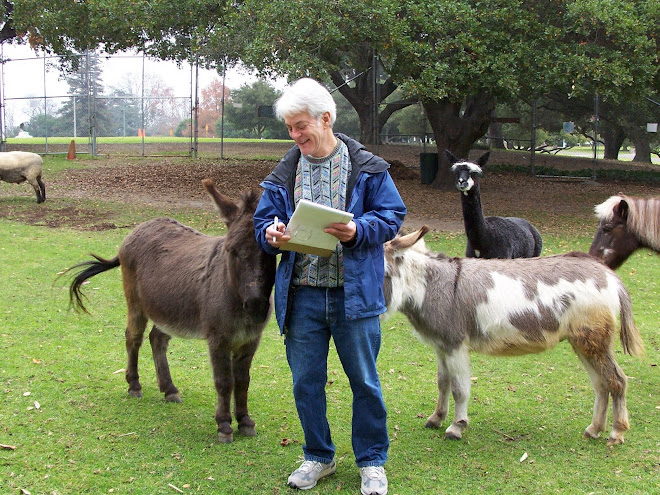
Interviewing the animals at Children's Fairyland in Oakland. L-R: Bobo the sheep, Gideon the miniature donkey, me, Tumbleweed Tommy the miniature donkey, Juan the alpaca, Coco the pony

Wednesday, November 5, 2008

Hail to the chief!


I haven't been able to stop crying since Tuesday. They're the first tears I've shed since 9/11, but these are tears of joy.
We hold these truths to be self-evident: That all men and women are created equal.
Finally, after 232 years, the American people have redeemed that pledge. Is this the greatest country in the world or what?
I'm old enough to remember drinking fountains labeled "white" and "colored" and American citizens being killed for the crime of attempting to vote.
Now they are not only voting, an African American has been elected to the highest office in the land.
But he's not just anyone. Our new president is the best we've got. He is wise and brave and good and smart. After 16 years of Baby Boomer presidents, it'll be nice to have a grownup in the White House again.
I feel like I've finally wakened from a nightmare that’s been going on for 40 years.
I watched my country being torn apart by meaningless culture wars while the real problems were left to fester year after year, decade after decade.
But now I have my country back. I mean the country as it was taught to me in high school civics class - a nation where all people are treated equally and the whole world looks to America as (to use Lincoln's words) "the last, best hope of man."
What happened on Tuesday wasn't a victory of party. It was the victory of a new generation of Americans who are sick and tired of what my generation, the Baby Boomers, have done to this country.
They've had it with our narcissism, our self-righteousness and our arrogance.
However respectfully they treat us (as they always do), make no mistake: We have firmly been given the heave-ho. There will never be another Boomer president. And the days of our zero-sum, I-win-you-lose politics are over.
That's why Democrats who are lusting for revenge after eight years in the wilderness are going to be sorely disappointed. The last thing Obama wants to do is replace a bunch of right-wing ideologues with a bunch of left-wing ideologues.
Instead, we're about to have a government of national unity, with prominent members of the opposition in key cabinet positions.
That's what JFK did after his paper-thin victory over Nixon in 1960, and what FDR did after Pearl Harbor. And it's what Bush should have done in 2000 after the Bush v. Gore fiasco, and in 2001 after 9/11.
I'm glad Obama's victory was so decisive because now he'll be able to reach out to the Republicans without it being interpreted as weakness. It will be seen for what it is: a magnanimous gesture.
He understands that somebody has to call a halt to the tit-for-tat that has crippled our politics for so long.
He also understands that his true base isn't racial or ideological, it's generational. He has to answer to the millions of young people who flocked to his standard.
They are the true victors. They consider it their patriotic duty to lay aside all the old differences that have divided us for decades and work together for the common good.
They are the ones who will have to live with the consequences of our decisions, so I'm glad they're getting the president they want. They deserve it.
It won't be easy. We have just handed him a set of problems more daunting than any president has faced since FDR.
But I think he's up to it. And so are we.
As Winston Churchill said during the gloomiest days of World War II, "These are not dark days: They are great days - the greatest days our country has ever lived. And we must all thank God that we have been allowed, each of us according to our stations, to play a part in making these days memorable in the history of our race."

Sunday, October 26, 2008

When Elections Really Were Fun


I can hardly wait until Election Night. After the most exciting election race in memory, we'll finally have a winner.
But oh, how I miss Nelson Polsby. It would be so much more fun if he were still here.
Nelson died Feb. 6, 2007. As director of UC Berkeley's Institute of Governmental Studies from 1988 to 1999, he probably knew more about American politics than anyone else in the world.
He didn't waste his time speculating about how politics ought to be; he was fascinated by politics as they are. His special delight was skewering conventional wisdom with unconventional ideas.
Take his final book, "How Congress Evolves" (2004), which argued that today's polarized politics were caused by air conditioning.
The theory goes like this: When air conditioning became common after World War II, the South suddenly became habitable. And Northerners - half of them Republicans - started moving there.
As a result, there were now enough Republicans in the South that being one was no longer political suicide. So the Dixiecrats switched parties en masse, making the national Republican Party more conservative (by addition) and the Democrats more liberal (by subtraction).
Anyway, since Nelson isn't here, I'll say it for him: Presidential elections aren't as much fun they used to be.
Where are the great campaign songs of yesteryear, like "Sidewalks of New York" (Al Smith 1928), "Happy Days Are Here Again" (FDR 1932) and "High Hopes" (JFK 1960)?
Where are the great slogans, like "Tippecanoe and Tyler too" (Harrison 1840), "Don't Swap Horses in the Middle of the Stream" (Lincoln 1864) and "Keep Cool With Coolidge" (Coolidge 1924)?
My favorite slogan was "I Like Ike" (Eisenhower 1952) - short, simple and much snapper than opponent Adlai Stevenson's "I'm Madly For Adlai" and "We Need Adlai Badly."
But Stevenson redeemed himself with a great concession speech: "I feel like the boy who stubbed his toe. He said it hurt too much to laugh, but he was too old to cry."
I also miss paper ballots.
The best thing was that they took a long time to count. So the East Coast returns didn't come in until about 8 p.m. Pacific Time, obviating the risk of the election being decided before the polls closed on the West Coast, which actually happened in 1980.
And I loved the delicious suspense of watching the tension mount through the evening as the returns slowly rolled in across the country.
Elections often weren't decided until the wee small hours of the morning. In 1916 Republican Charles Evans Hughes went to bed convinced he had been elected president. But late overnight returns from California gave the nod to Democrat Woodrow Wilson, instead.
The next morning a reporter phoned the Hughes home.
"The president is asleep," said Hughes' son.
"Well," said the reporter, "when he wakes up, tell him he isn't president."
But nowadays the networks announce the winner as soon as the polls close. And the rest of the night is one long anti-climax, like opening all your Christmas presents in the first five minutes and having nothing to do for the rest of the day.
But whatever happens on Tuesday, the East Bay's best-known power couple, Tom Bates and Loni Hancock, will finally be able to settle a long-standing argument.
He's running for re-election as mayor of Berkeley (a job she once held), and she's running for the state senate (a job he once held).
"We got married on the Sunday after I was first elected mayor in 1986, which was Nov. 9," said Hancock. "Tom thinks we should celebrate our anniversary on Nov. 9, and I think we should celebrate on the first Sunday after Election Day."
Bates added, "We've always compromised by celebrating on her date in odd years and on my date in even years. But this year the two dates coincide, for the first time since we got married. So we can finally agree on which day to celebrate."

Monday, October 20, 2008

A Man For All Seasons


An important anniversary is coming up on Tuesday, although I doubt many people will take note of it. Fifty years ago, the College of Cardinals emerged from the Sistine Chapel to announce that they had elected a dark horse as the new pope.
They chose the kindly Patriarch of Venice, Angelo Roncalli, assuming he would be a temporary caretaker because he was already 77.
But they were wrong. Roncalli, who took the name John XXIII, lived only another five years; but that was long enough for him to change the world.
I remember the day he died. The radio announcer said, "Ladies and gentlemen, I have terrible news. Our beloved Pope John is dead."
And the announcer wasn't even Catholic. You see, Papa John wasn't just the pope of the Catholics, he was everyone's. He was loved by Catholics, Protestants, Orthodox, Jews, Muslims, Buddhists, people of all faiths and people of none.
He didn't look very impressive. He was a fat, dumpy little man with a face like a kindly old Italian grandmother.
"His face was like a jigsaw puzzle of borrowed pieces," wrote religious scholar Peter de Rosa. "But his heart was one of God's masterpieces."
As Papal Nuncio to Turkey during World War II, he smuggled thousands of Jews to safety. That's why he's known in Israel as a Righteous Gentile, the highest honor Jews can pay to a non-Jew.
After the war, the Vatican sent him to France on a delicate diplomatic mission: to save the Church from the vengeance of Charles De Gaulle, who wanted to put three French cardinals and 20 bishops on trial for treason because they collaborated with the Vichy regime.
He not only dissuaded De Gaulle, he did it with such tact that Edouard Herriot, leader of the rabidly anti-clerical Radical party, said, "If all priests were like Nuncio Roncalli, there would be no anti-clericals left!" After Papa John's death, De Gaulle himself filed a letter with the Vatican attesting to his sainthood.
As pope, he didn't think it was his job to lecture people or root out heresy or issue dire warnings about the future. He thought his job was to be a good Christian. And that meant carrying out the injunction of the Gospels: to love everyone.
That included the prisoners in Rome's infamous Regina Coeli prison, whom he visited shortly after his election, saying, "You cannot come to see me, so I have come to see you."
And the little boy who wrote to him, saying he couldn't make up his mind whether to be a pope or a policeman. Papa John wrote back, "It would be safer for you to train for the police. Anyone can be pope - as you can see, since I became one."
And it especially included those who disagreed with him: communists, capitalists and church conservatives alike. To all of them, he was simply The Good Shepherd.
He was the pope who took the anti-Semitic language out of the liturgy, and the first to reach out to the Jewish community. Many Jews fondly recall the words from the Bible he used in greeting a delegation of rabbis: "I am Joseph, your brother."
And, of course, he was the genius who dreamed up the Ecumenical Council, one of the most revolutionary events in Church history.
He inherited a Church that was mired in arcane scholastic disputes and obsessed with the torments of Hell. He left it suffused with love, charity and service to others, and with its eye turned firmly toward Heaven.
He may not have been a caretaker, but he took awfully good care of his Church. He was truly Christ's vicar on Earth.
Papa John was beatified by the Vatican in 2000, which is just one step away from sainthood. But the whole world already knew: If ever a saint walked this earth, Angelo Giuseppe Roncalli, also known as Pope John XXIII, was it.

Thursday, October 16, 2008

The moment McCain lost the election


Every once in a while, you can spot the exact moment when an election is won or lost.
In 1976, it was when Jerry Ford denied that Poland was under the thumb of the Soviet Union.
In 1984, it was when Ronald Reagan said he wasn't going to make an issue of Mondale's "youth and inexperience" (which was funny because Mondale was middle aged and had been on the political scene for years).
This year's moment came last night, right after Obama outlined his rather moderate position on the abortion, saying he'd be willing to consider a late-term abortion ban if it included an exception for the life or health of the mother.
McCain replied, "Just again, the example of the eloquence of Sen. Obama. He's health for the mother. You know, that's been stretched by the pro-abortion movement in America to mean almost anything. That's the extreme pro-abortion position, quote, 'health.'"
Aside from the fact that every pro-choice person in America is going to resent being labeled "pro-abortion," the sneer when he said 'health' sent a Cindy McCain-like cold shiver down the spine of not only every woman, but every man who has daughters. And, I suspect, many more people.
This election is over.

Sunday, October 12, 2008

That championship season


The 1958 Cal football team, the last Golden Bears squad to go to the Rose Bowl, will hold their 50th reunion Oct. 24-26. And that season is still magical, even 50 years later.
This was a team that had won only one game the year before. And except for the two captains - quarterback Joe Kapp and halfback Jack Hart - they were sophomores and juniors. The running joke was that they were "small but slow."
The season didn't start off auspiciously. The first game was a 24-20 loss to COP (now UOP), whose All-America running back, Dick Bass, ran wild.
"On one of his long touchdown runs, every guy on our team had a shot at him," said tight end Tom Bates, who is now mayor of Berkeley. "I had two shots, and I missed both times."
The next game was even worse - a 32-12 loss to mighty Michigan State.
But at practice the following week, everything turned around.
"As we ran our offensive plays for timing and precision, the coaches made us run really hard for about 10 yards," said halfback Hank Olguin. "But Joe and Jack kept running after the play ended. And we ran after them, shouting and howling all the way down the field.
"The coaches were dumbfounded; we were essentially running wind sprints on every play. Our collective will to win was extraordinary. I'll never forget that week of practice as long as I live."
Thus fired up, they went out and crushed a heavily favored Washington State team, 34-14. And, except for a one-point loss to Oregon State, they ran the table the rest of the season.
"Our secret was that there were no stars," said Kapp. "We won because we played together as a team."
"Joe's just being modest, as usual," demurred guard Pete Domoto. "The truth is that it began and ended with him. He was so talented, he could have started at all 22 positions, offense or defense."
But in a larger sense, Kapp was right. The '58 team was a classic case of what the military calls "unit cohesion" - an extremely close group of friends working together under a charismatic leader. In the end, they did it for each other.
The charismatic leader, of course, was Kapp. By happy coincidence, the best athlete on the team was also its fiercest competitor.
"I'll never forget the moment we hit the field at the Washington State game," said Olguin. "We all clasped hands in the huddle, and Joe looked at us with those grinning teeth of his and said, 'Anyone who doesn't think we're going to win this game get the (bleep) off the field!'"
Back then, players had to play both offense and defense, which put a premium on conditioning. So all those wind sprints came in handy, especially as the season wore on.
"Another factor is that we got almost no penalties," said fullback Bill Patton. "We were a very smart team."
Everyone rallied around the team. Two frequent visitors on the sidelines were U.S. Chief Justice Earl Warren (Cal '12) and Cal Chancellor (and Nobel laureate) Glenn Seaborg, who was proud that his name was an anagram for "Go Bears."
But the players weren't pampered the way players are now. Athletic scholarships were only $125 per month. And for this they had to clean the stadium after every game and water the field during the off-season.
I'd love to report that Cal won the Rose Bowl. But, alas, they lost to a powerful Iowa team, 38-12.
"But the important thing is that we won as a team and we lost as a team," said Kapp.
To a man, they insist that they want nothing more than to see the Bears go back to the Rose Bowl again.
"Fifty years is way too long," said left end Bob Duey.
"That's what they say," said his wife, Pat. "But I think they're secretly thrilled to be the last Rose Bowl team."

Wednesday, October 8, 2008

Brennan's is here to stay


For the last few weeks, I've been getting calls and e-mails from anxious customers of Brennan's Restaurant, who are hearing rumors that their favorite eatery is about to close.
Relax, folks. Brennan's isn't going anywhere.
Actually, that's not quite true. It is going somewhere - next door, into the historic Santa Fe depot.
The last day in the old place was Monday. Brennan's will re-open on the new site this weekend, barring a last-minute glitch.
"In a perfect world, we'd stay right here for another 50 years," said Margaret Wade, granddaughter of founder Jack Brennan. "But it was a choice between moving now or waiting until our lease expires in 2012 and taking our chances that we'd be able to find someplace suitable."
Architecturally, the Mission-style Santa Fe depot is a big step up from the old building, a rectangular box that Brennan, a retired contractor, built with his own hands in 1959.
But the exterior doesn’t' really matter. The essence of Brennan's is the interior - the pictures on the walls, the menu board over the serving counter, the tables and chairs. They're all moving to the new place. And the food will still be served cafeteria-style.
The only major icon that isn't going is the bar.
"It's mostly old, bad fake wood and plastic laminate," said Wade. "But we will be taking the brass foot rail and the bar stools."
But what really makes Brennan's special is the people, and they're all going to the new place, too, including Jim "Float" Agrusa, who has been tending bar at Brennan's since 1975 and knows what every regular wants to drink the moment they walk in the door and has it ready for them by the time they get to the bar.
"There's always hell to pay whenever he goes on vacation," said Wade. "People ask in a somewhat grumpy voice, 'Where's Float?'"
Wade's grandfather founded Brennan's so he could have a place to eat that served the simple meat-and-potatoes fare he loved. The menu hasn't changed much since then, and that's just the way the regulars like it.
"It's nice to know you can go in and get exactly what you expect," said Jerry Figone of El Cerrito, a customer since the day Brennan's opened in 1959, when he was in high school. "The roast beef is always going to be great, and so is the turkey and corned beef."
Brennan located his restaurant at the foot of University Avenue, partly to take advantage of the spillover business from nearby Spenger's Fish Grotto. From the beginning, it has been a hangout for people from all different walks of life, and each group had its own territory.
When I discovered it back in the '70s, the cops sat near the entrance, next to the now long-gone cigarette machine. The politicos, including Jerry Brown, sat in the northwest corner. Next to them sat deputy coroner Michael King, known to his fellow regulars as "The Grateful Dead."
From the start, Brennan's has been a place where everyone knows your name. It's also a piece of living, breathing Berkeley history. I'm glad reports of its demise are greatly exaggerated.
* * *
Speaking of Berkeley history, did you play football for Cal in 1957 or 1959? The guys on the '58 team invite you to join them at their 50th reunion Oct. 24-26, the weekend of the UCLA game.
The guest of honor will be your old coach, Pete Elliott. Assistant coach John Ralston, who later went on to great coaching success at (gasp!) Stanford, will also be there. On Saturday, you'll sit in a special section at the game.
I'm going to write more about the '58 team next week, but in the meantime they wanted me to get the word out to '57 and '59 players as early as possible.
So if you're one of Pete's Boys (the successors to Pappy's Boys), call Andy Segale at 925-934-8168 or Pete Domoto at 360-387990.

Monday, October 6, 2008

Debate prediction: McCain will channel Carter, Obama will channel Reagan


I think tomorrow is make or break night, and here's how I think it's going to shape up: McCain will go negative to the max.
I think he believes it's his only shot at getting everyone's attention off the economy. Besides, he's a risk-taker by nature, and his default impulse when under stress is to double down on his bet.
His problem, of course, is that while his favorite game is craps, Obama's favorite game is poker. Obama is lying in wait for him.
To switch images, Obama will be the matador and McCain will be the bull. Whenever McCain brings up Ayers or Rev. Wright, Obama will say, "There you go again," as Ronald Reagan did when debating Jimmy Carter, and then turn the conversation back to the economy.
After tomorrow, Obama's lead will be in the double digits.