A columnist of heart and mind

A columnist of heart and mind
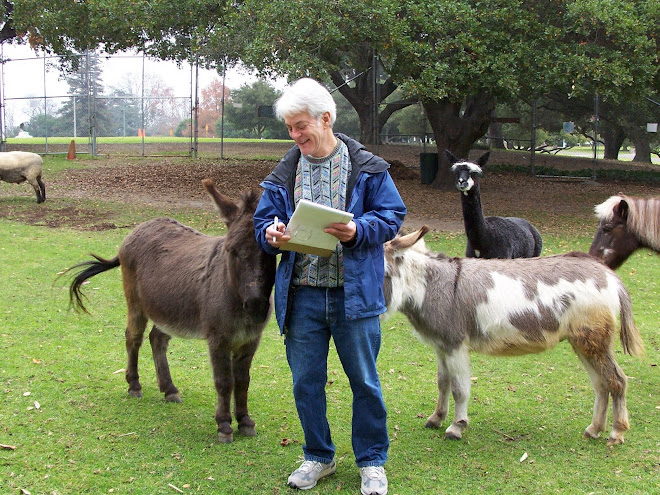
Interviewing the animals at Children's Fairyland in Oakland. L-R: Bobo the sheep, Gideon the miniature donkey, me, Tumbleweed Tommy the miniature donkey, Juan the alpaca, Coco the pony

Monday, October 20, 2008

A Man For All Seasons


An important anniversary is coming up on Tuesday, although I doubt many people will take note of it. Fifty years ago, the College of Cardinals emerged from the Sistine Chapel to announce that they had elected a dark horse as the new pope.
They chose the kindly Patriarch of Venice, Angelo Roncalli, assuming he would be a temporary caretaker because he was already 77.
But they were wrong. Roncalli, who took the name John XXIII, lived only another five years; but that was long enough for him to change the world.
I remember the day he died. The radio announcer said, "Ladies and gentlemen, I have terrible news. Our beloved Pope John is dead."
And the announcer wasn't even Catholic. You see, Papa John wasn't just the pope of the Catholics, he was everyone's. He was loved by Catholics, Protestants, Orthodox, Jews, Muslims, Buddhists, people of all faiths and people of none.
He didn't look very impressive. He was a fat, dumpy little man with a face like a kindly old Italian grandmother.
"His face was like a jigsaw puzzle of borrowed pieces," wrote religious scholar Peter de Rosa. "But his heart was one of God's masterpieces."
As Papal Nuncio to Turkey during World War II, he smuggled thousands of Jews to safety. That's why he's known in Israel as a Righteous Gentile, the highest honor Jews can pay to a non-Jew.
After the war, the Vatican sent him to France on a delicate diplomatic mission: to save the Church from the vengeance of Charles De Gaulle, who wanted to put three French cardinals and 20 bishops on trial for treason because they collaborated with the Vichy regime.
He not only dissuaded De Gaulle, he did it with such tact that Edouard Herriot, leader of the rabidly anti-clerical Radical party, said, "If all priests were like Nuncio Roncalli, there would be no anti-clericals left!" After Papa John's death, De Gaulle himself filed a letter with the Vatican attesting to his sainthood.
As pope, he didn't think it was his job to lecture people or root out heresy or issue dire warnings about the future. He thought his job was to be a good Christian. And that meant carrying out the injunction of the Gospels: to love everyone.
That included the prisoners in Rome's infamous Regina Coeli prison, whom he visited shortly after his election, saying, "You cannot come to see me, so I have come to see you."
And the little boy who wrote to him, saying he couldn't make up his mind whether to be a pope or a policeman. Papa John wrote back, "It would be safer for you to train for the police. Anyone can be pope - as you can see, since I became one."
And it especially included those who disagreed with him: communists, capitalists and church conservatives alike. To all of them, he was simply The Good Shepherd.
He was the pope who took the anti-Semitic language out of the liturgy, and the first to reach out to the Jewish community. Many Jews fondly recall the words from the Bible he used in greeting a delegation of rabbis: "I am Joseph, your brother."
And, of course, he was the genius who dreamed up the Ecumenical Council, one of the most revolutionary events in Church history.
He inherited a Church that was mired in arcane scholastic disputes and obsessed with the torments of Hell. He left it suffused with love, charity and service to others, and with its eye turned firmly toward Heaven.
He may not have been a caretaker, but he took awfully good care of his Church. He was truly Christ's vicar on Earth.
Papa John was beatified by the Vatican in 2000, which is just one step away from sainthood. But the whole world already knew: If ever a saint walked this earth, Angelo Giuseppe Roncalli, also known as Pope John XXIII, was it.

Thursday, October 16, 2008

The moment McCain lost the election


Every once in a while, you can spot the exact moment when an election is won or lost.
In 1976, it was when Jerry Ford denied that Poland was under the thumb of the Soviet Union.
In 1984, it was when Ronald Reagan said he wasn't going to make an issue of Mondale's "youth and inexperience" (which was funny because Mondale was middle aged and had been on the political scene for years).
This year's moment came last night, right after Obama outlined his rather moderate position on the abortion, saying he'd be willing to consider a late-term abortion ban if it included an exception for the life or health of the mother.
McCain replied, "Just again, the example of the eloquence of Sen. Obama. He's health for the mother. You know, that's been stretched by the pro-abortion movement in America to mean almost anything. That's the extreme pro-abortion position, quote, 'health.'"
Aside from the fact that every pro-choice person in America is going to resent being labeled "pro-abortion," the sneer when he said 'health' sent a Cindy McCain-like cold shiver down the spine of not only every woman, but every man who has daughters. And, I suspect, many more people.
This election is over.

Sunday, October 12, 2008

That championship season


The 1958 Cal football team, the last Golden Bears squad to go to the Rose Bowl, will hold their 50th reunion Oct. 24-26. And that season is still magical, even 50 years later.
This was a team that had won only one game the year before. And except for the two captains - quarterback Joe Kapp and halfback Jack Hart - they were sophomores and juniors. The running joke was that they were "small but slow."
The season didn't start off auspiciously. The first game was a 24-20 loss to COP (now UOP), whose All-America running back, Dick Bass, ran wild.
"On one of his long touchdown runs, every guy on our team had a shot at him," said tight end Tom Bates, who is now mayor of Berkeley. "I had two shots, and I missed both times."
The next game was even worse - a 32-12 loss to mighty Michigan State.
But at practice the following week, everything turned around.
"As we ran our offensive plays for timing and precision, the coaches made us run really hard for about 10 yards," said halfback Hank Olguin. "But Joe and Jack kept running after the play ended. And we ran after them, shouting and howling all the way down the field.
"The coaches were dumbfounded; we were essentially running wind sprints on every play. Our collective will to win was extraordinary. I'll never forget that week of practice as long as I live."
Thus fired up, they went out and crushed a heavily favored Washington State team, 34-14. And, except for a one-point loss to Oregon State, they ran the table the rest of the season.
"Our secret was that there were no stars," said Kapp. "We won because we played together as a team."
"Joe's just being modest, as usual," demurred guard Pete Domoto. "The truth is that it began and ended with him. He was so talented, he could have started at all 22 positions, offense or defense."
But in a larger sense, Kapp was right. The '58 team was a classic case of what the military calls "unit cohesion" - an extremely close group of friends working together under a charismatic leader. In the end, they did it for each other.
The charismatic leader, of course, was Kapp. By happy coincidence, the best athlete on the team was also its fiercest competitor.
"I'll never forget the moment we hit the field at the Washington State game," said Olguin. "We all clasped hands in the huddle, and Joe looked at us with those grinning teeth of his and said, 'Anyone who doesn't think we're going to win this game get the (bleep) off the field!'"
Back then, players had to play both offense and defense, which put a premium on conditioning. So all those wind sprints came in handy, especially as the season wore on.
"Another factor is that we got almost no penalties," said fullback Bill Patton. "We were a very smart team."
Everyone rallied around the team. Two frequent visitors on the sidelines were U.S. Chief Justice Earl Warren (Cal '12) and Cal Chancellor (and Nobel laureate) Glenn Seaborg, who was proud that his name was an anagram for "Go Bears."
But the players weren't pampered the way players are now. Athletic scholarships were only $125 per month. And for this they had to clean the stadium after every game and water the field during the off-season.
I'd love to report that Cal won the Rose Bowl. But, alas, they lost to a powerful Iowa team, 38-12.
"But the important thing is that we won as a team and we lost as a team," said Kapp.
To a man, they insist that they want nothing more than to see the Bears go back to the Rose Bowl again.
"Fifty years is way too long," said left end Bob Duey.
"That's what they say," said his wife, Pat. "But I think they're secretly thrilled to be the last Rose Bowl team."

Wednesday, October 8, 2008

Brennan's is here to stay


For the last few weeks, I've been getting calls and e-mails from anxious customers of Brennan's Restaurant, who are hearing rumors that their favorite eatery is about to close.
Relax, folks. Brennan's isn't going anywhere.
Actually, that's not quite true. It is going somewhere - next door, into the historic Santa Fe depot.
The last day in the old place was Monday. Brennan's will re-open on the new site this weekend, barring a last-minute glitch.
"In a perfect world, we'd stay right here for another 50 years," said Margaret Wade, granddaughter of founder Jack Brennan. "But it was a choice between moving now or waiting until our lease expires in 2012 and taking our chances that we'd be able to find someplace suitable."
Architecturally, the Mission-style Santa Fe depot is a big step up from the old building, a rectangular box that Brennan, a retired contractor, built with his own hands in 1959.
But the exterior doesn’t' really matter. The essence of Brennan's is the interior - the pictures on the walls, the menu board over the serving counter, the tables and chairs. They're all moving to the new place. And the food will still be served cafeteria-style.
The only major icon that isn't going is the bar.
"It's mostly old, bad fake wood and plastic laminate," said Wade. "But we will be taking the brass foot rail and the bar stools."
But what really makes Brennan's special is the people, and they're all going to the new place, too, including Jim "Float" Agrusa, who has been tending bar at Brennan's since 1975 and knows what every regular wants to drink the moment they walk in the door and has it ready for them by the time they get to the bar.
"There's always hell to pay whenever he goes on vacation," said Wade. "People ask in a somewhat grumpy voice, 'Where's Float?'"
Wade's grandfather founded Brennan's so he could have a place to eat that served the simple meat-and-potatoes fare he loved. The menu hasn't changed much since then, and that's just the way the regulars like it.
"It's nice to know you can go in and get exactly what you expect," said Jerry Figone of El Cerrito, a customer since the day Brennan's opened in 1959, when he was in high school. "The roast beef is always going to be great, and so is the turkey and corned beef."
Brennan located his restaurant at the foot of University Avenue, partly to take advantage of the spillover business from nearby Spenger's Fish Grotto. From the beginning, it has been a hangout for people from all different walks of life, and each group had its own territory.
When I discovered it back in the '70s, the cops sat near the entrance, next to the now long-gone cigarette machine. The politicos, including Jerry Brown, sat in the northwest corner. Next to them sat deputy coroner Michael King, known to his fellow regulars as "The Grateful Dead."
From the start, Brennan's has been a place where everyone knows your name. It's also a piece of living, breathing Berkeley history. I'm glad reports of its demise are greatly exaggerated.
* * *
Speaking of Berkeley history, did you play football for Cal in 1957 or 1959? The guys on the '58 team invite you to join them at their 50th reunion Oct. 24-26, the weekend of the UCLA game.
The guest of honor will be your old coach, Pete Elliott. Assistant coach John Ralston, who later went on to great coaching success at (gasp!) Stanford, will also be there. On Saturday, you'll sit in a special section at the game.
I'm going to write more about the '58 team next week, but in the meantime they wanted me to get the word out to '57 and '59 players as early as possible.
So if you're one of Pete's Boys (the successors to Pappy's Boys), call Andy Segale at 925-934-8168 or Pete Domoto at 360-387990.

Monday, October 6, 2008

Debate prediction: McCain will channel Carter, Obama will channel Reagan


I think tomorrow is make or break night, and here's how I think it's going to shape up: McCain will go negative to the max.
I think he believes it's his only shot at getting everyone's attention off the economy. Besides, he's a risk-taker by nature, and his default impulse when under stress is to double down on his bet.
His problem, of course, is that while his favorite game is craps, Obama's favorite game is poker. Obama is lying in wait for him.
To switch images, Obama will be the matador and McCain will be the bull. Whenever McCain brings up Ayers or Rev. Wright, Obama will say, "There you go again," as Ronald Reagan did when debating Jimmy Carter, and then turn the conversation back to the economy.
After tomorrow, Obama's lead will be in the double digits.

Saturday, September 27, 2008

Paul Newman R.I.P.


I don't know about you, but I was taken aback by the depth of my sorrow this morning when I heard that Paul Newman had died.
He was the coolest guy of our time - an unpretentious man who lived as far away as he could from Hollywood, stayed married to the same woman for 50 years, and was most comfortable hanging out with people who didn't have the slightest idea he was somebody famous, such as the cancer-stricken little kids at his Hole In The Wall Camp.
When I was growing up in L.A. during the late '50s and early '60s, he was a common sight zipping around town in his Porsche 550 Spyder - except it didn't look like one.
He removed the body and substituted one from a beat-up old Volkswagen Beetle. On the outside, it looked just like a VW. But inside, it was still a racetrack-ready Porsche.
It gave him a huge kick to watch the stunned look on the faces of other drivers when he passed them on steep hills.
Newman wasn't the best actor of his generation. That distinction goes to Marlon Brando.
But he was something better: the actor who embodied his generation's fondest ideal of what American men are really like deep down - world-weary anti-heroes who end up doing the right thing in the last reel.
He was a part of a line that runs directly from Clark Gable through Humphrey Bogart, William Holden, Newman, Harrison Ford and Tom Hanks.
Without exception, they tended to under-act. And their work still feels natural, even today.
Compare them to the parallel line of "best actors," which runs from Paul Muni through Spencer Tracy, Brando, Jack Nicholson and Sean Penn.
Except for Tracy, they tended to over-act. They wanted you to see what great actors they were. As a result, much of their work looks over-the-top to our 21st Century tastes.
Sure, you admire the virtuosity when you watch Brando or Nicholson melting down. But you're still thinking, "What terrific acting," not "Aw, the poor guy." You're watching the actor, not the character.
But in Newman's movies, whether he was Fast Eddie Felson in "The Hustler," Rocky Graziano in "Somebody Up There Likes Me," Ari Ben Canaan in "Exodus" or Butch Cassidy to Robert Redford's Sundance Kid, you always rooted for the character, not the actor who was playing him.
And his salad dressing wasn't bad, either.
Newman was a steadfast Democrat, long before liberalism became the flavor du jour in Hollywood. An avid supporter of the civil rights and anti-war movements, he claimed his proudest achievement was making Richard Nixon's "enemies list."
And he had a rare quality in Hollywood, then and now: humility.
After his first movie, "The Silver Chalice," was released, he took out a full-page ad in Variety apologizing for the movie and his performance in it.
Back in 1968, when he was campaigning for anti-war candidate Eugene McCarthy in New Hampshire, one of the officers in his police escort pointed to his partner and told Newman that the man had received word the night before that his son had been killed in Vietnam.
Saddened by the news, Newman offered the grieving father his condolences and added thoughtfully, "What do you think about some creep, some Hollywood peacenik, coming in here and telling you about the war?"
"I don't resent you," the father replied. "Even if a war takes your boy, that doesn't make it right."
Last month, Newman's doctors told him he had only a few days to live. So he checked himself out of the hospital and died at home, surrounded by his family.
But what do you want to bet that he filled out an absentee ballot for Obama and mailed it in before he died?

Thursday, September 25, 2008

Making a joyful noise unto The Lord


Happy Rosh Hashanah to the happiest man I know. His name is Yehuda Ferris, and he's the rabbi at Chabad House in Berkeley.
Like other Jews all over the world, he's busy cleaning his house and stocking up on sweets in anticipation of the holiday, which begins next Monday at sundown.
"No vinegar, green apples, pickles or herring," he says. "We'll only eat sweet things, to express our wish for a sweet year."
Rosh Hashanah is the start of the High Holy Days, which culminate 10 days later on Yom Kippur, the Day of Atonement.
Jews believe that during this period God decides the fate of the world.
"He's taking inventory," says Ferris. "Running the world is a business, like any other. If there's a profit, he'll keep the world going for another year. If not, goodbye world."
But God doesn't measure profit by dollars and cents. He measures it by good deeds, called mitzvahs. There are 613 mitzvahs in all. (Remember that number. It'll pop up again.)
Some mitzvahs are about our relationship with each other, such as caring for widows and orphans. Others are about our relationship with God, such as observing the dietary laws.
"Our job is to do as many mitzvahs as we can in this 10-day period. But they must be performed with a joyous heart, not out of duty," says Ferris.
So what makes him so happy?
He belongs to a branch of Judaism called Hassidism, which was founded about 280 years ago by Rabbi Israel ben Eliezer, better known as the Ba'al Shem Tov (Master of the Good Name).
The Ba'al Shem Tov came along at a time when Judaism was in the doldrums, after suffering a series of brutal pogroms in Eastern Europe. Many Jews responded to the outside pressure by turning inward and devoting their lives to studying the Talmud. But the Ba'al Shem Tov went the other way.
Though an eminent Talmudic scholar himself, he said a personal relationship with God is more important than book learning, and even a simple, illiterate person can have one.
He called that relationship "cleaving to God;" and for his followers, it's an ecstatic experience.
"Even something as simple as tying your shoelaces or changing your baby's diaper can bring you closer to God, if it's done in the right spirit," says Ferris. "If you stop and think about all the blessings The Lord has given us, it's just overwhelming. All you can do is laugh and sing and dance with gratitude and joy."
To Ferris, all the wonders of the universe can be seen in a single flower petal. It's the same epiphany that the hippies were trying to achieve by taking LSD back in the '60s. But Ferris doesn't need any drugs, and the high doesn't wear off after a few hours.
Rosh Hashanah will kick off at exactly 6:13 p.m. Monday with a joyful - even raucous - celebration at the Bancroft Hotel. The festivities will include prayers, jokes, singing, dancing and symbolic foods such as pomegranates, which are sweet to the taste and contain exactly 613 seeds. The partying will go on until the wee small hours of the morning.
Not everyone thinks such enthusiasm is seemly. Even in his own lifetime, the Ba'al Shem Tov was criticized by the rabbinical establishment, who said carrying on like this is undignified, even crazy. This is what he replied:
"Once, in a house, there was a wedding festival. The musicians sat in a corner and played their instruments, the guests danced to the music and were merry, and the house was filled with joy.
"But a deaf man passed outside the house. He looked in the window and saw people whirling around the room, leaping and throwing their arms.
"'See how they fling themselves about!' he cried. 'It is a house filled with madmen!' For he could not hear the music to which they danced."